3.2.4 gas exchange (humans)
 Studied by 0 people
 Call with Kai
 Learn
Learn Practice Test
 Spaced Repetition
 Match
Match Flashcards
 Knowt Play
1/18

There's no tags or description
Looks like no tags are added yet.
Name | Mastery | Learn | Test | Matching | Spaced | Call with Kai |
|---|
No study sessions yet.
19 Terms
List the structure of the human gas exchange system
trachea
Bronchi
Bronchioles
Alveoli and capillary network
What are the features of the alveolar epithelium that made it adapted for gas exchange
flattened cells/ 1 cell thick so short diffusion distance
Folded so large surface area
Permeable so allows diffusion of O2/ CO2
Moist so gases can dissolve for diffusion
Good blood supply from large network of capillaries so maintain concentration gradient
How does gas exchange occur in the lungs (Oxygen)
oxygen diffuses from alveolar air space into blood down its concentration gradient
Goes across the alveolar epithelium, then across capillary endothelium
Describe how gas exchange occurs in the lungs (carbon dioxide)
carbon dioxide diffuses from blood into alveolar air space down its concentration gradient
Across capillary endothelium, then across alveolar epithelium
Explain the importance of ventilation
bring in air containing higher concentration of oxygen
Also removes air with lower concentration of oxygen
This maintains concentration gradients
What is inspiration
Breathing in
Describe the process of inspiration
Diaphragm muscles contract and flatten
External intercostal muscles contract and internal intercostal muscles relax (antagonistic)
Ribcage is pulled up and out
This increases volume and decreases pressure (below atmospheric) in thoracic cavity
So air moves into lungs down pressure gradient
What is expiration
Breathing out
Describe the process of expiration
Diaphragm relaxes and moves upwards
External intercostal muscles relax and internal intercostal muscles may contract
Ribcage moves down and in
This decreases volume and increases pressure (above atmospheric) in thoracic cavity
So air moves out of lungs, down pressure gradient
Why is expiration normally passive at rest
because internal intercostal muscles do not normally need to contract
As expiration is aided by elastic recoil in alveoli
How does thickened alveolar tissue (fibrosis) reduce the rate of gas exchange
Increases diffusion distance
How does alveolar wall breakdown reduce the rate of gas exchange
Reduces surface area
How does reduced lung elasticity reduce the rate of gas exchange
Lungs expand and recoil less which reduces the concentration gradient of O2/ CO2
How does reduced lung elasticity affect ventilation
lungs expand and recoil less which
This reduces the volume of air in each breath (tidal volume)
Therefore reducing the maximum volume of air breathed out in one breath (forced vital capacity)
How does narrow airways/ reduced airflow affect ventilation (e.g asthma)
reduces the maximum volume of air breathed out in 1 second (forced expiratory volume)
How does reduced rate of gas exchange affect ventilation
Leads to increased ventilation rate to compensate for the reduced oxygen in the blood
Why does people with lung disease experience fatigue
Cells recieve less oxygen so rate of aerobic respiration is reduced, so less ATP is made
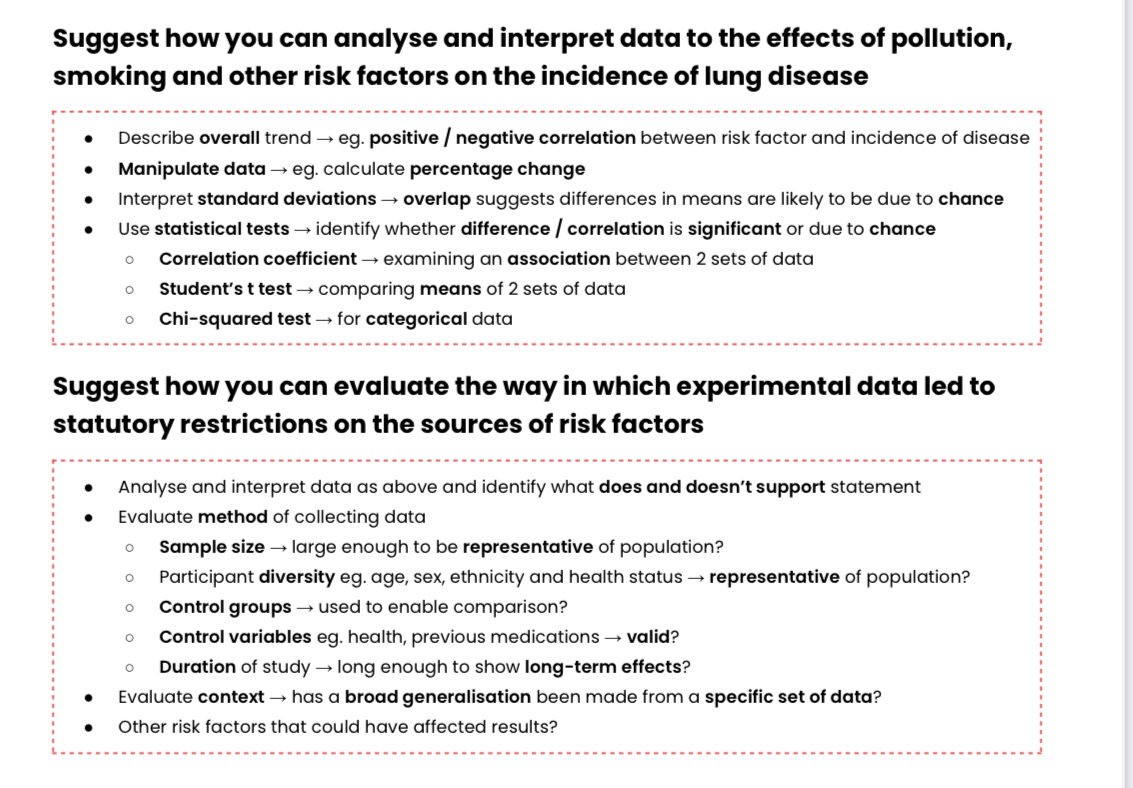
?
?
Explain the difference between correlation and causation
Correlation = change in one variable reflected by a change in another
Causation = change in one variable causes a change in another