MSK Week 1 - Lec 1 - Anatomy and Skeletal System

0.0(0)
studied byStudied by 0 people
0.0(0)
full-widthCall with Kai
learnLearn
examPractice Test
spaced repetitionSpaced Repetition
heart puzzleMatch
flashcardsFlashcards
GameKnowt Play
Card Sorting

1/34

encourage image

There's no tags or description

Looks like no tags are added yet.

Study Analytics
Name
Mastery
Learn
Test
Matching
Spaced
Call with Kai

No study sessions yet.

35 Terms

1
New cards

what is anatomy? how is it best studied in humans?

  • anatomy is the study of a structure and the relationships among structures

  • in humans, these relationships are best revealed by dissection

2
New cards

what are the different subdivisions of anatomy?

  • surface anatomy

  • gross anatomy

  • systemic anatomy

  • regional anatomy - easier to understand, main focus of the course

  • radiographic anatomy

  • developmental anatomy (embryology)

3
New cards

what is systemic anatomy?

  • study of the body by organ systems, examining the structures and functions of each system as a whole rather than region by region

4
New cards

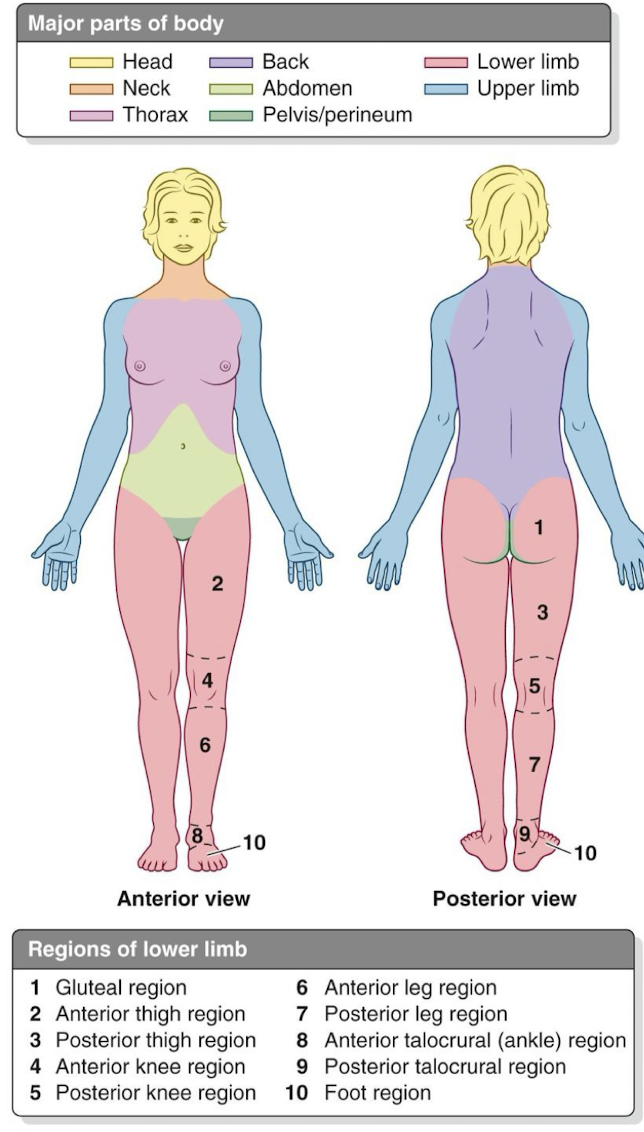
what major regions of the body are studied in regional anatomy?

  • head (cephalic)

  • neck (cervical)

  • trunk (thoracic)

    • thoracic - chest

    • abdominal - abdominal organs

    • pelvis - genitourinary organs

  • upper limbs

  • lower limbs

<ul><li><p>head (cephalic)</p></li><li><p>neck (cervical)</p></li><li><p>trunk (thoracic)</p><ul><li><p>thoracic - chest</p></li><li><p>abdominal - abdominal organs</p></li><li><p>pelvis - genitourinary organs</p></li></ul></li><li><p>upper limbs</p></li><li><p>lower limbs</p></li></ul><p></p>
5
New cards

define anatomical position

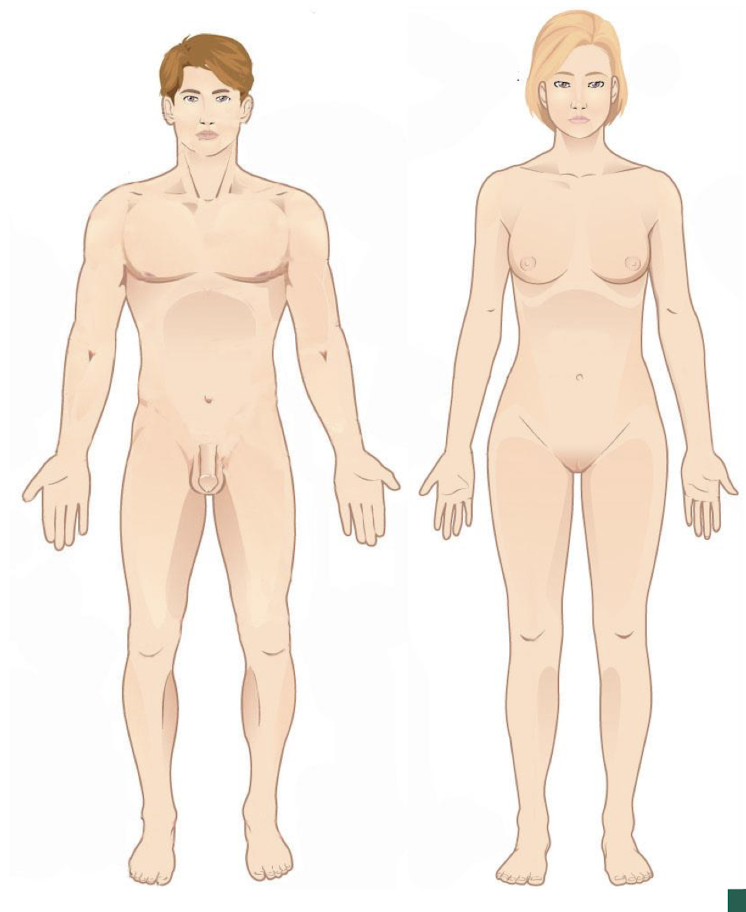
  • anatomical position is a standardized method of observing or imaging the body that allows precise and consistent anatomical references

    • body must be upright

    • standing erect facing the observer

    • head and eyes facing forward

    • feel flat on the floor and forward

    • upper limbs to the sides, palms turned forward

  • descriptions of movements are always explained as if the body is in this position, no matter the actual body position
<ul><li><p>anatomical position is a standardized method of observing or imaging the body that allows precise and consistent anatomical references</p><ul><li><p>body must be upright</p></li><li><p>standing erect facing the observer</p></li><li><p>head and eyes facing forward</p></li><li><p>feel flat on the floor and forward</p></li><li><p>upper limbs to the sides, palms turned forward</p></li></ul></li></ul><ul><li><p>descriptions of movements are always explained as if the body is in this position, <strong>no matter the actual body position</strong></p></li></ul><p></p>
6
New cards

positional terminology - supine, prone, and lateral decubitus

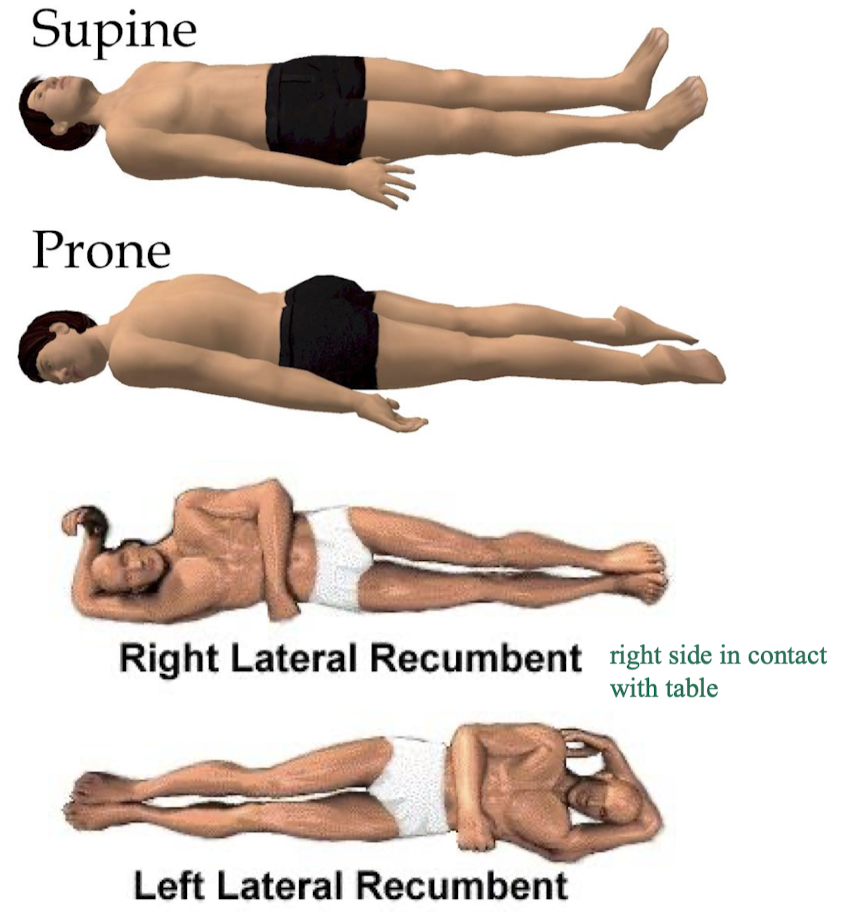
  • supine - patient is lying face up (think “lying on spine” - supine)

  • prone - patient is lying face down

  • lateral decubitus (recumbent) - pt is lying on their side

    • on right side - right lateral decubitus (or recumbent)

    • on left side - left lateral decubitus (or recumbent)
<ul><li><p><strong>supine </strong>- patient is lying face up (think “lying on spine” - supine)</p></li><li><p><strong>prone</strong> - patient is lying face down</p></li><li><p><strong>lateral decubitus (recumbent)</strong> - pt is lying on their side </p><ul><li><p>on right side - right lateral decubitus (or recumbent)</p></li><li><p>on left side - left lateral decubitus (or recumbent)</p></li></ul></li></ul><p></p>
7
New cards

what do we call the anatomical midline of the body?

the midline or the median plane - important reference point

8
New cards

planes and sections of the body - sagittal, coronal, and transverse

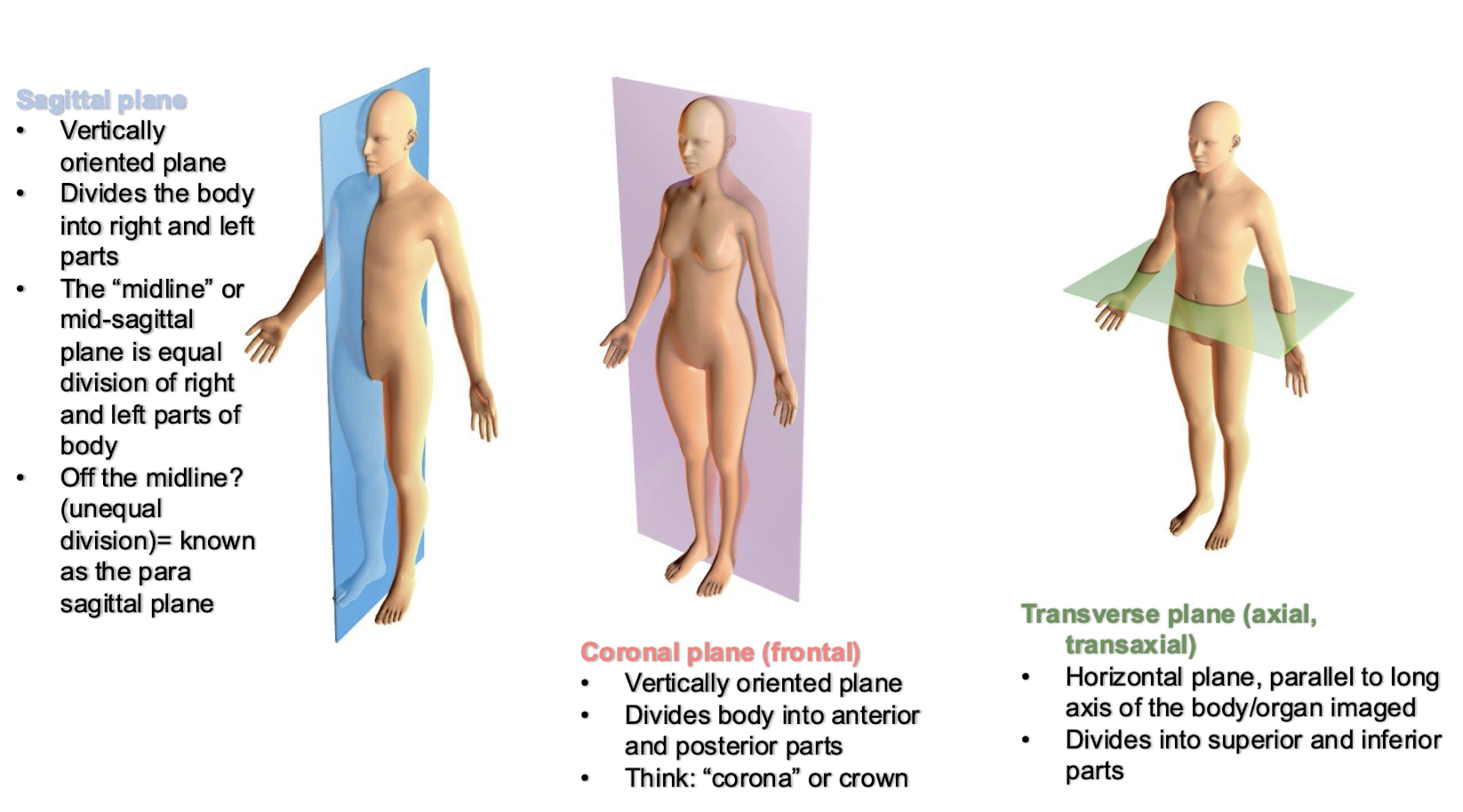
  • sagittal plane

    • vertically oriented, divides body into left and right

    • mid-sagittal - equal divisions of left and right

    • off midline - para sagittal plane

  • coronal plane (frontal)

    • vertically oriented, divides body into anterior and posterior parts

  • transverse plane (axial, transaxial)

    • horizontal plane parallel to long axis of the body/organ imaged

    • divides into superior and inferior parts
<ul><li><p>sagittal plane</p><ul><li><p>vertically oriented, divides body into left and right</p></li><li><p>mid-sagittal - equal divisions of left and right</p></li><li><p>off midline - para sagittal plane</p></li></ul></li><li><p>coronal plane (frontal)</p><ul><li><p>vertically oriented, divides body into anterior and posterior parts</p></li></ul></li><li><p>transverse plane (axial, transaxial)</p><ul><li><p>horizontal plane parallel to long axis of the body/organ imaged</p></li><li><p>divides into superior and inferior parts</p></li></ul></li></ul><p></p>
9
New cards

planes and sections of the body - oblique

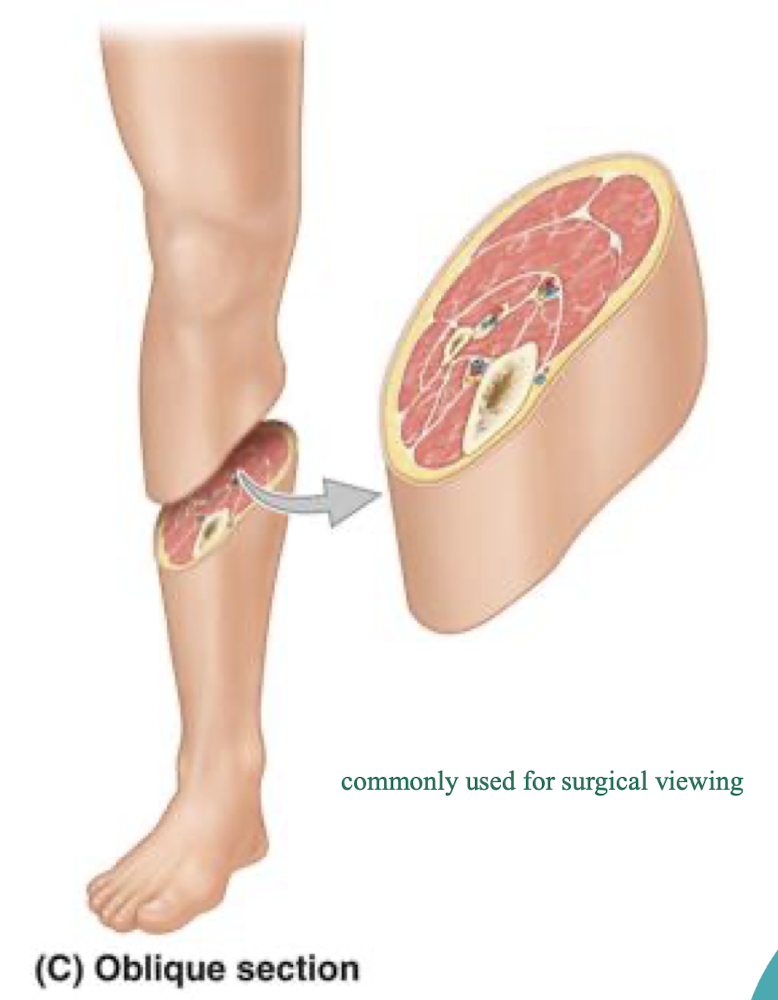
oblique plane - passes through the body or an organ at an angle, commonly used for surgical viewing

  • combining features of transverse + sagittal or transverse + frontal planes because it is a diagonal slice at an angle
<p><strong>oblique plane </strong>- passes through the body or an organ at an angle, commonly used for surgical viewing</p><ul><li><p>combining features of transverse + sagittal <strong><span>or</span></strong> transverse + frontal planes because it is a diagonal slice at an angle</p></li></ul><p></p>
10
New cards

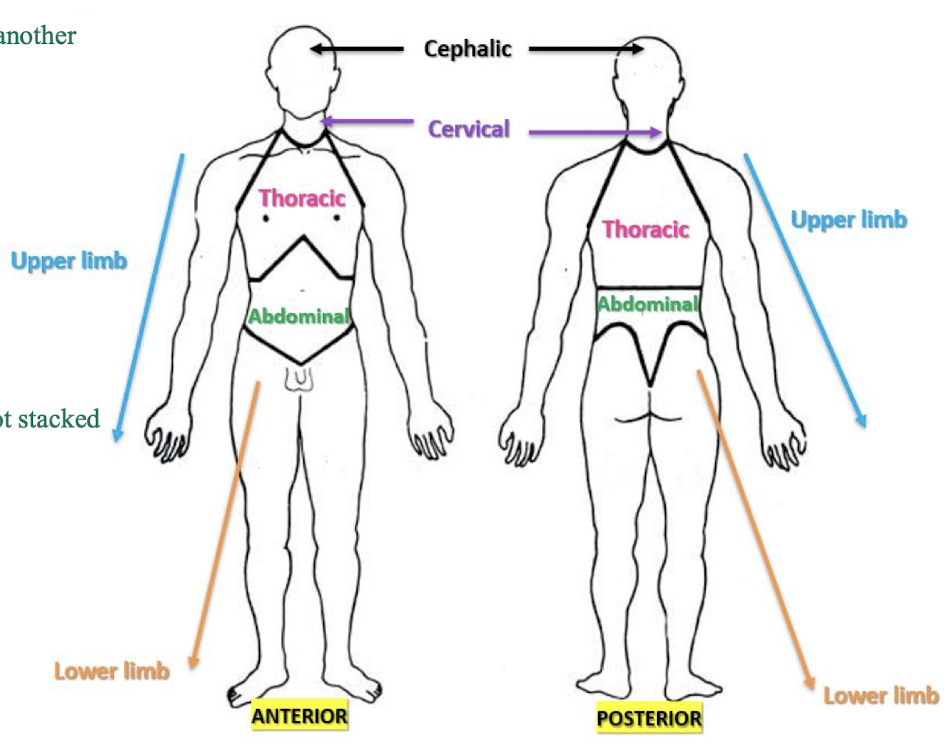
what are the primary axes of the body and what do they include?

  • vertical axis - they stack on top of one another

    • cephalic (head)

    • cervical (neck)

    • thoracic (chest)

    • abdominal (stomach)

  • oblique axis - away from body, not stacked on top of one another

    • upper limb

    • lower limb

<ul><li><p>vertical axis - they stack on top of one another</p><ul><li><p>cephalic (head)</p></li><li><p>cervical (neck)</p></li><li><p>thoracic (chest)</p></li><li><p>abdominal (stomach)</p></li></ul></li><li><p>oblique axis - away from body, not stacked on top of one another</p><ul><li><p>upper limb</p></li><li><p>lower limb</p></li></ul></li></ul><p></p>
11
New cards

directional terminology relating to the vertical axis of the body

  • superior, cranial, cephalic - towards the head

  • inferior, caudal - towards the feet

  • anterior, ventral - towards the front of the body

  • posterior, dorsal - towards the back of the body

  • for example, the shoulder is inferior and posterior to the nose

<ul><li><p><strong>superior, cranial, cephalic </strong>- towards the head</p></li><li><p><strong>inferior, caudal</strong> - towards the feet</p></li><li><p><strong>anterior, ventral </strong>- towards the front of the body</p></li><li><p><strong>posterior, dorsal</strong> - towards the back of the body</p></li></ul><p></p><ul><li><p>for example, the shoulder is inferior and posterior to the nose</p></li></ul><p></p>
12
New cards

more directional terminology relating to the vertical axis of the body

  • medial - towards the midline of the body (i.e. nose is medial to eyes)

  • lateral - away from midline of the body (i.e. eyes are lateral to nose)
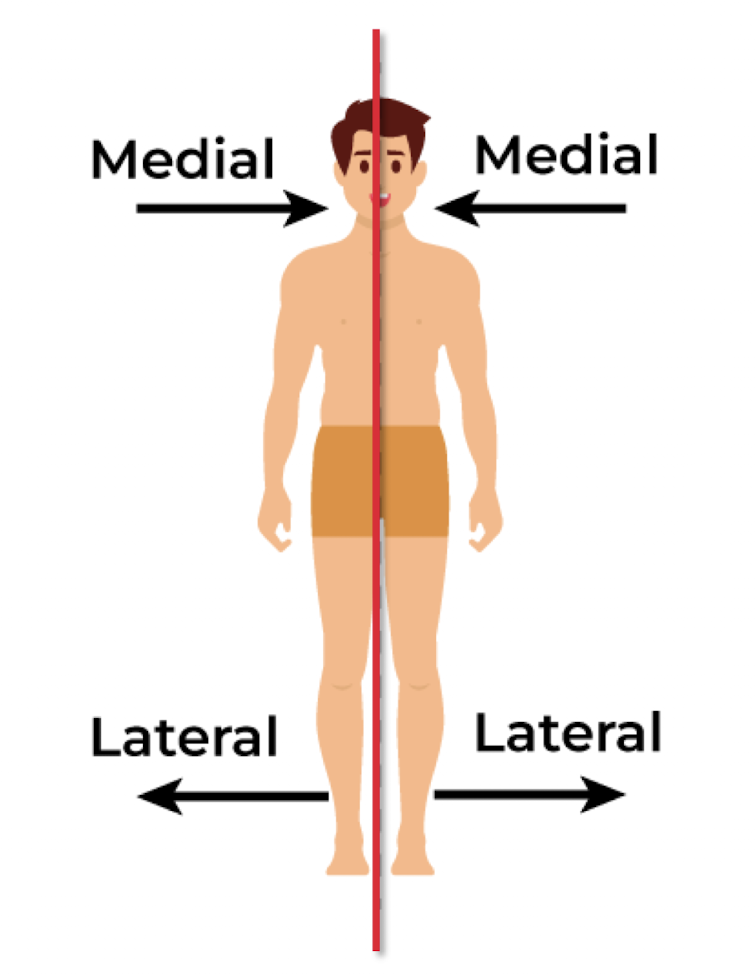
<ul><li><p><strong>medial</strong> - towards the midline of the body (i.e. nose is medial to eyes)</p></li><li><p><strong>lateral</strong> - away from midline of the body (i.e. eyes are lateral to nose)</p></li></ul><p></p>
13
New cards

directional terminology relating to the oblique axis of the body

  • proximal - closer to the the point of attachment of the limb to the trunk (i.e. elbow is proximal to the wrist because it is closer to the shoulder than the wrist is)

  • distal - farther from the point of attachment of the limb to the trunk (i.e. ankle is distal to the knee because it is farther from the hip joint than the knee is)
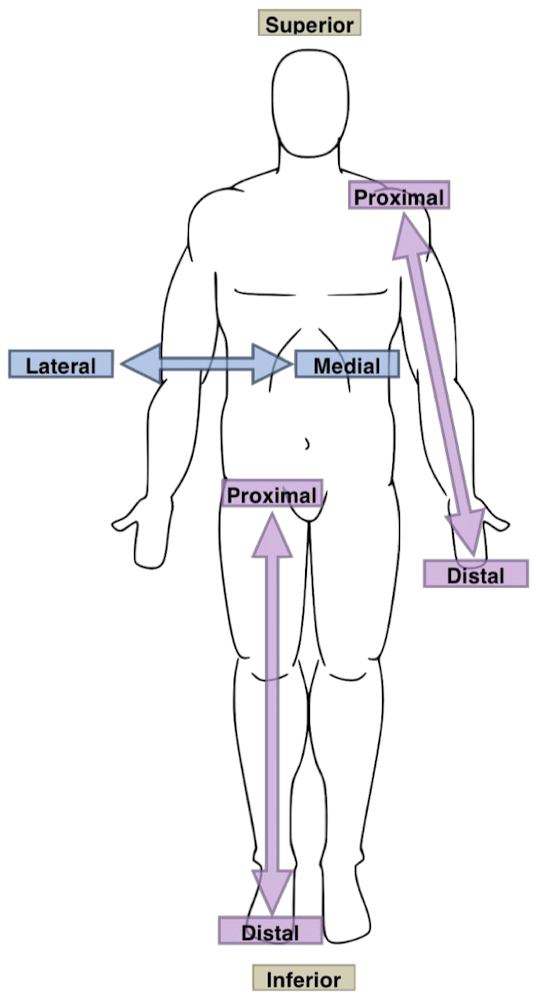
<ul><li><p><strong>proximal</strong> - closer to the the point of attachment of the limb to the trunk (i.e. elbow is proximal to the wrist because it is <em>closer</em> to the shoulder than the wrist is)</p></li><li><p><strong>distal</strong> - farther from the point of attachment of the limb to the trunk (i.e. ankle is distal to the knee because it is <em>farther</em> from the hip joint than the knee is)</p></li></ul><p></p>
14
New cards

hand and foot specific directional terms

  • hand - the anterior surface of the hand is palmar, the posterior surface is dorsal

  • foot - bottom of the foot is the plantar surface of the foot (anterior surface), and top of the foot is the dorsal surface of the foot (posterior surface)

  • THESE ARE RELATIVE TO ANATOMICAL POSITION
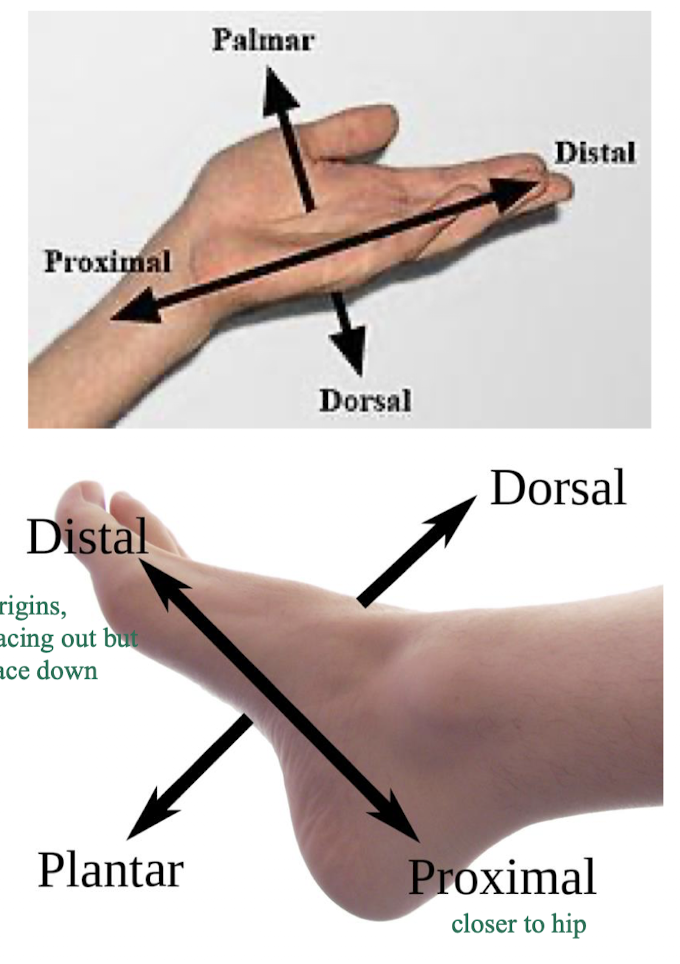
<ul><li><p><strong>hand </strong>- the anterior surface of the hand is <strong>palmar</strong>, the posterior surface is <strong>dorsal </strong></p></li><li><p><strong>foot </strong>- bottom of the foot is the <strong>plantar</strong> surface of the foot (anterior surface), and top of the foot is the <strong>dorsal</strong> surface of the foot (posterior surface)</p></li></ul><ul><li><p><span style="color: rgb(209, 43, 43);"><strong>THESE ARE RELATIVE TO ANATOMICAL POSITION</strong></span></p></li></ul><p></p>
15
New cards

directional terms of laterality

  • right and left - always must describe from the position of the patient, must cross sides

  • bilateral - describing paired structures (e.g structures that you have both left and right like arms, kidneys, lungs, etc.)

  • unilateral - describing one side of the body (i.e. heart is unilateral left)

  • ipsilateral - describing structures on the same side of the body (i.e. spleen is ipsilateral to the stomach, both are on left side of the midline)

  • contralateral - describing structures on opposite sides of the body
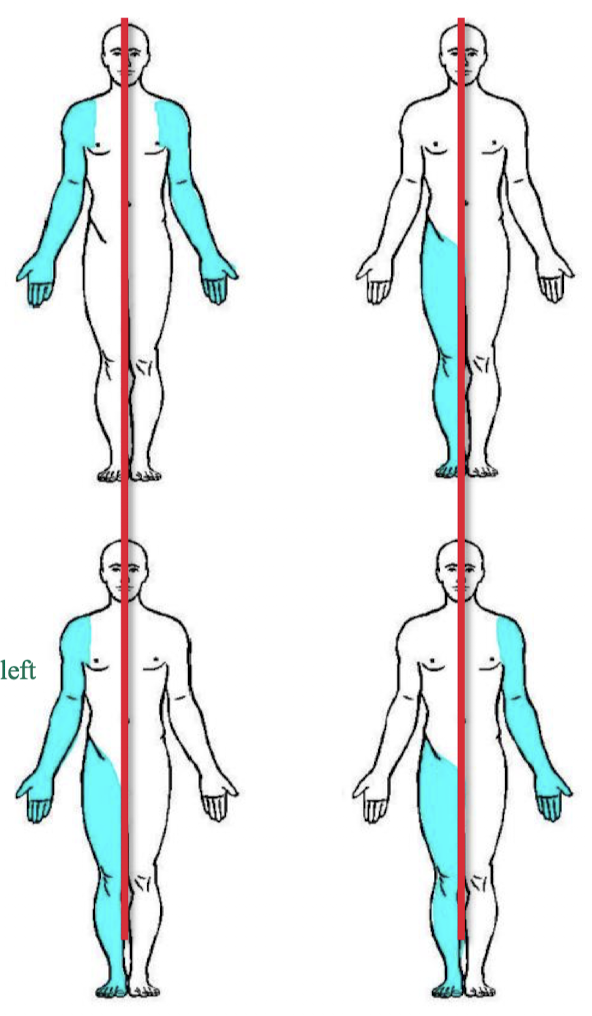
<ul><li><p><strong>right and left </strong>- always must describe from the position of the patient, must cross sides</p></li><li><p><strong>bilateral</strong> - describing paired structures (e.g structures that you have both left and right like arms, kidneys, lungs, etc.)</p></li><li><p><strong>unilateral </strong>- describing one side of the body  (i.e. heart is unilateral left)</p></li><li><p><strong>ipsilateral</strong> - describing structures on the same side of the body (i.e. spleen is ipsilateral to the stomach, both are on left side of the midline)</p></li><li><p><strong>contralateral</strong> - describing structures on opposite sides of the body</p></li></ul><p></p>
16
New cards

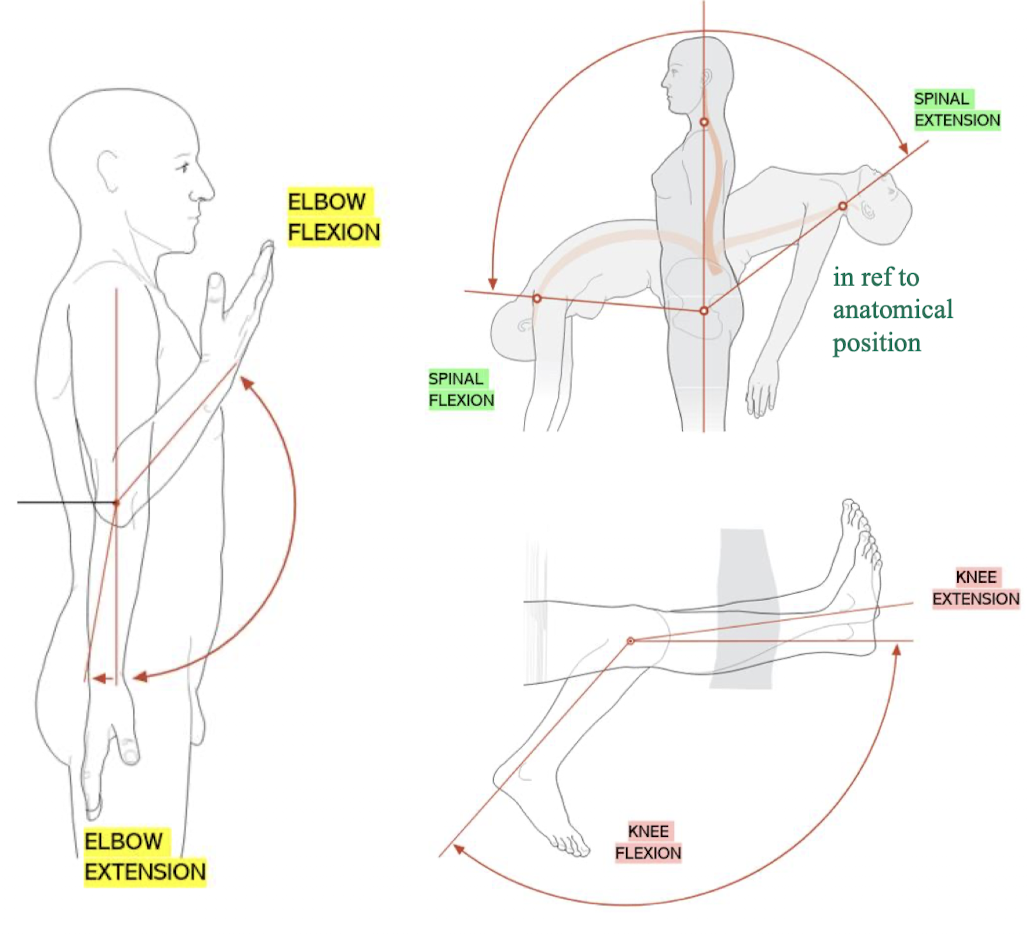
terms of movement - flexion and extension

  • flexion

    • for extremities - movement that decreases the angle between two body parts

    • for the spine - forward bending

  • extension

    • for extremities - movement that increases the angle between two body parts

    • for the spine - bending backwards

<ul><li><p><strong>flexion</strong> </p><ul><li><p>for extremities - movement that decreases the angle between two body parts</p></li><li><p>for the spine - forward bending</p></li></ul></li><li><p><strong>extension</strong></p><ul><li><p>for extremities - movement that increases the angle between two body parts</p></li><li><p>for the spine - bending backwards</p></li></ul></li></ul><p></p>
17
New cards

terms of movement - abduction and adduction

  • abduction - movement away from midline

    • in hand - movement away from midline of hand (3rd digit)

    • in foot - movement away from midline of foot (2nd digit)

  • adduction - movement toward from midline

    • in hand - movement toward midline of hand (3rd digit)

    • in foot - movement toward midline of foot (2nd digit)
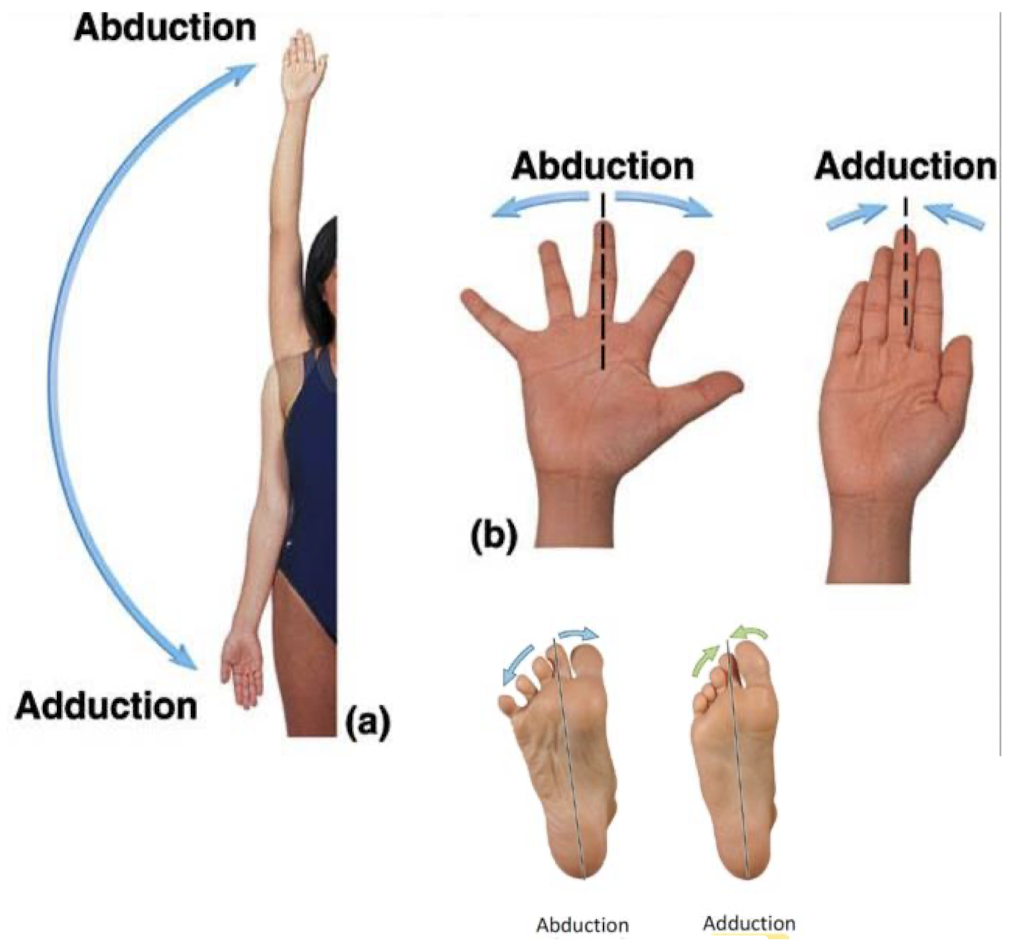
<ul><li><p><strong>abduction</strong> - movement away from midline</p><ul><li><p>in hand - movement away from midline of hand (3rd digit)</p></li><li><p>in foot - movement away from midline of foot (2nd digit)</p></li></ul></li><li><p><strong>adduction </strong>- movement toward from midline</p><ul><li><p>in hand - movement toward midline of hand (3rd digit)</p></li><li><p>in foot - movement toward midline of foot (2nd digit)</p></li></ul></li></ul><p></p>
18
New cards

what does the abduction of the shoulder and hip look like?
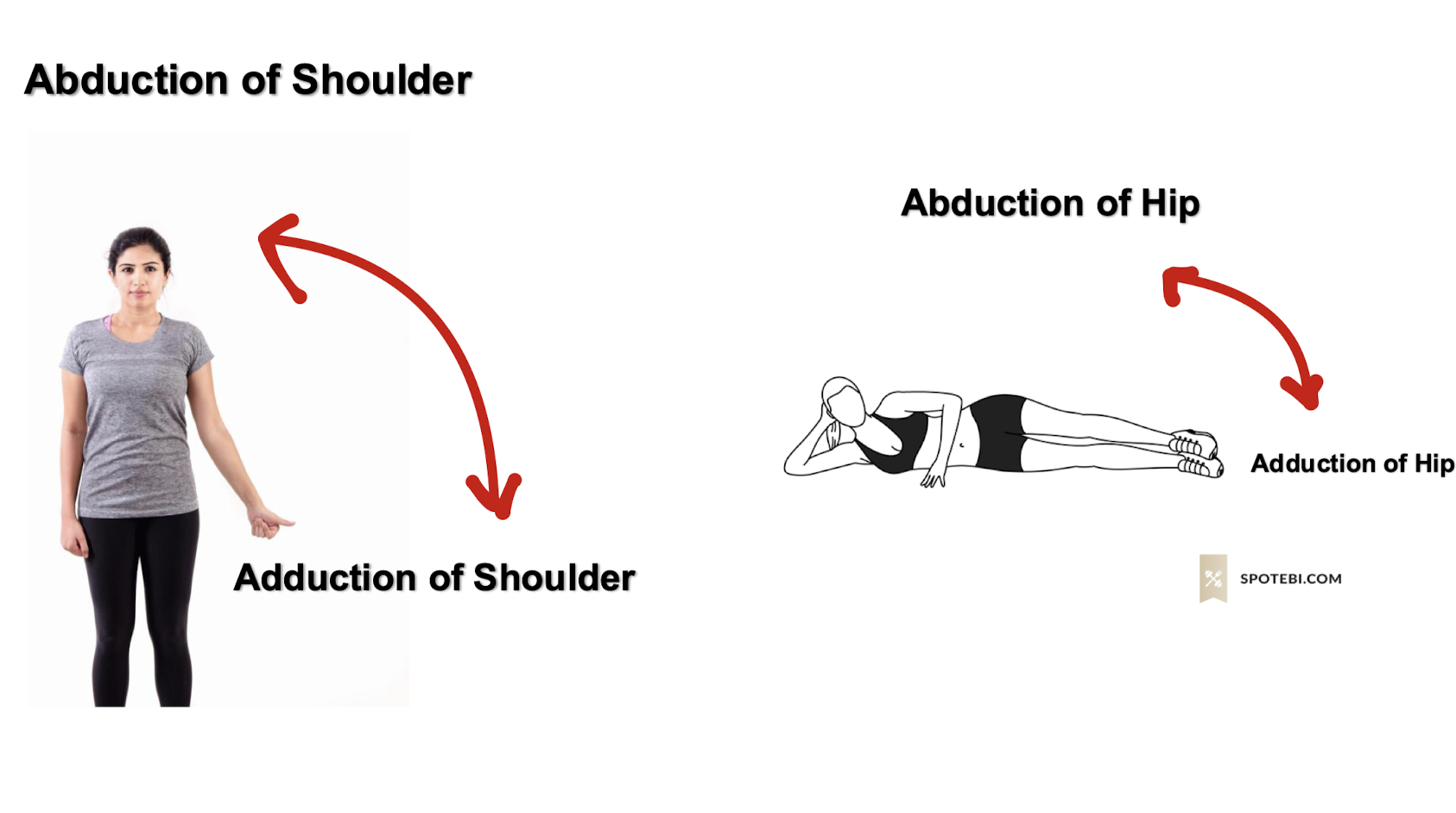
19
New cards

medial and lateral rotation

  • medial rotation - rotation toward the midline of the body

  • lateral rotation - rotation away from midline of the body

*NOTE: rotating your whole arm at the shoulder is called circumduction - it is a biaxial movement because the arm moves in more than one plane; can’t be called rotation; rotation happens only in one plane
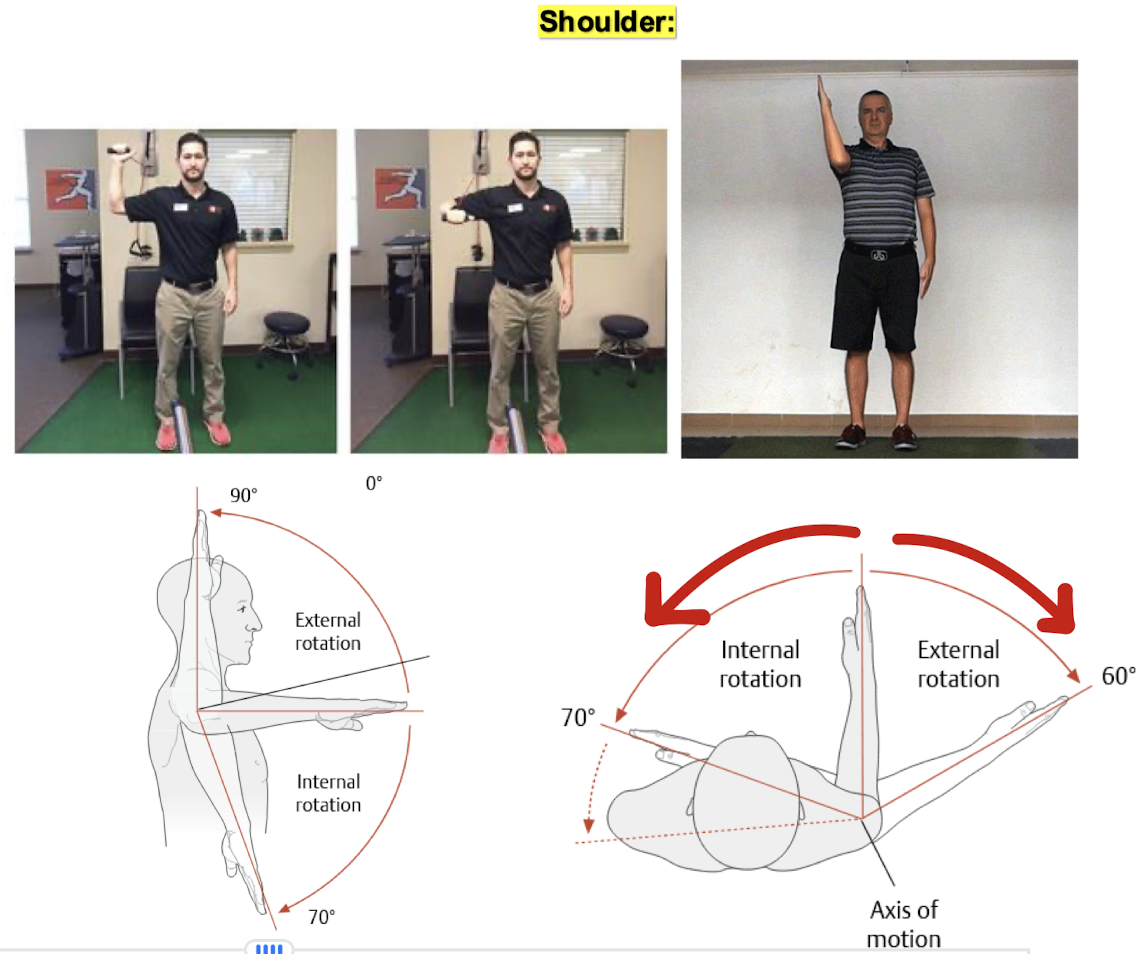
<ul><li><p><strong>medial rotation </strong>- rotation toward the midline of the body</p></li><li><p><strong>lateral rotation</strong> - rotation away from midline of the body</p></li></ul><p><strong>*NOTE: rotating your whole arm at the shoulder is called circumduction - it is a biaxial movement because the arm moves in more than one plane; can’t be called rotation; rotation happens only in one plane</strong></p><p></p>
20
New cards

why does internal and external rotation look like for the hip and the shoulder?
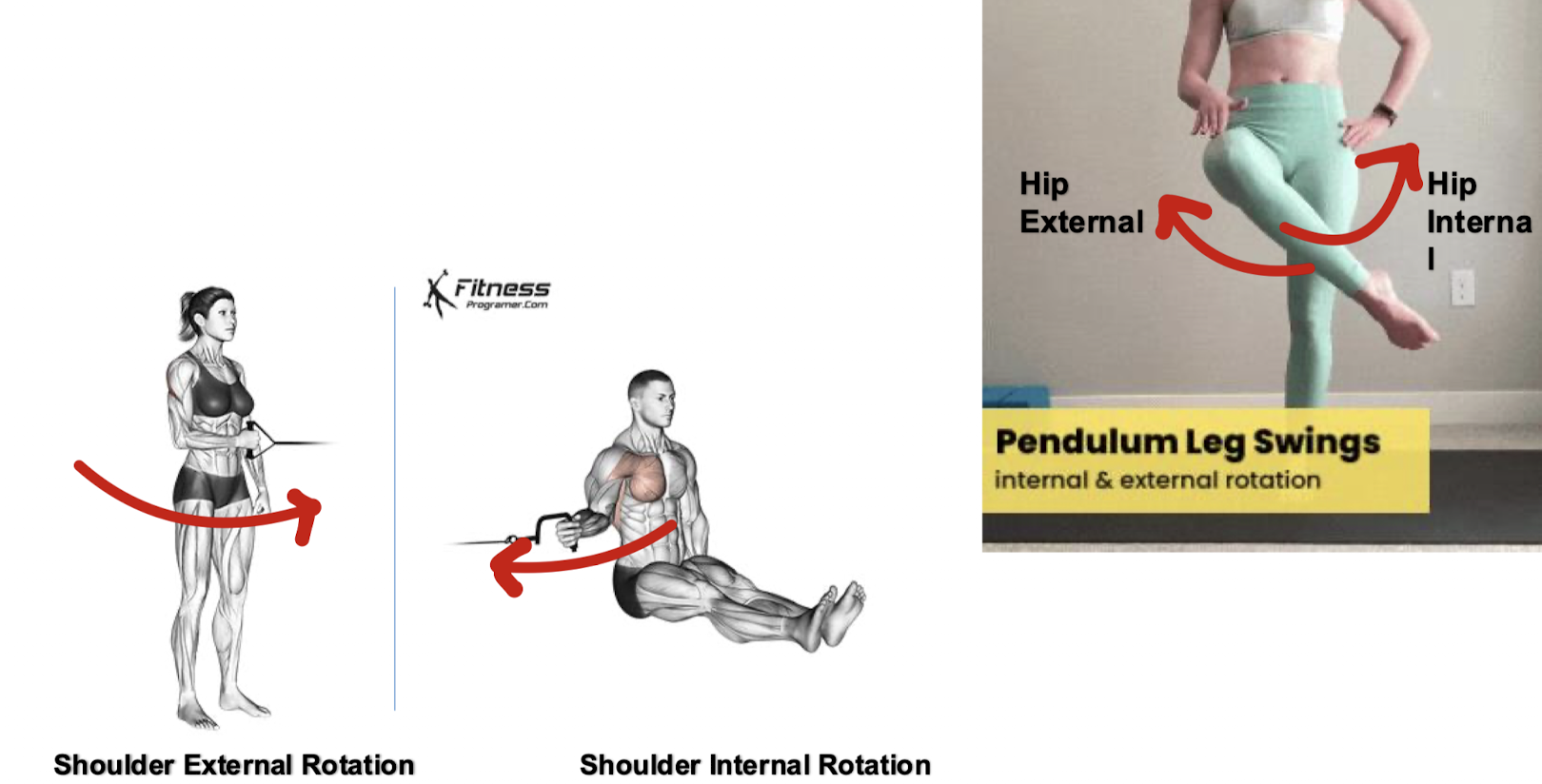
21
New cards

elevation and depression

we only see these movements at the shoulder blades and jaw

  • elevation - movement in a superior direction

  • depression - movement in an inferior direction
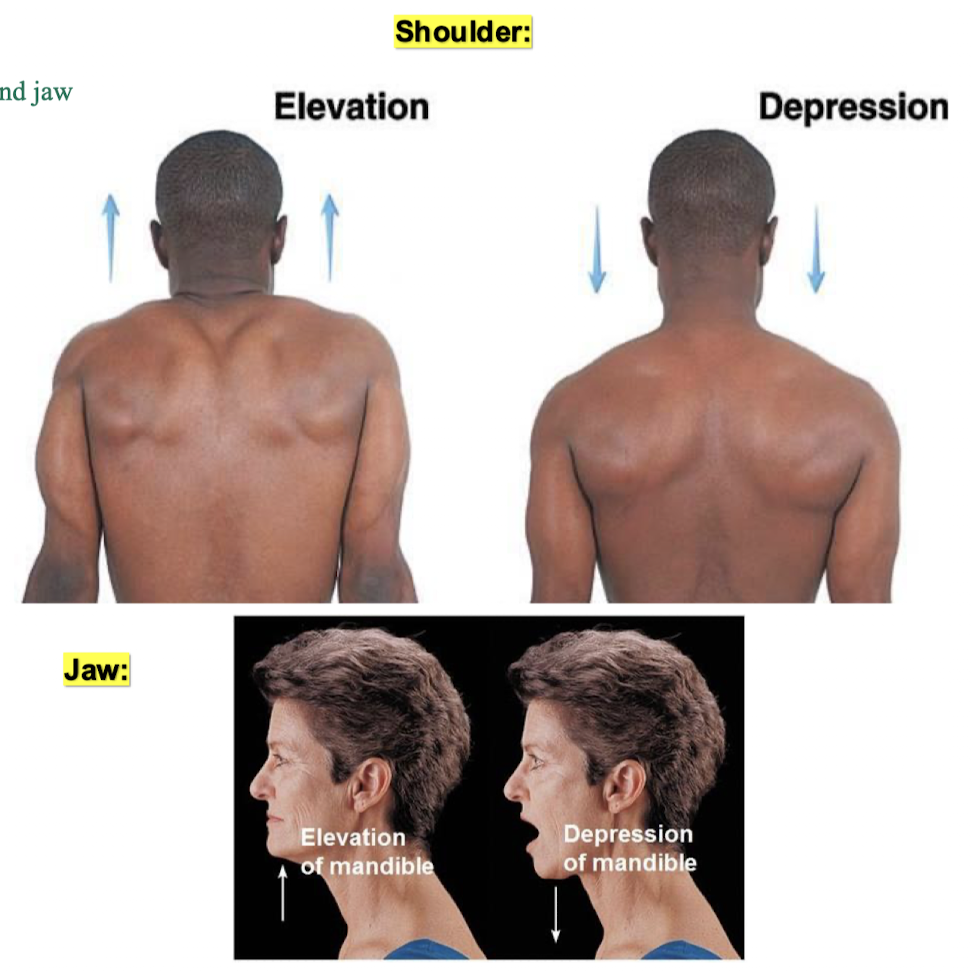
<p>we only see these movements at the shoulder blades and jaw</p><ul><li><p><strong>elevation</strong> - movement in a superior direction</p></li><li><p><strong>depression</strong> - movement in an inferior direction</p></li></ul><p></p>
22
New cards

movement terms of the hand

  • supination - the forearm is rotated laterally (palm up)

  • pronation - the forearm is rotated medially (palm down)

  • ulnar deviation - adduction of wrist (pointing wrist towards ulna)

  • radial deviation - abduction of wrist (pointing wrist towards radius)

  • opposition - thumb moves medially to meet the other fingers

  • reposition - put the thumb back to neutral position
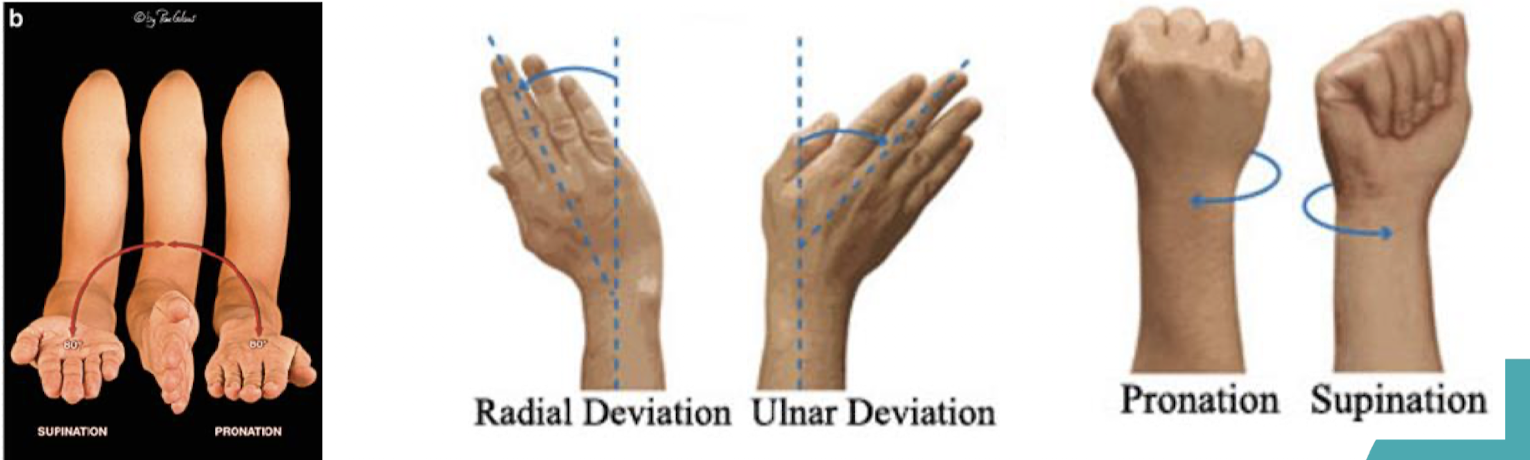
<ul><li><p><strong>supination</strong> - the forearm is rotated laterally (palm up)</p></li><li><p><strong>pronation</strong> - the forearm is rotated medially (palm down)</p></li></ul><p></p><ul><li><p><strong>ulnar deviation</strong> - adduction of wrist (pointing wrist towards ulna)</p></li><li><p><strong>radial deviation</strong> - abduction of wrist (pointing wrist towards radius)</p></li></ul><p></p><ul><li><p><strong>opposition</strong> - thumb moves medially to meet the other fingers</p></li><li><p><strong>reposition</strong> - put the thumb back to neutral position</p></li></ul><p></p>
23
New cards

movement terms of the foot

  • eversion - plantar surface of the foot moves laterally

  • inversion - plantar surface of the foot moves medially

  • dorsiflexion - bending ankle towards the shin (toes point up)

  • plantar flexion - bending ankle towards posterior/back of body (toes point down)
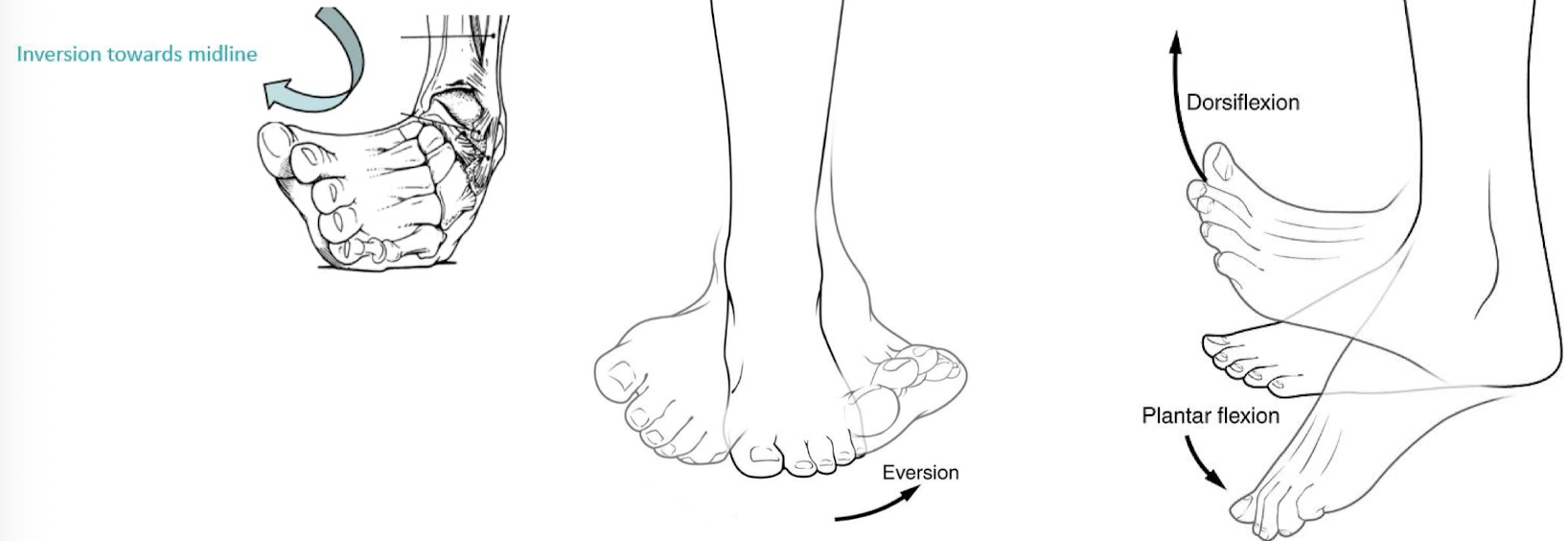
<ul><li><p><strong>eversion</strong> - plantar surface of the foot moves laterally</p></li><li><p><strong>inversion</strong> - plantar surface of the foot moves medially</p></li></ul><p></p><ul><li><p><strong>dorsiflexion</strong> - bending ankle towards the shin (toes point up)</p></li><li><p><strong>plantar flexion</strong> - bending ankle towards posterior/back of body (toes point down)</p></li></ul><p></p>
24
New cards

what is the skeletal system comprised of? what are the 2 basic subdivisions?

  • includes bone and cartilage

  • 2 basic subdivisions

    • axial - central core of skeletal system

    • appendicular - includes bones of upper and lower limbs and bones that attach the limbs to axial skeleton

25
New cards

what forms the musculoskeletal system?

the bones, muscles, and joints

26
New cards

bones that make up the axial and appendicular skeleton

  • axial

    • 80 bones

    • lie along longitudinal axis

  • appendicular

    • 126 bones

    • upper + lower limbs and pelvic + pectoral girdles
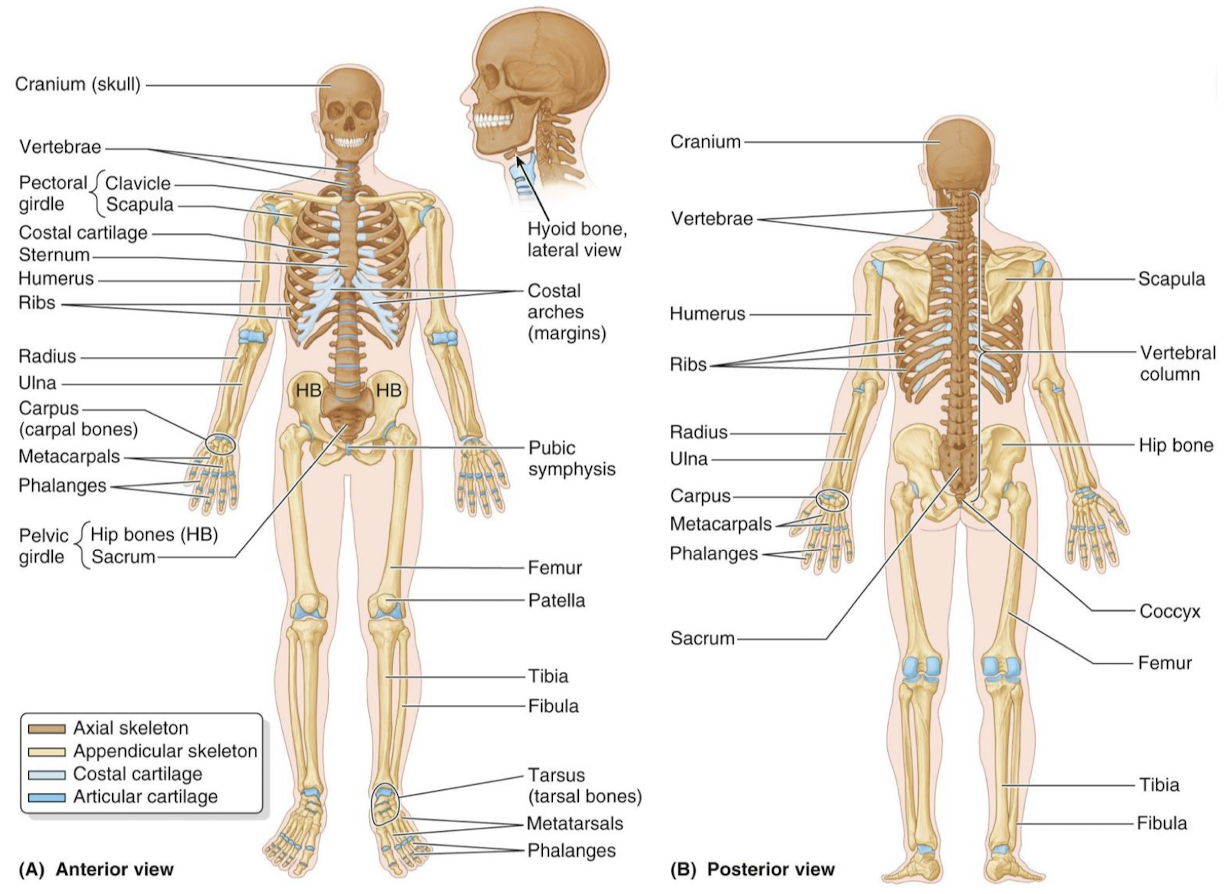
<ul><li><p><strong>axial</strong></p><ul><li><p>80 bones</p></li><li><p>lie along longitudinal axis</p></li></ul></li><li><p><strong>appendicular</strong></p><ul><li><p>126 bones</p></li><li><p>upper + lower limbs and pelvic + pectoral girdles </p></li></ul></li></ul><p></p>
27
New cards

functions of the skeletal system

  • protection for vital structures

  • support the body and vital cavities

  • movement

  • mineral deposition (like calcium, phosphorus, etc., deficiencies in these lead to bone break down)

  • blood element production (hematopoiesis)

  • energy storage (yellow marrow has adipose cells (fat - used for energy)

28
New cards

cartilage and its role

  • skeletal system is composed of cartilage and bones

    • cartilage is semi rigid and is found where flexibility is needed (i.e. costal cartilage and ribs)

29
New cards

types of cartilage

  • hyaline (joints) - most common, precursor to bone, referred to as articular because allows for friction and free movement

  • elastic (ear) - springy, moldable, holds shape

  • fibrocartilage (discs of spinal column) - very specific roles and areas of body

30
New cards

describe bone

  • bone is living tissue that is hard makes up most of the skeleton

  • bone is subject to constant rebuilding the same as any other living tissue

31
New cards

bone composition

  • compact bone - superficial thin layer provides the strength to bones for weight bearing, larger proportion of compact bone is found at ends of bones

  • spongy/cancellous/trabecular bone - found deep to compact bone and superficial to marrow cavity if present, contains many small spaces
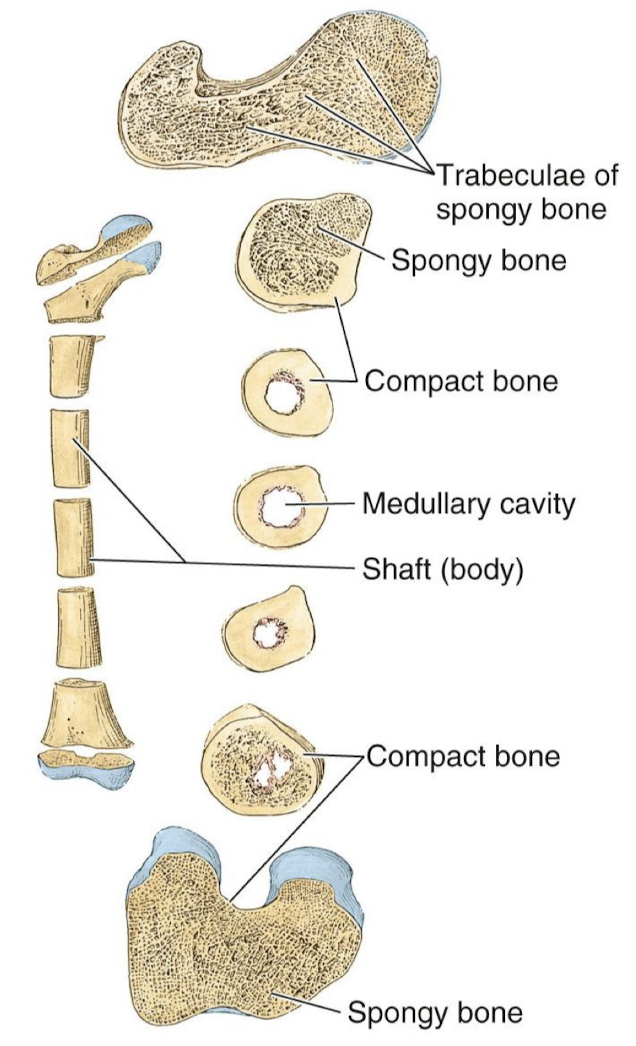
<ul><li><p>compact bone - superficial thin layer provides the strength to bones for weight bearing, larger proportion of compact bone is found at ends of bones</p></li><li><p>spongy/cancellous/trabecular bone - found deep to compact bone and superficial to marrow cavity if present, contains many small spaces</p></li></ul><p></p>
32
New cards

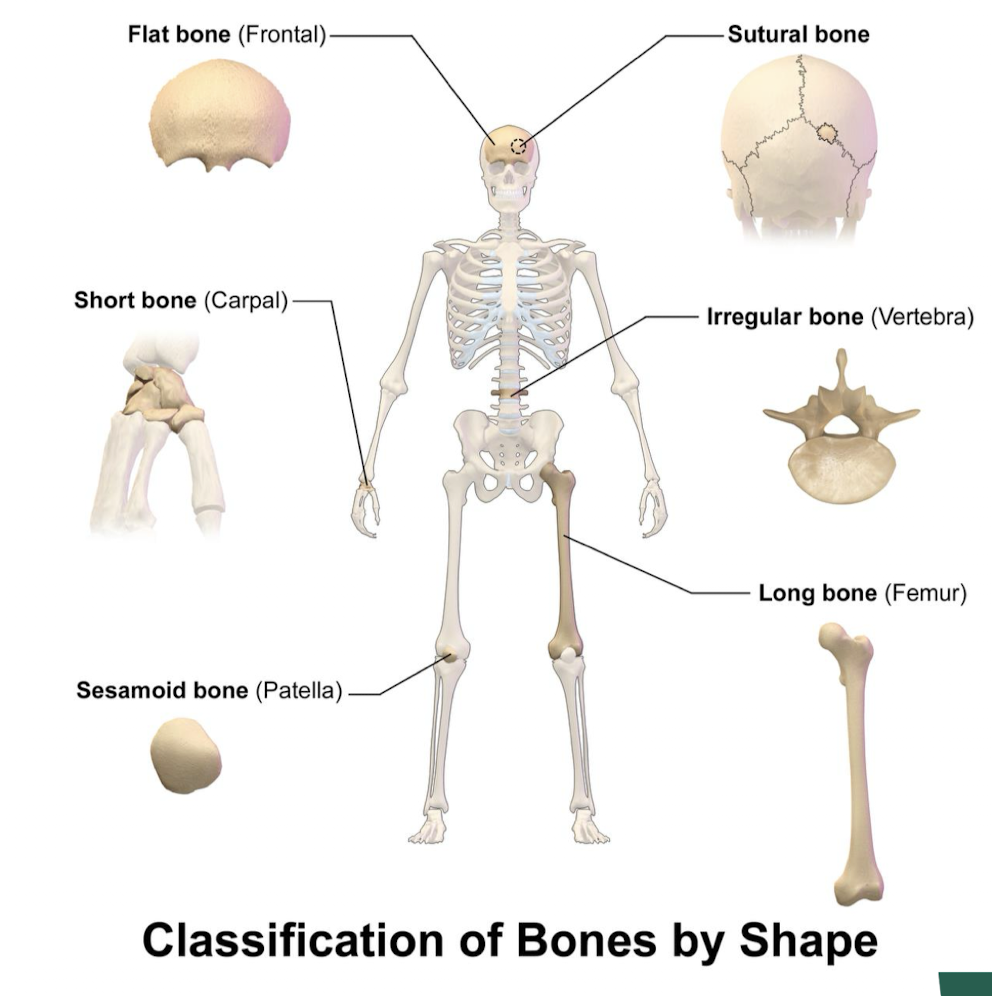
5 basic bone types

  • long - greater length than width (most common)

    • does not necessarily mean physically long, but has to fit the structural description of top, middle, end

  • short - almost cube-shaped and are nearly equal in length and width (i.e. some carpal bones)

    • needed in areas where we need a lot of mobility but not enough room

  • flat - thin bones

    • in areas where we need to spread out forces for protection, multiple bones share the burden

  • irregular - variable shape i.e. vertebrae

  • sesamoid - develop in tendons (patella)

    • reduce strain and muscles that travel in a straight line at the knee

  • sutural - in joint between skull bones

    • tightly adhere skull bones together

<ul><li><p><strong>long </strong>- greater length than width (most common)</p><ul><li><p>does not necessarily mean physically long, but has to fit the structural description of top, middle, end</p></li></ul></li><li><p><strong>short</strong> - almost cube-shaped and are nearly equal in length and width (i.e. some carpal bones)</p><ul><li><p>needed in areas where we need a lot of mobility but not enough room</p></li></ul></li><li><p><strong>flat</strong> - thin bones</p><ul><li><p>in areas where we need to spread out forces for protection, multiple bones share the burden</p></li></ul></li><li><p><strong>irregular</strong> - variable shape i.e. vertebrae</p></li><li><p><strong>sesamoid</strong> - develop in tendons (patella)</p><ul><li><p>reduce strain and muscles that travel in a straight line at the knee </p></li></ul></li><li><p><strong>sutural</strong> - in joint between skull bones</p><ul><li><p>tightly adhere skull bones together</p></li></ul></li></ul><p></p>
33
New cards

parts of a typical long bone

  • epiphysis - end of long bone - form articulation with other bones

  • metaphysis - the region between the epiphysis and the diaphysis

  • diaphysis - the shaft of the long bone - where bone marrow is found

  • epiphyseal plate - bone located within metaphysis, in adults this is a remnant line where the epiphyseal (growth) plate was in the child or developing
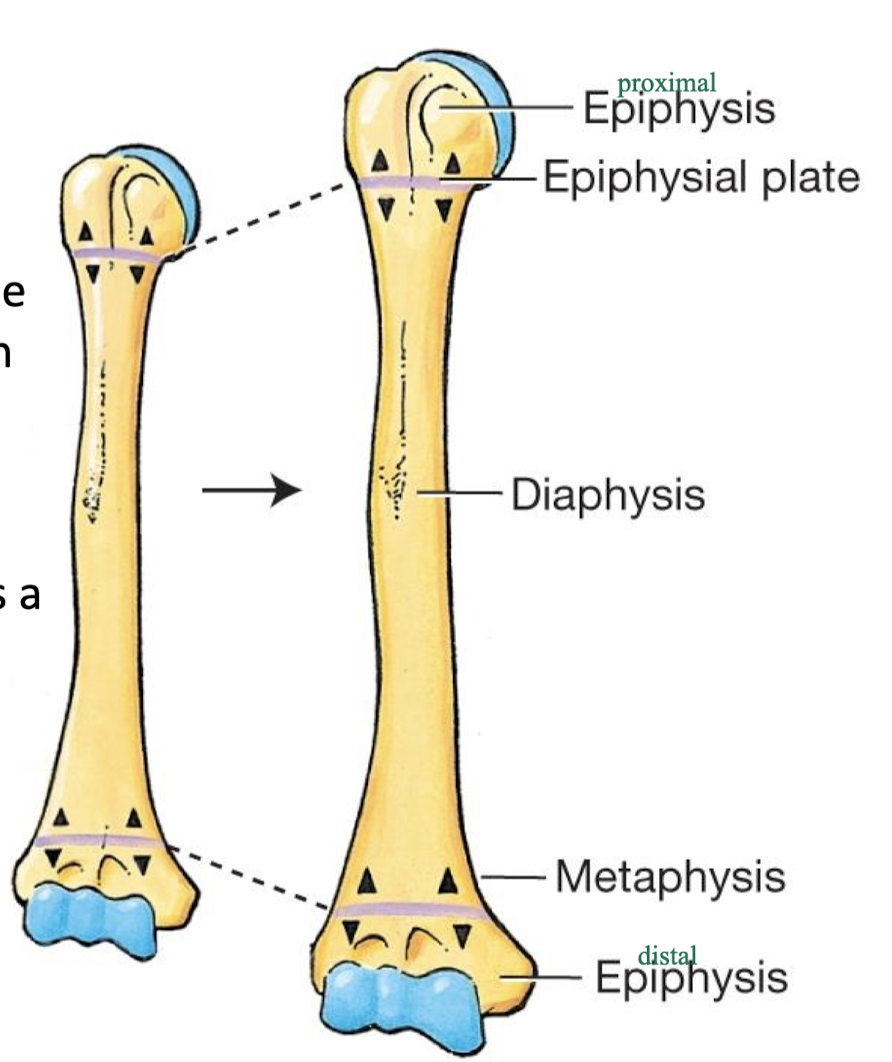
<ul><li><p><strong>epiphysis</strong> - end of long bone - form articulation with other bones</p></li><li><p><strong>metaphysis</strong> - the region between the epiphysis and the diaphysis</p></li><li><p><strong>diaphysis</strong> - the shaft of the long bone - where bone marrow is found</p></li><li><p><strong>epiphyseal plate </strong>- bone located within metaphysis, in adults this is a remnant line where the epiphyseal (growth) plate was in the child or developing </p></li></ul><p></p>
34
New cards

bone articulations

  • ends of long bones will usually form an articulation with another bone

  • these surfaces are covered with articular cartilage to offer smooth movement at joint surface

    • head - rounded projection at end of bone, articulates with base of adjacent bone

    • neck - supports head in articulation

    • condyle - large rounded protuberance at end of bone

    • trochlea - groove at end of bone, houses moveable tendon

    • facet - smooth flat articular surface

35
New cards

two major types of bone surface markings

  • depressions and openings - participate in joints or allow passage of soft tissue - called fossa, sulcus, foramen, fissure, canal

  • processes - projections or outgrowths that either help form joints or serve as attachment points for connective tissue - called trochanter, tubercle, tuberosity, spinous, crest