Unit 1 : The drainage basin system
 Call Kai
 Learn
Learn Practice Test
 Spaced Repetition
 Match
Match Flashcards
 Knowt Play
1/29

There's no tags or description
Looks like no tags are added yet.
Name | Mastery | Learn | Test | Matching | Spaced | Call with Kai | Chat |
|---|
No analytics yet
Send a link to your students to track their progress
30 Terms
The Drainage Basin System
classified as a natural system.
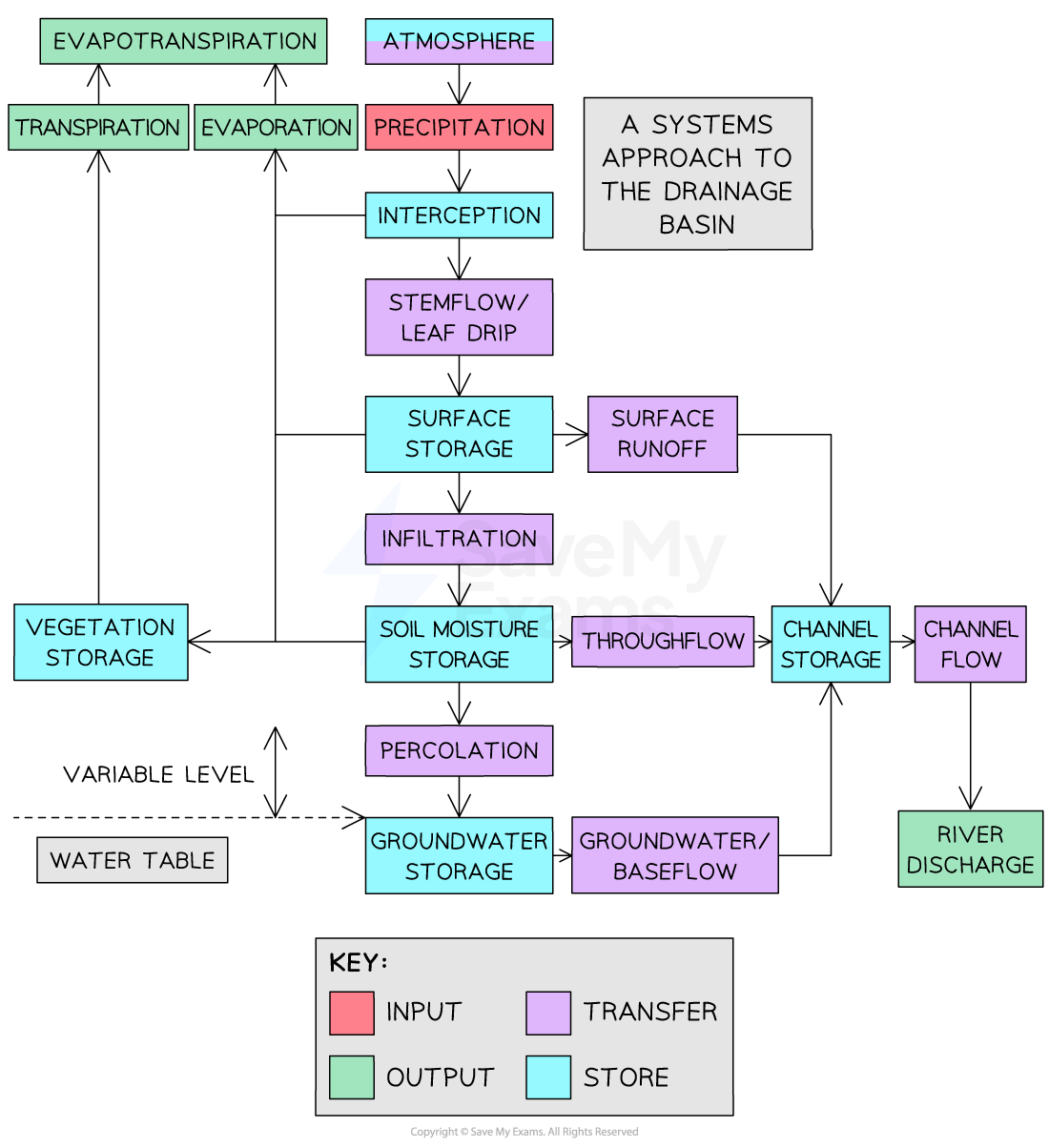
it is an area that is drained by a river and any tributaries. There are outputs , stores and flows.
watershed
The boundary of a drainage basin ; if water drains out of the watershed, it is classified as within another drainage basin.

Outputs
where water or energy leaves the system.
Types of output
Evaporation
Evapotranspiration
River discharge
evaporation
state of water from liquid to gas when water is heated by solar energy, causing it to evaporate and rise into the atmosphere
Evapotranspiration
Compromised of evaporation and transpiration. Transpiration occurs in plants when they respire through leaves, releasing water they absorb through their roots, which then evaporates.
River discharge
The volume of water passing through a cross-sectional point of the river at any one point in time, unit Cubic Metres Per Second (Cumecs)
Stores
Where matter or energy builds up and is stored in the system.
What are the types of stores?
Interception
Soil water
Surface water
Groundwater
Channel storage
Interception
water that is intercepted by plants’ branches and leaves before reaching the ground. This water is stored short-term.
Soil water
water stored in the upper levels of the soil, which is utilised by plants
Surface water
water stored in puddles,ponds,lakes etc. (Dependent on the size of these stores).
groundwater
water stored in the pore spaces of the rock.
Channel storage
water that is stored in a river’s channel.
flows
where matter or energy moves in the system
there are 2 types: above ground & below ground.
Above ground flows
Throughfall
Stemflow
Overland flow
Channel flow
Throughfall
water flows from leaves and foliage onto the ground. This is prominent in areas with large canopies that recieves a lot of rainfall.
Overland flow
Intercepted water stored on plants and tress flows down a stem onto the ground.
Channel flow
Water that moves through established channels i.e streams or rivers. Channel flows is fed by 2 sources: overland & groundwater (flow where a channel intersects the water table).
Below ground flows
infiltration
Percolation
Throughflow
Groundwater flow
Base flow
Infiltration
it is affected by multiple factors: permeability of the soil, rate of precipitation, saturation of levels of soil, reliefs.
Percolation
Water flows from the ground into porous rock or rock fractures. Percolation rate is dependent on the fractures/permeability of the rock.
Throughflow
Water flows through the soil and into the streams or rivers. Speed of flow is dependent on the type of soil e.g clay have a slower flow rate than sandy soil.
Groundwater flow
water flows through permeable rocks, below the water table, and may also flow as springs. Aquifers maintains and store groundwater.
Base flow
The level of channel flow when there is no overland flow. (no contribution of preciptitation)

Underground Water
it accounts for around 30% of all the Earth’s freshwater. Shallow groundwater aquifers can store water up to 200 years, but deeper fossil aquifers , formed during wetter climatic periods, may last for 10,000 years.
The water table
the level at which the pore spaces and fractures in the ground become saturated. Above the water table is unsaturated soil, and the below is saturated soil.
Groundwater recharge
When groundwater levels deplete ( by human extraction or groundwater replenishing surface water levels)
What is groundwater recharged by?
-when precipitation is higher, and evaporation is lower.
-Surface water bodies ( such as lakes and rivers) seeping into groundwater stores.
-the type of precipitation affects the amount of groundwater recharge. i.e storm events which are less effective as there is more overland flow.