Lab 6: Bone Histology - Long Bone, Cartilage, and Bone Types
 Call Kai
 Learn
Learn Practice Test
 Spaced Repetition
 Match
Match Flashcards
 Knowt Play
1/41

Earn XP
Description and Tags
(Anatomy & Physiology I)
Name | Mastery | Learn | Test | Matching | Spaced | Call with Kai | Chat |
|---|
No analytics yet
Send a link to your students to track their progress
42 Terms
Long bone
Bone that is longer than it is wide. Functions in support and movement.
Proximal epiphysis
End of a long bone closest to the point of attachment.
Distal epiphysis
End of a long bone farthest from the point of attachment.
Diaphysis
Shaft or long central portion of a long bone.
Metaphysis
Region between the epiphysis and diaphysis. Contains the growth plate.
Metaphysis
Where is the growth plate located?
Epiphyseal plate
Growth region responsible for lengthening bones during development.
Epiphyseal line
Remnant of the epiphyseal plate after growth stops.
Articular cartilage
Hyaline cartilage covering the ends of bones at joints. Reduces friction and absorbs shock.
Reduce friction, absorb shock
What does articular cartilage do?
Hyaline cartilage
What kind of tissue is articular cartilage composed of?
Hyaline cartilage
Smooth cartilage that reduces friction and supports joints.
Chondrocyte
Mature cartilage cell found in hyaline cartilage.
Fibrocartilage
Strong cartilage that resists compression and absorbs shock. Found in intervertebral discs.
Intervertebral discs
Where is fibrocartilage found?
Femur, humerus
What are examples of long bones?
Short bones
Cube-shaped bones that provide stability and support.
Carpals, tarsals
What are examples of short bones?
Sesamoid bones
Small bones that develop inside tendons.
Patella
What is an example of sesamoid bones?
Flat bones
Thin, flattened bones that protect organs and provide muscle attachment.
Skull, ribs, sternum
What are examples of flat bones?
Irregular bones
Bones with complex shapes.
Vertebrae, facial bones
What are examples of irregular bones?
Support
Provides framework for the body. (Bone Function)
Protection
Shields internal organs. (Bone Function)
Movement
Provides attachment points for muscles. (Bone Function)
Mineral storage
Stores calcium and phosphate. (Bone Function)
Hematopoiesis
Production of blood cells in red bone marrow. (Bone Function)
Energy storage
Storage of fat in yellow bone marrow.
Axial skeleton
Division of skeleton containing the skull, vertebral column, and rib cage.
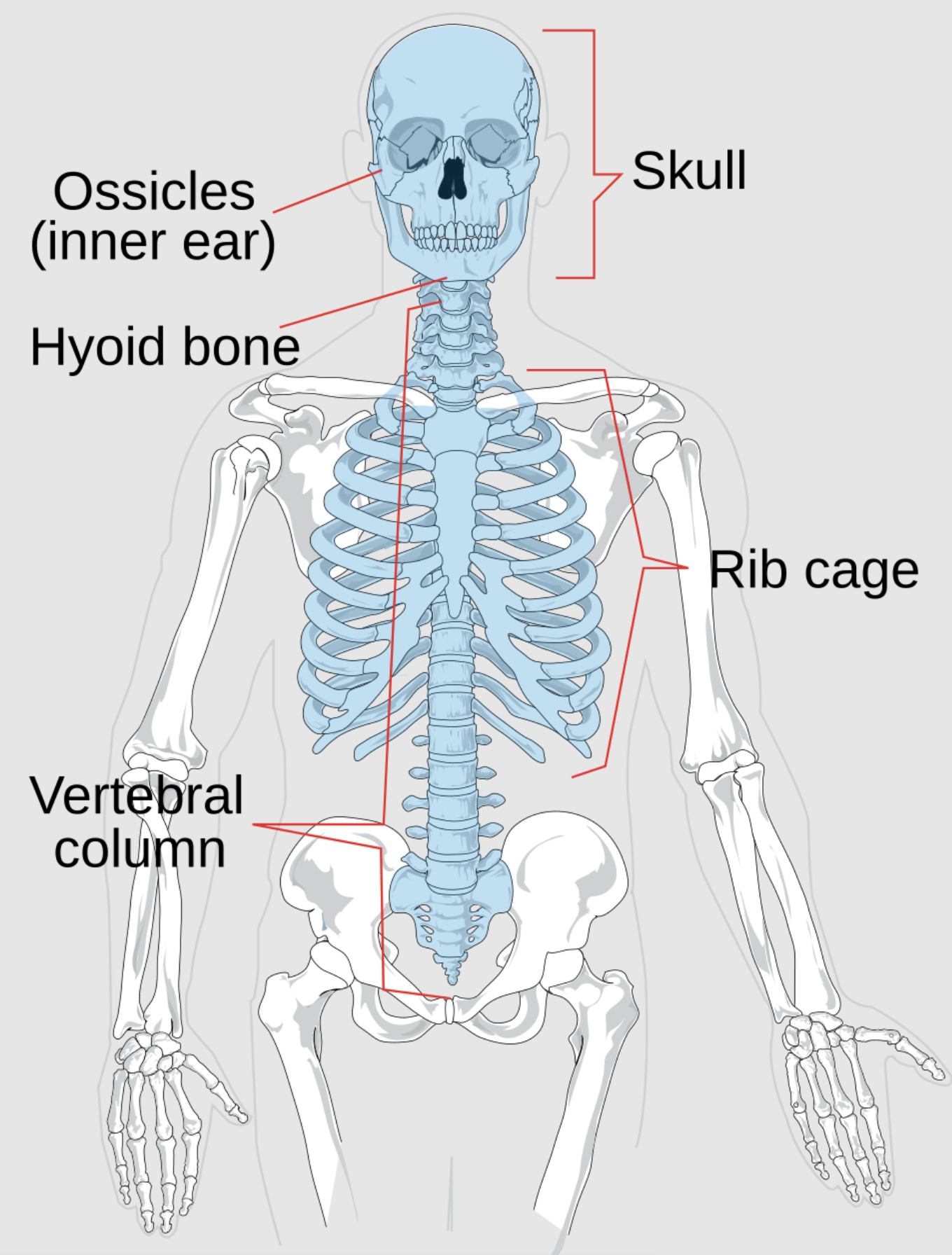
Skull, vertebral column, rib cage
What is contained in the Axial skeleton?
Appendicular skeleton
Division of skeleton containing limbs, pectoral girdle, and pelvic girdle.
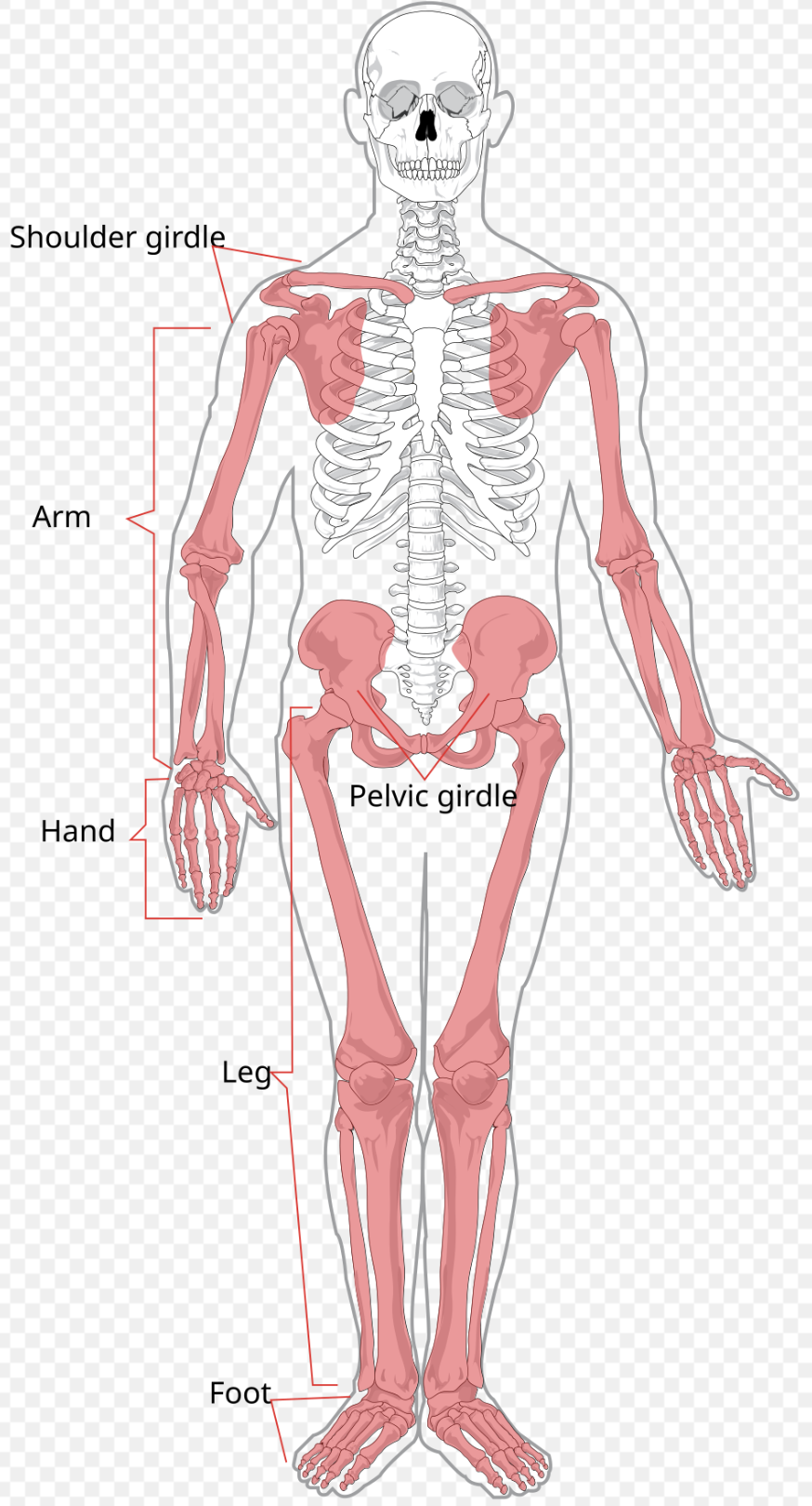
Limbs, pectoral girdle, pelvic girdle
What is contained in the Appendicular skeleton?
Bone markings
Surface features of bones used for attachment, articulation, and passageways.
Process
Projection from bone used for muscle, tendon, or ligament attachment.
Spine
Sharp projection from bone used for muscle attachment.
Foramen
Opening in bone that allows nerves and blood vessels to pass through.
Articulation
Location where two bones meet to form a joint.
Fontanelles, unfused bones
What does an infant skull have that adult skull does not?
Wider pelvis, larger pelvic opening, lighter bones
What are some characteristics of the female skeleton?
Narrower pelvis, heavier bones, larger muscle attachment sites
What are some characteristics of the male skeleton?