Microbiology: Module 9
 Call Kai
 Learn
Learn Practice Test
 Spaced Repetition
 Match
Match Flashcards
 Knowt Play
1/47

There's no tags or description
Looks like no tags are added yet.
Name | Mastery | Learn | Test | Matching | Spaced | Call with Kai | Chat |
|---|
No analytics yet
Send a link to your students to track their progress
48 Terms
denatured which can irreversibly destroy function
At higher temperatures, enzymes are
Heterotroph
An organism that obtains carbon from pre-formed organic molecules is called
Entner-Doudoroff pathway
Name one alternative pathway to glycolysis
False
Anaerobic respiration is a synonym for fermentation
NAD+
the oxidized form of nicotinamide adenine dinucleotide
Ribosomal RNA
the primary molecule used by Woese to place organism into domains
Photoheterotroph
an organism type that gets its carbon from pre-formed organic molecules and its energy from light
an explanation that is well-supported by evidence
In science, a “theory” is:
Proteobacteria
What group on Tree of life does the molecular evidence show as the ancestors of mitochondria?
b
Which of the following pathway is used in some bacteria which do not have glycolysis:
a. Embden-Meyerhof
b. Entner-Doudoroff
c. Pentose phosphate
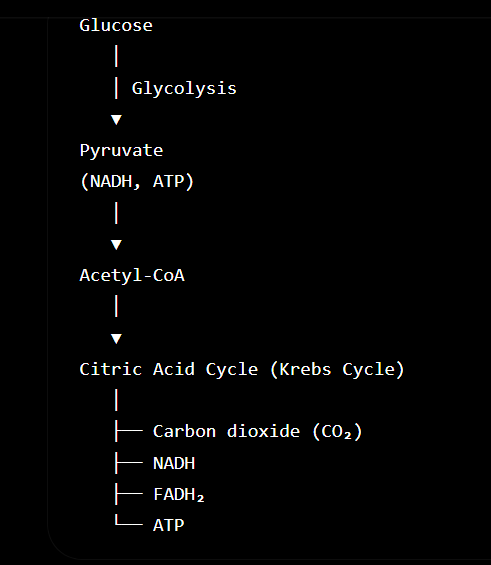
glucose catabolism
What do anabolic processes require?
ATP
NADPH (reducing power)
Pentose Phosphate Pathway
An alternative pathway to glycolysis that produces NADPH and 5-carbon sugars (ribose) for biosynthesis
Occurs simultaneously with glycolysis.
Found in Bacillus subtilis and Escherichia coli.
Entner-Doudoroff Pathway
An alternative glucose catabolism pathway used by some bacteria instead of glycolysis or the pentose phosphate pathway.
Produces 2 NADPH per glucose.
Produces 1 ATP per glucose.
Found in Pseudomonas, Rhizobium, and Agrobacterium.
Absence of Oxygen
When oxygen is unavailable, cells must recycle NADH back to NAD⁺ so glycolysis can continue.
Anaerobic Respiration
A type of respiration that uses an electron acceptor other than oxygen.
Anaerobic Respiration
Different bacteria use different acceptors including:
Nitrate (Pseudomonas)
Sulfate (Desulfovibrio)
Others
Use only part of the Krebs cycle
Less ATP generated than in aerobic respiration
Fermentation
Electron acceptor is an organic molecule
No additional ATP made from pyruvate
fermentation
A process that regenerates NAD⁺ by transferring electrons from NADH to an organic molecule.
Lactic Acid Fermentation
Glucose → Glycolysis → Pyruvate → Lactate
Ethanol Fermentation
Glucose → Glycolysis → Pyruvate → Acetaldehyde → Ethanol
Phototroph
An organism that gets its energy from light.
Chemotroph
An organism that gets its energy from chemicals
Autotroph
An organism that uses carbon dioxide (CO₂) as its carbon source
Heterotroph
An organism that obtains carbon from preformed organic molecules.
Photoautotroph
Uses light for energy and CO₂ for carbon
Chemoautotroph
Uses chemicals for energy and CO₂ for carbon.
Chemolithoautotroph
Uses inorganic chemicals for energy and CO₂ for carbon.
Chemoorganoautotroph
Uses organic chemicals for energy and CO₂ for carbon.
Photoheterotroph
Uses light for energy and organic molecules for carbon.
Chemoheterotroph
Uses organic chemicals for energy and organic molecules for carbon
Archaea
Bacteria
Eukarya
What are the three domains of life?
By comparing rRNA sequences.
How were the three domains determined?
16S rRNA
Prokaryotes (Bacteria & Archaea)
18S rRNA
Eukaryotes
molecular clock
Biological molecule sequences (such as rRNA) that change over time and are used to estimate evolutionary relationships.
Endosymbiotic Theory
an explanation for the origin of some organelles
Chromosome: Linear
Ribosomes: 80S
First amino acid: Met
Cell division: Mitosis
Cell type comparison for eukaryotes
Chromosome: circular
Ribosomes: 70S
First amino acid: fMet
Cell division: Binary fission
Cell type comparison for Bacteria, Mitochondria, and Chloroplasts
Glycolysis
The breakdown of glucose to produce ATP and pyruvate.
rRNA sequence similarities between bacteria and mitochondria/chloroplasts
Strongest molecular evidence for endosymbiosis?
Glycolysis
Found in cytoplasm of cells in all domains
Central to the biochemistry of cells
Does not require oxygen
Intermediates serve as precursors for other molecules in the cell
Anoxygenic (Cyclic) Photosynthesis
Photosynthesis that does not produce oxygen.
Found in several groups of bacteria, including some cyanobacteria
Oxygenic Photosynthesis
Photosynthesis that produces oxygen.
Cyanobacteria
Endosymbiotic Event
Cyanobacteria became chloroplasts after entering ancestral eukaryotic cells.
Prokaryotes
existed about 3.5 billion years ago.
Eukaryotes
evolved about 1.4 billion years ago.
Eukaryotes
evolved from a prokaryotic ancestor.