CH 10 HW
 Call Kai
 Learn
Learn Practice Test
 Spaced Repetition
 Match
Match Flashcards
 Knowt Play
1/9

There's no tags or description
Looks like no tags are added yet.
Name | Mastery | Learn | Test | Matching | Spaced | Call with Kai | Chat |
|---|
No analytics yet
Send a link to your students to track their progress
10 Terms
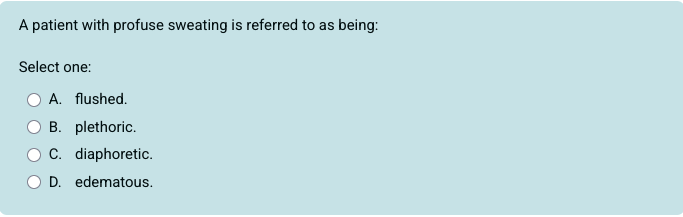
The correct answer for is C. diaphoretic.
Explanation
Diaphoretic (Diaphoresis): The medical term used to describe excessive, profuse, or uncharacteristic sweating, often associated with acute medical conditions such as shock, myocardial infarction, or severe pain.
Why the Other Options Are Incorrect
A (flushed): Refers to a reddish or warm appearance of the skin, usually resulting from fever, heat exposure, or vasodilation.
B (plethoric): Refers to a reddish or purplish complexion caused by an excess of blood volume or red blood cells (erythrocytosis).
D (edematous): Refers to swelling caused by excessive fluid retention in the body's tissues (edema).
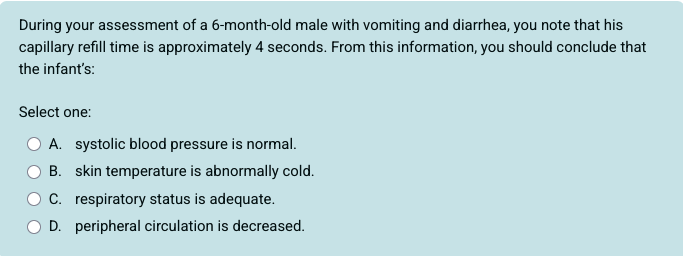
The correct answer for is D. peripheral circulation is decreased.
Explanation
Capillary Refill Time (CRT): Normal capillary refill time in infants and young children is 2 seconds or less.
Why D is correct: A delayed capillary refill time of 4 seconds in an infant with a history of vomiting and diarrhea (fluid loss) indicates poor peripheral perfusion and dehydration, meaning peripheral circulation is decreased.
Why the Other Options Are Incorrect
A (systolic blood pressure is normal): Capillary refill measures peripheral perfusion, not blood pressure directly. In pediatric patients, compensation mechanisms maintain blood pressure until late stages of shock, so blood pressure can remain normal even with severe hypoperfusion.
B (skin temperature is abnormally cold): Cold ambient temperature can falsely delay capillary refill, but given the clinical history of vomiting and diarrhea, the delayed refill is due to hypovolemia/poor perfusion rather than cold skin temperature alone.
C (respiratory status is adequate): CRT assesses the cardiovascular system and tissue perfusion, not respiratory adequacy.
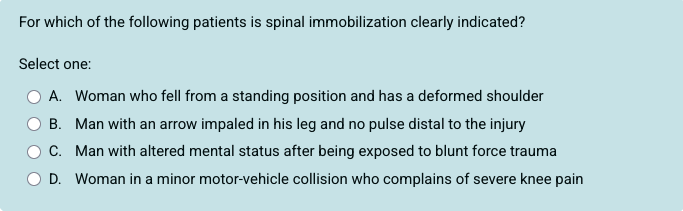
The correct answer is C. Man with altered mental status after being exposed to blunt force trauma.
Explanation:
Spinal immobilization (or spinal motion restriction) guidelines, such as NEXUS or the Canadian C-Spine Rule, outline specific criteria to determine when spinal precautions are necessary following potential trauma:
Altered Mental Status (Option C): Patients with an altered mental status cannot undergo a reliable physical assessment for spinal injury. Because blunt force trauma introduces a mechanism for potential spinal injury, an altered mental status is a clear indication for full spinal motion restriction.
Low-Risk Mechanisms / Isolated Injuries (Options A, B, & D):
A fall from a standing position with an isolated shoulder deformity (A) lacks a high-risk mechanism or spinal signs.
An isolated extremity injury, like an impaled arrow in the leg (B), does not involve a mechanism or presentation suggestive of spinal trauma.
A minor motor-vehicle collision with localized knee pain and normal mental status (D) generally does not meet criteria for spinal immobilization unless spinal pain or focal neurological deficits are present.
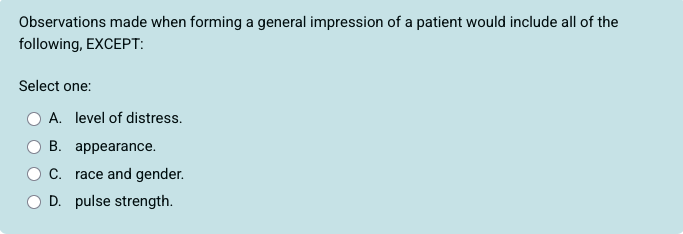
The correct answer is D. pulse strength.
Explanation:
General Impression: The general impression is formed immediately upon approaching the patient during the primary assessment. It relies on visual and auditory cues before touching the patient, such as observing their overall appearance (B), level of distress (A), and basic demographics like age, race, and gender (C).
Pulse Strength: Checking pulse quality and strength requires physical contact (palpation) and is performed as part of the primary assessment's circulation check ($C$ in the $ABCs$), rather than during the initial, visual general impression stage.
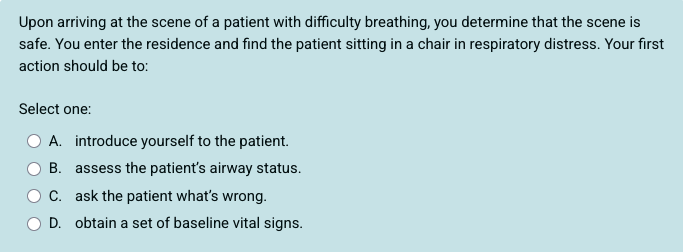
The correct answer is A. introduce yourself to the patient.
Explanation:
When initiating the primary assessment of a conscious patient:
Initial Contact & Communication: Upon approaching a conscious patient, your very first step before touching them or evaluating specific $ABCs$ is to introduce yourself, state your level of training, and ask for permission to help (gaining expressed consent).
Assessing Airway Status (Option B): Introducing yourself naturally allows you to begin assessing airway and mental status simultaneously—if the patient responds verbally when you introduce yourself, you immediately know that their airway is open and clear, and you can judge their level of consciousness.
Chief Complaint & Vitals (Options C & D): Asking what is wrong (chief complaint) comes right after introducing yourself, while obtaining baseline vital signs is part of the secondary assessment, which occurs after the primary assessment ($ABCs$) is complete.
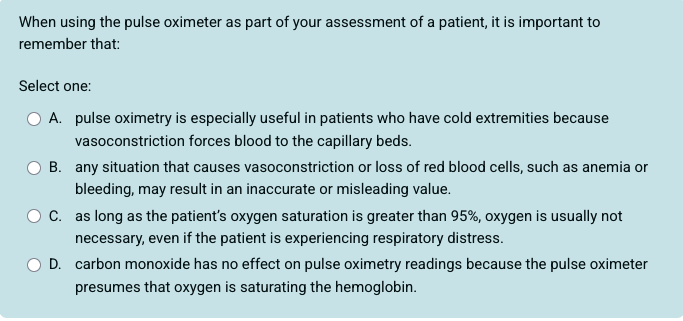
The correct answer is B. any situation that causes vasoconstriction or loss of red blood cells, such as anemia or bleeding, may result in an inaccurate or misleading value.
Explanation:
Vasoconstriction & Poor Perfusion (Option B): Pulse oximeters rely on adequate peripheral blood flow to measure light absorption through pulsating capillary beds. Peripheral vasoconstriction (due to cold, hypovolemia, or shock) reduces peripheral perfusion, which can prevent the device from getting an accurate reading. Similarly, severe anemia or acute blood loss means the remaining hemoglobin may be fully saturated (yielding a normal $\text{SpO}_2$), even though the total oxygen-carrying capacity of the blood is critically low.
Cold Extremities (Option A): Vasoconstriction reduces—rather than forces—blood flow to capillary beds, making pulse oximetry unreliable in cold extremities.
Treating the Patient, Not the Monitor (Option C): Oxygen therapy should be administered if a patient is in respiratory distress, regardless of whether their pulse oximetry reading shows $>95\%$.
Carbon Monoxide Effect (Option D): Carbon monoxide ($\text{CO}$) binds strongly to hemoglobin, forming carboxyhemoglobin. Standard pulse oximeters cannot distinguish between oxyhemoglobin and carboxyhemoglobin, resulting in a falsely high reading (often 99–100%) in cases of carbon monoxide poisoning.
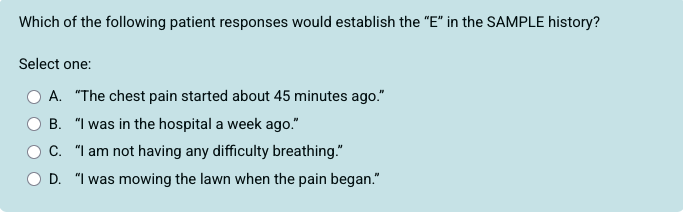
The correct answer is D. “I was mowing the lawn when the pain began.”
Explanation:
In the SAMPLE history mnemonic used during EMS patient assessment, E stands for Events leading up to the injury or illness.
Events leading up to (Option D): Answering what the patient was doing right when the symptoms started (e.g., exertion like mowing the lawn) describes the circumstances or events directly preceding the onset of symptoms.
Breakdown of Other Options:
Option A ("The chest pain started about 45 minutes ago."): Refers to the Onset component of the OPQRST mnemonic (or time frame of the complaint), not the event itself.
Option B ("I was in the hospital a week ago."): Falls under P in SAMPLE (Past pertinent medical history).
Option C ("I am not having any difficulty breathing."): Relates to Pertinent Negatives associated with S (Signs and symptoms).
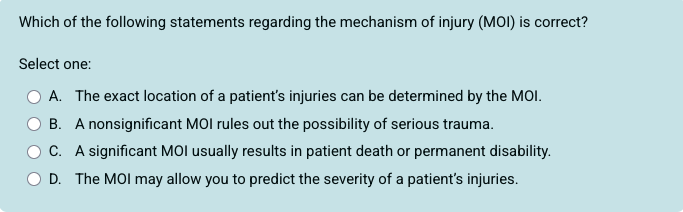
The correct answer is D. The MOI may allow you to predict the severity of a patient’s injuries.
Explanation:
Mechanism of Injury (MOI): The MOI describes the forces (chemical, thermal, or mechanical) applied to the body that caused the trauma. Evaluating the MOI helps EMS providers predict likely injury patterns and estimate the potential severity of underlying trauma before a full physical examination is completed.
Breakdown of Incorrect Options:
Option A: While MOI offers clues about possible injury locations, it cannot pinpoint the exact location or full extent of internal injuries—only a physical examination and medical imaging can do that.
Option B: A nonsignificant MOI does not completely rule out serious injury, especially in vulnerable populations like elderly patients or young children.
Option C: A significant MOI increases the index of suspicion for severe injury, but it does not mean the patient will usually suffer death or permanent disability.
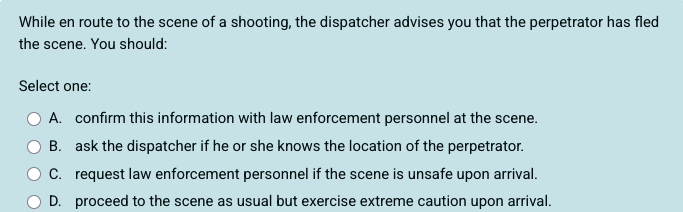
The correct answer is A. confirm this information with law enforcement personnel at the scene.
Explanation:
Scene Safety & Law Enforcement Confirmation: Even if dispatch receives reports that a perpetrator has fled a violent crime scene (such as a shooting), EMS personnel must never assume the scene is safe. Upon arrival, you must verify with law enforcement officers on scene that the area is secured before entering to provide patient care.
Why Other Options Are Incorrect:
Option B: Dispatch rarely has real-time tracking of a fleeing suspect, and asking them does not secure your immediate physical scene.
Option C: Law enforcement should already be dispatched and securing a shooting scene before or as EMS arrives, rather than waiting until you arrive to request them.
Option D: Proceeding as usual without confirmation from police puts EMS providers at extreme risk of entering an un-secured, active crime scene.
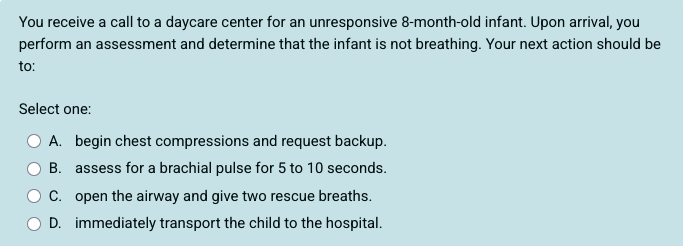
The correct answer is B. assess for a brachial pulse for 5 to 10 seconds.
Explanation:
Pulse Check in Infant BLS: When assessing an unresponsive infant who is not breathing (or only gasping), American Heart Association (AHA) and EMS guidelines state that you must check for a central pulse for at least 5 but no more than 10 seconds before initiating CPR or rescue breathing.
Brachial Artery: In infants (under 1 year of age), the brachial pulse (located on the inside of the upper arm) is the primary location used for pulse checks, as the carotid pulse is difficult to feel due to the infant's short, fleshy neck.
Why Other Options Are Incorrect:
Option A: You must check for a pulse first to determine whether to start full CPR (no pulse or pulse $<60\text{ bpm}$ with poor perfusion) or rescue breathing alone (pulse present, but not breathing).
Option C: Giving rescue breaths occurs after confirming the presence or absence of a pulse.
Option D: Delaying immediate resuscitation interventions to transport a non-breathing infant without establishing a pulse or providing basic life support reduces survival outcomes significantly.