Geog 3900 Exam 1 (option 2)
 Call Kai
 Learn
Learn Practice Test
 Spaced Repetition
 Match
Match Flashcards
 Knowt Play
1/80

There's no tags or description
Looks like no tags are added yet.
Name | Mastery | Learn | Test | Matching | Spaced | Call with Kai | Chat |
|---|
No analytics yet
Send a link to your students to track their progress
81 Terms
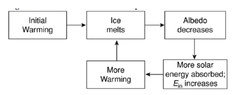
Ice albedo feedback
The feedback in which warmer temperatures melt ice, there is a less reflective surface (i.e. more ocean is exposed which absorbs heat), which leads to more warming and melting of ice
POSITIVE FEEDBACK (more ice melt leads to MORE ice melt)
Solar Irradiance
Energy we receive from the sun
Proxy Data
The data that paleoclimatologists gather from natural recorders of climate variability (tree rings, ice cores, fossil pollen, ocean sediments, coral and historical data)
Biogeochemical cycle
The cycling of substances that creates a pathway by which a chemical substance moves through both biotic (biosphere) and abiotic (lithosphere, atmosphere, and hydrosphere) compartments of Earth
Temperature
measure of average KE of molecules in a body
Radiative forcing
The measurement of the capacity of a gas or other forcing agents to affect that energy balance, thereby contributing to climate change. Put more simply, RF expresses the change in energy in the atmosphere due to GHG emissions.
Stefan-Boltzman Law
P/a = εσT⁴
Intensity increases to 4th power of its temp
P/a = power / area
ε = emissivity (unitless; 0-1, 1 for BB)
σ = Stefan-Boltzmann constant (5.67 x 10⁻⁸ W
m⁻² K⁻⁴)
T = temp. (K)
ITCZ
The Inter Tropical Convergence Zone, or ITCZ, is a belt of low pressure which circles the Earth generally near the equator where the trade winds of the Northern and Southern Hemispheres come together.
Albedo
amount of SW reflectivity, given as % (range: 0 - 1.0)
Aerosols
particles so small they're unaffected by gravity, but remain suspended in atmosphere for days or weeks
Normal period
30 years
Coriolis force
deflects a freely moving object to the right in the Northern Hemisphere and left in southern
Negative feedback
If evaporation from the oceans causes more low-level clouds to form, they will reflect more sunlight back into space, causing a slight decrease in surface temperatures.
Anomaly
difference between the actual temperature and a reference temperature
Wien's Law
λmax = (constant / T)
wavelength of object decreases with temperature
HOT sun = shorter wavelengths
COOL Earth = longer wavelengths
Thermohaline circulation
Is a part of the large-scale ocean circulation that is driven by global density gradients created by surface heat and freshwater fluxes.
drives the mixing of surface water and deep water
Climate change
change in the statistics of the atmosphere over decades
Holocene
epoch that began after the Pleistocene (and last glacial period) at approximately 11,700 years BP
part of Quaternary period
Greenhouse gas
A gas that contributes to the greenhouse effect by absorbing and re-emitting infrared radiation
e.g., carbon dioxide and chlorofluorocarbons.
re-emit up and downwards
Inversion
A reversal of the normal decrease of air temperature with altitude, or of water temperature with depth.
Latent heat
Heat released or absorbed during a phase change
"Latent" since heat is not felt
Climate sensitivity
The equilibrium global mean surface temperature change following a doubling of atmospheric CO2 concentration.
Residence time
The average time spent in a reservoir by an individual atom or molecule
With respect to greenhouse gases, it refers to how long on average a particular molecule remains in the atmosphere.
Weather
instantaneous state of the atmosphere
Climate
statistical description of the weather over a period
of time
How do we know global warming is occurring?
Satellite temperatures
Glacial record
Retreat of glaciers
Sea level rise/Sea ice decline
Sea surface temps (SSTs)
Stratosphere cooling, ozone lessening/Troposphere warming
Probability of extreme events
How do we know increasing CO2 in the atmosphere is produced by human activity? Again, explain the scientific evidence we have for this.
Geochemical signal
The fossilized carbon has different isotopes that can be measured
Isotope "fingerprint" - CO2 from burning FFs has different signature than CO2 from atmosphere; Suess effect
Energy
The ability to do work (force x distance) on some
form of matter (mass)
What are the greenhouse gases? What units do we use to measure them?
water vapor, carbon dioxide, nitrogen, methane
GWP
Which GHGs are increasing? What are the relative warming potentials of GHGs compared to a molecule of CO2?
CO2 = 1
Methane = 25
Nitrous oxide = 300
CFCs = 12,000
Suess effect
decline in atmospheric C14/C12 ratio to carbon from fossil fuel burnin
1st Law of Thermodynamics
energy is neither created nor destroyed, just changed form
2nd Law of Thermodynamics
heat always goes from hot to cold; entropy (disorder) increases
Fundamental unit of energy
Joule (J)
Power
rate of energy flow/use/transfer per time
Fundamental unit of power
Watt (W) = (J/s)
Temperature conversions
F → C
C → K
C = (F- 32) * 9/5
K = C + 273.15
Difference between heat and temp
Heat = energy in process of being transferred between objects (particles) b/c of temp difference
Methods of Heat Transfer
Conduction
Convection
Radiation
Conduction
Molecule to molecule transfer
Heat flow: warm to cold
ex. leather seats in a car

Convection
transferred by vertical movement; physical mixing
ex. boiling water

Radiation
directional energy transfer; propagated w/o medium (can travel thru
vacuum) at speed of light (300,000 km/s)
ex. solar radiation

What provides nearly ALL energy to Earth?
the SUN
via solar radiation
How does temperature affect the density of the atmosphere?
Air is heated → molecules move more → get further apart = density decreases
Air cools → molecules slow → get closer together = density increases
Photosphere
surface of the Sun
Sunspots
"cool" regions, ~1500 K cooler
indicate solar activity; 11 year cycle

Earth receives _____ radiation from the sun and re-emits _____ radiation.
recieves SHORTWAVE radiation
re-emits LONGWAVE radiation `
T/F: Everything above absolute 0 emits radiation.
TRUE
Hotter objects emit (more/less) energy and at (longer/shorter) wavelengths.
more energy, shorter wavelengths
Blackbody (BB) radiation
Any object that is a perfect absorber AND a perfect emitter
Insolation
amount of sunlight (SW radiation) shining on Earth
Why are the tropics hotter?
amount of insolation received at Earth's surface varies by latitude, season, time (i.e. day to night; summer to winter; Equator to high latitude)
Same amount of light can be distributed over different surface area when it has a different angle of incidence
At ____ latitudes, infrared cooling exceeds warming. At _____ latitudes, the opposite is true.
HIGH
LOW
Global circulation is about transferring heat (energy)
from _____ to _____.
HOT TROPICS to COLD POLES

Global circulation
redistribution of global heat
What causes global circulation?
Differential heating of surface causing
pressure differences (low and high pressure direct surface winds)
What holds more heat, oceans or atmosphere? What about carbon?
OCEANS (1000x more)
ALSO OCEANS
What is the primary controller of CO2 levels in the atmosphere?
Oceans
Special properties of the ocean
High thermal capacity
Circulation moves heat around planet
Exchange carbon with atmosphere
Global conveyor belt
Constantly moving system of deep-ocean circulation driven by temperature and salinity.

Global warming
surface of the earth will be come hotter than it presently is, in part due to the "enhanced" greenhouse effect (more GH gases)
The more energy in the system, the ______ the temperature.
higher
Composition of Earth's atmosphere
1/1,000,000 of Earth's mass
78.08 Nitrogen
20.95 Oxygen
0.93 Argon
0.038 CO2
0.04 Trace gases (Neon, Helium, Methane, Krypton, Hydrogen, others)

Atmospheric layers we're concerned with
Troposphere
Stratosphere
Mesosphere
Thermosphere
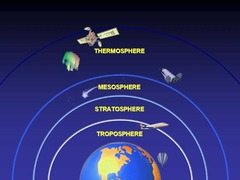
Stratosphere is hot because:
it has ozone (O3) which absorbs UV

Greenhouse Effect (GHE)
The atmosphere gains temperature from the
surface, AND warms the surface temperature by making it harder to loose energy to space
The atmosphere gets heat from (above/below).
BELOW
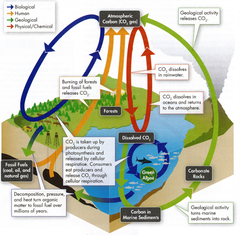
Carbon cycle
biogeochemical cycle through Earth
System (between lithosphere, biosphere, hydrosphere and atmosphere)
moderates the radiative balance as a GHG in the atmosphere
Most carbon is stored in _______, and the
natural fluxes to/from it are very _____.
the lithosphere (rocks)
small
Short-term reservoir: main ways CO2 is removed from atmosphere and enters OCEANS
takes months to centuries to recycle
1. growth and death of plants, animals, and microbes
2. dissolved C in ocean, helps maintain stable pH for life
Long-term reservoir: main ways CO2 is removed from atmosphere and enters ROCKS
~99.9 percent of the total carbon
atm. CO2 + water + minerals = calcium bicarbonate
ends up in oceans where it becomes shells of various marine organisms
shells accumulate on ocean floor and transform into rocks and fossil fuels
Over millions of years this material is buried and heat and pressure melts the rocks and converts the carbonate back to CO2
Some rocks become part of volcanoes and release CO2 via eruptions
removed from atmosphere by plants and burial of dead plant matter
swamps = material transformed into coal
river deltas = carbonaceous shale
The biogeochemical cycle
The flow of carbon (C) among global "reservoirs"
that store C
might mistakenly assume most C is in living
organisms or coal & oil. NOT! (99.9% in ROCKS - limestones, carbon-rich shales, coal & oil)
Carbon Sources v. Sinks
sources = processes that release CO2 to the atmosphere (volcanoes, fires, decomposition, respiration, digestion, burning fossil fuels)
sinks = processes that absorb carbon (photosynthesis, forests, oceans and freshwater bodies, fossil fuels and carbonate rocks)
Radiative forcing factors
trace gasses = −0.05 W/m2
aersosols = −1.2 W/m2
land use changes = −0.2 W/m2
Assumptions of simple GHE model
Like glass, atm transparent to visible sunlight (SW), but not LW; absorbs and re-radiates up & down
Energy in = energy out
We can balance energy budgets for each part of the model: (1) atmosphere; (2) ground; and (3) boundary to space that is the planet as a whole
How to find temp of earth in simple model
Eout = σ(TE)4
James Hansen
loaded dice
extreme weather events
Svante Arhenius
pioneering 1896 study of how changes in the amount of CO2 may affect climate
Joseph Fourier
1820s - intuition about Earth radiation and greenhouse action of atmosphere
Charles Keeling
Developed an instrument that measures CO2 in air

Guy Stewart Callendar
theory that linked rising carbon dioxide concentrations in the atmosphere to global temperature