Smart factory- module 2
 Call Kai
 Learn
Learn Practice Test
 Spaced Repetition
 Match
Match Flashcards
 Knowt Play
1/49

There's no tags or description
Looks like no tags are added yet.
Name | Mastery | Learn | Test | Matching | Spaced | Call with Kai | Chat |
|---|
No analytics yet
Send a link to your students to track their progress
50 Terms
Industry 1.0 ( 1st indutrial revolution)
characterised by the mechanisation of production, centrally driven machines, independance of production from wind and weather, eg steam engine in mining, driven by growth in demand from stong population growth
Industry 2.0 ( 2st indutrial revolution)
characterised by use of electrical energy, disappearance of noisy and dangerous transmissions (pollution) from steam engine, increase of labor through breaking down of work into specialised tasks “division of labor”
eg phones, assembly line work
Industry 3.0 ( 3st indutrial revolution)
characterised in major advances in electronics, revolution in many areas by commercially usable computers
eg CAD, automated production line, group production type, microprocessors
Industry4.0 ( 4st indutrial revolution)
characterised by steady rapid increase of computer performance, “individualization” batch size 1, highly flexible resource saving production, networking of all areas involved in creation, intelligent systems that adapt to their environment
eg connection of virtual and physical world with “cyber-physical systems”, use of sensors to get physical data, data analytics, human machine interfaces, decentralised networking, web based services
what is smart factory
Fully integrated, collaborative manufacturing system that responds in real time to meet changing demands and conditions in the factory, in the supply network and in customer needs
What are properties of smart factory
Networking and integration
Decentralisation and adaptivity
Flexibity and modularity
Real time monitoring and data analysis
Energy efficiency & resource conservation
Software defined manufacturing
approach to implementing smart factories, enables flexibility and reconfigurable production by decoupling software from specific hardware and defining hardware functions through software. (The machines no longer have a specific job, they are generic and the software can decide exactly which job they have to take )
more adaptive
more scalable
less manual adaptation efforts
Digitilisation
integration of digital tech into traditional production and business for more efficiency, flexibility and intelligence
characterised by connection btw virtual and physical world, collection of data, process automation and real time data
Basis of digitalisation is through analog to digital and back conversion
What are the basic principles of industry 4.0
Digitalization
Networking
Information transparency
Dencentralisation
Decision support systems
What is networking
The connection of devices and systems within a production environment so easy info exchange and collaboration is possible
Interoperability and seamless data transmission through wireless technologies
what is vertical integration
a business strategy where a company owns or controls multiple stages of its supply chain, instead of outsourcing to external vendors, for more control and maximised efficienecy
What is horizontal integration
business strategy where you aquire competitors or at least collaborate with them, to gain market share and reach new audiences
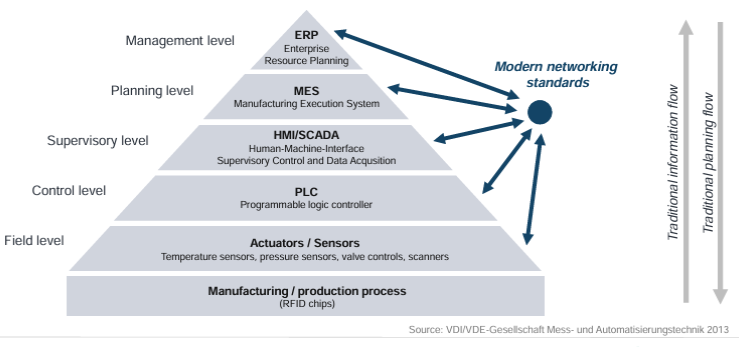
Automation pyramid and how does is it connected in traditional production vs with modern networking
Managment level - manage money, inventory, orders, purchasing (ERP)
Planning level- plan work hours, schedule resources, measure yield (MES)
Supervisory level - human-machine interface, now humans can see data and act (HMI/SCADA)
Control level - takes info from sensors and acts accordingly(PLC)
Field level - (sensors/actuators)
Manufacturing process
in tradition national production it is aa hierachry, info has to travel through the stages in order when wanting to get to another stage, with networking, they are all connected, direct info transmission as needed
Information transparency
the accessibility of relevant info at all times, places for all authorised people so there’s higher visibility of data accross the production and therefore more informed decisions
What is a key enabler for information transparency
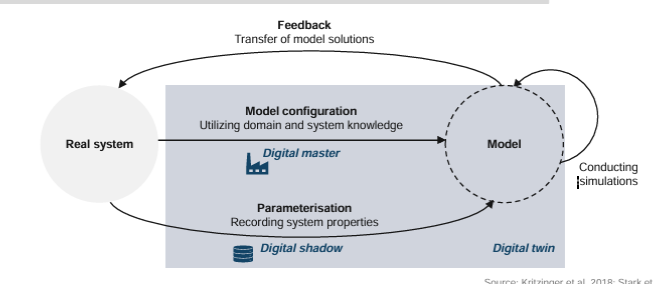
digital twin
used for simulation, testing, predictive maintenance, remote monitoring
What is digital twin and what is it composed of
exact real time model of physical object, machine, entire factory floor
made of digital shadow (real time operational data collected from physical system) and digital master (theoretical blueprint of system)
Decentralisation
decision making is no longer given to central authority, its shifted to individual autonomous system elements in the network that adapt to changing conditions
enables autonomous decision making by smart machines and modular architechture, more flexible and no longer 1 point failure
Cyber physical systems
network of physical systems with decentralised control system
interlaps with industry 4.0 bc of info transparency, decision making support systems, and decentralisation
Decision support system and example
IT based tools to improve decision making in complex situations, uses data analysis, also manages workflow(doments processes)
SAP S/4HANA
Human machine interface
connection points at which people interact with machines to control them and exchnage info
Internet of things vs Industry 4.0
both include digitalization, networking, info transparency and decentralisation
but internet of things does not include decision support system
Internet of things IoT
network of physical objects with computing power to generate, exchange and use data in their own network with minimal human interaction
5 layer of internet of things
physical layer (collect data) - sensors/actuators
Integration layer (send) - communication network
middleware layer (store) - databases
application layer (use) - application programming interface
presentation layer (display to human) - human machine interface
What is a sensor
A sensor detects a physical or chemical property and converts it into an electrical signal.
sensors measure
What is an actuator
An actuator receives an electrical signal and converts it into physical movement or action.
actuators act
Classifications for sensors
Active vs passive
sends out own signal and measures response vs only recieves signal already present
What is an encoder
converts mechanical movement (rotation ro linear motion) into electrical signals (sensor for motion)
3 different types of encoder
optical
magnetic
electric/inductive
When to use optical encoder based on advantages and disadvantages
Advantages
Very high precision
High resolution
Disadvantages
Sensitive to dust, oil, and moisture
Best suited for: Clean industrial environments.
When to use magnetic encoder based on advantages and disadvantages
Advantages
Resistant to dust, oil, and vibration
Compact design
Disadvantages
not as precise as optical
Best suited for: Harsh industrial environments. also where compactness needed
When to use electric encoder based on advantages and disadvantages
Advantages
Contactless operation
No mechanical wear
Not affected by strong external magnetic fields
very durable
Best suited for: Harsh industrial environments.
Linear position sensor and when its used
encoder for linear movement, used where travel distance determines quality eg pressing, injection molding
What is RFID
radio frequency identification - wireless identification tech (reader communicates with tag using electromagnetic induction)
What is condition monitoring
Condition monitoring continuously collects sensor data (e.g., vibration, temperature, humidity, pressure) to monitor machine health and detect failures before they occur.
Different categories of sensors
Mechanical, optical, aucoustic, chemical, thermal, electric, magnetic
Different categories of actuators
electromagnetic, electromechanical(eg linear press) , fluidic, piezoelectric, smart material, natural(human operator, not automated)
3 modular steps of assembly
transport (of main component from one station to another)
process
feeding (of auxilliary components needed for the process
Automation of modular station tasks
Collaborative robots can be used for all 3 tasks of transport, process and feeding. they use encoders, sensors embedded in actuators to achieve this
Programmable logic center PLC
digital control unit used to automate systems, it makes decisions from real time data of sensors and give actuator commands. Ensures machines function according to programmed logic
Components of integration layer and what is the model called
Application (provides network over which to communicate)
Presentation (compressing, encrypting, or converting data into common format)
Session (creation, maintenance and closing of connection session)
Transport (divides data in segments, controls flow and reassembles them, ensures data integrity)
Network (determines route that data needs to take)
Data link (enables communication btw locally connected devices )
Physical (sends actual bits over physical medium, defines physical medium and electrical signals used to transmit data)
Open system Interconnection model (OSI)
What does integration layer work based on
Network protocols, like OSI
What is the role of network protocols in smart factory
defines rules that allow machines, sensors, PLCs and software systems to communicate
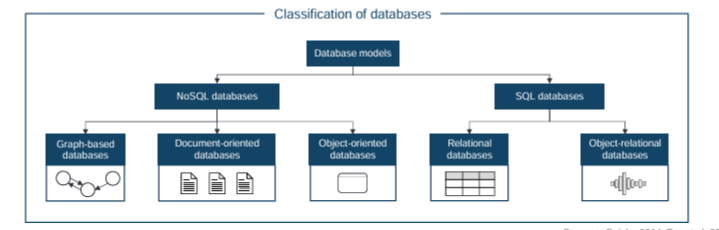
What is a database
system for storage and management of data in structured way so accessed processed and shared efficiently
Classification of database models
Application Programming interfaces API
enables different sofware systems to communicate with each other, defines methods and data format used
Business information systems BIS and relation with automation pyramid
collects, processes, stores and distributes info to support business operations and decision making in smart factory
includes the 3 highest level of automation pyramid: management level(ERP), planning level(MES), supervisory level(HMI/SCADA)
ERP entreprise resource planning
a system that manages the overall business operations of a company.
documents and analyses resource control
plans and controls business processes
central management of company’s resources
SCADA (Supervisory Control and Data Acquisition)
system used to monitor and supervise processes in real time
collects and monitors data
possible HMI
MES manufacturing execution system
system that manages and controls production in real time