Art History exam #1 monuments
 Call Kai
 Learn
Learn Practice Test
 Spaced Repetition
 Match
Match Flashcards
 Knowt Play
1/36

There's no tags or description
Looks like no tags are added yet.
Name | Mastery | Learn | Test | Matching | Spaced | Call with Kai | Chat |
|---|
No analytics yet
Send a link to your students to track their progress
37 Terms

Cimabue, Virgin and Child Enthroned
Early Italian Renaissance
Painted for the high altar of the church of Santa Trinita, Florence
Italo-Byzantine Style
Iconic subjects

Giotto, Virgin and Child Enthroned
Early Italian Renaissance
Painted for the high altar of the church of the Ognissanti, Florence
Subjects are more human

Giotto, frescoes for the Scrovegni (Arena) Chapel, Padua
Early Italian Renaissance
Narrative scenes
Chronological Biblical stories
The Lamentation

Giotto, Lamentation, from the Scrovegni (Arena) Chapel, Padua
Early Italian Renaissance
Christ is being mourned by his mother after the crucifixion
Emotion in the face
Naturalism
Landscape draws eyes to Christ
Backs of people
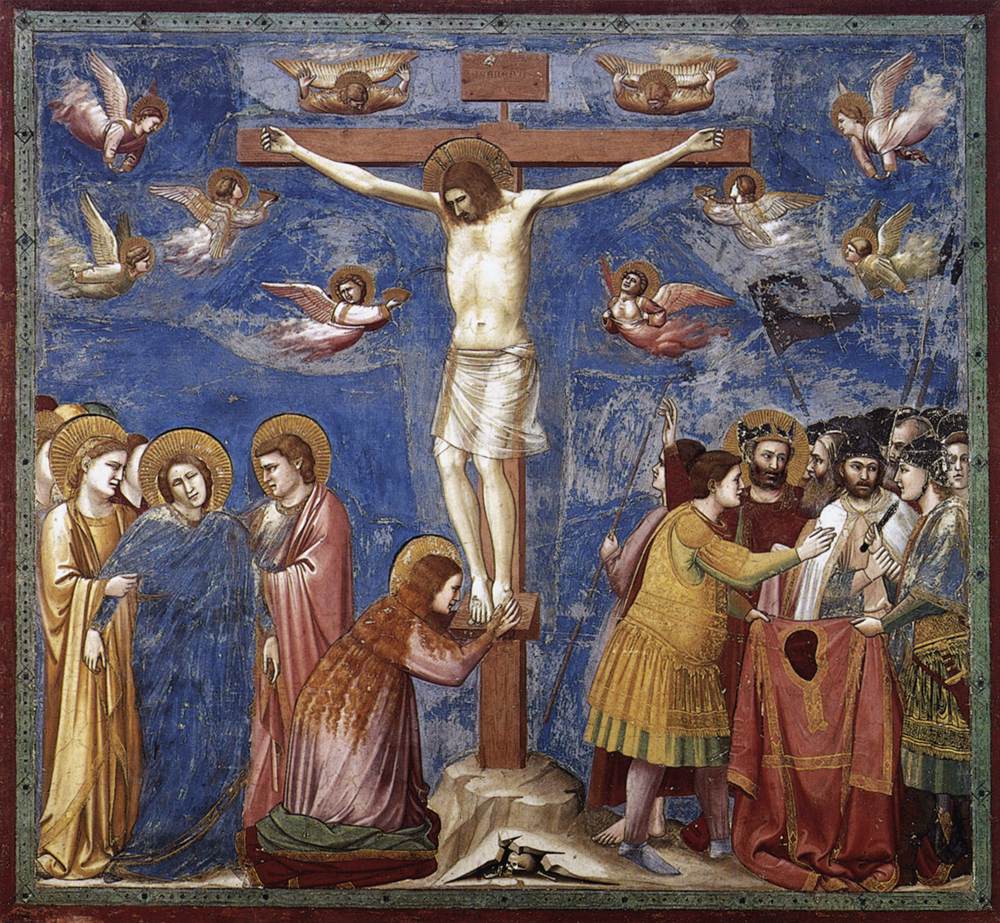
Giotto, Crucifixion, from the Scrovegni Arena Chapel, Padua
Early Italian Renaissance
Wants to draw the eye to Christ

Duccio, Madonna and Child
Early Italian Renaissance
Small, and was housed in a home
Original frame (damaged from candles burning in front of it)
Communication of prayer through Mary

Duccio, Maestra Altarpiece
Painted for the Cathedral of Siena
Early Italian Renaissance
Mary’s life on the front, Christ’s life on the back
Panel painting
Angles and saints are life size
Blue paint and gold show wealth, luxury and status
Light and shadow to indicate folds of clothing
Emotion (awareness and wisdom)
Continuous narrative

Madonna Dell’Impruneta
Early Italian Renaissance

Master of the St. Lucy Legend, Altarpiece with Madonna and Child with Angels
Early Northern Renaissance
Paliptych (multiple panels that can be opened and closed)
Panels

Workshop of Robert Campin, Annunciation Triptych (Merode Altarpiece)
Early Northern Renaissance
Commissioned for prayer in homes
Portrays “The Incarnation”
Oil painting
The angel Gabriel tells Mary she is pregnant

Jan and Hubert van Eyck, Ghent Altarpiece
Early Northern Renaissance
Panels
Words backwards and upside down, perhaps because Mary is speaking to God
Cityscape
Texture on skin to show age

Rogier van der Weyden, Last Judgment Altarpiece/”Beaune” Last Judgment
Early Northern Renaissance
Painted for the chapel of the Hotel-Dieu, Beaune, France

Jan van Eyck, Holy Face (Icon of Jesus of Christ)
Early Northern Renaissance
“Johannes van Eyck made and completed me in the year 1438 on January 31”
Glorified painting of Jesus

Jan van Eyck, Giovanni Arnolfini and His Wife
Early Northern Renaissance
Attention to detail
Signed “Jan van Eyke was here 1434”
Wealth is shown through clothing and environment
Oil paint
Proportions of the room and figures are not accurate
Don’t know the context of this painting
Mirror in the background

Jan van Eyck, Man in a Red Turban
Early Northern Renaissance
Self portrait?
Inscription on the frame “as I can”
Looks as if he is looking in a mirror
Wrinkles in his eyes show age

Lorenzo Ghiberti, Sacrifice of Isaac
Italian Renaissance
Made for a competition for a set of doors
Represents the “before”
Attention to anatomy
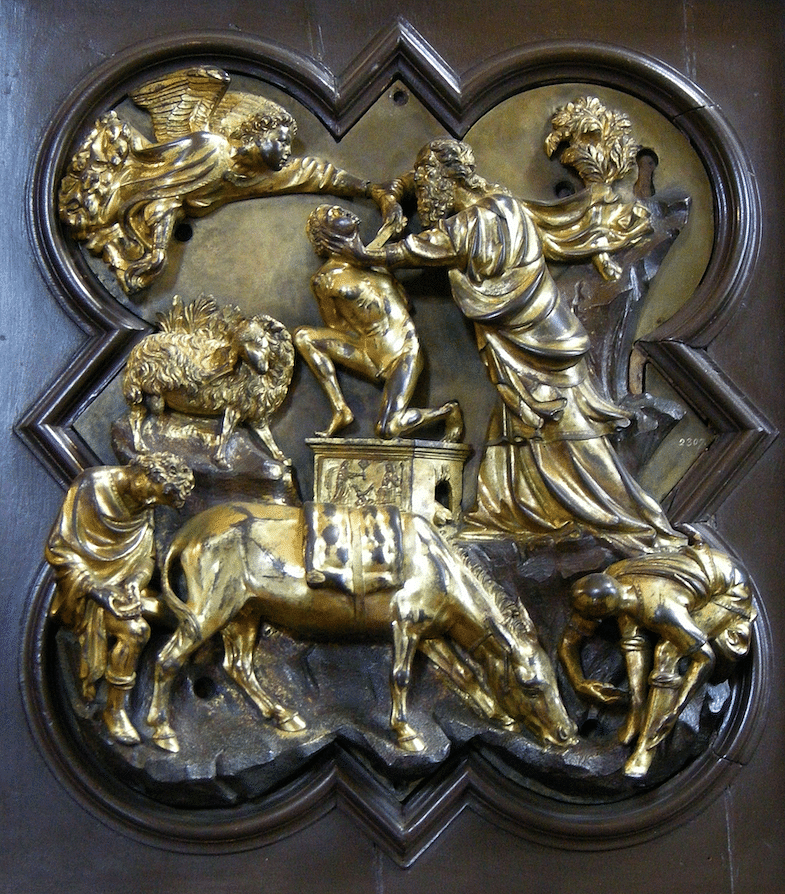
Filippo Brunelleschi, Sacrifice of Isaac
Italian Renaissance
Competition for a set of doors
Represents in the moment
Attention to anatomy

Donatello, St. Mark
Italian Renaissance
Commissioned by the linen weavers guild, Orsanmichele, Florence
Was placed in a grainary that was originally a church

Nanni di Banco, The Four Crowned Martyrs
Italian Renaissance
Commissioned by the stone carvers and woodworkers guild, Orsanmichele, Florence
Shows recognized communication about accepting their own death (mouths are not open but they are sharing glances)
Ancient Roman individuals

Masaccio, The Tribute Money
Italian Renaissance
Brancacci Chapel, Church of Santa Maria del Carmine, Florence
Scene that shows three different events
Linear perspective
Orthoganals, Vanishing point, Horizontal line, viewing point

Masaccio, Trinity
Italian Renaissance
Church of Santa Maria Novella, Florence
Trinity: God the Father, The Holy Spirit, The Son (Christ)
Early use of linear perspective
Victory of Christianity

Sandro Botticelli, Calumny of Apelles
Italian Renaissance
Figures are weightless
No emphasis on the background
Venus
Ancient Roman architecture
Apelles is known as the best ancient painter

Sandro Botticelli, Primavera
Italian Renaissance
Painted for the wedding of Lorenzo di Pierfrancesco de Medici
Ancient Greek and Roman mythology
Elongated, weightless figures
Sense of a halo
Venus in a sacred grove

Sandro Botticelli, Birth of Venus
Italian Renaissance
Female nude (Venus)…unusual
Understanding of the human body
2 demensional
Figures occupy the same plane

Raphael, Madonna of the Goldfinch
High Renaissance
St. John on the left is handing Christ a gold finch
Finch represents Christ’s suffering
Nature
Stability and balance, perfect triangle
Idealization
Grace and beauty

Leonardo da Vinci, Mona Lisa
High Renaissance
Ambiguous smile
Bust (waist up)
Shoulders turned towards viewer
Hands are included
Sfumato (soft, smokey outline)
Made for a private home but Leonardo kept it
Naturalism
Physiological presence

Leonardo da Vinci (??), Salvator Mundi
High Renaissance
Sfumato
Portrait like quality

Nicolo Rondinelli, St. John the Evangelist Appearing Before Galla Placidia
High Renaissance
Object of holy significance at the altar
Painting in the style of the time it was painted in, NOT the time of the subject
Not common to have gold in the background of the Madonna and Child
To inspire religious devotion
Madonna and Child was usually found in the home, not the church

Antoniazzo Romano, Icon of the Madonna and Child
High Renaissance

Michelangelo, Bacchus
High Renaissance
Anatomy isn’t as defined
Early Michelangelo sculpture
Facial expression isn’t super dramatic
Posture on one foot (Explains that he is drunk)
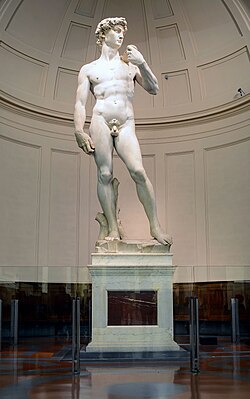
Michelangelo, David
High Renaissance
Commissioned to decorate the outside of the cathedral
Weight shifted to the right (contrapposto)
Tension in his eyes and body position
Rediscovery of Greek and Roman sculpture
Over defined features so that they could be seen from far away
Created the full body even though the back would not be seen
Captures the moment when David sees Goliath

Michelangelo, paintings for the Sistine Chapel ceiling, Rome
High Renaissance
Depictions of living bodies and dead bodies
Art as devine creation

Michelangelo, Creation of Adam, from the Sistine Chapel, Rome
High Renaissance
Defined body
Parallel to God’s creation

Michelangelo, Pieta
High Renaissance
Depicts Mary holding Christ’s dead body
No sense that the figure has life

Michelangelo, Doni Tondo
High Renaissance (but also Mannerism)
Bodily contortions
Posture is not idealized
Poses are not natural
Not balanced like most Manneristic paintings

Jacopo Pontormo, Deposition (aka Entombment), Capponi Chapel, Santa Felicita, Florence
Mannerism
Circular arrangement
Narrative is confusing
No clear focal point
Little background
Crowded
Carrying Christ towards the viewer
Is placed in a chapel burial

Parmigianino, Madonna with the Long Neck
Mannerism
Balanced
Idealized beauty
Huge lap and legs
Long fingers
Christ is unnaturally large
Unfinished work