8.1 - Origins of genetic variation
 Call Kai
 Learn
Learn Practice Test
 Spaced Repetition
 Match
Match Flashcards
 Knowt Play
1/13

There's no tags or description
Looks like no tags are added yet.
Name | Mastery | Learn | Test | Matching | Spaced | Call with Kai | Chat |
|---|
No analytics yet
Send a link to your students to track their progress
14 Terms
What are some factors that increase genetic variation?
Mutations
Independent assortment & crossing over during meiosis
Random fertilisation during sexual reproduction
What is a mutation?
A change in the number, or sequence, of bases in a particular gene
What is the definition of a gene?
A sequence of nucleotide bases that encodes an amino acid sequence of a polypeptide
Why might a mutation not lead to change in the amino acid sequence?
The genetic code is degenerate, meaning the mutation may end up coding for the same amino acid as the original triplet unless a frame shift occurs
What are addition & deletion mutations?
One or more nucleotides (bases) are either inserted or deleted from the DNA sequence:
this is more likely to be harmful & significant, as it leads to a frame shift, meaning the entire amino acid sequence downstream of the mutation will be different
What is a substitution mutation?
A nucleotide in the DNA sequence is replaced by another:
this is more likely to be a silent mutation, meaning no change occurs in the amino acid sequence
What is crossing over & how does it produce genetic variation?
While paired in a bivalent during prophase I, chromatids of homologous chromosomes swap alleles/genes at the chiasmata
This produces new combinations of alleles

What is independent assortment & how does it produce genetic variation?
Homologous pairs of chromosomes align randomly during metaphase I, leading to a random movement to the poles of the cell
This leads to different combinations of chromosomes in gametes

How does random fertilisation bring about genetic variation?
Gametes are haploid cells, meaning they only contain half of a person’s DNA
As this is determined by meiosis, every gamete contains different DNA
Therefore, the same two individuals can produce genetically different offspring
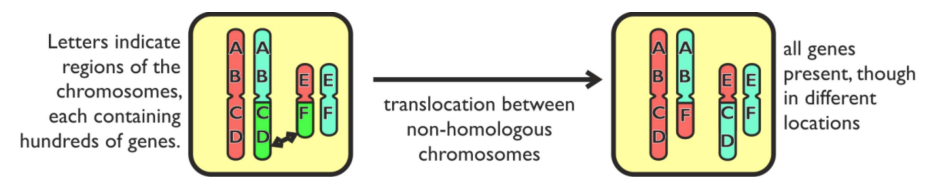
What is a translocation mutation?
One part of a chromosome is swapped with a part of a different chromosome
Swapped parts can be unequal in size & between non-homologous chromosomes
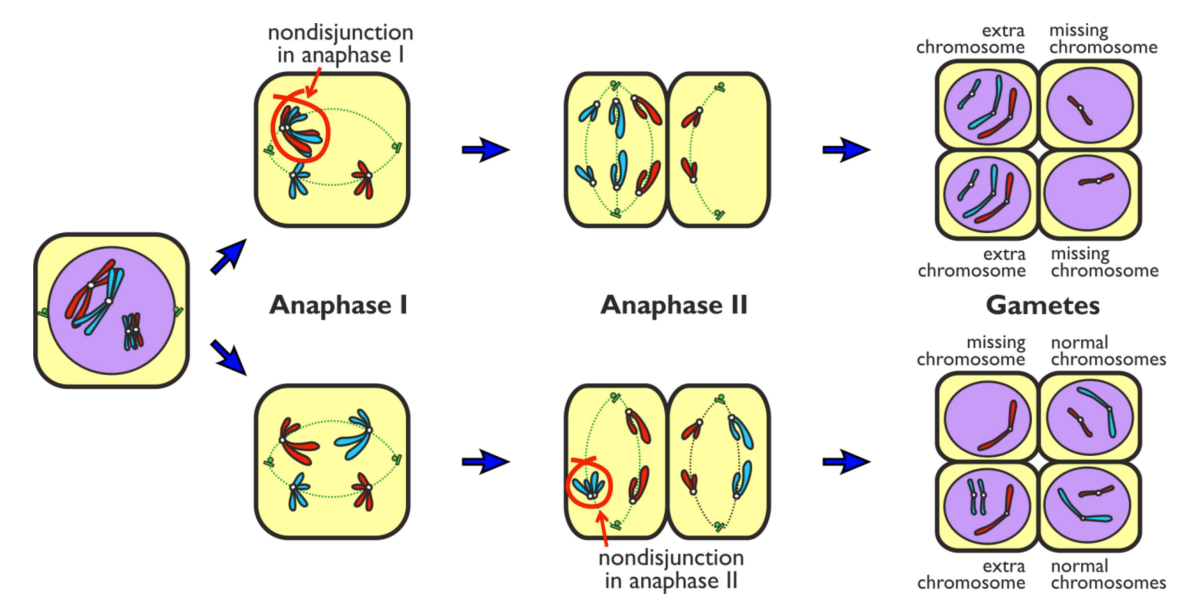
What is a non-disjunction mutation?
Chromosomes fail to separate correctly during anaphase in meiosis
Gametes may end up with one extra copy of a particular chromosome or no copies of a particular chromosome
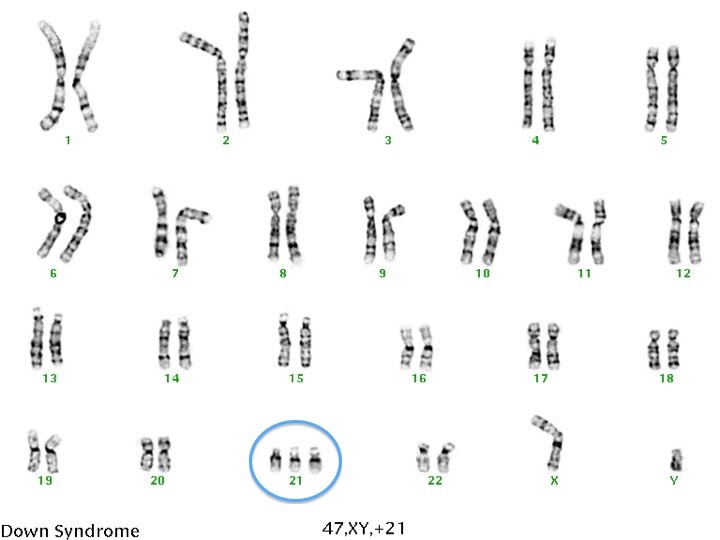
How can non-disjunction lead to polysomy?
If a gamete with an extra chromosome is fertilised by a normal gamete, the zygote will show trisomy:
three chromosome copies, instead of two (e.g. Down’s syndrome, which is caused by trisomy 21)
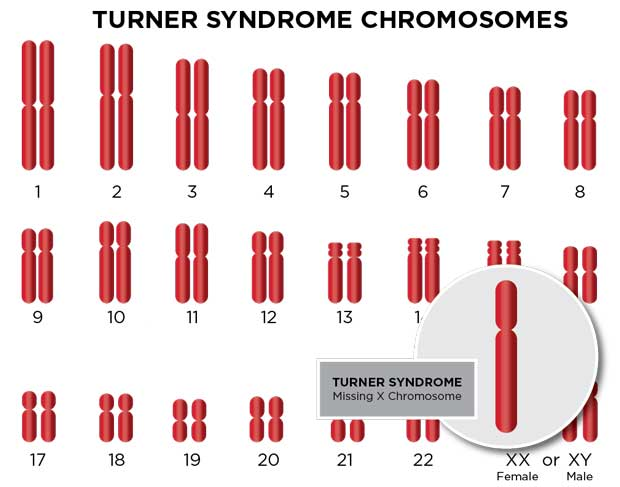
How can non-disjunction lead to monosomy?
If a gamete with a missing chromosome is fertilised by a normal gamete, the zygote will show monosomy:
one chromosome copy, instead of two (e.g. Turner’s syndrome, which is X0)
Recombination of alleles can be due to the crossing over that occurs during meiosis. This process results in gametes with different combinations of alleles and genetic variation in the offspring.
Crossing over occurs between two genes found on the same chromosome.
The recombination frequency reflects the likelihood of crossing over occurring. It depends on how close the genes are on the chromosome.
Explain why crossing over between two different genes, located on a pair of homologous chromosomes, results in a maximum of 50% of gametes with the recombinant alleles. (3)
Crossing over occurs between chromatids between the same homologous chromosomes
Therefore, only half the chromosomes produced by anaphase II will be recombinant chromosomes, so a maximum of 50%
Crossing over does not always take place, so can be less than 50%