[DISPENSING] Compounding & Incompatibilities
 Call Kai
 Learn
Learn Practice Test
 Spaced Repetition
 Match
Match Flashcards
 Knowt Play
1/138

There's no tags or description
Looks like no tags are added yet.
Name | Mastery | Learn | Test | Matching | Spaced | Call with Kai | Chat |
|---|
No analytics yet
Send a link to your students to track their progress
139 Terms
b. 2 years
[RECORDING AND FILLING]
Prescription Record Book must be kept for how many years?
a. 1 year
b. 2 years
c. 3 years
d. 5 years
a. 1 year
[RECORDING AND FILLING]
Dangerous Drugs Record Book must be kept for how many years?
a. 1 year
b. 2 years
c. 3 years
d. 5 years
d. 5 years
[RECORDING AND FILLING]
Poison Book must be kept for how many years?
a. 1 year
b. 2 years
c. 3 years
d. 5 years
c. Both a and b
HAM (High Alert Medicines)
SALAD (Sound Alike Look Alike Drugs)
[FILLING THE ORDER: COMPOUNDING/DISPENSING]
Drugs that pharmacists should be careful with during retrieval.
a. HAM
b. SALAD
c. Both a and b
d. ISMP
b. SALAD (Sound Alike Look Alike Drugs)
[FILLING THE ORDER: COMPOUNDING/DISPENSING]
Look-alike drugs that pharmacists should be careful with during retrieval.
a. HAM
b. SALAD
c. FDA
d. ISMP
b. HAM (High Alert Medicines)
[FILLING THE ORDER: COMPOUNDING/DISPENSING]
Medicines with a narrow therapeutic index (TD50/ED50) that pharmacists should be careful with during retrieval.
a. SALAD
b. HAM
c. FDA
d. ISMP
a. Tall-man lettering
[FILLING THE ORDER: COMPOUNDING/DISPENSING]
A strategy used to distinguish between sound-alike, look-alike drugs by using uppercase letters to highlight differences.
a. Tall-man lettering
b. Bold lettering
c. Italic lettering
d. Underlining
d. Both b and c
US FDA
ISMP (Institute for Safe Medication Practices)
[FILLING THE ORDER: COMPOUNDING/DISPENSING]
Tall-man lettering is recommended by the _____ and _____ organization?
a. WHO
b. US FDA
c. ISMP
d. Both b and c
acetaZOLAMIDE vs acetoHEXAMIDE
buPROPion vs. busPIRone
chlorproMAZINE vs. chlorproPAMIDE
cycloSERINE vs. cycloSPORINE
DOBUTamine vs. DOPamine
hydrALAzine vs. hydrOXYzine
[FILLING THE ORDER: COMPOUNDING/DISPENSING]
Example of Tall Man Lettering
b. Extemporaneous compounding
[FILLING THE ORDER: COMPOUNDING/DISPENSING]
Compounding that involves repacking, reconstitution, and mixing.
a. Bulk compounding
b. Extemporaneous compounding
c. Industrial compounding
d. Sterile compounding
Name of components
Quantity, as written in the prescription
[FILLING THE ORDER: COMPOUNDING/DISPENSING]
In extemporaneous compounding, the label must contain the content which includes:
a. Name of components and quantity, as written in the prescription
b. Only the brand name
c. Only the generic name
d. The price of the medication
d. 28 days
[FILLING THE ORDER: COMPOUNDING/DISPENSING]
For extemporaneously compounded topical or oral preparations, the expiry date is:
a. 24 hours
b. 7 days
c. 14 days
d. 28 days
a. 24 hours
[FILLING THE ORDER: COMPOUNDING/DISPENSING]
For extemporaneously compounded parenteral preparations, the expiry date is:
a. 24 hours
b. 48 hours
c. 7 days
d. 14 days
a. Auxiliary labels
[FILLING THE ORDER: COMPOUNDING/DISPENSING]
_______ are required on extemporaneously compounded preparations.
a. Auxiliary labels
b. Prescription labels
c. Warning labels
d. Poison labels
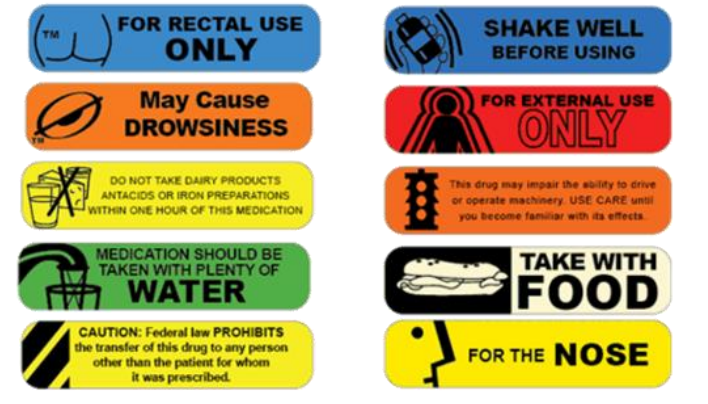
[FILLING THE ORDER: COMPOUNDING/DISPENSING]
Example of Auxiliary Labels
c. Both a and b
Prepared by
Date of preparation
[FILLING THE ORDER: COMPOUNDING/DISPENSING]
The label of an extemporaneously compounded preparation must include:
a. Prepared by
b. Date of preparation
c. Both a and b
d. Neither a nor b
Aseptic Technique
Laminar airflow hood
Vertical LAF
Horizontal LAF
Terminal Sterilization
[FILLING THE ORDER: COMPOUNDING/DISPENSING]
Sterile compounding uses [2]
b. Sterile compounding
[FILLING THE ORDER: COMPOUNDING/DISPENSING]
Compounding that uses aseptic techniques such as laminar airflow hoods.
a. Extemporaneous compounding
b. Sterile compounding
c. Bulk compounding
d. Non-sterile compounding
b. Vertical LAF
[FILLING THE ORDER: COMPOUNDING/DISPENSING]
Type of laminar airflow hood where you do NOT stack items
a. Horizontal LAF
b. Vertical LAF
c. Biological safety cabinet
d. Clean bench
b. Vertical LAF
[FILLING THE ORDER: COMPOUNDING/DISPENSING]
Used for chemotherapeutic agents.
a. Horizontal LAF
b. Vertical LAF
c. Biological safety cabinet
d. Clean bench
a. Horizontal LAF
[FILLING THE ORDER: COMPOUNDING/DISPENSING]
of laminar airflow hood where you do NOT block the airflow
a. Horizontal LAF
b. Vertical LAF
c. Biological safety cabinet
d. Clean bench
b. Chemotherapeutic agents
[FILLING THE ORDER: COMPOUNDING/DISPENSING]
Vertical laminar airflow hood is used for which type of agents?
a. Antibiotics
b. Chemotherapeutic agents
c. Vaccines
d. Vitamins
b. Terminal sterilization
[FILLING THE ORDER: COMPOUNDING/DISPENSING]
Process where after compounding, the product is subjected to final sterilization.
a. Aseptic processing
b. Terminal sterilization
c. Filtration sterilization
d. Radiation sterilization
a. Moist Heat
[FILLING THE ORDER: COMPOUNDING/DISPENSING]
MOA is protein coagulation.
a. Moist Heat
b. Dry heat
c. Membrane filtration /Cold Sterilization
d. Gas sterilization
e. Ionizing Radiation
a. Moist Heat
[FILLING THE ORDER: COMPOUNDING/DISPENSING]
Sterilization method that uses an autoclave at 121°C, 15 psi, for 15-30 minutes.
a. Moist Heat
b. Dry heat
c. Membrane filtration /Cold Sterilization
d. Gas sterilization
e. Ionizing Radiation
b. Dry heat
[FILLING THE ORDER: COMPOUNDING/DISPENSING]
MOA is oxidation.
a. Moist Heat
b. Dry heat
c. Membrane filtration /Cold Sterilization
d. Gas sterilization
e. Ionizing Radiation
b. Dry heat
[FILLING THE ORDER: COMPOUNDING/DISPENSING]
Sterilization method that uses an oven at 160°C for 2-4 hours.
a. Moist Heat
b. Dry heat
c. Membrane filtration /Cold Sterilization
d. Gas sterilization
e. Ionizing Radiation
c. Membrane filtration /Cold Sterilization
[FILLING THE ORDER: COMPOUNDING/DISPENSING]
MOA is physical separation.
a. Moist Heat
b. Dry heat
c. Membrane filtration /Cold Sterilization
d. Gas sterilization
e. Ionizing Radiation
b. Cold sterilization
[FILLING THE ORDER: COMPOUNDING/DISPENSING]
Membrane filtration is also known as _____
a. Dry sterilization
b. Cold sterilization
c. Thermal sterilization
d. Gas sterilization
c. Membrane filtration /Cold Sterilization
[FILLING THE ORDER: COMPOUNDING/DISPENSING]
Sterilization method that uses a 0.2-micron filter
a. Moist Heat
b. Dry heat
c. Membrane filtration /Cold Sterilization
d. Gas sterilization
e. Ionizing Radiation
d. Gas sterilization
[FILLING THE ORDER: COMPOUNDING/DISPENSING]
MOA is alkylation.
a. Moist Heat
b. Dry heat
c. Membrane filtration /Cold Sterilization
d. Gas sterilization
e. Ionizing Radiation
d. Gas sterilization
[FILLING THE ORDER: COMPOUNDING/DISPENSING]
Sterilization method that uses Ethylene oxide / Carboxide (10% EtO + 90% CO₂)
a. Moist Heat
b. Dry heat
c. Membrane filtration /Cold Sterilization
d. Gas sterilization
e. Ionizing Radiation
a. Carboxide (10% EtO + 90% CO₂)
[FILLING THE ORDER: COMPOUNDING/DISPENSING]
Ethylene oxide gas sterilization is also known as:
a. Carboxide (10% EtO + 90% CO₂)
b. Carbogen
c. Carbonic acid gas
d. Carbon dioxide
e. Ionizing Radiation
[FILLING THE ORDER: COMPOUNDING/DISPENSING]
MOA is DNA mutation
a. Moist Heat
b. Dry heat
c. Membrane filtration /Cold Sterilization
d. Gas sterilization
e. Ionizing Radiation
e. Ionizing Radiation
[FILLING THE ORDER: COMPOUNDING/DISPENSING]
Sterilization method that uses gamma rays.
a. Moist Heat
b. Dry heat
c. Membrane filtration /Cold Sterilization
d. Gas sterilization
e. Ionizing Radiation
c. Adverse drug event (ADE)
Any untoward occurrence during use of a drug with or without correlation to the mechanism of action of the drug.
a. ADR
b. Toxicity
c. Adverse drug event
d. Medication error
b. Medication error
Medication error is caused by incompatibilities and human error.
a. Toxicity
b. Medication error
c. Adverse Drug Reaction (ADR)
d. Adverse drug event
c. Adverse Drug Reaction (ADR)
Occurs at normal doses.
a. Toxicity
b. Medication error
c. Adverse Drug Reaction (ADR)
d. Adverse drug event
a. Toxicity
Caused by overdose.
a. Toxicity
a. Toxicity
b. Medication error
c. Adverse Drug Reaction (ADR)
d. Adverse drug event
Life threatening
Disabling
Reasonably drug-related
Unexpected
Characteristics of a serious adverse reaction include [4]
c. Adverse Drug Reaction (ADR)
Unwanted effects of a drug
a. Toxicity
b. Medication error
c. Adverse Drug Reaction (ADR)
d. Adverse drug event
c. Adverse Drug Reaction (ADR)
A response to an administered drug that is noxious and unintended
a. Toxicity
b. Medication error
c. Adverse Drug Reaction (ADR)
d. Adverse drug event
c. Adverse Drug Reaction (ADR)
Occurs at doses normally used in man for the prophylaxis, diagnosis or therapy of disease, or for the modification of physiologic function
a. Toxicity
b. Medication error
c. Adverse Drug Reaction (ADR)
d. Adverse drug event
c. Adverse Drug Reaction (ADR)
The result of the intrinsic properties (natural property) of the drug that cannot be prevented
a. Toxicity
b. Medication error
c. Adverse Drug Reaction (ADR)
d. Adverse drug event
b. Physicochemical incompatibilities
[TYPES OF INCOMPATIBILITIES]
Problems which could arise during the compounding or dispensing of prescription.
a. Therapeutic incompatibilities
b. Physicochemical incompatibilities
c. Pharmacokinetic interactions
d. Pharmacodynamic interactions
b. Physicochemical incompatibilities
[TYPES OF INCOMPATIBILITIES]
Arise from interaction of 2 or more substances
a. Therapeutic incompatibilities
b. Physicochemical incompatibilities
c. Pharmacokinetic interactions
d. Pharmacodynamic interactions
b. Physicochemical incompatibilities
[TYPES OF INCOMPATIBILITIES]
Usually occur during polypharmacy.
a. Therapeutic incompatibilities
b. Physicochemical incompatibilities
c. Pharmacokinetic interactions
d. Pharmacodynamic interactions
Physical Incompatibilities
Chemical Incompatibilities
Therapeutic Incompatibilities
Type of Incompatibilites [3]
Incomplete solution
Precipitation
Liquefaction
Polymorphism
Sorption
Volatilization / Vaporization
Loss of water
Physical Incompatibilities
Redox
Hydrolysis
Acid-base reaction
Racemization
Optical isomerism
Solvolysis
Explosive mixture
Photooxidative degradatio
Gelatinization
Cementation
Chemical Incompatibilties
a. Physical incompatibility
[TYPES OF INCOMPATIBILITIES]
Drug is the same but the physical state is altered, leading to the inefficacy of the dosage form.
a. Physical incompatibility
b. Chemical incompatibility
c. Therapeutic incompatibility
d. Biological incompatibility
b. Insolubility
[PHYSICAL INCOMPATIBILITIES]
Physical incompatibility where the solute does not dissolve in the solvent
a. Immiscibility
b. Insolubility
c. Precipitation
d. Liquefaction
b. Insolubility
[PHYSICAL INCOMPATIBILITIES]
Physical incompatibility that happens commonly in solutions.
a. Immiscibility
b. Insolubility
c. Precipitation
d. Liquefaction
b. Make a suspension
[PHYSICAL INCOMPATIBILITIES]
Remedy for insolubility is to _____
a. Make a solution
b. Make a suspension
c. Make an emulsion
d. Make a gel
a. Immiscibility
[PHYSICAL INCOMPATIBILITIES]
Physical incompatibility that happens between two different liquids (polar and non-polar)
Liquid in liquid
a. Immiscibility
b. Insolubility
c. Precipitation
d. Liquefaction
c. Make an emulsion
[PHYSICAL INCOMPATIBILITIES]
Remedy for immiscibility is to _____
a. Make a solution
b. Make a suspension
c. Make an emulsion
d. Make a powder
Gum (Acacia, Tragacanth) + OH
Pectin + OH
Resin + H2O
Oil + H2O
[PHYSICAL INCOMPATIBILITIES]
Example of emulsifying agents used as a remedy for immiscibility [4]
b. Precipitation
[PHYSICAL INCOMPATIBILITIES]
Type of incompatibility that is both physical and chemical.
a. Liquefaction
b. Precipitation
c. Polymorphism
d. Sorption
b. Salting out process
[PHYSICAL INCOMPATIBILITIES]
Most common cause of precipitation.
a. Polymorphism
b. Salting out process
c. Volatilization
d. Gelatinization
b. Precipitation
[PHYSICAL INCOMPATIBILITIES]
Process where a solute originally dissolved in a solvent is thrown out of the solution by the addition of another solute that has more solubility in the solvent.
a. Liquefaction
b. Precipitation
c. Polymorphism
d. Sorption
b. Precipitation
[PHYSICAL INCOMPATIBILITIES]
Usually occurs when solvent is organic
a. Liquefaction
b. Precipitation
c. Polymorphism
d. Sorption
b. ppt of nonelectrolyte
[PHYSICAL INCOMPATIBILITIES]
Electrolyte + non-electrolyte → _______
a. separation of alcohol
b. ppt of nonelectrolyte
a. separation of alcohol
[PHYSICAL INCOMPATIBILITIES]
Electrolyte + hydroalcoholic solution → ________
a. separation of alcohol
b. ppt of nonelectrolyte
Mucilage + Pb acetate
Aromatic water + salt
Spirit + salt solution/electrolyte
Camphor solution + water
[PHYSICAL INCOMPATIBILITIES]
Examples agents that causes Precipitation as Physical Incompatibility
d. Eutexia
[LIQUEFACTION]
Depression of melting point of solids in contact with each other
a. Efflorescence
b. Deliquescence
c. Hygroscopicity
d. Eutexia
d. Eutexia
[LIQUEFACTION]
Liquefaction at room temperature
a. Efflorescence
b. Deliquescence
c. Hygroscopicity
d. Eutexia
a. 5% EMLA cream (Lidocaine + Prilocaine)
[LIQUEFACTION]
Eutectic mixture of local anesthetics.
a. 5% EMLA cream (Lidocaine + Prilocaine)
b. 5% Xylocaine cream (Lidocaine only)
c. 5% Betamethasone cream
d. 5% Hydrocortisone cream
b. Lidocaine + Prilocaine
[LIQUEFACTION]
5% EMLA cream
a. Lidocaine + Bupivacaine
b. Lidocaine + Prilocaine
c. Prilocaine + Tetracaine
d. Benzocaine + Lidocaine
Camphor + menthol
Thymol
Phenol
Salicylic acid
Chloral hydrate
[LIQUEFACTION]
Examples of substances that form eutectic mixtures include: [5]
b. Add MgO / MgCO₃ / Kaolin
[LIQUEFACTION]
Remedy for liquefaction (eutexia) is to:
a. Add water
b. Add MgO / MgCO₃ / Kaolin
c. Add alcohol
d. Add glycerin
c. Hygroscopicity
[LIQUEFACTION]
Absorbs moisture but does not dissolve (e.g., CaO, Sucrose, NaCl).
a. Deliquescence
b. Efflorescence
c. Hygroscopicity
d. Eutexia
a. Deliquescence
[LIQUEFACTION]
Absorbs moisture and dissolves (e.g., NaOH, KOH, NaNO₃, NH₄Cl).
a. Deliquescence
b. Efflorescence
c. Hygroscopicity
d. Eutexia
b. Efflorescence
[LIQUEFACTION]
Release of water of crystallization (e.g., CuSO₄·5H₂O, MgSO₄·7H₂O, Na₂CO₃·10H₂O)
a. Deliquescence
b. Efflorescence
c. Hygroscopicity
d. Eutexia
c. Polymorphism
[POLYMORPHISM]
Interchange between crystalline arrangements.
a. Deliquescence
b. Efflorescence
c. Polymorphism
d. Hygroscopicity
e. All of the above
Aspirin
Sulfanilamide
Chloramphenicol
Theobroma cacao
[POLYMORPHISM]
Examples of compounds that exhibit polymorphism include:
a. Aspirin
b. Sulfanilamide
c. Chloramphenicol
d. Theobroma cacao
e. All of the above
b. γ < α < β' < β
[POLYMORPHISM]
The polymorphic forms of Cocoa Butter, NF, in order of increasing stability are:
a. β < α < β' < γ
b. γ < α < β' < β
c. α < β < γ < β'
d. β' < γ < α < β
a. Cubic
[POLYMORPHISM]
Sodium chloride (NaCl) forms which type of crystal?
a. Cubic
b. Monoclinic
c. Triclinic
d. Tetragonal
e. Hexagonal
d. Rhombic
b. Monoclinic
[POLYMORPHISM]
Sucrose forms which type of crystal?
a. Cubic
b. Monoclinic
c. Triclinic
d. Tetragonal
e. Hexagonal
d. Rhombic
c. Triclinic
[POLYMORPHISM]
Boric acid forms which type of crystal?
a. Cubic
b. Monoclinic
c. Triclinic
d. Tetragonal
e. Hexagonal
d. Rhombic
d. Tetragonal
[POLYMORPHISM]
Urea forms which type of crystal?
a. Cubic
b. Monoclinic
c. Triclinic
d. Tetragonal
e. Hexagonal
d. Rhombic
e. Hexagonal
[POLYMORPHISM]
Iodoform forms which type of crystal?
a. Cubic
b. Monoclinic
c. Triclinic
d. Tetragonal
e. Hexagonal
d. Rhombic
d. Rhombic
[POLYMORPHISM]
Iodine forms which type of crystal?
a. Cubic
b. Monoclinic
c. Triclinic
d. Tetragonal
e. Hexagonal
d. Rhombic
a. Sorption
[SORPTION]
Drug solution to container
a. Sorption
b. Leaching
c. Absorption
d. Adsorption
b. Leaching
[SORPTION]
Container to solution
a. Sorption
b. Leaching
c. Absorption
d. Adsorption
c. Absorption
[SORPTION]
Penetration to capillary spaces
a. Sorption
b. Leaching
c. Absorption
d. Adsorption
d. Adsorption
[SORPTION]
Surface phenomenon
a. Sorption
b. Leaching
c. Absorption
d. Adsorption
Magnesium Oxide (MgO)
Activated Charcoal
Tannic acid
📌Mnemonic: “MAT”
[SORPTION]
Universal Antidote include [3]
b. Volatilization / Vaporization
Liberation of the active pharmaceutical ingredient (API) through evaporation;
a. Precipitation
b. Volatilization / Vaporization
c. Liquefaction
d. Polymorphism
b. Volatilization / Vaporization
Commonly happens in preparations with volatile oils, organic solvents (alcohols and carbonyls), and nitroglycerin.
a. Precipitation
b. Volatilization / Vaporization
c. Liquefaction
d. Polymorphism
b. Breaking / cracking
[LOSS OF WATER]
Loss of solvent in an emulsion results in:
a. Syneresis
b. Breaking / cracking
c. Crumbling
d. Increased potency
d. Increased potency
[LOSS OF WATER]
Loss of solvent in suspensions or solutions results in:
a. Cracking
b. Syneresis
c. Crumbling
d. Increased potency
c. Crumbling
[LOSS OF WATER]
Loss of solvent in ointments results in:
a. Breaking
b. Syneresis
c. Crumbling
d. Increased potency
b. Syneresis → formation of Xerogel
[LOSS OF WATER]
Loss of solvent in gels results in:
a. Crumbling
b. Syneresis → formation of Xerogel
c. Cracking
d. Increased potency
b. Xerogel
[LOSS OF WATER]
Loss of water (solvent) in a gel leads to syneresis and the formation of:
a. Hydrogel
b. Xerogel
c. Lyogel
d. Organogel
b. Chemical incompatibility
Reaction in which a visible change is not necessary, but the original drug is no longer present
a. Physical incompatibility
b. Chemical incompatibility
c. Therapeutic incompatibility
d. Biological incompatibility
b. Redox
[CHEMICAL INCOMPATIBILITIES]
Can be reduction or oxidation but oxidation is more common.
a. Hydrolysis
b. Redox
c. Racemization
d. Solvolysis
a. Oxidation
[CHEMICAL INCOMPATIBILITIES]
Manifest a change in color
a. Oxidation
b. Reduction
[CHEMICAL INCOMPATIBILITIES]
Oxygen
Light (photooxidation)
Excessive heat
Metals
[CHEMICAL INCOMPATIBILITIES]
Oxidations is triggered by the presence of ____ [4]
Vitamin E / α-tocopherol
Propyl gallate
Butylated hydroxy anisole (BHA)
Butylated hydroxytoluene (BHT)
[CHEMICAL INCOMPATIBILITIES]
Examples of True Antioxidants [4]
a. True antioxidants
[TYPES OF ANTIOXIDANTS]
Reacts with oxygen to avoid formation of free radicals.
a. True antioxidants
b. Reducing agents
c. Chelating agents
d. Oxidizing agents