Immunology Solo 2 Lecture 1 Basic Serologic Laboratory Techniques
 Call Kai
 Learn
Learn Practice Test
 Spaced Repetition
 Match
Match Flashcards
 Knowt Play
1/34

Earn XP
Description and Tags
Name | Mastery | Learn | Test | Matching | Spaced | Call with Kai | Chat |
|---|
No analytics yet
Send a link to your students to track their progress
35 Terms
Serologic Testing
An assay involving serum constituents
Important part of diagnostic testing for viral and bacterial disease
Immunologic Testing
Testing related to antigens and antibodies
Performed in many areas of the lab
Blood specimen preparation
Preanalytical Variables
Specimen types
Delay in testing
Excessive heat
Bacterial contamination
Strong acid or alkali solutions
Lipemia, hemolysis, or icterus
Specimen types
Most immunology assays are done on serum; tube should be allowed to clot before centrifugation occurs; some assays are done on body fluids (cerebrospinal fluid or urine)
Delay in testing
In most cases, immunology testing should be done within 72 hours; if not, serum should be frozen
Excessive heat
Coagulates proteins
Bacterial Contamination
Alters protein molecules
Strong acid or alkali solutions
Must be avoided because these substances have a denaturing effect on serum proteins and make the specimens useless for serologic testing

Lipemia, hemolysis, or icterus
Can make a specimen unacceptable
Inactivation of Complement
Some immunology procedures may require heat inactivation of complement in the serum
Complement in the body fluids can be inactivated by heating at 56 degrees Celsius for 30 minutes
If more than 4 hours has elapsed since inactivation, a specimen can be reheated to 56 degrees Celsius for 10 minutes
Complement may
Interfere with certain syphilis tests
Agglutinate latex particles causing a false positive result
Lyse indicator cells in hemagglutination assays
Manual Pipettes
Pipettes are used to transfer a certain amount of liquid (Sample, reagents, or diluting fluids) while performing certain assays
Graduated Pipettes
Serologic Pipettes
Graduated Pipettes
Delivers the amount of liquid contained between two calibration marks on the pipette
Requires draining between two calibration marks (less accurate)
Serologic Pipettes
Similar to the graduated pipette, but it is calibrated to the tip
Contains a frosted ring at the non-calibrated end
To Contain (TC)
Glassware designed to contain, like graduated cylinders and volumetric flasks, are usually marked with a TC
When liquid is poured from a piece of glassware a small amount remains behind, clinging to the sides of the vessel
A 100ml volumetric flask is designed to hold exactly 100 ml but if the liquid is poured out it will actually deliver a little less than the 100 mL
To Deliver (TD)
Glassware designed to deliver, like pipettes and burets, are marked with a TD
These pieces of glassware account for the small amount of liquid that remains behind
A 100mL pipette contains a little more than 100 mL of liquid, but when the liquid is drained from a pipette exactly 100 mL is delivered

Manual Pipettes: Pipetting Technique
Using mechanical suction
Wipe off outside of pipette with gauze
Adjusting the meniscus
Drain into the receiving vessel

Manual Pipettes:
Reading the Meniscus
Manual Pipettes - Step by Step Usage
Check the pipette to ascertain its correct size, being careful also to check for broken delivery or suction tips
Wearing protective gloves, hold the pipette lightly between the thumb and the last three fingers leaving the index finger free
Place the tip of the pipette well below the surface of the liquid to be pipetted
Using mechanical suction or an aspirator bulb, carefully draw the liquid up into the pipette until the level of the liquid is well above the calibration mark
Quickly cover the suction of the opening at the top of the pipette with the index finger
Wipe the outside of the pipette dry with a piece of Kimwipe tissue to remove excess fluid
Hold the pipette in a vertical position with the delivery tip of against the inside of the original vessel. Carefully allow the liquid in the pipette to drain by gravity until the bottom of the meniscus is exactly at the calibration mark. To do this, do not entirely remove the index finger from the suction hole end of the pipette; rather, by rolling the finger slightly over the opening, allow slow drainage to take place
While still holding the pipette in a vertical position, touch the tip of the pipette to the inside wall of the receiving vessel. Remove the index finger from the top of the pipette to permit free drainage. Remember to keep the pipette in a vertical position for correct drainage. In TD (to deliver) pipettes, a small amount of fluid will remain in the delivery tip
To be certain that the drainage is as complete as possible, touch the delivery tip of the pipette to another area on the inside wall of the receiving vessel
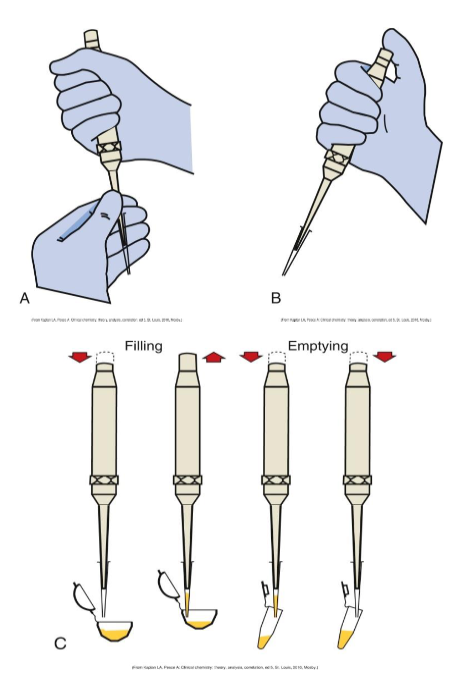
Automatic Pipettes
Steps in using piston type automatic micropipette
A: Attaching proper tip size for range of pipette volume and twisting tip as it is pushed onto pipette to give an airtight, continuous seal
B: Holding pipette before use
C: Follow instructions for filling and emptying a pipette tip
If testing cannot be done within ____ hours of collection, a serum specimen should be frozen at -20 degrees Celsius
72 hours
Complement can be inactivated in human serum by heating to ____ degrees Celsius
56
Solution
The mixture of one substance (solute) into another (solvent)
Dilution
Reduces the concentration of the original solute in the solution
Dilutions
To make a dilution, a solvent (also referred to as a diluent) is mixed with a solution to decrease the concentration of the solute
A dilution is the number of parts of the substance in the total number of parts of the final diluted solution
Dilution Examples
If we make a ½ dilution of blood using saline, this would be one part blood and one part saline for a total of two parts:
1 mL of blood + 1 mL of saline = 2mL total
A 1/10 dilution would be 1 part blood and 9 parts saline for a total of 10 parts
1 mL of blood and 9 mL of saline = 10 mL total
The result obtained from the procedure using a diluted specimen must be multiplied by the dilution factor to get your final result
The dilution factor is the number on the right of the expression; results from a 1/10 dilution would be multiplied by 10 to get the actual result
A patient blood sample is ran on the instrument and reads > 500 mg/dL for glucose. A 1/3 dilution with saline is required in order to get the reading in the dynamic range. How many mL of patient’s blood would be used to prepare a 1/3 dilution in which the total volume is 6 mL
2 mL
A patient blood sample is ran on the instrument and reads > 500 mg/dL for glucose. A 1/3 dilution with saline is required in order to get the reading in the dynamic range. If the analyzer gives a result of 300 mg/dL, how should this patient’s glucose level be reported
900 mg/dL

Serial Dilutions
The stepwise decreasing strength of a substance in solution

Antibody Testing - Testing for Antibody Levels
Acute Phase Specimen
Convalescent Phase Specimen
Acute Phase Specimen
Serum from one with a current infection for which bacterial or viral specific immunoglobulins are measured
Convalescent Phase Specimen
Serum from one who has recovered from an infectious disease and considered to be especially rich in antibodies against the infectious agent
Antibody Testing - Antibody Titer
Refers to the concentration of an antibody
The antibody titer is defined as the reciprocal of the highest dilution of the patient’s serum in which the antibody is still detectable
If serum is being tested for antibody levels with a specific infectious organism:
One blood sample should be drawn during the acute phase of the illness and
Another sample drawn during the convalescent phase of the illness
Antibody Titers - Determination of a Titer
Determination of an antibody titer (concentration) for a specific antigen involves two steps
Preparing a serial dilution of the antibody containing solution (serum)
Adding an equal volume of antigen suspension to each dilution
High titer indicates that a considerable amount of antibody is present in the serum
For most pathogenic infections, an increase in the patient’s titer of two doubling dilutions, or from a positive result of 1:8 to a positive result of 1:32 over several weeks is an indication of a current infection
This is known as a “four-fold” rise in antibody titer
Streptozyme testing is performed on an initial patient serum dilution of 1:100. Select the statement below that describes the correct dilution procedure
10 uL of patient serum is added to 990 uL of saline diluent
Serum for detection of antibodies should be drawn during the
Acute and convalescent phase of illness