Chemical Kinetics
 Call Kai
 Learn
Learn Practice Test
 Spaced Repetition
 Match
Match Flashcards
 Knowt Play
1/26

There's no tags or description
Looks like no tags are added yet.
Name | Mastery | Learn | Test | Matching | Spaced | Call with Kai | Chat |
|---|
No analytics yet
Send a link to your students to track their progress
27 Terms
Speed =
distance/time
Reaction rate =
∆[A] / ∆t
∆[A] = change in concentration of A
∆t = change in time
Rate = k[A]m[B]n
k = rate constant
[A] and [B] = concentration of the reactants
m and n = reaction orders
increase temp
increase rate constant and increase reaction rate
decrease Ea/activation energy
increase rate constant and increase reaction rate
increase reactants concentration
no effect on rate constant but increases reaction rate
rate of radioactive decay is
first order
Zero order
Rate = k[A]0
M•s-1
first order
Rate = k[A]1
s-1
second order
Rate = k[A]2
Rate = k[A][B] or k[A]2 or k[B]2
M-1•s-1
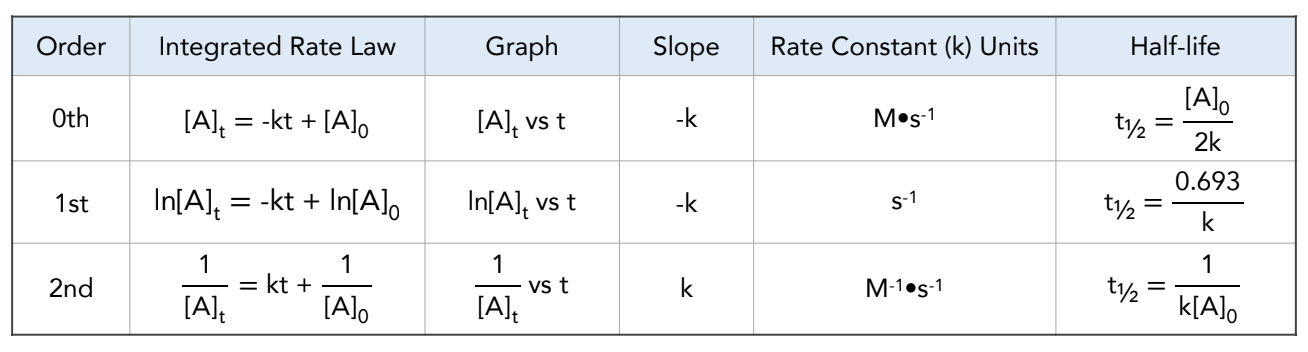
integrated rate law zero order
[A]t = -kt + [A]0
slope = -k
[A]t = concentration of A at the time of
interest (M)
k = rate constant (M•s-1)
t = time (s)
[A]0 = concentration of A at time = 0 (M)
integrated rate law first order
ln[A]t = -kt + ln[A]0
slope = -k
second order integrated rate law
1/[A]t = kt + 1/[A]0
summary of integrated rate laws
Intermediate IRS
Intermediates are products first and Reactans Second
Catalyst CARP
Catalysts Are Reactants first and Products second
Arrhenius equation
k = Ae -Ea/RT
k = rate constant
A = frequency factor
e = Euler's number (e ≈ 2.72)
Ea = activation energy
R = universal gas constant
T = temperature (K)
high temp
increase k and increase reaction rate
low temp
decrease k and decrease reaction rate
low Ea (activation energy)
increase in k and increase in reaction rate
high Ea
decrease k and decreased reaction rate
zero order half life
t1/2 = [A]0 / 2k
t1⁄2 = half-life
[A]0 = concentration of A at time = 0
k = rate constant (M•s-1)
![<p>t<sub>1/2</sub> = [A]<sub>0</sub> / 2k</p><p>t1⁄2 = half-life</p><p>[A]0 = concentration of A at time = 0</p><p>k = rate constant (M•s-1)</p>](https://assets.knowt.com/user-attachments/98f1014b-3bfd-422c-ad8c-66c9ade2202b.png)
first order half life
t1/2 = 0.693/k
k = rate constant s-1
second order half life
t1/2 = 1/k[A]0
k = rate constant M-1x S-1
![<p>t<sub>1/2</sub> = 1/k[A]<sub>0 </sub></p><p>k = rate constant M<sup>-1</sup>x S<sup>-1</sup></p>](https://assets.knowt.com/user-attachments/30215aec-ba19-4ae3-91b9-3d9a1f43e09c.png)
zero order reaction: as conc. decreases
half life decreases
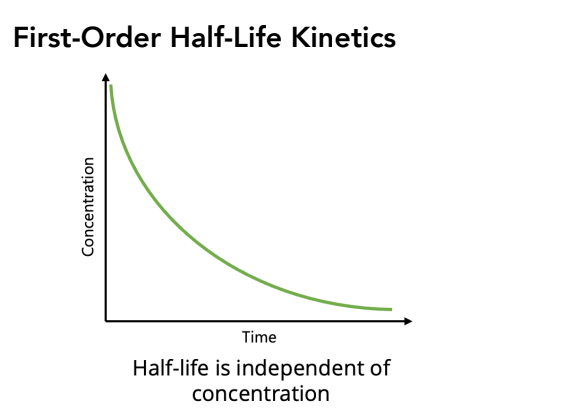
1st order reaction
half life is independent of concentration
second order reaction as conc. decreases
half life increases