Defects in crystalline structure
 Call Kai
 Learn
Learn Practice Test
 Spaced Repetition
 Match
Match Flashcards
 Knowt Play
1/30

There's no tags or description
Looks like no tags are added yet.
Name | Mastery | Learn | Test | Matching | Spaced | Call with Kai | Chat |
|---|
No analytics yet
Send a link to your students to track their progress
31 Terms
Why are crystal defects important in materials science?
They allow slip and plastic deformation to occur at much lower stresses than theoretical predictions
What are the three main types of crystal defect?
Point defects, line defects, and area defects
What is a point defect?
A missing or extra atom in the crystal lattice.
What is a line defect?
A missing or extra row of atoms in the lattice.
What is another name for a line defect?
A dislocation.
What is an area defect?
A defect with atomic dimensions in one direction and large dimensions in the other two.
Give an example of an area defect.
A grain boundary.
What effect do defects have on the crystal lattice?
They distort the lattice and increase stored strain energy.
What are the two common types of dislocation?
Edge dislocations and screw dislocations.
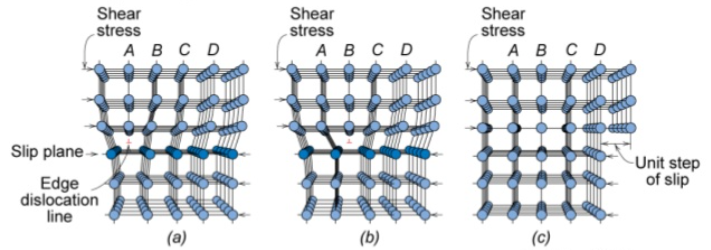
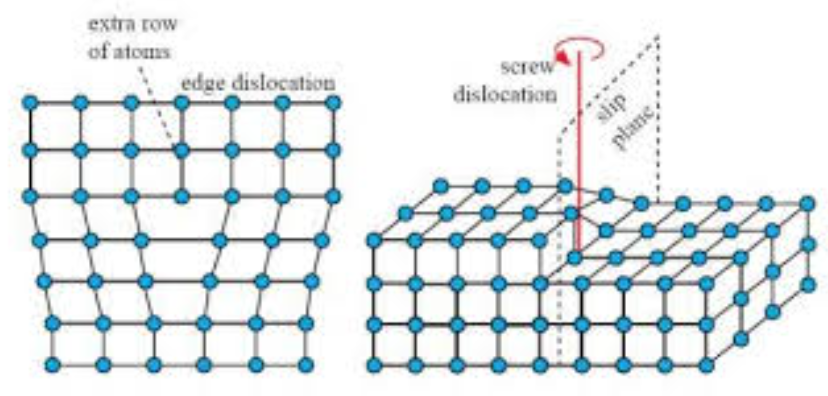
What is an edge dislocation?
A dislocation formed by an extra half-plane of atoms in the crystal.
What is a screw dislocation?
A dislocation where atomic planes form a spiral ramp around the dislocation line
What is the Burgers vector?
A vector that quantifies the severity and direction of a dislocation.
How is the Burgers vector determined?
By tracing a circuit around the dislocation; the vector needed to close the loop is the Burgers vector.
Why are dislocations important for plastic deformation?
They allow slip to occur progressively instead of all atoms slipping simultaneously.
Why are actual metal strengths much lower than theoretical strengths?
Because dislocations enable slip at much lower shear stresses.
What causes an edge dislocation to move?
Applied shear stress.
What happens when a dislocation reaches the edge of a crystal?
The lattice slips permanently by one atomic spacing.
What separates neighbouring grains in a polycrystal?
Grain boundaries.
Why do grain boundaries strengthen materials?
They obstruct slip and dislocation movement between grains.
What is the Hall–Petch equation?
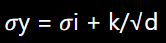
What does the Hall–Petch equation describe?
The increase in yield strength with decreasing grain size.
What happens to yield strength as grain size decreases?
Yield strength increases.
Why does smaller grain size strengthen a material?
More grain boundaries obstruct dislocation movement.
Why would a perfect crystal without dislocations be very strong?
Because slip would be extremely difficult as dislocations enable slip at much lower shear stress
Why can increasing dislocation density strengthen a material?
Dislocations interact and obstruct each other’s movement.
What is work hardening?
Strengthening caused by an increase in dislocation density during plastic deformation
List four ways to strengthen metals by obstructing dislocations.
Reduce grain size
increase dislocation density,
add small atoms to acts as barriers
add larger atoms to generate lattice strain and impede dislocations
What type of strain exists above an edge dislocation?
Compressive strain.
What type of strain exists below an edge dislocation?
Tensile strain.
What happens when opposite edge dislocations meet?
Their strains cancel and the lattice becomes undistorted.
How does deformation of a single crystal differ from a polycrystal?
Slip occurs more easily in single crystals because there are no grain boundaries blocking dislocations.