9.1 - Elasticity / plasticity & slip planes / systems
 Call Kai
 Learn
Learn Practice Test
 Spaced Repetition
 Match
Match Flashcards
 Knowt Play
1/11

There's no tags or description
Looks like no tags are added yet.
Name | Mastery | Learn | Test | Matching | Spaced | Call with Kai |
|---|
No analytics yet
Send a link to your students to track their progress
12 Terms
Give the definitions of plasticity & elasticity
PLASTICITY
→ ability of a material to undergo permanent deformation w/ rupture
→ irreversible / permanent deformation: once the applied stress is removed, it won’t return to its original shape, HOWEVER, if another stress is applied, it can still deform
→ macroscopic scale = plastic deformation
→ microscopic scale = movements of dislocations through the material when the applied stress exceeds the elastic limit → permanent change in the atomic arrangement
ELASTICITY
→ ability of a material to return to its original shape & size after the applied stress is removed
→ macroscopic scale = reversible, temporary deformation
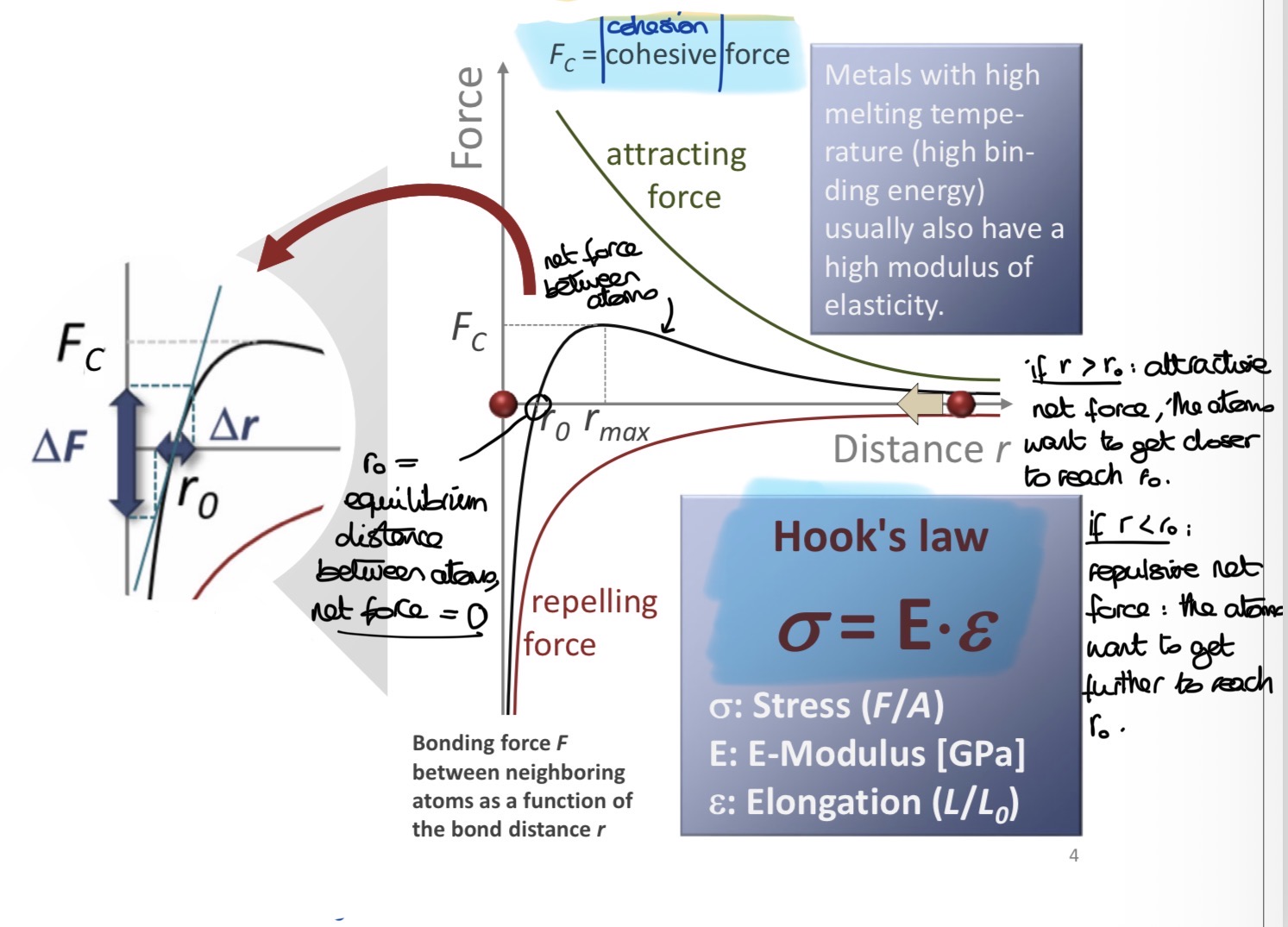
→ microscopic scale = slight displacement of atoms from their equilibrium position, but the bonds are not broken because the applied stress isn’t high enough to break them (<elastic limit). Atoms return to their original position once the stress is removed
What happens at an atomic scale during elastic deformation?
→ an external stress that doesn’t exceed the elastic limit is applied
→ atoms are slightly displaced, the distance between them slightly chsnges
→ bonds stretch / compress but don’t break
→ this configuration / change is retained as long as the external stress is applied
→ once the stress is removed, the attractive / repulsive net force due to the change in the distance between atoms pulls/pushes the atoms back to their equilibrium position
What’s the Hooke’s law? (Formula & when we apply it)
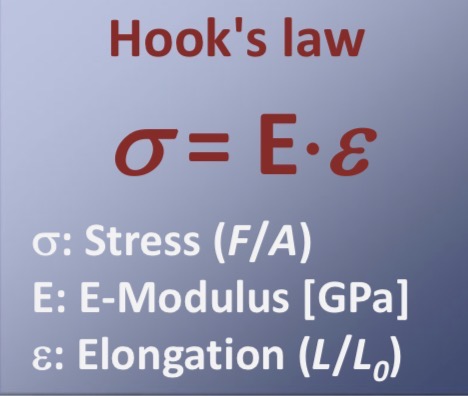
Sigma = stress
E = Young’s / elastic modulus (stiffness = rigidité)
Epsilon = strain (elongation)
→ only applies in the elastic region
What happens at an atomic scale during plastic deformation?
→ a stress that exceeds the elastic limit is applied
→ movements of atoms via movements of dislocations
→ atomic bonds break → permanent change in the atomic arrangement
What are plastic deformations constrained to?
Why?
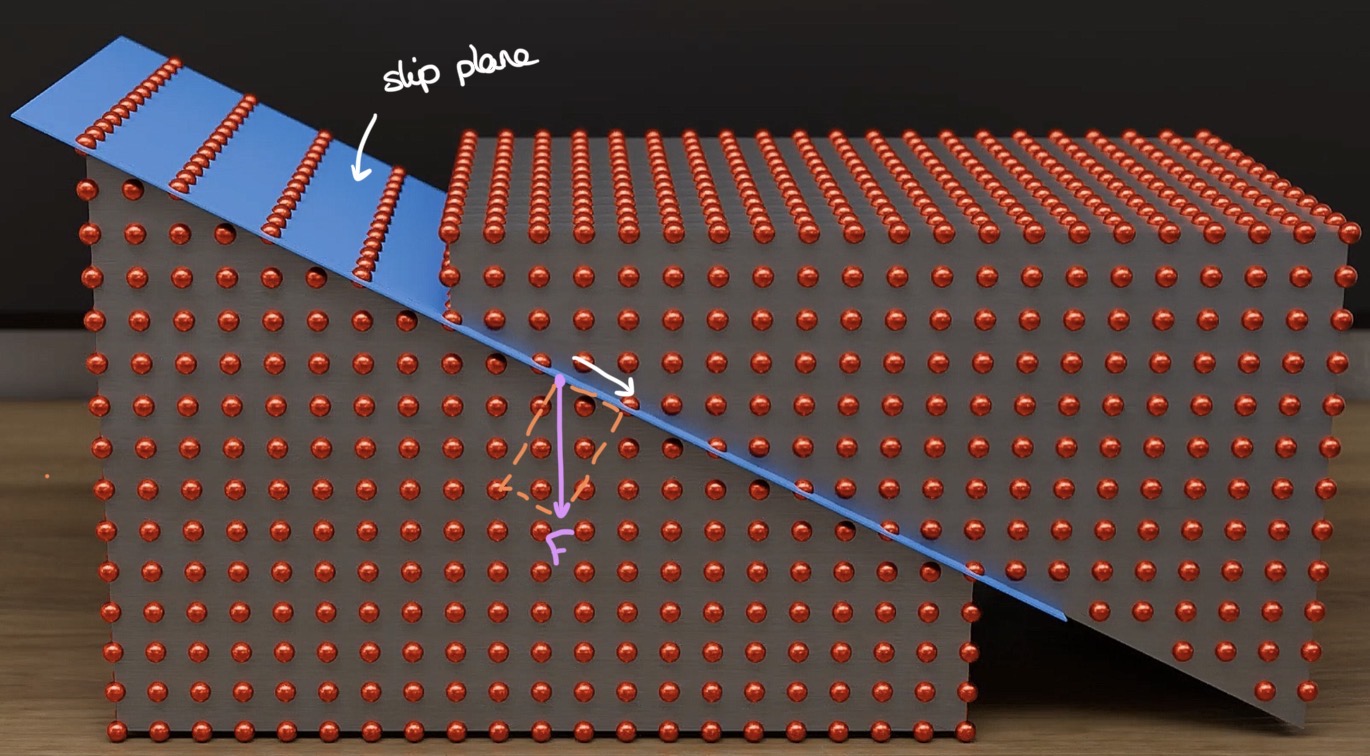
Can only take place in certain planes & directions → slip planes & slip directions
Because movement in these planes / directions requires smallest critical shear stress (min. shear stress required to initiate the movement of dislocations)
Give the definition of slip planes & slip systems
slip planes = planes (atomic layers) with densest packing (closed packed) & large plane spacing
slip systems = combination of slip planes & slip directions → describe deformation of metals
How many slip systems are there in FCC crystal structures?
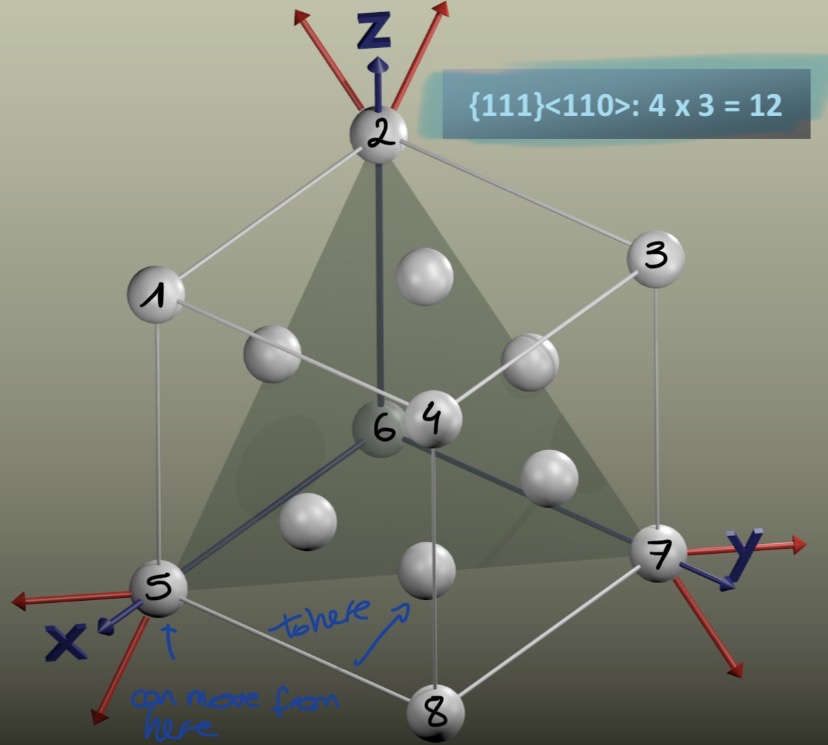
Draw a slip plane in a FCC unit cell
What deformability is thus obtained?
4 slip planes (parallel slip planes are put together and counted as 1) {111}
→ 2,5,7 // 1,3,8
→ 4,5,7 // 1,3,6
→ 6,8,1 // 2,4,7
→ 6,8,3 // 2,4,5
3 slip directions <110>
12 independent slip systems (4×3)
→ good plastic deformability
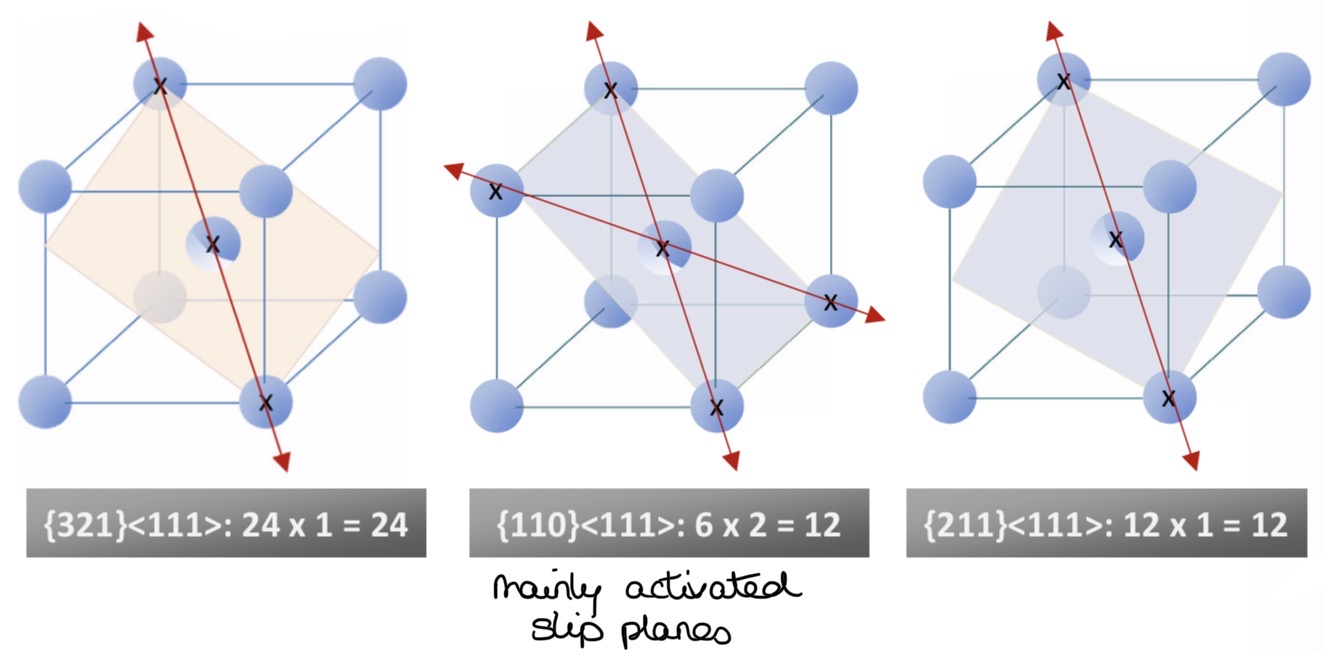
How many slip systems are there in BCC crystal structures?
Draw the different possible slip planes in a BCC unit cell
What deformability is thus obtained?
48 slip systems → only 12 are mainly activated (the others are activated when significant higher stresses are applied)
less dense packed slip systems than FCC
moderate deformability
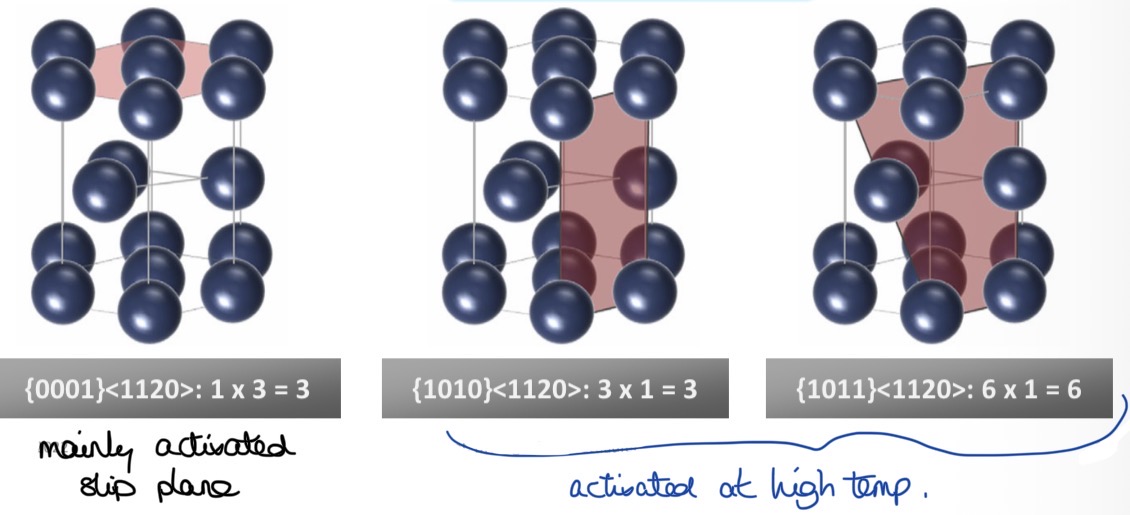
How many slip systems are there in HCP crystal structures?
Draw the different possible slip planes in a HCP unit cell
What deformability is thus obtained?
12 slip systems → only 1 mainly activated (the others are activated at higher temperatures)
low plastic deformability
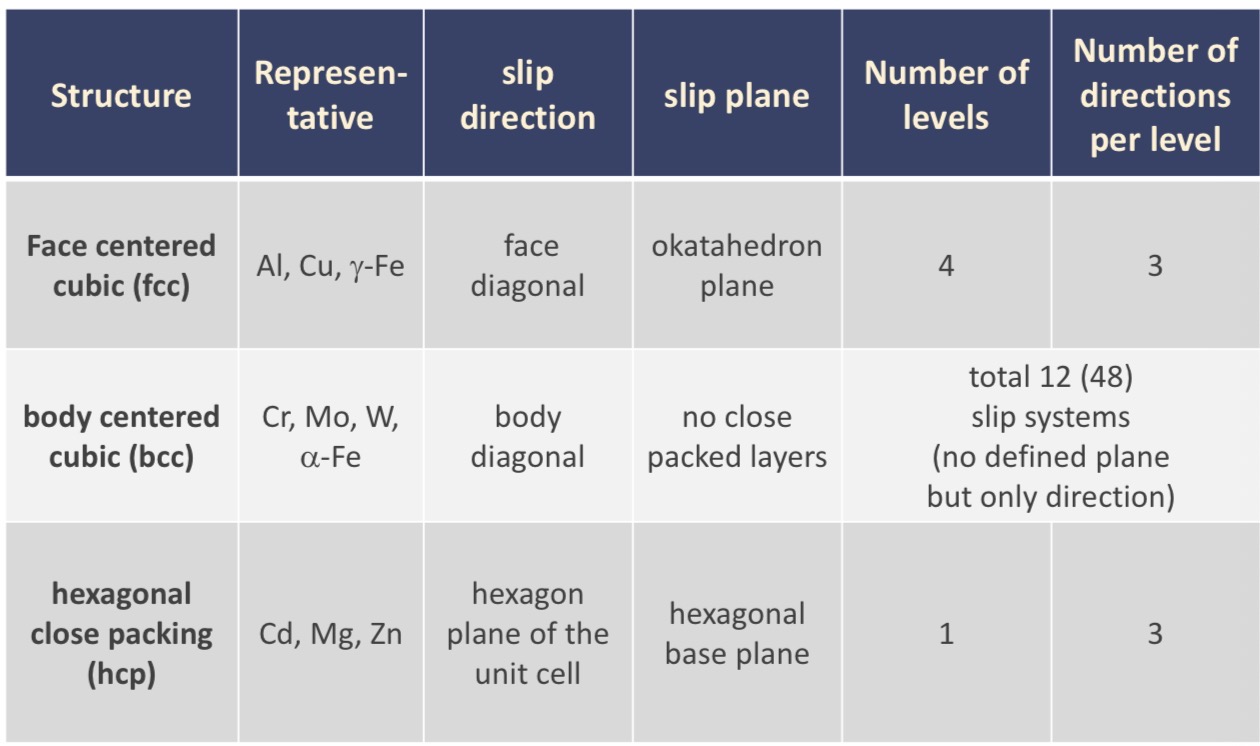
Classify the FCC, BCC, and HCP structures according to their deformability
FCC: very good deformability
BCC: moderate deformability
HCP: low deformability
What’s the definition of a good deformability?
Good deformability = ability of a material to deform its lattice structure w/ damage <=> as many usable slip systems as possible
What kind of forces can cause an atomic plane to slide?
→ shear forces (acting // to slip planes)
(Normal forces which act perpendicular to slip planes will only cause elongation / compression of the crystal lattice in their direction but no lateral displacement)
→ if a force is applied at an angle to a slip plane, the displacement onto the slip plane will only be driven by the component of the force that is // to it)