blg 101
 Call Kai
 Learn
Learn Practice Test
 Spaced Repetition
 Match
Match Flashcards
 Knowt Play
1/202

There's no tags or description
Looks like no tags are added yet.
Name | Mastery | Learn | Test | Matching | Spaced | Call with Kai | Chat |
|---|
No analytics yet
Send a link to your students to track their progress
203 Terms
Anatomy
is the study of:
The structure of the body
The parts of the body
Where body parts are located
How body structures relate to one another
examples
Where is the heart located?
What does the heart look like?
What bones make up the arm?
What tissues make up the stomach?
physiology
is the study of:
How body parts work
How organs perform their functions
How the body carries out life-sustaining activities
Examples:
How does the heart pump blood?
How do muscles contract?
How do kidneys produce urine?
How does the nervous system transmit signals?
why are anatomy and physiology inseparable
bc structure determines function
Example: Teeth 🦷
Incisors
Sharp edges
Designed for cutting food
Molars
Flat surfaces
Designed for grinding food
Gross anatomy (macroscopic)
It studies structures that can be seen with the naked eye.
Examples:
Heart
Lungs
Kidneys
Bones
Muscles
approaches to gross anatomy (3)
regional anatomy - studies everything in one specific region at the same time.
Example:
Studying the abdomen would include:
Muscles
Blood vessels
Nerves
Organs
Bones
systemic anatomy
studies the body one organ system at a time.
Example:
Studying the cardiovascular system means studying:
Heart
Blood vessels
Their locations throughout the body
surface anatomy
studies internal structures in relation to the body's surface.
For example, nurses use knowledge of surface anatomy to locate:
Blood vessels
Pulses
Muscles
Other structures beneath the skin
microscopic anatomy
Studies structures that are too small to see with the naked eye.
Usually requires a microscope.
2 subdivisions
subdivisions of microscopic anatomy (2)
Cytology
Study of cells
Histology
Study of tissues
developmental anatomy
Studies how body structures change throughout life.
Embryology
A subdivision of developmental anatomy.
Studies structural changes that occur before birth.
Pathological anatomy
Studies structural changes caused by disease.
Example:
Changes in lung tissue caused by disease
Radiographic anatomy
Studies internal structures using:
X-rays
CT scans
Other imaging techniques
cardiovascular physiology
Studies:
Heart function
Blood vessel function
Blood circulation
Renal physiology
Studies:
Kidney function
Urine production
Neurophysiology
Studies:
Nervous system function
Muscle physiology
Studies:
Muscle contraction
Muscle function
principle of complementarity
structure determines function
Examples
Bones
Hard mineralized structure
→ Can support and protect organs
Heart valves
Open in one direction
→ Allow blood to flow one way and prevent backflow
Incisors
Sharp
→ Cut food
Molars
Flat
→ Grind food
what is the order of structural organization
Chemical → Cellular → Tissue → Organ → Organ System → Organismal
chemical level:
Atoms
Molecules
Atoms combine to form molecules.
Examples:
Oxygen
Carbon
Water
Proteins
cell level
cells are made from molecules and are the smallest living units.
Examples:
Muscle cell
Nerve cell
Red blood cell
tissue level
A tissue is a group of similar cells working together to perform a common function.
epithelial - Covers body surfaces, Lines body cavities, Forms protective barrier
skin surface, lining of organs
muscle - produces movements, muscles contract
connective - provides support, protection, connection
bone
blood
cartiliage
fat
nervous - allows rapid communication, uses eletrical impulses to transmit info
organ level
An organ is a structure made of at least two different tissue types that performs a specific function.
heart, stomach, brain
Example: Stomach
The stomach contains multiple tissues:
Epithelial tissue
→ produces digestive juices
Muscle tissue
→ churns food
Connective tissue
→ strengthens the stomach wall
Nervous tissue
→ helps regulate activity
organ system level
multiple organs work together to accomplish a common purpose.
Example:
Cardiovascular system
Heart + blood vessels
Together:
→ circulate blood
organismal level
The entire human being.
All organ systems work together to keep the person alive.
organ systems (11)
Integumentary System
skeletal
muscular
nervous
endocrine
cardio
lymphatic/immune
respiratory
digestive
urinary
reproductive
integumentary System
Main structures:
Skin
Hair
Nails
Sweat glands
Oil glands
Functions:
Protects body
Prevents injury
Prevents excessive water loss
Helps regulate temperature
Produces vitamin D
Contains sensory receptors
skeletal system
Structures:
Bones
Joints
Functions:
Supports body
Protects organs
Provides framework for movement
Stores minerals
Produces blood cells in bone marrow
muscular system
Structures:
Skeletal muscles
Functions:
Movement
Locomotion
Facial expressions
Maintains posture
Produces heat
nervous system
Structures:
Brain
Spinal cord
Nerves
Function:
fast control and communication
It responds to:
Internal changes
External changes
And activates:
Muscles
Glands
endocrine system
Structures include:
Pituitary gland
Thyroid gland
Adrenal glands
Pancreas
Ovaries
Testes
Function:
Produces hormones.
Hormones regulate:
Growth
Reproduction
Metabolism
Other body processes
cardio system
structures:
Heart
Blood vessels
Blood
Functions:
Transports oxygen
Transports nutrients
Transports hormones
Carries carbon dioxide
Carries wastes
Circulates blood
lymphatic/immune system
Structures:
Lymphatic vessels
Lymph nodes
Spleen
Thymus
Lymphocytes
Functions:
Returns leaked fluid to blood
Helps remove debris
Provides immune defense
Houses immune cells
respiratory system
structures:
Nose/nasal cavity
Pharynx
Larynx
Trachea
Bronchi
Lungs
Functions:
brings o2 in and removes co2
digestive system
Structures:
Mouth
Esophagus
Stomach
Small intestine
Large intestine
Rectum
Anus
Liver
Pancreas
Functions:
Breaks down food
Absorbs nutrients
Eliminates indigestible material as feces
urinary system
Structures:
Kidneys
Ureters
Urinary bladder
Urethra
Functions:
Removes nitrogenous wastes
Produces urine
Regulates water
Regulates electrolytes
Helps regulate acid-base balance
reproductive system
Male
Testes
Ductus deferens
Penis
Prostate
Scrotum
Functions:
Produces sperm
Produces male sex hormones
Helps deliver sperm
Female
Ovaries
Uterine tubes
Uterus
Vagina
Mammary glands
Functions:
Produces eggs
Produces female sex hormones
Provides site for fertilization
Supports fetal development
Produces milk
requirements for life (8)
body must perform certain necessary life functions to stay alive.
Maintaining boundaries
Movement
Responsiveness
Digestion
Metabolism
Excretion
Reproduction
Growth
maintaining boundaries
The body must separate its internal environment from the outside world.
At the cellular level:
The plasma membrane separates:
Intracellular fluid
from
Extracellular fluid
movement
includes:
Whole-body movement
Running
Swimming
Walking
Moving substances internally
Blood
Food
Urine
Cellular movement
Muscle cells shorten. - Contractility
responsiveness
ability to detect a change and respond to it
The change is called a:
Stimulus
Example:
You touch something painful.
→ Receptors detect pain
→ Nervous system responds
→ Hand pulls away
This is a withdrawal reflex.
digestion
breaks food down into smaller molecules that can be absorbed
The digestive system breaks down food.
Then nutrients enter the blood.
The cardiovascular system distributes them to cells.
Metabolism
= all chemical reactions occurring inside body cells.
Catabolism
Breaks larger substances into smaller ones.
anabolism
Builds larger/complex substances from smaller ones.
cellular respiration
Cells use nutrients + oxygen to produce: ATP
ATP
is an energy-rich molecule used to power cellular activities.
excretion
= removal of waste from the body.
Examples:
Urinary system
Removes:
Urea
Nitrogenous wastes
Respiratory system
Removes:
Carbon dioxide
Digestive system
Removes:
Indigestible food as feces
reproduction
Cellular reproduction
A cell divides:
1 cell → 2 daughter cells
Important for:
Growth
Repair
Organismal reproduction
Produces a new human.
Sperm + egg → fertilized egg → developing baby
growth
increase in size.
Usually happens because: number of cells increase
But individual cells can also become larger.
survival needs (5)
1. Nutrients - chemicals for energy and cell building (macro)
2. Oxygen - essential for the release of energy from food
3. Water - Most abundant molecule in body; provides the watery environment needed for chemical reactions
4. Normal body temperature - If body temp falls below or goes above 37°C, rates of chemical reactions are affected
5. Appropriate atmospheric pressure - Specific air pressure is needed for adequate breathing and gas exchange in lungs
homeostasis
maintenance of relatively stable internal conditions despite changes in the external environment.
dynamic equilibrium - The body constantly adjusts conditions within a relatively narrow range.
law of mass balance
for a substance to remain relatively constant: amount entering = amount leaving
why is homeostasis important
our cells require a relatively stable environment.
The body must regulate things such as:
Temperature
Blood pressure
Blood glucose
Oxygen
Carbon dioxide
Water
Electrolytes
Nutrients
If these become severely abnormal:
→ cells stop functioning properly
→ disease can occur
→ potentially death
receptor
Detects a change.
eg. Temperature receptors detect that your body is getting too hot.
control center
Receives the information.
It:
Compares the current value to the set point
Determines what should happen
Set point: The desired level/range for a variable.
Example:
Body temperature has a normal target range.
effector
Carries out the response.
Examples:
Sweat glands
Muscles
Glands
Organs
afferent
carries information toward the control center
efferent
carries info away from the control center
negative feedback
reverses/reduces the original change
It moves the variable back toward its set point.
Pattern:
Stimulus → response → response reduces stimulus
Example: Body Temperature TOO HOT
Body temperature rises.
↓
Temperature receptors detect change.
↓
Information goes to brain.
↓
Brain activates sweat glands.
↓
Sweating occurs.
↓
Sweat evaporates.
↓
Body temperature decreases.
↓
Temperature returns toward normal.
positive feedback
amplifies the original stimulus
The response causes more of the same response.
Example: Childbirth 👶
Baby presses against cervix.
↓
Signals cause oxytocin release.
↓
Oxytocin increases uterine contractions.
↓
Stronger contractions increase stimulation.
↓
More oxytocin released.
↓
Even stronger contractions.
↓
Baby is born.
↓
Stimulus ends.
what does feedforward mean
The body responds before the change actually happens.
Anatomical Position
The standard reference position.
The person is:
Standing upright
Facing forward
Feet slightly apart
Arms at sides
Palms facing forward
Thumbs pointing away from body
superior (cranial)
toward the head.
Also means:
above
Example:
Head is superior to abdomen.

inferior (caudal)
Away from the head.
Also means:
below
Example:
Navel is inferior to chin.

anterior (ventral)
toward the front.
Example:
Breastbone is anterior to spine
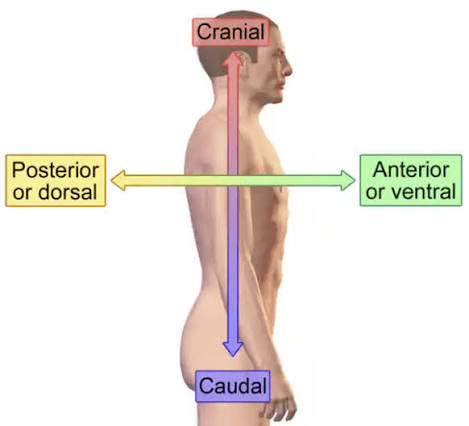
posterior (dorsal)
Toward the back.
Example:
Heart is posterior to breastbone.

medial
Toward the midline.
Example:
Heart is medial to arm.

lateral
Away from the midline.
Example:
Arms are lateral to chest.

intermediate
Between a more medial and a more lateral structure.
Example:
The collarbone is intermediate between the breastbone and shoulder.
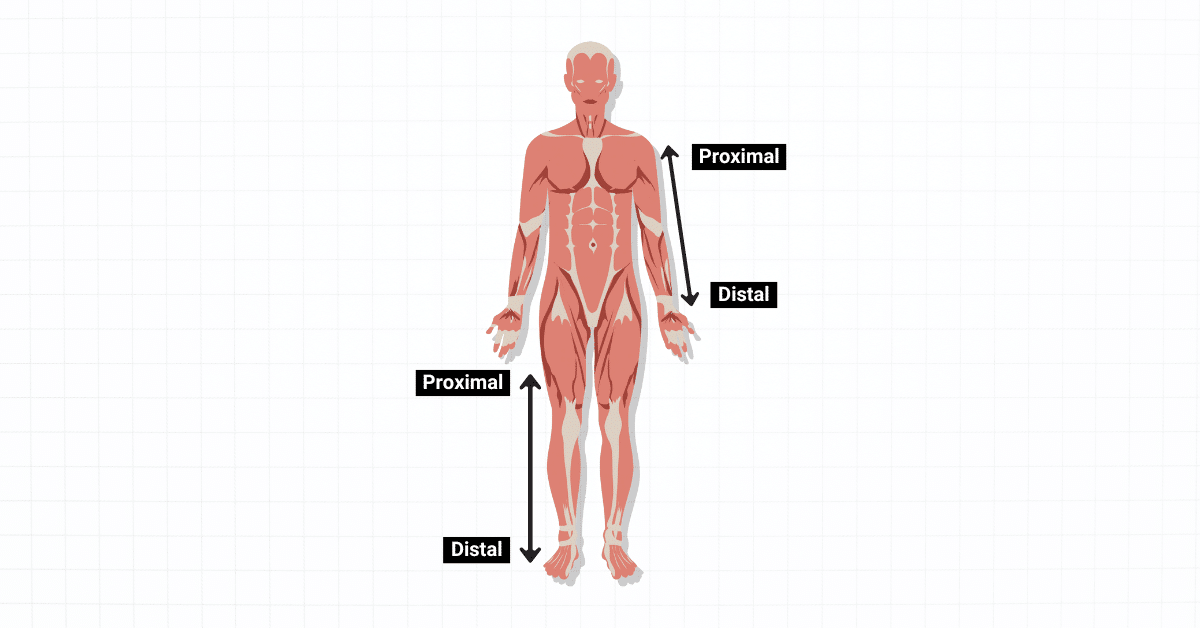
proximal
Closer to:
The point of attachment of a limb
The origin of a structure
Example:
Elbow is proximal to wrist.

distal
Farther from the point of attachment/origin.
Example:
Wrist is distal to elbow.
deep (internal)
farther from the body surface.
Example:
Muscles are deep to the skin.

superficial (external)
Superficial
Closer to the body's surface.
Example:
Skin is superficial to skeletal muscle.
what is a body planes and section
A plane is an imaginary flat surface along which the body can be sectioned.
A section is the actual cut made along a plane.
sagittal plane
Divides body into:
RIGHT + LEFT

Median/Midsagittal Plane
Divides body into:
Equal right and left portions
It passes exactly through the midline

Parasagittal Plane
Also divides: Right + left
But not equally.
It is off the midline.

Frontal / Coronal Plane
Divides body into:
ANTERIOR + POSTERIOR

Transverse Plane
Divides body into:
SUPERIOR + INFERIOR

Oblique Plane
Cuts the body:
Diagonally
Between vertical and horizontal planes.
body cavity
Body cavities protect internal organs.
dorsal body cavity
Contains the: Brain + spinal cord
It has two subdivisions:
Cranial cavity
Contains: Brain
Vertebral/spinal cavity
Contains: Spinal cord
These two cavities are continuous.
The brain and spinal cord are covered by: Meninges

ventral body cavity
The larger, more anterior cavity.
Contains many internal organs called: Viscera
It has two major subdivisions:
Thoracic cavity
Abdominopelvic cavity

thoracic cavity
Located in the chest.
Contains:
Lungs
Heart
Other thoracic organs
It has:
Pleural cavities - One around each lung.
Mediastinum - Central area between the lungs. Contains many thoracic organs.
Within the mediastinum is the: Pericardial cavity which surrounds the heart.

Diaphragm
A dome-shaped muscle separating:
Thoracic cavity from Abdominopelvic cavity
It is very important for: Breathing
Abdominopelvic Cavity
Has two portions:
Abdominal cavity
Contains:
Stomach
Liver
Spleen
Intestines
Other digestive organs
Pelvic cavity
Contains:
Urinary bladder
Some reproductive organs
Rectum

Serous membranes
These are thin, double-layered membranes.
They produce: Serous fluid - which reduces friction.
Parietal serosa
Lines the: Cavity wall
Visceral serosa
Covers the: Organ
Abdominopelvic Quadrants
RUQ, LUQ, RLQ, LLQ

RUQ
Liver
Gallbladder
Part of large intestine
Small intestine
LUQ
Stomach
Spleen
Liver (part)
Intestine
RLQ
Cecum
Appendix
Small intestine
LLQ
descending colon, sigmoid colon, left ureter, left ovary
what are elements
substances that cannot be broken down into simpler substances by
ordinary chemical methods
what 4 elements make up 96% of our body
carbon, o2, hydrogen, nitrogen
o2
component of organic and inorganic molecules
required as a gas for ATP production
carbon
fundamental component of all organic molecules including carbs, lipids, proteins, and nucleic acids
hydrogen
a constituent element in all organic molecules
nitrogen
a component of nucleic acids
calcium
found in bones and teeth
vital for muscle contraction, nerve impulse conduction and blood clotting