AP Biology Unit 2 : Ecology and Animal Behavior
5.0(1)
 Studied by 46 people
5.0(1)
 Call Kai
 Learn
Learn Practice Test
 Spaced Repetition
 Match
Match Flashcards
 Knowt Play
Card Sorting
1/113

Earn XP
Description and Tags
Study Analytics
Name | Mastery | Learn | Test | Matching | Spaced |
|---|
No study sessions yet.
114 Terms
1
New cards
Behavior
1) What an animal does and how it does it
2) Subject to natural selection
2) Subject to natural selection
2
New cards
What is behavior affected by?
Genetic and Environmental Factors
3
New cards
Ethology
The study of behavior
4
New cards
Proximate Cause
"How" a behavior occurs or is modified
5
New cards
Ultimate Cause
"Why" a behavior in context of natural selection
6
New cards
Innate Behavior
1) Developmentally Fixed (instinctual)
2) Automatic (Built in)
3) All Individuals do them
2) Automatic (Built in)
3) All Individuals do them
7
New cards
Learned Behaviors
1) Behaviors modified based on experiences
2) Flexible with environment
3) Complex
2) Flexible with environment
3) Complex
8
New cards
Types of Innate Behaviors
1) Fixed Action Patterns
2) Movement
3) Communication
2) Movement
3) Communication
9
New cards
Fixed Action Patterns
1) Sequence of unlearned acts that are unchangeable and usually carried to completion
2) Triggered by sign stimulus
2) Triggered by sign stimulus
10
New cards
Movement Types
1) Kinesis
2) Taxis
3) Communication
2) Taxis
3) Communication
11
New cards
Kinesis
Random movement in response to a stimulus
12
New cards
Taxis
Oriented movement toward or away from a stimulus
13
New cards
Types of Taxis
1) Phototaxis (light)
2) Geotaxis (earth)
3) Rheotaxis (current)
4) Chemotaxis (chemicals)
2) Geotaxis (earth)
3) Rheotaxis (current)
4) Chemotaxis (chemicals)
14
New cards
Migration
Regular, long-distance change in location
15
New cards
How Animals know where to migrate
Environmental Cues
16
New cards
Types of Communication
1) Auditory (sound)
2) Visual (sight)
3) Tactile (touch)
4) Pheromones (chemicals, smell)
5) Dancing
2) Visual (sight)
3) Tactile (touch)
4) Pheromones (chemicals, smell)
5) Dancing
17
New cards
Types of Learned Behaviors
1) Imprinting
2) Associative Learning
3) Social Learning
2) Associative Learning
3) Social Learning
18
New cards
Imprinting
1) Long-lasting behavioral response to an individual/object
2) Both learned and innate components
3) Formed during sensitive period in life
4) Results in newborn animals bonding with their parent(s).
2) Both learned and innate components
3) Formed during sensitive period in life
4) Results in newborn animals bonding with their parent(s).
19
New cards
Associative Learning
1) Associate one stimulus w/ another
2) Classical and operant conditioning
2) Classical and operant conditioning
20
New cards
Classical conditioning
Arbitrary stimulus associated with a particular outcome
21
New cards
Operant conditioning
Associates own behavior with a reward or punishment
22
New cards
Social Learning
Learning by observing others
23
New cards
Foraging Behavior
1) Food obtaining behavior
2) Includes searching for, recognizing, and capturing food items
2) Includes searching for, recognizing, and capturing food items
24
New cards
Optimal Foraging Model
1) A "cost benefit" analysis
2) Natural selection should favor a foraging strategy that maximizes benefits and minimizes costs
2a) Costs of foraging (risk of predation/injury, energy spent)
2b) Benefits of foraging (food for energy, survival)
2) Natural selection should favor a foraging strategy that maximizes benefits and minimizes costs
2a) Costs of foraging (risk of predation/injury, energy spent)
2b) Benefits of foraging (food for energy, survival)
25
New cards
Mating Systems
1) Monogamy
2) Polygamy
2) Polygamy
26
New cards
Monogamy
Male-Female pair
27
New cards
Polygamy
1) Individual of one sex mating with several of the other
2) Polygyny
3) Polyandry
2) Polygyny
3) Polyandry
28
New cards
Polygyny
One males; many females
29
New cards
Polyandry
One female; many males
30
New cards
Factors that influence Mating Systems
1) If offspring need large, continuous food supply
2) If both partners can contribute
3) Certainty of paternity
4) Maximizing reproductive success
2) If both partners can contribute
3) Certainty of paternity
4) Maximizing reproductive success
31
New cards
Parental Care
Young born to or eggs laid by female definitely share 50% of her genes
32
New cards
Internal fertilization
1) Mating and egg laying/birth separated by time
2) Paternity unknown
2) Paternity unknown
33
New cards
External fertilization
1) Mating and egg laying occurs at the same time
2) Paternity more clear
3) More male parental care
2) Paternity more clear
3) More male parental care
34
New cards
Selfishness and Fitness
1) Natural selection favors an individuals survival and reproduction
2) Behavior is often selfish (ie blood parasitism)
2) Behavior is often selfish (ie blood parasitism)
35
New cards
Altruism
A behavior that reduces an individuals fitness but increases the fitness of other individuals in the population
36
New cards
Inclusive fitness (altruism)
Genes passed on by producing own offspring AND helping close relatives to produce offspring
37
New cards
Kin Selection
Enhancing reproductive success of relatives
38
New cards
Hamilton's Rule of Altruism
Altruism will be selected for if r*B > C
r = coefficient of relatedness (% of shared genes)
B = benefit to relative
C = Cost to helper
"I would lay down my life for 2 of my siblings or eight of my cousins"
r = coefficient of relatedness (% of shared genes)
B = benefit to relative
C = Cost to helper
"I would lay down my life for 2 of my siblings or eight of my cousins"
39
New cards
Reciprocal Altruism
Altruism/cooperation between unrelated individuals
"I help you now, you help me later"
"I help you now, you help me later"
40
New cards
Biological Organization
Organized by Small to Big or Big to Small
41
New cards
BECPO
biosphere, ecosystem, community, population, organism
42
New cards
Biosphere
The part of the earth that contains all ecosystems
43
New cards
Ecosystem
A biological community of interacting organisms and their abiotic (non-living) factors with which they interact.
44
New cards
Community
populations that live together in a defined area
45
New cards
Population
a group of organisms of the same species that live in the same area
46
New cards
Organism
Individual living thing
47
New cards
Abiotic Components of an Environment
Non-living things (water, gasses, minerals, temp, etc)
48
New cards
Biotic Components of an Environment
Living things (plants, animals, bacteria, fungi, dead things, etc)
49
New cards
Ecology
Study of ecosystems
50
New cards
Biome
1) A major ecosystem type
2) Classified by predominant vegetation or physical environment
2) Classified by predominant vegetation or physical environment
51
New cards
Ecosystem vs. Biome
Biome is a general term; Ecosystem is specific
(Desert vs. Mojave Desert)
(Desert vs. Mojave Desert)
52
New cards
Habitats and Niches
Habitat - Where an organism lives
Niche - The role a species plays; its job (includes its habitat, activity patterns, resources it uses)
Niche - The role a species plays; its job (includes its habitat, activity patterns, resources it uses)
53
New cards
Trophic Levels
1) Autotroph
2) Heterotroph
2) Heterotroph
54
New cards
Autotroph
Self-feeder/Primary Producer - Energy from sun/light
55
New cards
Heterotroph
Other-feeder/Consumers (eat other auto/heterotrophs)
56
New cards
Heterotroph Types
1) Primary consumers (herbivores)
2) Secondary consumers (carnivores) - eat herbivores
3) Tertiary Consumers (carnivores)
4) Decomposers (eat dead stuff)/Heterotrophs
2) Secondary consumers (carnivores) - eat herbivores
3) Tertiary Consumers (carnivores)
4) Decomposers (eat dead stuff)/Heterotrophs
57
New cards
Food Chain vs. Food web
Food Chain: Pathway along which food energy is transferred between trophic levels
Food Web: Interconnected feeding relationships of various organisms in an ecosystem
Both: Arrows pt. towards direction biomass is moving
Food Web: Interconnected feeding relationships of various organisms in an ecosystem
Both: Arrows pt. towards direction biomass is moving
58
New cards
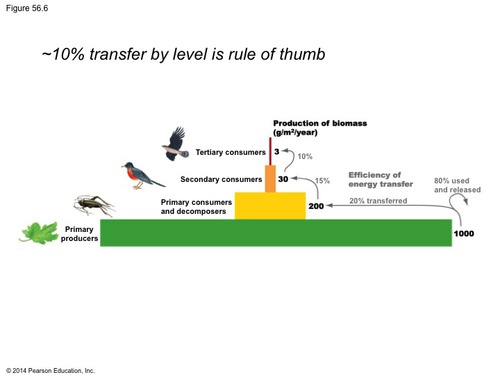
Trophic Pyramid Energy Transfer
Only 10% of biomass & energy transfers up each trophic level
59
New cards
Measure of efficiency of animals as energy transforms
Production Efficiency =
(net secondary production * 100%) /
(Assimilation of primary production)
(net secondary production * 100%) /
(Assimilation of primary production)
60
New cards
Factors that Influence Population Growth
1) Birth Rate
2) Death Rate
3) Immigration
4) Emigration
2) Death Rate
3) Immigration
4) Emigration
61
New cards
What would zero population growth look like?
Birth Rate = Death Rate
62
New cards
Experimental Population Growth Ideal Conditions
1) Few/No predators
2) Lots of Food/shelter
3) Population grows rapidly
2) Lots of Food/shelter
3) Population grows rapidly
63
New cards
Experimental Population Growth Equation
dN/dt = rmax(N)
dN/dt : Population size during time interval
rmax : Maximum per capita growth rate of population (birth rate - death rate)
N : population size
dN/dt : Population size during time interval
rmax : Maximum per capita growth rate of population (birth rate - death rate)
N : population size
64
New cards
Logistical Population Growth
Population growth that levels off as population size approaches carrying capacity
K : Carrying Capacity - max stable population which can be sustained by environment
K : Carrying Capacity - max stable population which can be sustained by environment
65
New cards
Logistical Population Growth Equation
dN/dt = rmax(N) * ((K-N)/K)
66
New cards
Factors Influencing Carrying Capacity
Abiotic Factors
1) Rainfall, Temperature, Sunlight, Currents
Biotic Factors
1) Food sources, predators, diseases, competition
1) Rainfall, Temperature, Sunlight, Currents
Biotic Factors
1) Food sources, predators, diseases, competition
67
New cards
What happens if a population size goes over K?
The Population size will return to K
68
New cards
Human Carrying Capacity
Varies; depends on standard of living
69
New cards
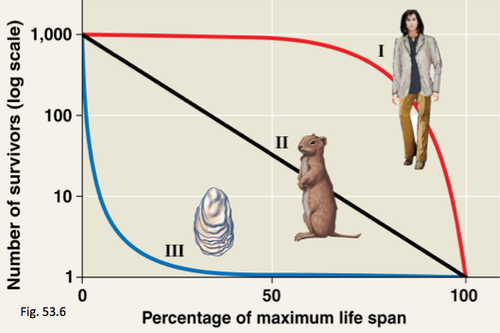
Survivorship Curve
Shows the proportion of individuals likely to survive to each age
70
New cards
Type 1 survivorship curve
Low death rate; many individuals live to old ages
71
New cards
Type 2 survivorship curve
Moderate death rate; individuals die at all ages
72
New cards
Type 3 survivorship curve
High death rate; many individuals die young and few live to old age
73
New cards
Life History
Things that affect an organism's schedule of reproduction and survival
74
New cards
Life History Traits
1) Age of sexual maturation
2) How often an organisms reproduces
3) Number of offspring each time
*Remember these traits are evolutionary outcomes, not conscious decisions
2) How often an organisms reproduces
3) Number of offspring each time
*Remember these traits are evolutionary outcomes, not conscious decisions
75
New cards
r/K Selection theory
1) Reproduction is a trade off between "quality" and quantity of offspring
2) Not enough energy for tons of offspring, multiple times, provide lot of care to all babies for super high fitness
2) Not enough energy for tons of offspring, multiple times, provide lot of care to all babies for super high fitness
76
New cards
Evolutionary Strategies
1) r-selection
2) k-selection
2) k-selection
77
New cards
r-selection
Have MANY babies, provide little/no care
78
New cards
K-selection
Have FEW babies, provide care to help with survival
79
New cards
Semelparity (Semelparous)
"Big bang reproduction"
-Many offspring produced at once
-Individual often dies afterward
-Less stable environments
-Many offspring produced at once
-Individual often dies afterward
-Less stable environments
80
New cards
Iteroparity (Iteroparous)
Repeated reproductive events
-Few offspring multiple times during life
-Usually larger
-More stable environments
-Few offspring multiple times during life
-Usually larger
-More stable environments
81
New cards
Density Independent Factors
Population size DOESN'T matter
- Natural disasters, fire, flood, drought
- Natural disasters, fire, flood, drought
82
New cards
Density Dependent Factors
Population size DOES matter
- Competition, territoriality, parasitism, disease, predation, waste build up, stress
- Competition, territoriality, parasitism, disease, predation, waste build up, stress
83
New cards
competitive exclusion principle
1) Two species cannot coexist in a community in identical niches
2) one will eventually "win"
2) one will eventually "win"
84
New cards
Resource Partitioning (niche competition)
differences in niches that enable similar species to coexist
85
New cards
Fundamental Niche
The niche potentially occupied by the species
86
New cards
Realized niche
Portion of fundamental niche actually occupied by the species
87
New cards
Predation defenses
1) Camouflage/Cryptic coloration
2) Aposematic/warning coloration (poison)
3) Toxins/thorns/spikes
2) Aposematic/warning coloration (poison)
3) Toxins/thorns/spikes
88
New cards
Batesian mimicry
A harmless species mimics color of harmful species
89
New cards
Mullerian mimicry
Bad tasting species resemble each other; both to be avoided
90
New cards
Dominant species
Species with the highest biomass or most abundant species in the community
91
New cards
Keystone species
1) Species that play a critical role in their community
2) impact is greater than expected based on their abundance
2) impact is greater than expected based on their abundance
92
New cards
Community Regulation
Top Down: Top predator in the trophic pyramid controls biomass
Bottom Up: The autotrophs control the biomass of the trophic levels above it
Bottom Up: The autotrophs control the biomass of the trophic levels above it
93
New cards
Trophic Cascade (Top Down)
1) Predators suppress the abundance or alter the behavior of prey
2) Releases the next lower trophic level from predation
2) Releases the next lower trophic level from predation
94
New cards
Primary succession
Species invade where soil has not yet formed
95
New cards
Secondary succession
1) Disturbances: Fire, flood, storm, human activity
2) Soil still intact
2) Soil still intact
96
New cards
Succession sequence
1) Pioneer species - 1st to colonize
2) Climax community - no longer changing
2) Climax community - no longer changing
97
New cards
Biogeochemical (nutrient) Cycles
1) Life depends on recycling chemical elements
2) Nutrient cycles in ecosystems involve biotic and abiotic compounds
2) Nutrient cycles in ecosystems involve biotic and abiotic compounds
98
New cards
Four nutrient cycles
1) Water
2) Carbon
3) Nitrogen
4) Phosphorous
2) Carbon
3) Nitrogen
4) Phosphorous
99
New cards
Water (hydrologic) cycle
1) Essential to all organisms
2) Nearly all chemical reactions in our body occur in water found in/around cells
3) Water carries nutrients, gas, and waste
4) Influences rate of primary production/decomposition in terrestrial ecosystems
5) Liquid water is the primary physical phase in which water is used
2) Nearly all chemical reactions in our body occur in water found in/around cells
3) Water carries nutrients, gas, and waste
4) Influences rate of primary production/decomposition in terrestrial ecosystems
5) Liquid water is the primary physical phase in which water is used
100
New cards
Water Cycle Key Processes
1) Evaporation by solar energy
2) Condensation of water vapor into clouds
3) Precipitation (rain, snow, fog, hail)
4) Transpiration (water loss from plants)
4) Surface/ground water flow to ocean
2) Condensation of water vapor into clouds
3) Precipitation (rain, snow, fog, hail)
4) Transpiration (water loss from plants)
4) Surface/ground water flow to ocean