Class 6 - The Immittance Battery
 Call Kai
 Learn
Learn Practice Test
 Spaced Repetition
 Match
Match Flashcards
 Knowt Play
1/99

There's no tags or description
Looks like no tags are added yet.
Name | Mastery | Learn | Test | Matching | Spaced | Call with Kai | Chat |
|---|
No analytics yet
Send a link to your students to track their progress
100 Terms
What is the immittance battery?
a few kinds of different tests on 1 machine (ex: tympanogram)
Who is the man responsible for acoustic immittance?
Otto Metz
Who was Otto Metz? What did he want to do?
- Jewish German doctor
- wanted to distinguish sensorineural from conductive loss (tuning forks still popular!)
- so he began reading about sound absorption in constructing materials
What was the Danish Resistance?
- in 1943, the Germans were preparing to lock up all of the Jews in Denmark
- Otto Metz was helped by the Danish Resistance, who brought him to Sweden
- He continued his work in Lund for a few years, then returned to Copenhagen safely in 1945 (after war)
What did Otto Metz do in 1946?
he published the basic principles of immittance audiometry
5 years after 1946, Otto Metz published his first work on:
acoustic reflexes
What did Otto Metz provide us with?
the 2 major acoustic immittance tests
1) tympanometry
2) acoustic reflexes
Tympanometry provides ___ information about the ____ ear and is ____ to obtain
provides rich information about the middle ear
easy to obtain
What do acoustic reflexes provide?
rich information about the auditory and facial nerves and lower brainstem (lower pons)
some information about hearing
*just as easy to obtain
What is Otto Metz legacy?
- learning about something by its impedance to sound (how hard is it to get it moving)
- the ossicular chain is connected
- this is a powerful tool for studying the middle ear
What is acoustic impedance?
the degree to which sound energy is NOT absorbed (how much is stopped)
What would have low impedance vs. high impedance?
a good paper towel absorbs moisture well --> low impedance
if paper towel is covered in butter, impedance would increase --> high impedance
concrete --> high impedance
What absorbs more sound, carpet or hardwood floor?
carpet (low impedance)
What absorbs more sound, small or large room?
large room (low impedance)
*think of turning on a speaker in a gym vs. a classroom
What are some tricks to determine acoustic impedance?
- knock on it
- shout
*if it reflects back to you, it is high impedance (not much absorbs)
How does impedance in the middle ear work?
sound is absorbed from the ear canal into the ossicular chain when acoustic energy sets the ossicular chain in motion
What does low impedance in the middle ear mean?
that the ossicles move well with the sound
high impedance means that sound:
bounces back
low impedance means that sound is:
absorbed
What does absorbing sound mean?
means moving with the sound, the engagement of the ear
(not just passing through)
Does low impedance mean better hearing?
no! what if ossicles are damaged? you can be moving the ear drum but that may not transfer up the chain!
What are the 3 components of acoustic impedance?
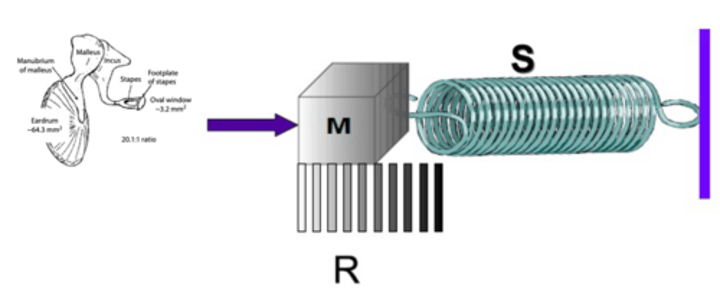
mass
stiffness
resistance
What happens if resistance in is increased?
speed is decreased
- loss of energy that is NOT dependent on frequency (fairly minimal in the middle ear system)
Since we are not concerned about resistance, we are mainly looking at the effects of mass and stiffness, together these are called:
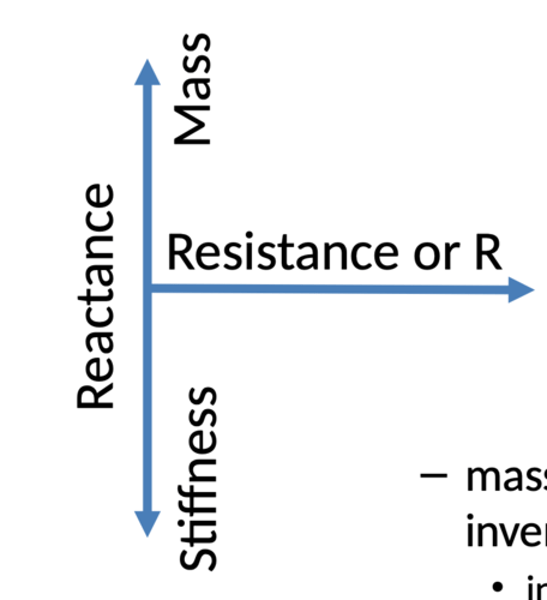
reactance (mass reactance & stiffness reactance)
What is mass reactance?
the impedance you get from mass
mass reactance ____ as frequency goes up
increases (hard to move big things fast aka high frequency)
Its difficult to move large things back and forth quickly, so this is an _____ issue
acceleration
high mass _____ with high frequencies, so:
interferes
more reactance and thus more impedance
high mass moves ____ at low frequencies, so:
better
less reactance and thus less impedance
What is stiffness reactance?
the impedance you get from stiffness
Stiffness reactance ___ as frequency goes up
decreases (moves better at high frequency)
*something stiff will want to return to its resting position faster = higher frequency (and lower impedance)
high stiffness _____ with low frequencies, so:
interferes
more reactance and thus more impedance
highly stiff systems move ____ at high frequencies, so:
better
less reactance and thus less impedance
reactance is the sum of:
mass and stiffness
If mass and stiffness are perfectly balanced for a particular frequency, we call this:
resonant frequency (moves best here)
mass reactance and stiffness reactance are inversely related to frequency,
if we increase frequency then mass reactance will ___ and stiffness reactance will _____
mass - increase
stiffness - decrease
When are the effects of stiffness and mass perfectly balanced?
at 800-1200Hz (resonant frequency of the middle ear)
Why does the ME have such a high frequency resonant peak?
because its small and stiff (mostly stiff)
Changes in middle ear impedance are primarily changes in its:
stiffness (mass is there but negligible)
lower frequencies are not transmitted as well because:
the high stiffness of the system and because it has low mass
--> stiffness of tympanic membrane
--> stiffness of ossicular chain
How could you improve low frequency response?
make it less stiff or more massive
higher frequencies are not transmitted as well because:
the system has some mass (although a small amount)
--> mass of the ossicles and tympanic membrane
How could you improve high frequency response?
reducing mass or making it stiffer
What do we clinically measure impedance at? Why?
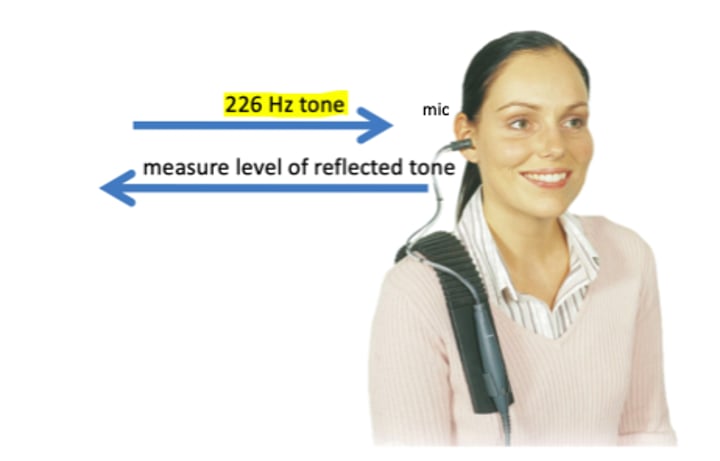
226Hz
the mass of the ossicular chain is negligible here
What is admittance?
it is the inverse of impedance, it is a measure of amount of sound that IS absorbed
Clinical systems generally measure:
admittance
Impedance is how much sound is ____ absorbed, i.e. how ____ it is to get something into motion
NOT
hard
Admittance is how much sound is _____ absorbed, i.e. how ____ it is to get something in motion
Is absorbed (nothing in space)
easy
What is immittance?
generic term that refers to both admittance (how easy) and impedance (how resistant)
Acoustic admittance is equal to:
- sound flow (volume velocity)/ sound pressure i.e how much sound flows into the system for a given amount of pressure
- sound flow is measure in m^3/s
- sound pressure is measured in pascals (N/m^2)
How can acoustic admittance be estimated?
by measuring reflected sound (i.e. how much sound isn't reflected)
When energy is reflected back, there is ____ admittance and _____ impedance
low
high
With low admittance and high impedance, the TM/ossicular chain:
cannot be set into motion easily (it is harder to move)
With otitis media with effusion, we would expect ____ admittance
low
With ossicular discontinuity, we would expect ____ admittance
high
With ossicular fixation, we would expect ____ admittance
low
With no middle ear, we would expect ____ admittance
low
Admittance also relates to volume, with more volume, there is ____ admittance
more
*more sound is absorbed into a large cavity... so less is reflected (higher admittance)
* a large ear canal = more volume = more admittance
What is the unit of impedance?
Ohms
What is the unit of admittance?
mhos (ohm --> mho = the reverse)
Why do we use a 226 Hz probe tone?
at 226Hz, at sea level, air in a cavity that is 1 cubic centimetre (or 1 ml) has approximately 1 millimho of admittance
*this 1:1 correspondence makes it really easy to measure volume of ear canal
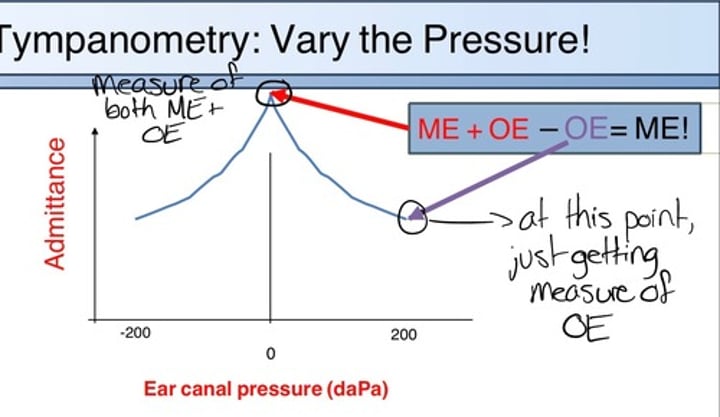
The admittance that you measure includes the middle and outer ear, so how could you assess ONLY middle ear admittance?
we actually get rid of the ME admittance, because its hard to do it with OE (this way we can get ME admittance without OE admittance)
How do we remove the ME admittance?
- when the ear drum is very stretched it doesn't move as well, and admittance of the middle ear goes down (ex: pushed out (full of fluid) or retracted (negative middle ear pressure)
- so we make the ear drum so tight that it doesn't move (thus the middle ear admittance becomes zero)
When the middle ear admittance is zero, the outer ear:
becomes hard-walled cavity (like a cup) so we get the admittance of the outer ear
*we subtract this from the total admittance to get just the middle ear admittance
What are 2 ways to accomplish zero middle ear admittance?
1. adding pressure to the ear (pushing TM in)
2. removing pressure from the ear (pulling TM out)
Who decided to try manually changing the pressure in the ear?
Terkildsen and Thomsom
What did Paul Madsen create?
the first clinical tympanometer - the Madsen Z061 while in Copenhagen
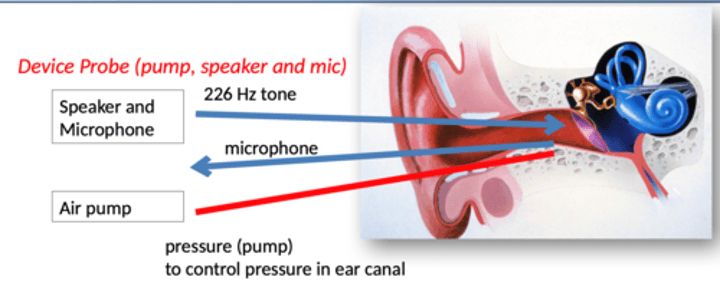
How does tympanometry work?
1 - Canal Probe creates air tight seal at the entrance of EAM
2 - Ear probe presents a tone presented through the speaker
3 - Air Pump pressurizes and varies the pressure in the EAM
4 - The microphone measures the amount of sound reflectance off the tympanic membrane
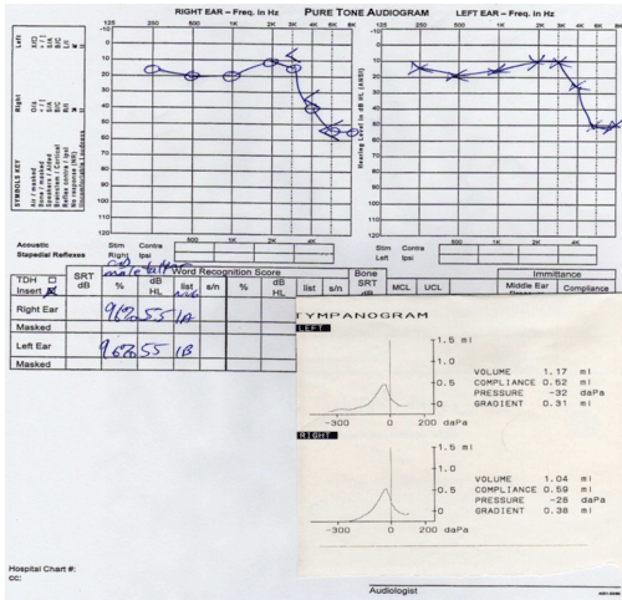
5 - Results are plotted in graphical format to show tympanic compliance
What is the biggest problem with tymp?
ear wax, it can plug up the 3 tiny holes on the proves very easily
A Tympanometer is essentially a plot of ear canal:
sound level
tympanometry is not only a measure of admittance but also:
an estimate of the size of the ear canal
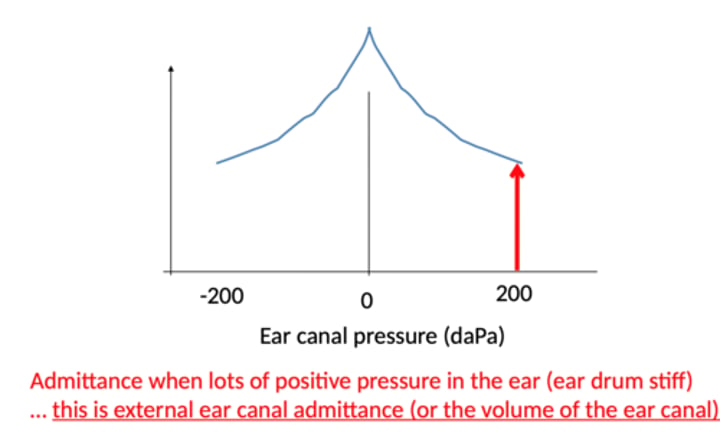
What does the lower end of the peak of a tympanometer tell us?
What does the peak of a tympanometer tell us?
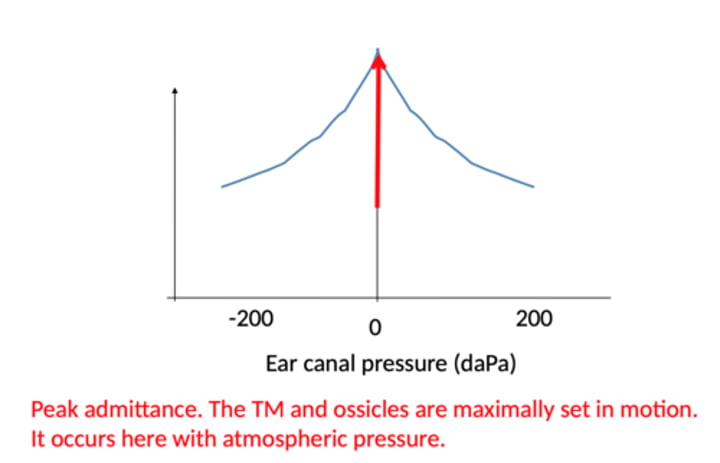
What does the peak admittance minus the ear canal admittance tell us?
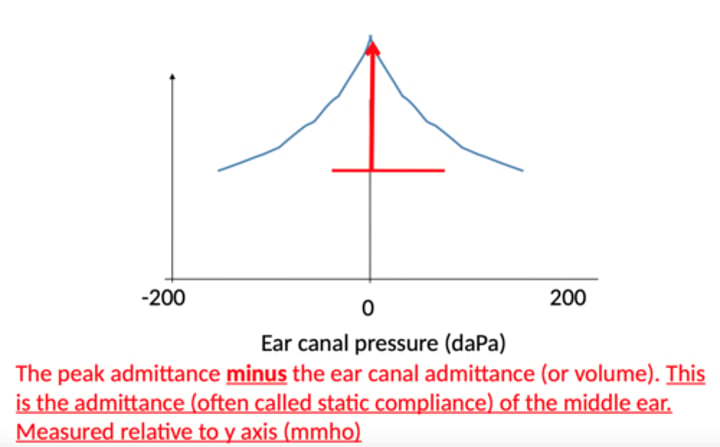
What are we interested in relative to the peak pressure of a tympanogram?
how high the peak is (y-axis) and where it happens (x-axis)
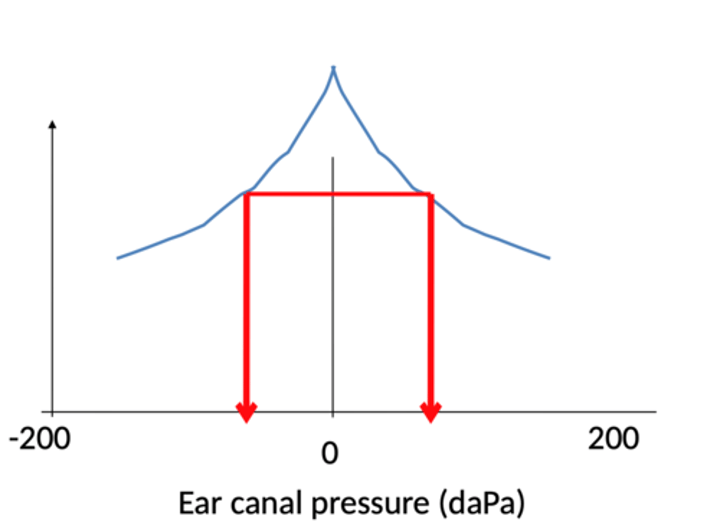
What is tympanometry width used for?
measured relative to x axis, can be used to see if it meets norms
What are the two types of tympanograms?
- non compensated
- compensated
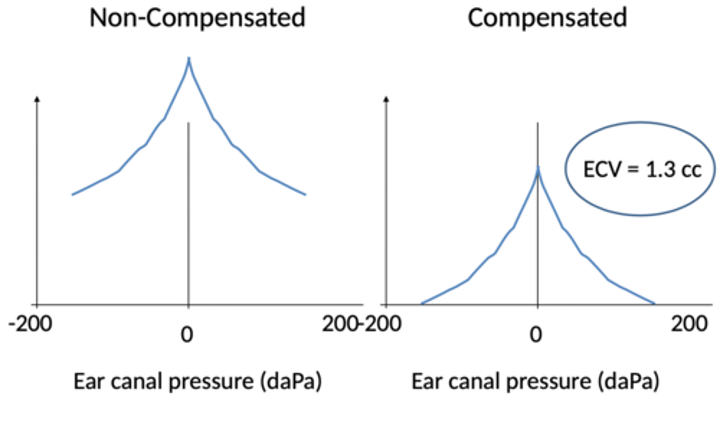
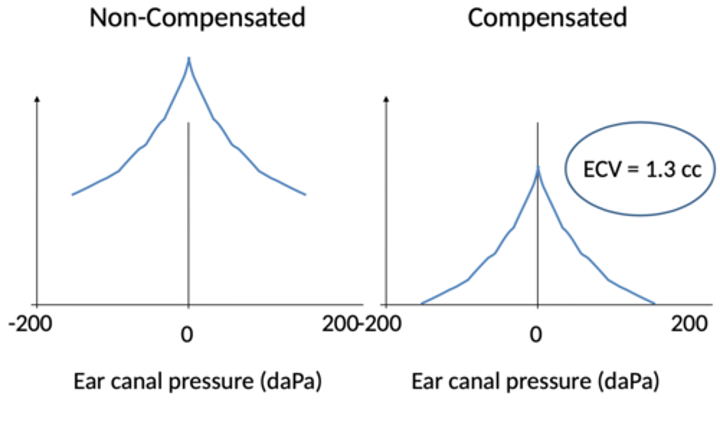
What does a compensated tympanogram do?
takes out the effect of the outer ear
What is tymapanometric peak pressure: TPP (daPa)?
pressure at which peak compliance is found
What is equivalent ear canal volume: Vec (cm^3 or ml)?
admittance when maximum positive pressure in ear
What is Middle ear admittance, or peak-compensated static acoustic admittance (or 'static compliance'): Ytm (mmho)?
peak admittance minus external ear admittance (height of tymp when compensated)
What is tympanogram width: TW (daPA)?
width of the tympanogram at 50% of peak
What is the standard value for tymapanometric peak pressure: TPP (daPa)?
-100 to +50 daPa
What is the standard value for equivalent ear canal volume: Vec (cm^3 or ml)?
.6 to 2 cm^3
What is the standard value for Middle ear admittance, or peak-compensated static acoustic admittance (or 'static compliance'): Ytm (mmho)?
.3 to 1.7 mmho
What is the standard value for tympanogram width: TW (daPA)?
51 to 114 daPa
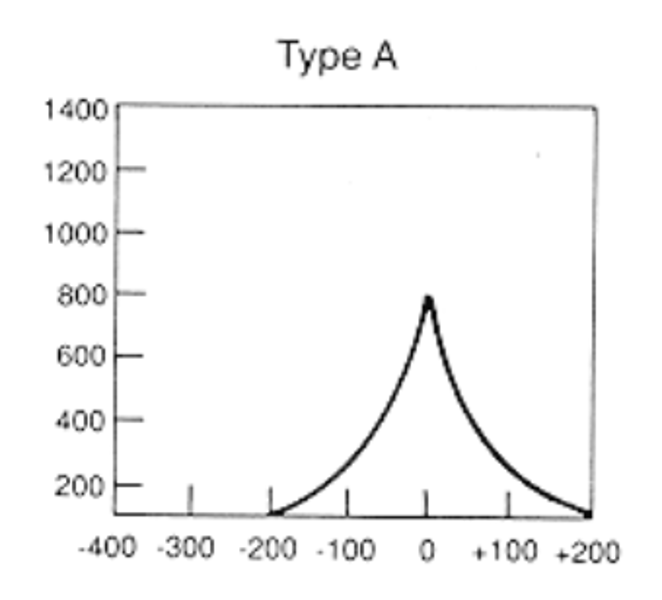
What does a type A tymp look like?
ME ossicles moving well
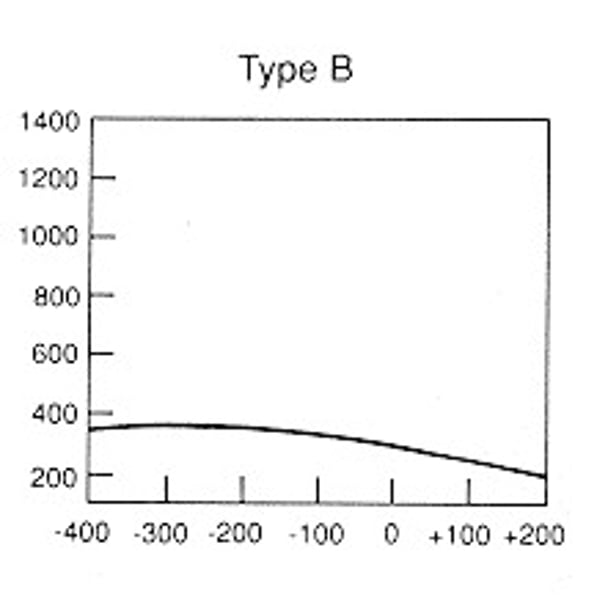
What does a type B tymp look like?
flat tymp (no peak)
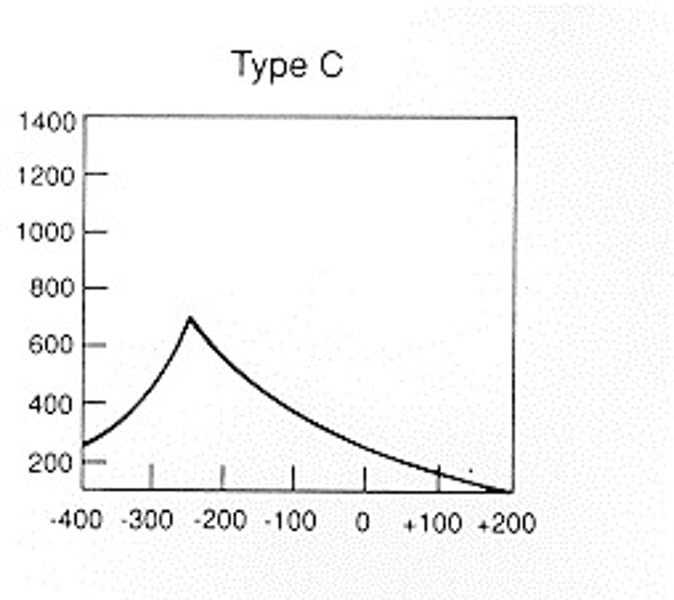
What does a type C tymp look like?
negative pressure
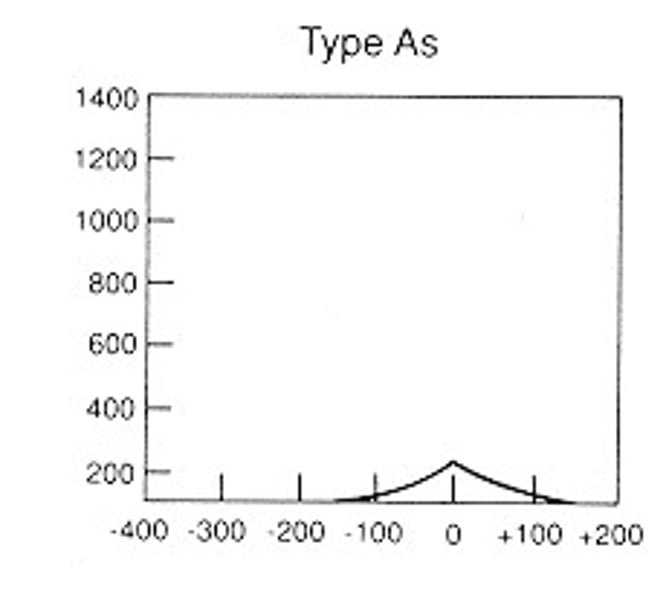
What does a type As tymp look like?
too shallow
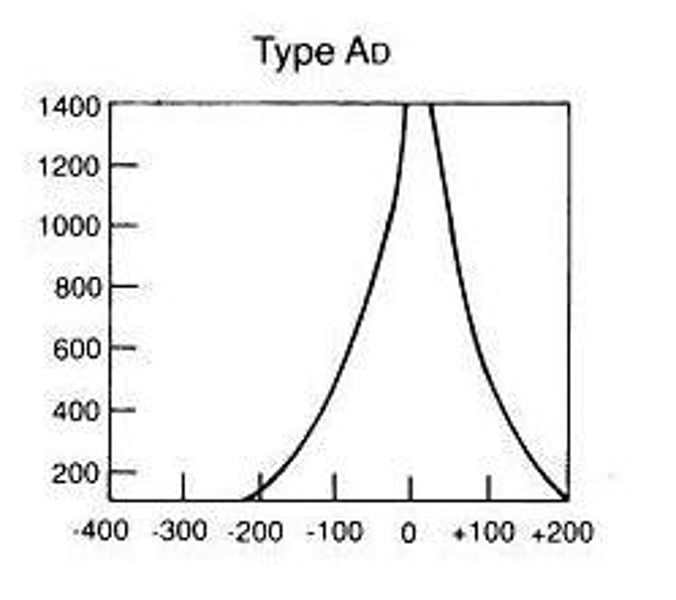
What does a type Ad look like?
too deep
What usually causes a type B or flat tymp?
ME effusion, perforation or blocked probe (can't change pressure in the ear)
What could cause a type Ad tymp?
ossicular discontinuity or TM pathology (ear drum is too loose)
What is the likely pattern of tymps with OM with effusion?
As --> C --> B --> C --> A
How do you differentiate between a type B tymp from OME, perforation or blocked probe?
volume!
OME - normal volume
perforation - volume is HUGE (ear canal and ME space)
blocked probe - no volume
- this is really the only use for the volume measure with tymp
*MUST BE DONE ON NON-COMPENSATED TYMP
What would cause a type A or As tymp?
otosclerosis (depending how fixed it is)
*shallow tymp with other symptoms of otosclerosis = ding ding
What would cause a type C tymp?
Eustachian tube blockage
What is the acoustic reflex?
loud sounds evoke a reflex that reduces admittance (tightening of ossicular chain)
What tightens up in the acoustic reflex? between was thresholds?
the stapedius muscle
thresholds between 70 and 100 dB HL
What does the acoustic reflex do?
Stiffens the ossicular chain which reduces intense low frequency sound