MCAT General Chemistry Chapter 7: Thermochemistry
 Studied by 0 people
 Call Kai
 Learn
Learn Practice Test
 Spaced Repetition
 Match
Match Flashcards
 Knowt Play
1/50

There's no tags or description
Looks like no tags are added yet.
Name | Mastery | Learn | Test | Matching | Spaced | Call with Kai |
|---|
No analytics yet
Send a link to your students to track their progress
51 Terms
Systems vs. Surroundings
System: that matter that is being observed; the total amount of reactants and products in a chemical reaction
Surroundings: everything outside of the system
The boundary between system and surroundings is based on what phenomena is being tested
Isolated System
the system cannot exchange energy (heat and work) or matter with the surrounding
Ex.: insulated bomb calorimeter
Closed System
the system can exchange energy (heat and work) but not matter with surroundings
Ex: a steam radiator
Open System
the system can exchange both energy (heat and work) and matter with the surroundings
Ex: a pot of boiling water
Process
describes a system experiencing a change in one or more properties
Are uniquely identified by some property that is constant throughout
Allow us to simplify the first law of thermodynamics
The First Law of Thermodynamics
Equation 7.1: The first law of thermodynamics
ΔU = Q -W
W = -PV
Q = heat added
W= work
ΔU = internal energy
Isothermal Process
occur when the system’s temperature is constant
Total internal energy of system (U) is constant, ΔU = 0
Q = W ; heat added = work done by system

Adiabitic Process
occur when no heat is exchanged between the system and the environment
Thermal energy of the system is constant throughout
When Q=0, change in internal energy = work done on the system ΔU = -W

Isobaric Process
occur when the pressure of the system is constant
Do not alter the first law but appear as a flat line on the P-V graph

Isovolumetric Process
the system experiences no change in volume
Change in internal energy = heat added to system; ΔU = W
Is a vertical line on the P-V graph
Spontaneous Processes
One that can occur by itself without have to be drive by energy from an outside source; can be calculated from Gibbs free energy
Do not necessarily happen quickly or go to completion; many reach an equilibrium with dynamically stable concentrations of reactants and products
Often spontaneous reactions are coupled to nonspontaneous reactions to provide energy for nonspontaneous reactions
Relating Keq and Q (reaction quotient)
Q < Keq then reaction proceeds spontaneously until equilibrium is reached
Q > Keq then reaction proceeds spontaneously in reverse direction until equilibrium is reached
State Functions
describe the system in an equilibrium state; cannot describe the process
Include pressure, density, temperature, volume, enthalpy, internal energy, Gibbs free energy, and entropy
Standard Conditions
Defined for measuring the enthalpy, entropy, and Gibbs free energy
25℃ (298°K), 1 atm pressure, 1 M concentration
Here, the most stable of substance is its standard state
Common MCAT ex.: H2 (g), H2O (l), NaCl (s), O2 (g) and C (s, graphite)
Standard Enthalpy, entropy, free energy
are changes in these state functions that occur under standard conditions
ΔH, ΔS, ΔG
Phase Diagrams
show the standard and nonstandard states of matter for a given substance in an isolated system
Show temperatures and pressures at which a substance will be thermodynamically stable in a particular phase or in which particular phases will be in equilibrium
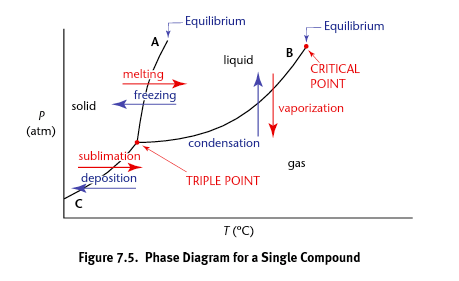
Lines of equilirbium (Phase diagram)
indicate temperatures and pressure of equilibria and divide the diagram into 3 phases
liquids : found at moderate temperatures and moderate pressures
Gases: found at high temperatures and low pressures
Solids: found at low temperatures and high pressures
Triple point (phase diagram)
point at which three phase boundaries meet
Critical Point (phase diagram)
point at which there is no distinction between liquid and gas phases
Phase Changes
are reversible
An equilibrium of phases will eventually be reached at any given combination of temperature and and pressure
are analogous to dynamic equilibria reversible chemical reactions
Concentrations of each phase are constant because the amount of substance in one phase is equal to the amount of that substance in another phase
Evaporation or Vaporizatoin
describes a point of gas liquid equilbrium
a point at liquid phase, when molecules near surface have enough kinetic energy to leave liquid phase and escape into gaseous phase ; process is known as
Temperature of substance in any phase is related to the average kinetic energy of the molecules that make up the substance
Boiling
specific type of vaporization where rapid bubbling an entrie liquid causes it to rapidly release as gas particles
Temperature at which vapor pressure equals the ambient/external pressure is called boiling point
Condensation
when escaping molecules from a solution exert countering pressure that forces a gas back into its liquid phase
Facilitated by lower temperature or higher pressure
Fusion (melting)
availability of energy microstates increases as the temperature of the solid increases; molecules have greater freedom of movement and energy disperses
describes when atoms in the solid phase absorb enough energy and their 3-D structure breaks down, allowing molecules to escape into liquid phase
The reverse is called solidification, crystallization, freezing
Melting or freezing point is the temperature at which these processes occur
Gas Solid Equilbirium
sublimation : when a solid goes directly into the gas phase
Deposition: when a gas goes into the solid phase
Distinction Between Heat and Termperature
Temperature: related to the average kinetic energy of the particles of a substance
Is related to the thermal energy (enthalpy) of the substance
Heat (Q): the transfer of energy form one substance to another as a result of their differences in temperature
Zeroth Law of Thermodynamics
implies that objects are in thermal equilibrium only when their temperatures are equal
says heat is process function because we can quantify how much thermal energy is transferred between two or more objects as a result of temp. Difference
Endothermic: ΔQ > 0; system absorbs heat
Exothermic: ΔQ < 0 ; system loses heat
Enthalpy is equivalent to heat under constant pressure (usually context of MCAT problems)
Calorimetry
process of measuring transferred heat
Equation 7.2: Heat Absorbed
q =mcΔT
M = mass
C = specific heat
ΔT - change in temperature
Constant Pressure Calorimetry
Atmospheric pressure is constant throughout the process; temperature can be measured as reaction progresses
Sufficient thermal insulation is necessary to ensure heat measured is accurate representation of of the reaction without gain or loss to environment
Constant Volume Calorimetry
A hydrocarbon is placed in steel decomposition vessel which is filled pure oxygen gas
Vessel is placed in insulated container holding known mass of water
Material combusts in presence of oxygen
Calorimeter is considered isolated from the rest of the universe
System: sample plus oxygen and steel vessel
Surroundings: water
Since no work is done, ΔUsystem = ΔUsurroundings and qsystem = -qsurr
Heating Curves
Temperature rises until melting point/boiling point is reached, then temperature remains constant as compound is converted to the next phase
Once entire sample is converted, sample continues to rise again
show that phase reactions do not undergo changes in temperature

Enthalpy or heat of fusion (ΔHfus)
must be used to determine the heat transferred during the phase change at solid liquid boundary
Solid to liquid: ΔHfus will be positive
Liquid to solid: ΔHfus will be negative
Enthalpy or Heat of Vaporization (ΔHvap)
must be used to determine the heat transferred during the phase change at liquid gas boundary
Equation 7.3: Heat of Vaporization
Q = mL
M = mass
L = latent heat (term for enthalpy of isothermal process)
Enthalpy
Used to explain heat changes at a constant temperature
Can never be measured directly and can only be measured for certain spontaneous processes
Equation 7.4: Enthalpy change of Reaction
ΔHrxn = Hproducts - Hreactants
Positive ΔHrxn = endothermic process
Negative ΔHrxn = exothermic process
Standard enthalpy of formation (ΔH°f)
The enthalpy required to produce one mole of a compound from its elements in their standard states
This means the ΔH°f of an element in standard state is 0
Standard Heat of Reaction
Equation 7.5: Standard Enthalpy of Rxn
The enthalpy change accompanying a reaction being carried out under standard conditions
ΔH°rxn = ∑ΔH°f, products - ∑ΔH°f, reactants
Hess’s Law
Property of the equilibrium state; process is irrelevant to change in enthalpy from one equilibrium to another
States that enthalpy changes of reactions are additive

Bond Dissociation Energy
explains Hess’ Law
The average energy that is required to break a particular type of bone between atoms in the gas phase
Bond dissociation is an endothermic process
Bond formation is negative, exothermic process
Bond Enthalpies (Bond dissociation energy)
Equation 7.6:
ΔH°rxn = ∑ΔHbonds broken - ∑ΔHbonds formed = total energy absorbed - total energy released
Standard heat of combustion (ΔH°comb)
The enthalpy change associated with the combustion of a fuel
Require a reaction to be spontaneous and fast
MCAT combustion reactions for this occur in presence of atmospheric oxygen (some reactions can occur in presence of diatomic molecules)

Second Law of Thermodynamics
States that energy spontaneously disperses from being localized to becoming spread out if it is not hindered from doing so
describes entropy
Entropy
the measure of the spontaneous dispersal of energy at a specific temperature
Entropy can be localized/concentrated but this rarely happens spontaneously: work must be done to concentrate energy against spontaneity
Change in Entropy (equation)
Equation 7.7: Change in Entropy
ΔS = Qrev / T
Qrev = heat gained or lost in a reversible process
T = the temperature in kelvin
Energy distributed into system = increase in entropy
Energy distributed out of system = decrease in entropy
Equation 7.8:
ΔS universe = ΔS system + ΔS surroundings > 0
Explains how entropy of a universe is always increasing
Entropy of Reaction
Equation 7.9 :
ΔS°rxn = ∑ΔS°f, products - ∑ΔS°f, reactants
Gibbs Free Energy
Is a state function that is combination of temperature, enthalpy, and entropy state functions
Any system will move in whichever direction results in a reduction of the gree energy of the system (towards equilibrium)

Calcuating Gibbs Free Energy
Equation 7.10: Gibbs Free Energy
ΔG = ΔH - TΔS
TΔS = the total amount of energy absorbed by a system when its entropy increases reversibly
ΔG < 0 = spontaneous (exergonic) reaction
ΔG > 0 = non spontaneous (endergonic) reaction
ΔG = 0; system is in equilibrium
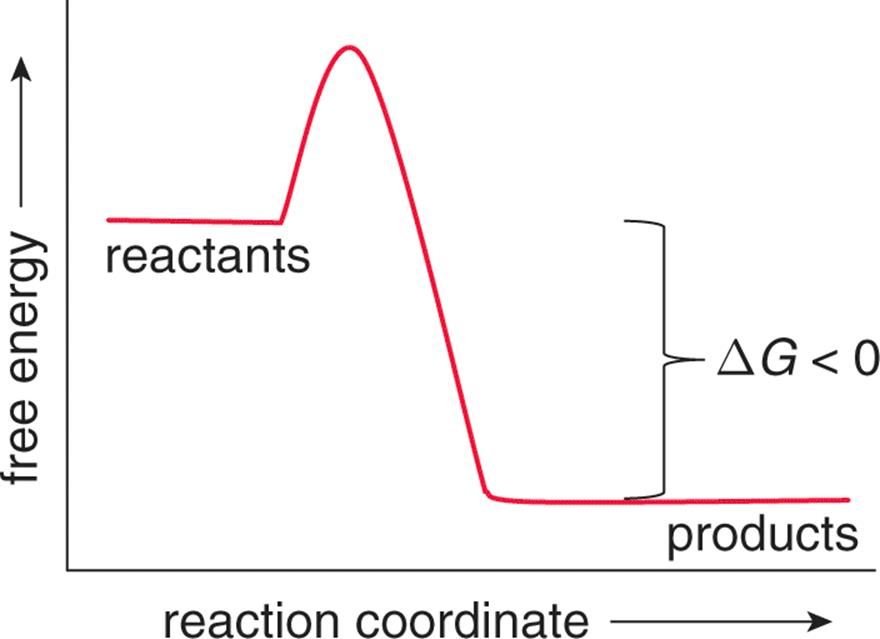
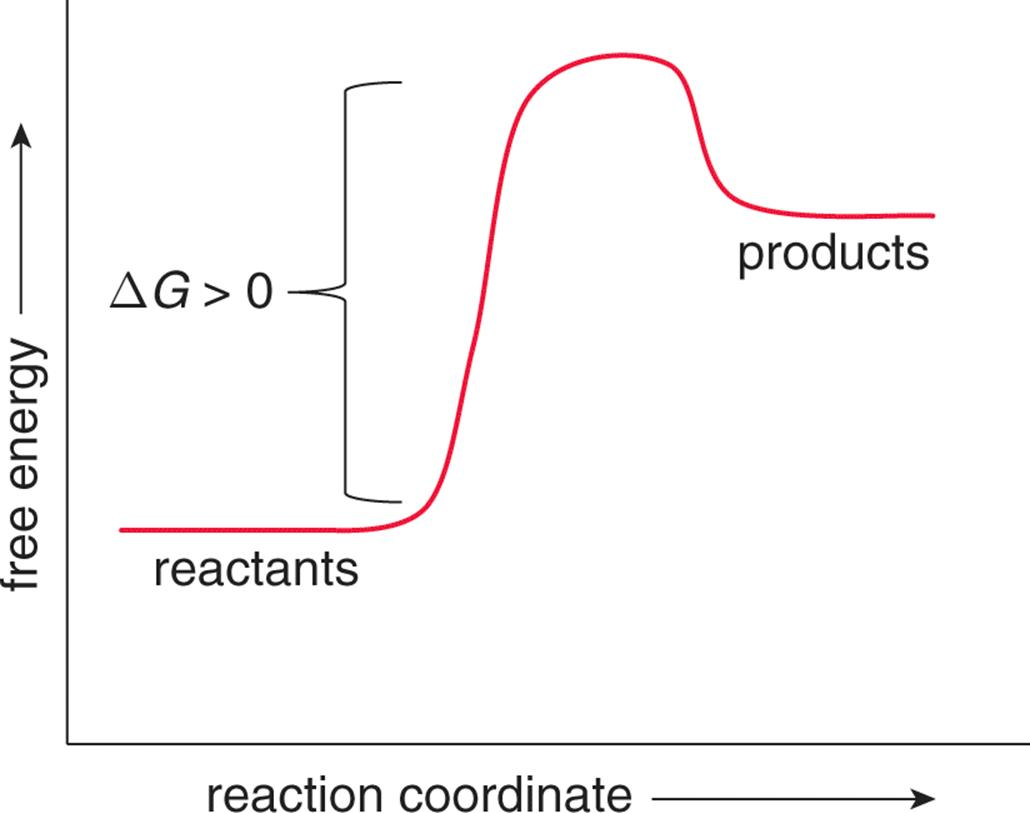
Phase Equilibria and Spontaneity
Equilibria are states in which more than one phase exists
Change in Gibbs free energy must be equal to zero (ΔG =0)
Effects on Spontaneity
The rate of a reaction depend on the activation not ΔG

Standard Gibbs Free Energy
Describes free energy change of reactions under standard state conditions
Concentrations of any solutions in reaction are 1M
Standard free energy of formation of a compound, ΔG°f ;
The free energy change that occurs when 1 mole of a compound in its standard state is produced from its respective elements in their standard state (under standard conditions)
Thus, ΔG°f for any element under standard conditions is zero
Equation: 7.11
ΔG°rxn = ∑ΔG°f, products - ∑ΔG°f, reactants
Free Energy (G), Keq and Q
We can derive the standard free energy change for a reaction from the equilibrium constant Keq
When a reaction begins, standard state conditions no longer apply
Value of equilibrium constant must be replaced with a value that is reflective of where the reaction is in its path toward equilibrium
Main Point:
Q denotes equilbrium when a rxn begins (no longer Keq)
Keq used for standard state
Calculating Spontaneity From Keq and Q
Equation 7.12:
ΔG°rxn = -RT ln Keq
The greater the value of Keq the more spontaneous the reaction
Equation 7.13:
ΔGrxn = ΔG°rxn + RT lnQ = RT ln(Q/Keq)
 Note
Note  Flashcards (30)