chem u2 aos 1
 Call Kai
 Learn
Learn Practice Test
 Spaced Repetition
 Match
Match Flashcards
 Knowt Play
1/343

There's no tags or description
Looks like no tags are added yet.
Name | Mastery | Learn | Test | Matching | Spaced | Call with Kai | Chat |
|---|
No analytics yet
Send a link to your students to track their progress
344 Terms
CHAPTER 10 — WATER AS A UNIQUE CHEMICAL
Chapter 10 — Water as a unique chemical
What is the focus of Chapter 10?
Water as a unique chemical, including its states, availability, anomalous properties, hydrogen bonding, density, specific heat capacity and latent heat
What are the three states of water found at Earth's surface?
Solid, liquid and gas
What is potable water?
Water that is fit for drinking
What is brackish water?
Water that is slightly salty
What is the chemical formula of water?
H₂O
Is water polar or non-polar?
Water is a polar molecule
Why is water polar?
Oxygen is more electronegative than hydrogen, so the bonding electrons spend more time near oxygen, giving oxygen a partial negative charge and hydrogen atoms partial positive charges
What partial charge does oxygen have in water?
δ−
What partial charge do the hydrogen atoms have in water?
δ
What is an intramolecular bond in water?
The polar covalent O–H bond within a water molecule
What is an intermolecular force between water molecules?
Hydrogen bonding
What is hydrogen bonding?
An intermolecular attraction involving a hydrogen atom covalently bonded to N, O or F and a lone pair on N, O or F of another molecule
Which atoms can hydrogen be covalently bonded to for hydrogen bonding to occur?
Nitrogen, oxygen or fluorine
What is the difference between a hydrogen bond and a covalent bond?
A covalent bond holds atoms together within a molecule, while a hydrogen bond is an intermolecular attraction between molecules
Why does water have an unusually high boiling point?
Water molecules form strong hydrogen bonds with each other, so a large amount of energy is required to separate them
What is the boiling point of water?
100 °C at standard atmospheric pressure
Why does H₂O have a much higher boiling point than H₂S?
H₂O forms hydrogen bonds while H₂S mainly has weaker intermolecular attractions
What is surface tension?
The tendency of a liquid surface to resist being stretched due to cohesive intermolecular forces
Why does water have high surface tension?
Strong hydrogen bonding makes water molecules highly cohesive
What does cohesive mean?
Attraction between molecules of the same substance
What does hydrophobic mean?
Having little or no attraction to water and tending not to dissolve in it
Why does water dissolve many substances?
Its polarity allows it to interact strongly with many ionic and polar substances
What is the rule describing the solubility of polar substances?
Like dissolves like
What types of substances generally do not dissolve well in water?
Non-polar substances
What is the structure of ice?
Water molecules form an ordered, open hydrogen-bonded crystalline structure
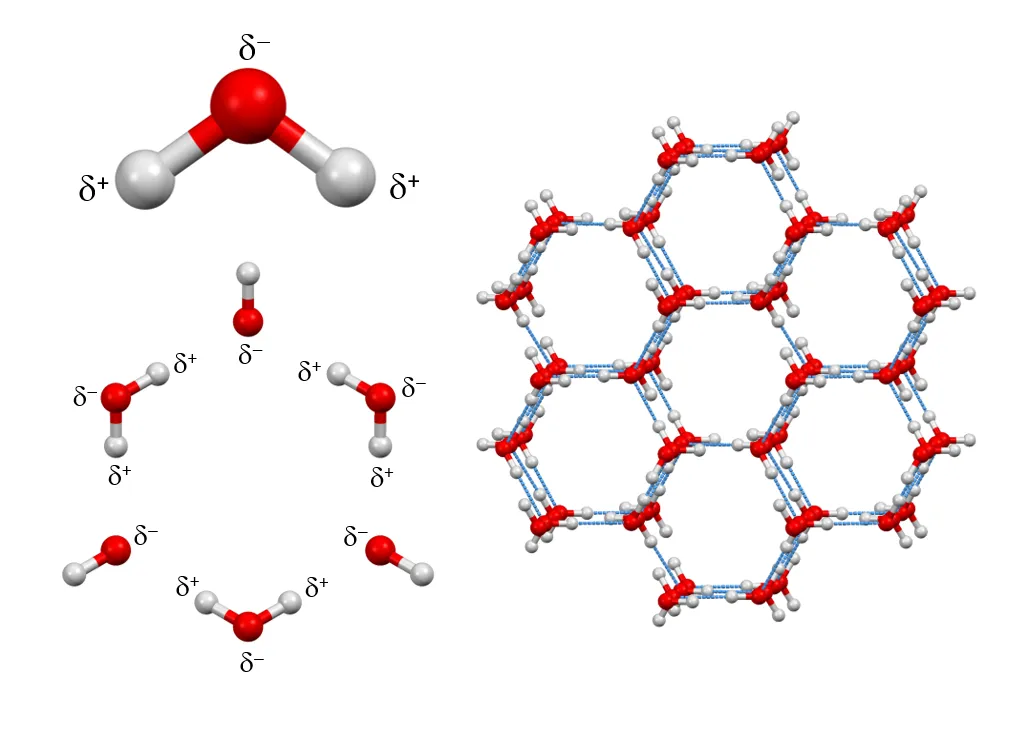
Why is ice less dense than liquid water?
The hydrogen-bonded structure of ice holds water molecules farther apart than in liquid water
What happens to water when it freezes?
It expands and becomes less dense
Why does ice float on liquid water?
Ice has a lower density than liquid water
What is the biological importance of floating ice?
The surface ice layer insulates the liquid water below, allowing aquatic organisms to survive
At approximately what temperature is liquid water most dense?
About 4 °C
Why is the density of water anomalous?
Water reaches maximum density near 4 °C and becomes less dense as it freezes because freezing produces an open hydrogen-bonded structure
What is density?
Mass per unit volume
What is the formula for density?
d = m/V
What does d represent in d = m/V?
Density
What does m represent in d = m/V?
Mass
What does V represent in d = m/V?
Volume
What are common units for density?
g mL⁻¹, g cm⁻³ or kg m⁻³
What is the relationship between g mL⁻¹ and g cm⁻³?
1 g mL⁻¹ = 1 g cm⁻³
How do you rearrange the density formula to find mass?
m = dV
How do you rearrange the density formula to find volume?
V = m/d
Why does the density of a substance change with temperature?
Density changes because volume can change as particles move closer together or farther apart
What is specific heat capacity?
The amount of energy required to raise the temperature of 1 gram of a substance by 1 °C or 1 K
What is the symbol for specific heat capacity?
c
What is the specific heat capacity of water?
4.18 J g⁻¹ °C⁻¹
What is the formula for heat energy required to change temperature?
q = mcΔT
What does q represent in q = mcΔT?
Heat energy in joules
What does m represent in q = mcΔT?
Mass in grams
What does c represent in q = mcΔT?
Specific heat capacity in J g⁻¹ °C⁻¹
What does ΔT represent in q = mcΔT?
Change in temperature
What is the formula for change in temperature?
ΔT = T_f − T_i
What does T_f represent?
Final temperature
What does T_i represent?
Initial temperature
Why does water have a high specific heat capacity?
A large amount of energy is required to increase the temperature of water because energy is absorbed by the hydrogen-bonded system
What is the consequence of water's high specific heat capacity?
Water heats and cools relatively slowly
Why is the high specific heat capacity of water important for oceans?
Oceans can absorb large amounts of heat while experiencing relatively small temperature changes
What is latent heat?
Energy required to change the state of a substance without changing its temperature
Why does temperature remain constant during a phase change?
Energy is used to overcome or form intermolecular attractions rather than change the kinetic energy of the particles
What is latent heat of fusion?
The energy required to change a substance from solid to liquid at its melting temperature
What is the latent heat of fusion of water?
6.01 kJ mol⁻¹
What is latent heat of vaporisation?
The energy required to change a substance from liquid to gas at its boiling temperature
What is the latent heat of vaporisation of water?
40.7 kJ mol⁻¹
What is the formula for latent heat using moles?
q = nL
What is the formula for latent heat using mass?
q = mL
What does L represent in q = nL or q = mL?
Latent heat
What does n represent in q = nL?
Amount of substance in mol
Why is water's latent heat of vaporisation high?
Strong hydrogen bonds between water molecules require a large amount of energy to overcome
How does sweating cool the body?
Water evaporating from the skin absorbs energy because of its high latent heat of vaporisation
What happens when water changes from liquid to gas?
Energy is absorbed and intermolecular attractions are overcome
What happens when water changes from gas to liquid?
Energy is released as intermolecular attractions form
What happens during melting?
Energy is absorbed to disrupt the ordered solid structure
What happens during freezing?
Energy is released as molecules form an ordered solid structure
What happens during evaporation?
Water molecules gain enough energy to escape the liquid and become gas
What happens during condensation?
Water vapour loses energy and molecules come together to form liquid water
How does water's high specific heat capacity affect Earth's climate?
It allows oceans to absorb and redistribute large quantities of thermal energy
What is the enhanced greenhouse effect?
An increase in heat trapped by increased greenhouse gases in the atmosphere
What human activities increase greenhouse gases?
Activities including burning fossil fuels and land clearing
What are possible consequences of climate change?
Changes in rainfall patterns, increased storm severity and impacts on ecosystems and biodiversity
CHAPTER 11 — ACID–BASE (PROTON TRANSFER) REACTIONS
Chapter 11 — Acid–Base (proton transfer) reactions
What is the main focus of Chapter 11?
Brønsted–Lowry acids and bases, conjugate pairs, amphiprotic species, polyprotic acids, acid/base strength, concentration, pH, neutralisation, indicators, ionic equations and applications of acid–base reactions
What is an acid according to Brønsted–Lowry?
A proton donor
What is a base according to Brønsted–Lowry?
A proton acceptor
What is a proton?
H⁺
What are common properties of acids?
They generally have pH below 7, turn blue litmus red, may be corrosive and react with bases
What are common properties of bases?
They generally have pH above 7, turn red litmus blue, may be corrosive or caustic and react with acids
What is an alkali?
A base that is soluble in water
What are common types of bases?
Oxides, hydroxides, carbonates and hydrogen carbonates of metals
What are examples of bases?
MgO, NaOH, CaCO₃ and KHCO₃
What are examples of acids?
HCl, H₂SO₄, HNO₃, H₃PO₄ and CH₃COOH
What is the general reaction of a strong acid with water?
Acid
What is the Brønsted–Lowry equation for nitric acid in water?
HNO₃(aq)
What is the Brønsted–Lowry equation for hydrochloric acid in water?
HCl(aq)
What is the Brønsted–Lowry equation for ethanoic acid in water?
CH₃COOH(aq)
What is a conjugate acid?
The species formed when a base accepts a proton
What is a conjugate base?
The species formed when an acid donates a proton
What happens to an acid when it donates H⁺?
It becomes its conjugate base
What happens to a base when it accepts H⁺?
It becomes its conjugate acid
How do conjugate acid–base pairs differ?
They differ by exactly one proton, H⁺
What is the conjugate base of HNO₃?
NO₃⁻
What is the conjugate acid of NH₃?
NH₄⁺