Biology definitions (Unit 1)
 Call Kai
 Learn
Learn Practice Test
 Spaced Repetition
 Match
Match Flashcards
 Knowt Play
1/26

There's no tags or description
Looks like no tags are added yet.
Name | Mastery | Learn | Test | Matching | Spaced | Call with Kai | Chat |
|---|
No analytics yet
Send a link to your students to track their progress
27 Terms
cytosol
“broth”
jelly like substance that organelles float in
nucleus
“boss”
where DNA (instructions for building proteins) is store
-ribosomes are also made in the nucleolus
Ribosomes
“workers”
reads mRNA and links amino acids together to produce / synthesize proteins
Rough Endoplasmic Reticulum
“factory” (where ribosomes work)
manufactures proteins intended for export
Smooth Endoplasmic Reticulum
“workerless factory”
involved in the synthesis of fats, phospholipids, and steroids
Golgi apparatus
“post office”
modifies and packages proteins and lipids for exportation out of the cell
Lysosome
“recycling bin”
breaks down / digests worn down cellular components so they can be reused
mitochondria
“powerhouse”
location of aerobic cellular respiration
-breaks down glucose to produce ATP to power rest of the cell
chloroplast
“solar powered kitchen”
involved in photosynthesis
-uses sunlight to create glucose
cell membrane
“bouncer”
is selectively permeable meaning it controls what substances enter and exit the cell
Cell wall
“brick wall”
gives strength and rigidity to the cell
vacuole
“football”
stores water, nutrients and waste -also gives the cell shape
cytoskeleton
“muscles and bones”
gives cell shape and moves materials along
centriole
made of microtubules
involved in cell division
only in animal cells
Cillia and Flagella
“boat oars and propella”
for cell movement
Prokaryote
no nucleus (only nucleoid)
circular DNA
eg: bacteria, archaea
Eukaryote
has a nucleus
has membrane bound organelles
linear DNA (chromosomes)
eukarya - animals, plants, fungi, protists
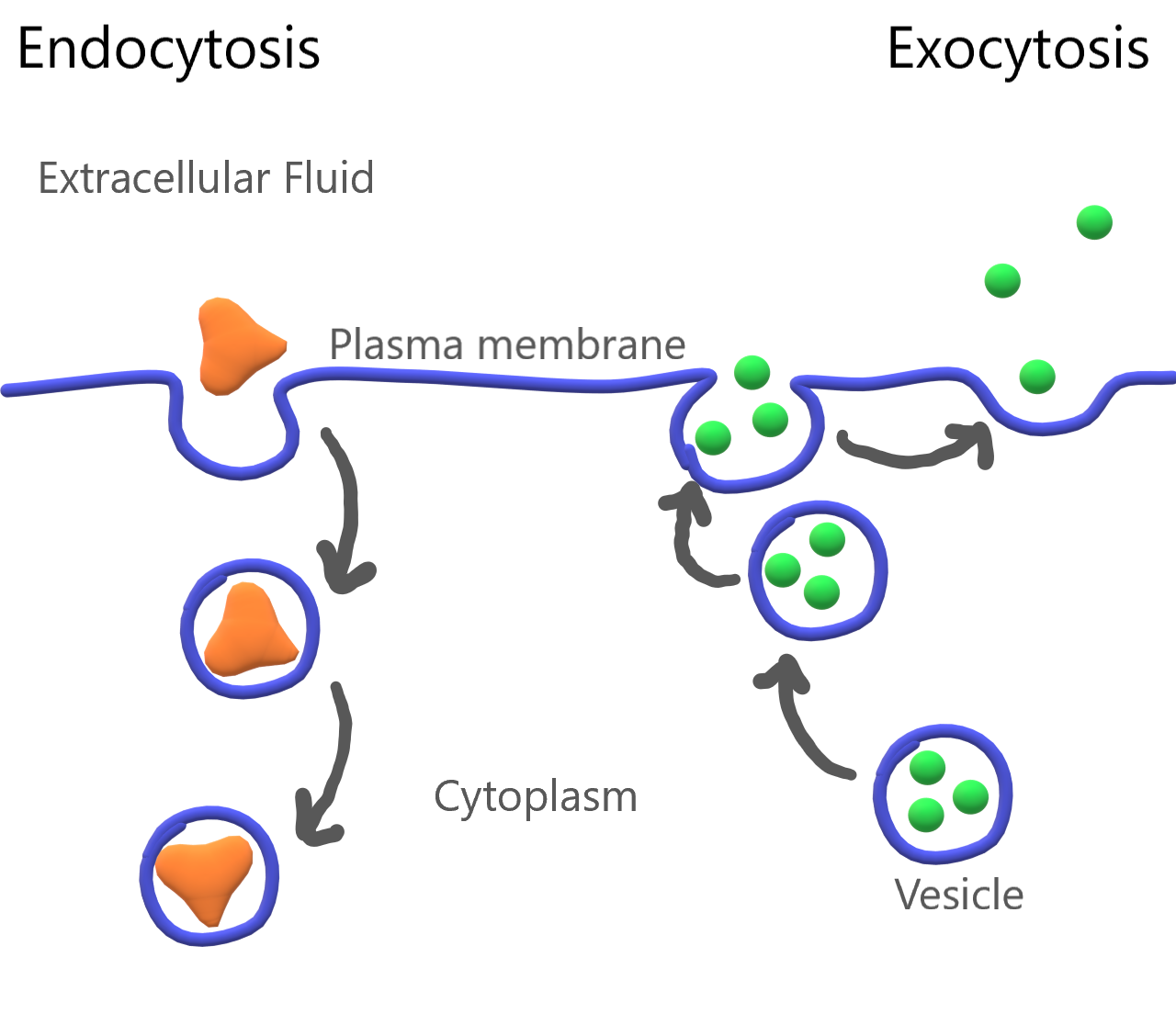
bulk transport
type of active transport that moves large molecules or groups of molecules across the cell membrane using vesicles
(endocytosis & exocytosis)
diffusion def
the NET passive movement of molecules across a selectively permeable membrane from an area of high concentration to an area of low concentration (along it’s concentration gradient)
osmosis def
the passive movement of free water molecules across a semi-permeable membrane from an area of low water / high solute concentration to an area of high water / low solute concentration
active transport def
the active movement of molecules across a semi-permeable membrane, from an area of low concentration to an area of high concentration (against the concentration gradient) requiring ATP
phospholipid head
hydrophilic
polar
phospholipid tail
hydrophobic
non-polar
how do prokaryotic cells generally reproduce and the steps
Binary fission
DNA replication
elongation
cell division / cytokinesis
eukaryotic cell cycle
interphase (G1,S, G2), mitosis (PMAT), cytokinesis
stages of interphase
G1- cell growth
S- DNA duplication
G2- cell checks for errors and prepares for division
cell cycle checkpoints
end of G1 - is cell big enough/enough resources?
end of G2 - similar to G1
towards end of Metaphase - have spindle fibres properly connected?