Term 3 - D3.2 Inheritance
 Call Kai
 Learn
Learn Practice Test
 Spaced Repetition
 Match
Match Flashcards
 Knowt Play
1/36

There's no tags or description
Looks like no tags are added yet.
Name | Mastery | Learn | Test | Matching | Spaced | Call with Kai | Chat |
|---|
No analytics yet
Send a link to your students to track their progress
37 Terms
D3.2.1 Haploid (3)
A haploid cell only has one single set of chromosomes
Written as n
In humans, egg and sperm cells are haploid and contain 23 chromosomes. When they join together, they make a full diploid cell with 46 chromosomes
D.3.2.1 Diploid (3)
A diploid cell or organism has two complete sets of chromosomes, with one set coming from each biological parent
Written as 2n
In humans, this equals 46 total chromosomes (23 pairs)
D.3.2.1 Gametes (4)
Gametes are sex cells used in sexual reproduction
Male gametes are sperm, and female gametes are eggs
Produced through meiosis
Each gamete is haploid --> fuse together to create a diploid zygote
D3.2.1 Zygote (3)
A zygote is the single cell formed when a sperm cell and an egg cell join together during fertilization
It carries a complete set of DNA from both parents and marks the very first developmental stage of a new living organism
Each zygote inherits two copies (genetic inheritance) - one from mom and one from dad (alleles)
D3.2.2 Generations (3)
P generation (parent generation) - the original parents in a genetic cross
F1 generation (first filial generation) - the offspring of the P generation
F2 generation (second filial generation) - the offspring of the two individuals from the F1 generations
D.3.2.2 Genes (1)
Genes are sections of DNA that code for a specific protein, and determine a trait
D.3.2.3 Alleles (4)
Alleles are alternative forms of a gene
Produced by mutations to a gene
Organisms which have cells with diploid nuclei will have two copies of each gene
Diploid organisms like us contain two alleles for each gene - one from each parent
D.3.2.3 Genotypes (3)
Homozygous: individuals have two identical copies of an allele for a gene
Heterozygous: individuals have two different copies of an allele for a gene
Genotype: is the combination of alleles inherited by an organism
D.3.2.4 Phenotypes (1)
Phenotypes are the observable traits of an organism determined by the genotype interacting with the environment
D.3.2.4 Traits determined by genotype only (3)
Blood type
Genetic diseases
Eye colour
D3.2.4 Traits determined by genotype interacting with the environment (2)
Height
Athletic performance
D.3.2.4 Traits determined solely by environment (1)
Language spoken and accent
D3.2.5 Dominant Alleles (3)
Dominant alleles are alleles that have the same effect on the phenotype in homozygous and heterozygous individuals
The dominant allele is always expressed in the phenotype
Dominant alleles mask the effect of recessive alleles --> an organism will express the dominant trait if they inherit at least one copy of it
D3.2.5 Recessive Alleles (3)
Recessive alleles that have an effect on the phenotype of a homozygous individual with two recessive alleles of the gene
Recessive alleles are only expressed when an individual has two recessive alleles for a trait
Recessive alleles only dictate the physical phenotype when an individual inherits two copies (one from each parent)
D3.2.5 Monohybrid Cross (3)
E.g. The presence of freckles is a trait controlled by a dominant allele in humans. If two parents are heterozygous for the trait, determine the probability of them having a child with freckles
Phenotype: Freckles x Freckles
Genotype: Ff x Ff

D3.2.6 Phenotypic Plasticity (2)
Phenotypic plasticity refers to reversible changes in phenotype suited in the environment due to changing patterns in gene expression
Is not due to changes in genotype, and the changes in traits may be reversible during the lifetime of an individuals
D3.2.6 Phenotypic Plasticity - face freckle example (2)
Face freckle gene (FF) --> tend to have pale skin, freckles, red hair
Example of phenotypic plasticity: Irish girl has freckles but moves to Australia --> more sun more UV --> pale skin becomes tan but freckles stay (genes stay the same but cells change)
D3.2.7 Most genetic diseases are caused by the recessive allele (2)
People who are homozygous (dd) recessive will display symptoms of the diseases
Those who are heterozygous (Dd) will be carriers of the disease - no symptoms
D3.2.7 Phenylketonuria (PKU) (4)
Phenylketonuria (PKU) is a genetic disease where an individual does not have a functioning gene to make the enzyme that converts the amino acid phenylalanine to tyrosine
Caused by a recessive allele
People with PKU are homozygous recessive for the disease
High concentrations of phenylalanine build up in the brain, causing intellectual disability, delayed development, behavioural, emotional, and social problems
D3.2.8 Gene Pools (4)
A gene pool is all of the different genes and alleles present within an interbreeding population of a species
There can be many different alleles of a gene in any gene pool
Many of the alleles are the result of base substitutions of the gene forming new variations of the gene known as single-nucleotide polymorphisms
Even though there may be many alleles of a gene in a population, an individual will only have two copies of the gene, inheriting one allele from each parent
D3.2.9 ABO Blood Groups (1)
ABO blood groups are based on the presence of antigen proteins on the plasma membrane of red blood cells. ABO blood types is an example of a gene with multiple alleles
D3.2.9 ABO Blood Group Alleles (2 + 3)
Multiple alleles occur when there are more than two alleles for a gene
There are three common alleles (IA, IB and i) for human blood type:
IA which is dominant to the allele i, but codominant to the allele IB
IB which is dominant to the allele i, but codominant to the allele IA
i which is a recessive allele to the alleles IA and IB
i is the recessive allele
IA and IB are dominant over i
IA and IB are codominant
D3.2.9 Example of Codominance - ABO Blood Groups
Phenotype/Blood Type (4 possible phenotypes) | Genotype (6 possible genotypes) | Antigens on RBCs | Antibodies in plasma | Can accept blood from |
A | IAIA or IAi | A | B | A, O |
B | IBIB or IBi | B | A | B, O |
AB (universal recipient) | IAIB | AB | No antibodies | A, B, AB, O |
O (universal donor) | ii | No antigens | AB | O |
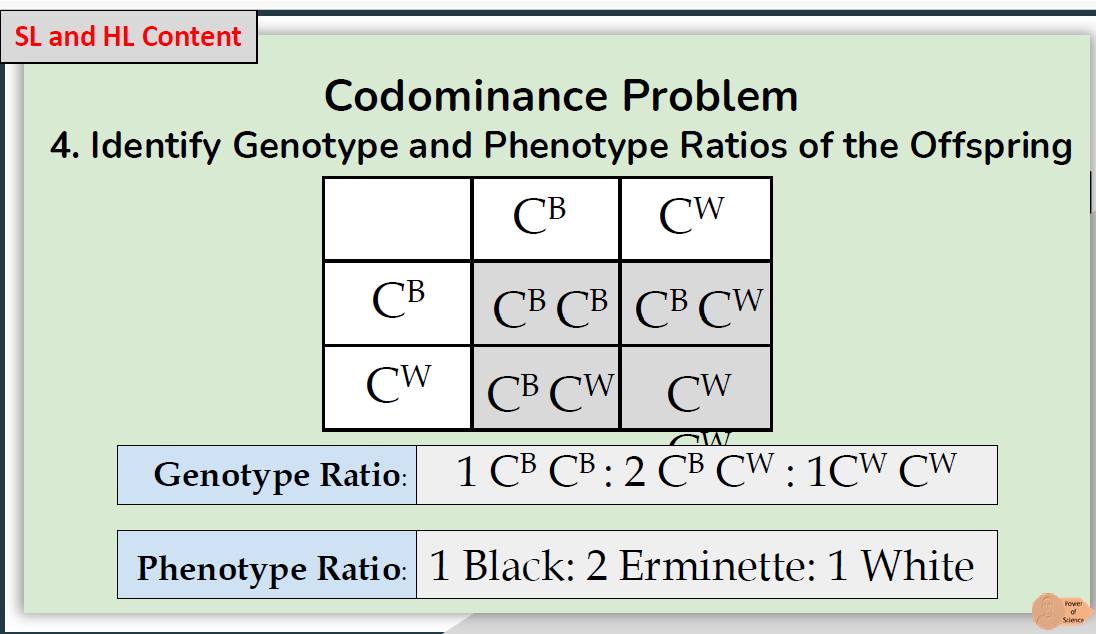
D3.2.10 Codominance (4)
Codominance occurs when heterozygotes have a dual phenotype
Both alleles are dominant, and both are expressed in the phenotype
The inheritance of blood type AB (IAIB) is an example of codominance
The protein coded by both versions of the allele is expressed as an antigen on the red blood cell for a person with an AB (IAIB) blood group
ABO blood group - both alleles are expressed in the phenotype
E.g. blood group AB - will express both A and B antigens on the surface
D3.2.10 Incomplete Dominance (3)
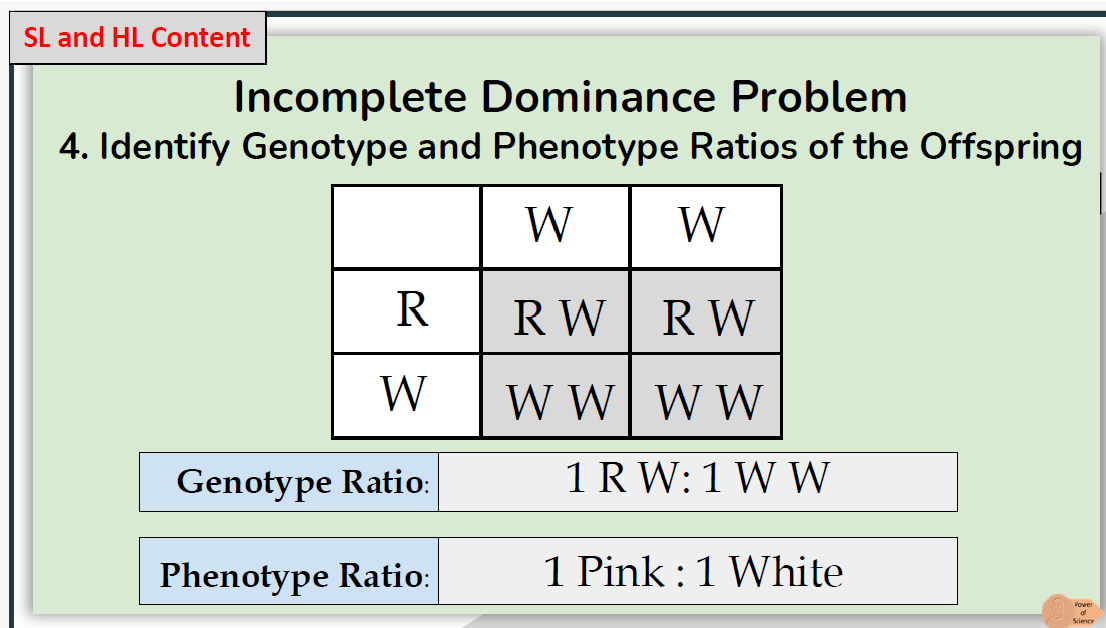
Incomplete dominance occurs when heterozygotes have an intermediate phenotype to homozygous individuals
Neither allele is dominant
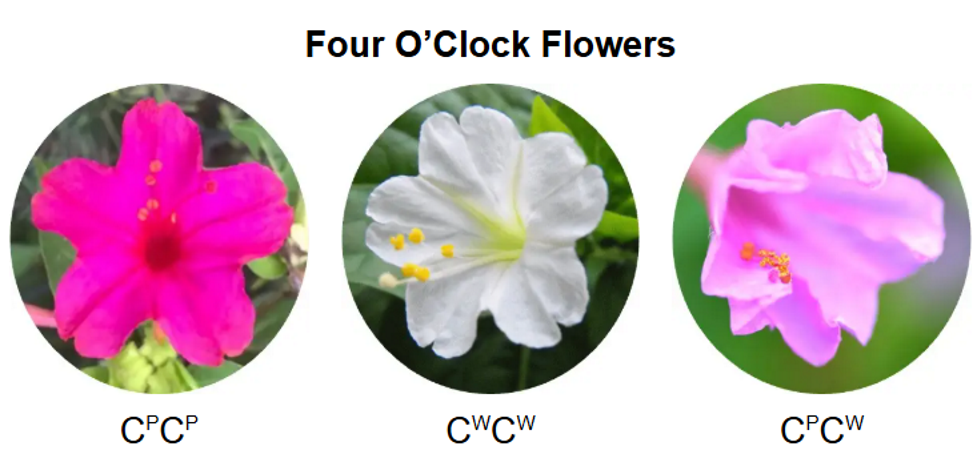
The inheritance of flower colour for the four o’clock flower (Mirabilis jalapa) is an example of incomplete dominance
D3.2.10 Four o’clock Flower (5)
There are three phenotypes for flower colour in four o'clock plants
Red, when the plant has two red alleles for flower colour
White, when the plant has two white alleles for flower colour
Pink, when the plant is heterozygous for flower colour
Pink is the intermediate phenotype between the red and white phenotypes
D3.2.11 Sex Chromosomes and Autosomes (5)
X and Y chromosomes are the sex chromosomes and determine biological sex
The X chromosome is longer than the Y chromosome and contains many more genes
The Y chromosome contains an SRY gene. If a human embryo has an SRY gene, it will develop male-typical characteristics
The X chromosome does not contain an SRY gene. An embryo with two X chromosomes does not have an SRY gene, and develops female-typical characteristics
All other chromosomes apart from the sex chromosomes, are autosomes
D3.2.11 Sex Determination in Humans (5)
Females = XX; males = XY
All female gametes and eggs will have one X chromosome
The male gametes and sperm will have either the X or the Y chromosome
Eggs fertilised by a sperm with an x chromosome will develop female-typical characteristics (XX)
Eggs fertilised by a sperm with a Y chromosome will develop male-typical characteristics
D3.2.11 Example of Sex Linkage using Drosophila (fruit flies)
Drosophila are fruit flies
Gene that determines eye colour in drosophila is found on the X chromosome
Cross a red eye dad and a white eye mom
| XR | Y |
Xr | XRXr | XrY |
Xr | XRXr | XrY |
Y: Y chromosome in males
XR: red eye allele (dominant phenotype)
Xr: white eye allele
Genotype: 50% XRXr : 50% XrY
Phenotype: 50% red eye female : 50% white eye male
What is the percentage of females that will display a red eye phenotype?
100% (talking abt a specific gender, not the whole offspring) - DON’T GET TRICKED BY THIS !!
D3.2.12 Sex-Linked Traits (4)
The sex chromosomes are homologous chromosomes, and should have the same genes
Sex-linked traits are traits where the allele is present on only one sex chromosome (usually X)
The Y chromosome is much shorter than the X chromosome. Therefore there are many genes that are on the X chromosome, but not on the Y chromosome
Females will get 2 copies of these sex linked genes, but males will only get one copy
D3.2.12 Haemophilia (4)
Haemophilia is a sex-linked disease caused by a mutation to a gene for making the blood clotting factor XIII
The gene is on the X chromosome, but not on the Y chromosome
Males carry one copy of the gene on their X chromosome. There is no allele on the Y chromosome
Females carry two copies of the gene, one allele on each X chromosome
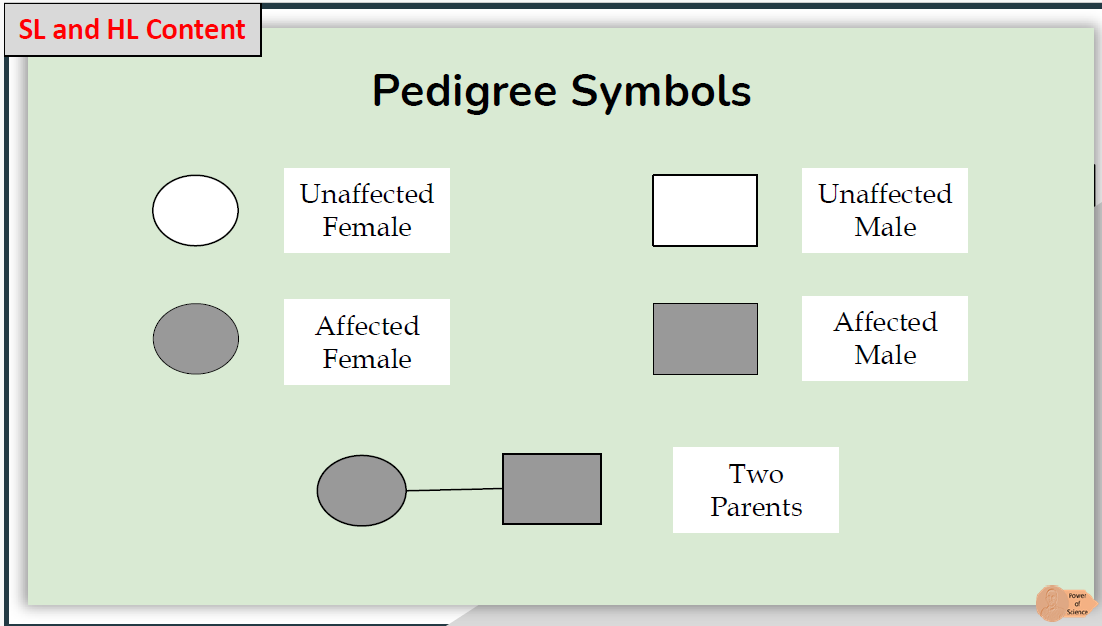
D3.2.13 Pedigree Charts (1)
A pedigree chart is a diagram that shows the occurrence and appearance of phenotypes of a particular gene or organism and its ancestors from one generation to the next
D3.2.14 Polygenic Inheritance (2)
Polygenic inheritance is a single characteristic controlled by multiple genes
Human skin colour is an example of a polygenic inheritance
D3.2.14 Inheritance of Skin Colour humans (6)
Skin colour depends on the amount and type of melanin represent in the skin
Melanin is a brown protein pigment
There are at least four genes which control the amount of melanin present in the skin
Each gene has multiple alleles, which may promote or inhibit melanin production
The alleles may be codominant
The inheritance of skin colour in a human is a polygenic trait
D3.2.14 Discrete Inheritance (6)
Discrete variation results from one gene being responsible for a trait
All individuals fit into a number of non-overlapping phenotype - phenotypes fall into distinct categories
Determined by a single gene (monogenic)
Not affected by environment
Frequency tables, pie charts, bar charts
Examples: ABO blood groups, haemophilia, eye colour, whether you have a disease or not
D3.2.14 Continuous Inheritance (
Continuous variation results from polygenic inheritance, where multiple genes determine the phenotype (polygenic)
Affected by environmental factors (nature and nurture)
Produces a range of overlapping phenotypes between two extremes
Phenotype are measured across a range, usually follows a normal distribution (bell curve)
Box and whisker
Examples: Human skin colour, height, weight
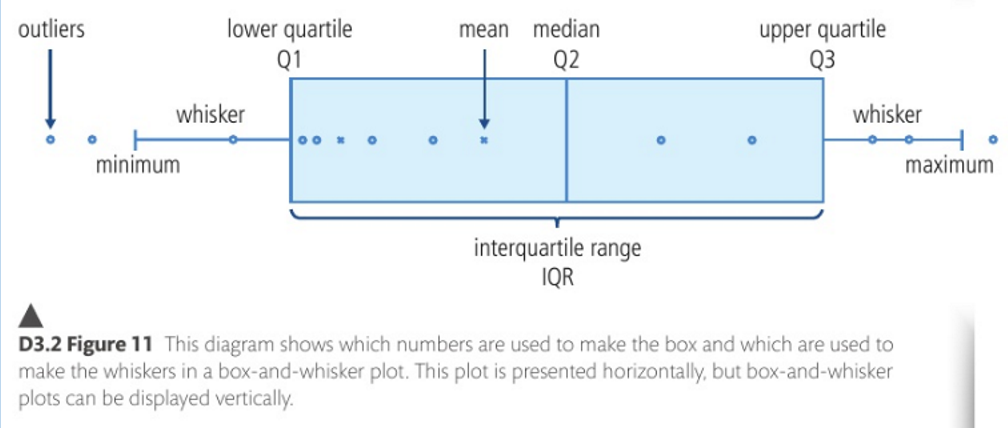
D3.2.15 Box-and-Whisker Plot (7)
IQR = Q3 - Q1
Q3: upper quartile, 75%
Q1: lower quartile, 25%
Q2: median
Minimum = Q1 - IQR*1.5
Maximum = Q3 + IQR*1.5
Anything that falls out of the min and max are outliers