Nurse Cheung ATI TEAS 7 Science - Scientific Reasoning
 Call Kai
 Learn
Learn Practice Test
 Spaced Repetition
 Match
Match Flashcards
 Knowt Play
1/48

There's no tags or description
Looks like no tags are added yet.
Name | Mastery | Learn | Test | Matching | Spaced | Call with Kai | Chat |
|---|
No analytics yet
Send a link to your students to track their progress
49 Terms
Standard Measurements
Used in the United States to measure length, weight, and capacity.
Standard Measurements: Length
Inches, feet, yards, miles.
Standard Measurements: Weight
Ounces, pounds.
Standard Measurements: Capacity
Teaspoon, tablespoon, cups, pints, quarts, and gallons.
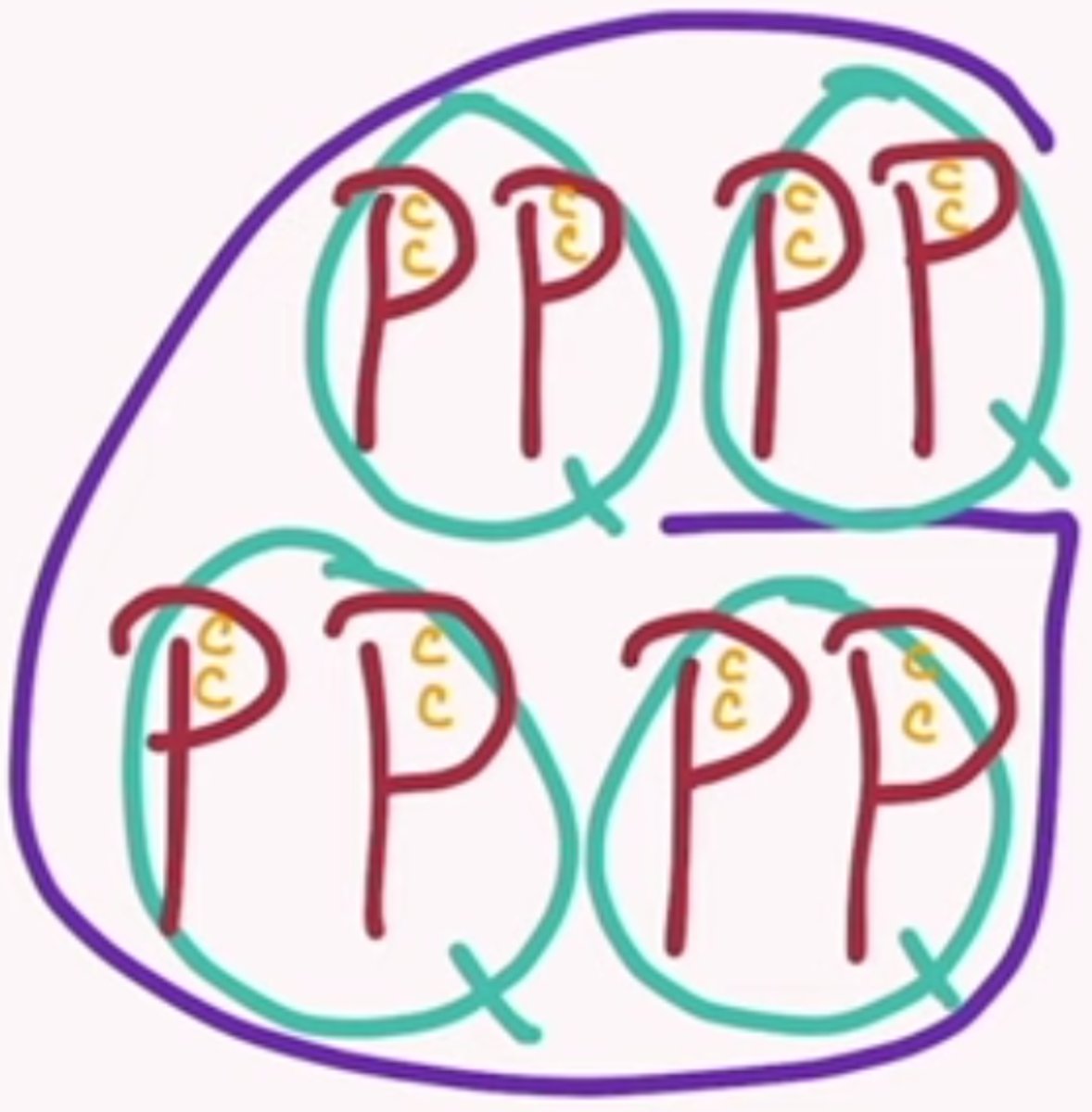
Metric Measurements
Used throughout the rest of the world to measure length, weight, and capacity.
Metric Measurements: Length
Meters
Metric Measurements: Weight
Grams
Metric Measurements: Capacity
Liters
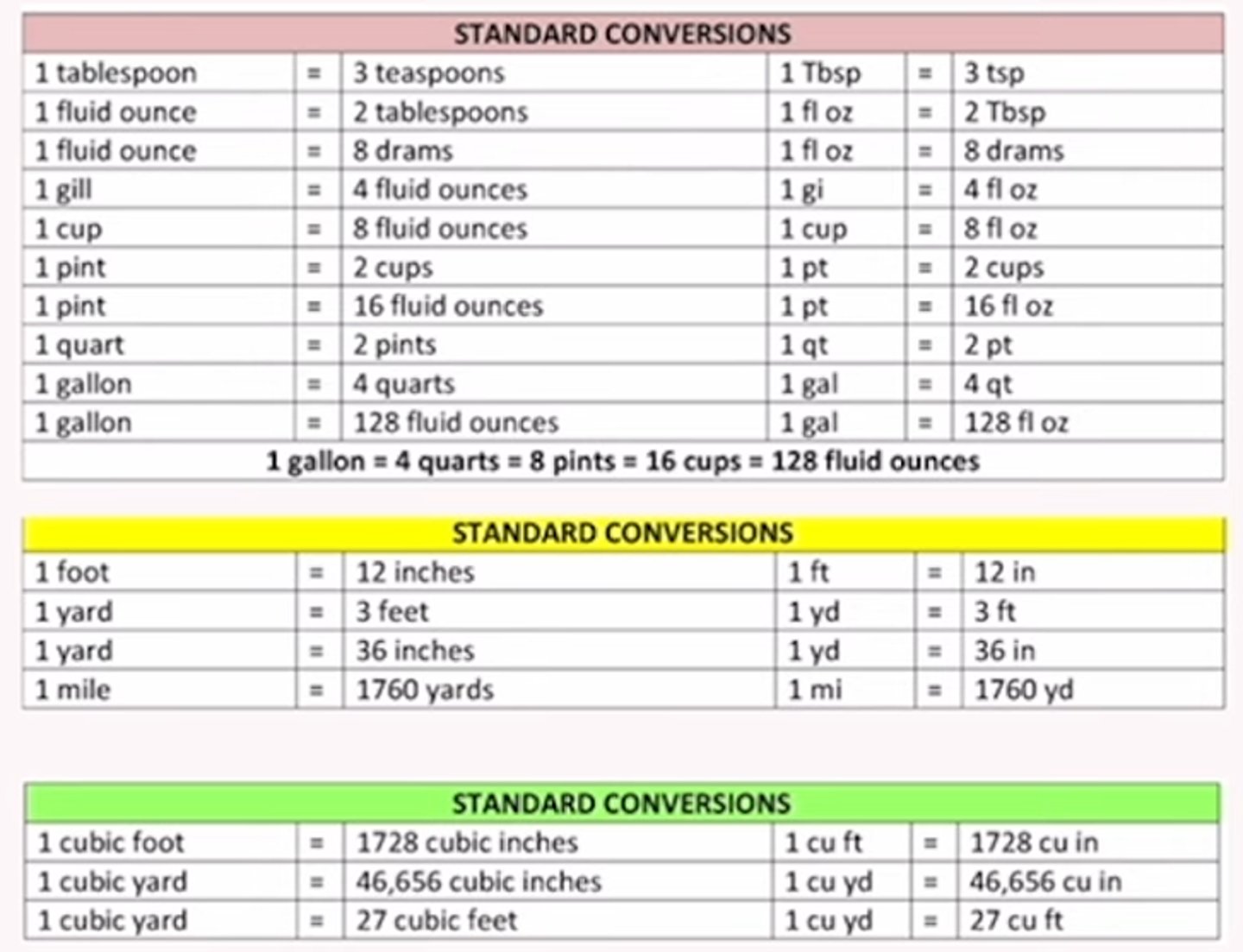
1 Foot
12 inches
1 Yard
3 feet; 36 inches
1 Mile
1,760 yards ; 5,280 feet; 63,360 inches
1 Pound
16 ounces
1 Gallon
4 quarts; 8 pints; 16 cups
4 Quart
8 pints; 16 cups
8 Pints
16 cups
1 Tablespoon
3 teaspoons
Standard Measurment: Common Conversions
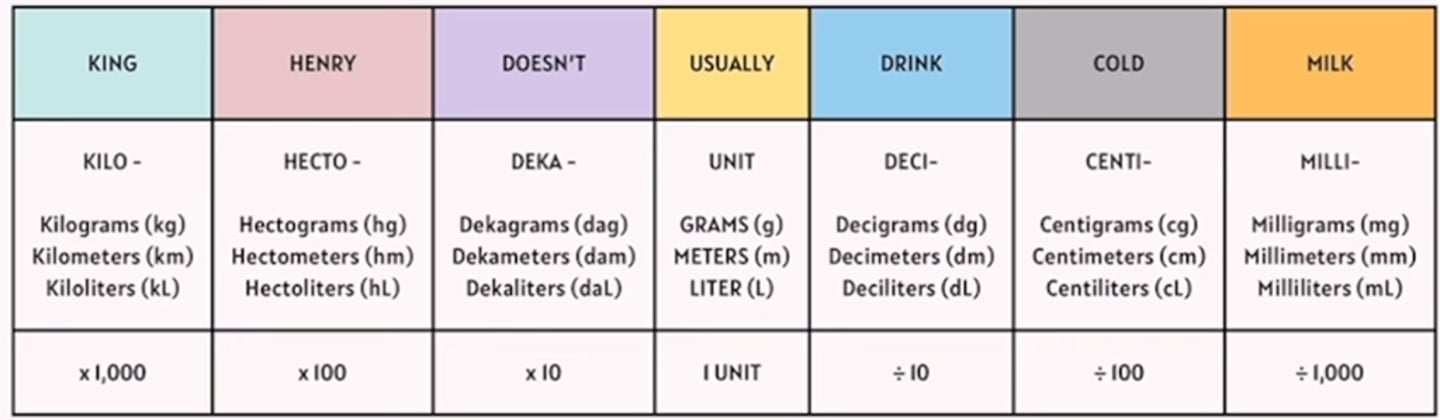
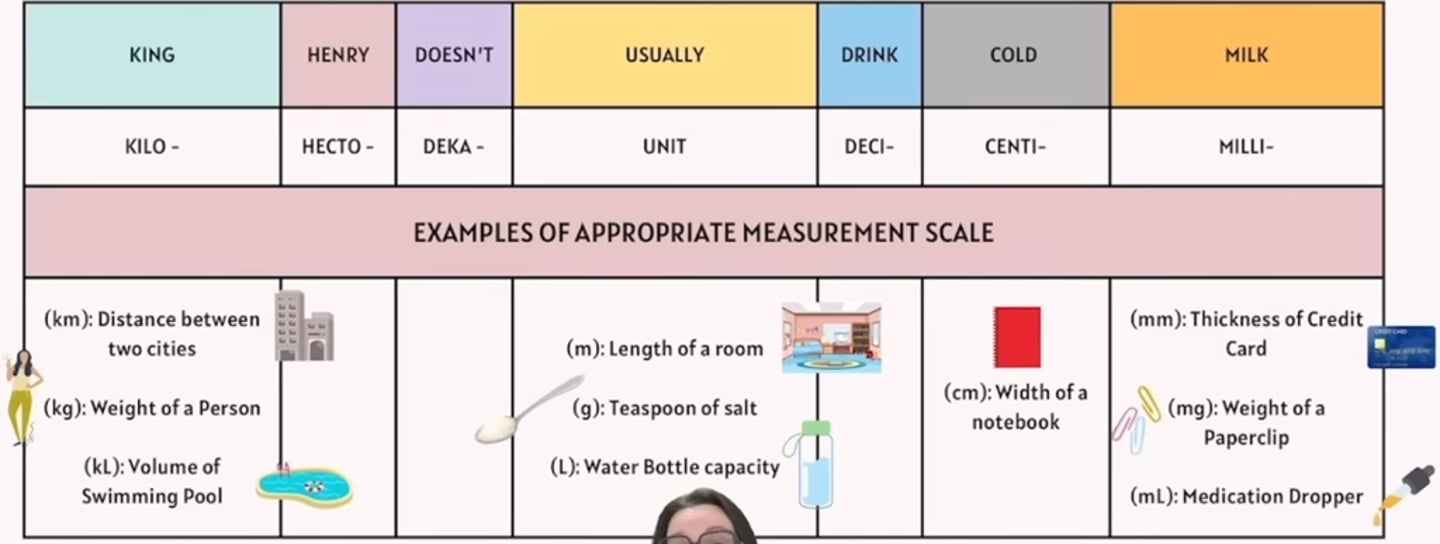
Metric Conversion Pneumonic
King Henry Doesn't Usually Drink Cold Milk
- Moving to the left you MULTIPLY!
- Moving to the right you DIVIDE!
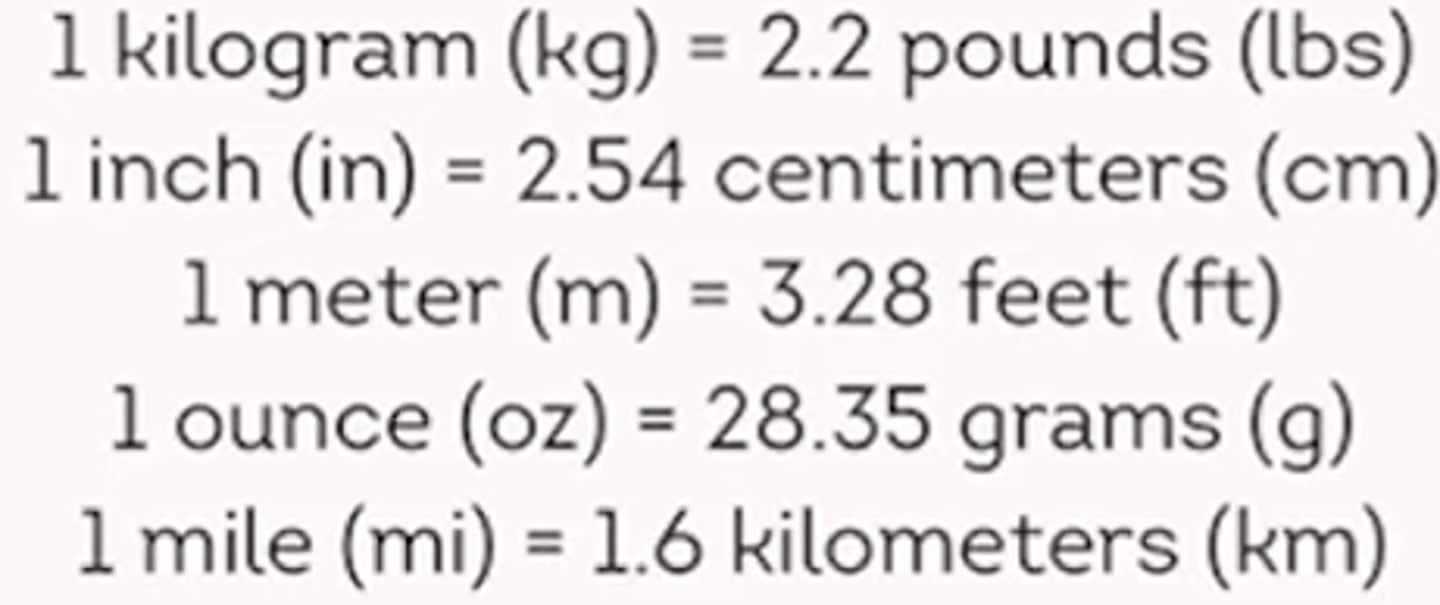
1 Kilogram (kg)
2.2 pounds (lbs)
1 Ich (in)
2.54 centimeters (cm)
1 Meter (m)
3.28 feet (ft)
1 Ounce (oz)
28.35 grams (g)
1 Mile (mi)
1.6 kilometers (km)
Converting from right to left: DIVIDE
Converting from left to right: MULTIPLY
Scientistic Measurement & Tools: Length and Distance
1. Ruler: measuring short, straight distances (length of pencil or book).
- 30 cm or 12 in
2. Tape Measure: measuring longer distances (length of a door or room).
- up to 25 feet
3. Calipers: precision instrument, measure the dimensions of smaller objects (diameter of ball bearing or thickness of a sheet metal).
Scientistic Measurement & Tools: Mass
1. Balance Scale: compares the mass of two objects (used in classrooms).
2. Digital Scale: precise measurement of the mass of an object. (used for ingredients in a recipe or chemicals in a Labatory).
3. Spring Scale: weight of an object using a force of gravity (used in grocery store to weigh produce).
Scientistic Measurement & Tools: Volume
1. Graduated Cylinder: measure volume of liquids with a high degree of accuracy in milliliters to liters (used in laboratories).
2. Measuring Cup: Measure liquids and solids (for baking and cooking purposes).
3. Pipette: to measure and transfer small amounts of liquids typically in milliliters or smaller (used in chemistry and biology).
How to scale measurements using the metric system:
Empirical Evidence
Information that is obtained through observation, experimentation, or other investigation processes.
- Used to support or counter a proposition, hypothesis, claim or statement.
- Needs to be observable and measurable.
Quanlitative
Involve descriptive or quality type of data.
- Found through observation of:
1. patterns
2. colors
3. textures
4. behaviors
Quantitative
Numerical data that is used to quantify variables and compare measurements.
- Found when it comes to:
1. length
2. height
3. frequency
4. quantity
Independent Variables
When a researcher manipulates to observe their effects on other variables.
- "THE CAUSE"
- INPUT
EXAMPLE: amount of sunlight a plant will receive during an experiment (full sun, partial sun, or full shade).
Dependent Variables
Measured to show how they respond to changes with the independent variable.
- THE "EFFECT"
- OUTPUT
EXAMPLE: plant growth in an experiment.
Controlled Variables
Conditions that are maintained consistently to ensure that any changes in the dependent variable are directly due to the manipulation of the independent variable.
EXAMPLE: ensuring all plants receive the same type of soil, same amount of water at the same frequency, and using the same species of plant).
Reproducible Results
Repeated experiment under the same condition yields, constantly similar results.
- Credible results.
- Reliable & valid evidence
Nonreproducible
Repeated experiments under the same condition yields, significantly varied results.
- Questionable results
Cause
Event or action that precipitates an outcome.
Indicator words: since, because, and/ or due.
EXAMPLE: Since it rained last night, the streets are wet.
Effect
The outcome or result.
Indicator words: consequently, therefore, and/or this leads to.
EXAMPLE: It rained heavily; Therefore, the baseball game was postponed.
Single Cause, Multiple Effects
One cause leading to several different outcomes.
EXAMPLE:
- Cause: forgetting to turn off water tap when leaving the house.
- Effect: flooded kitchen, high water bill, and damaged wooden floors.
Multiple Causes, Single Effect
Effect is the result of multiple causes.
EXAMPLE:
- Effect: Jane is exhausted.
- Cause: works long hours, new puppy causing no sleep, and training for a marathon.
Cause and Effect Chain
An effect from one scenario can become the cause of another creating a chain of events.
EXAMPLE:
- Initial cause: Alex studies diligently for his exam.
- 1st Effect: he scored top marks.
- 2nd Effect: high marks earned him a scholarship.
Scientific Method
The process of observing, asking questions, and seeking answers through test and experiments to establish facts.
STEPS:
1. Observation
2. Research
3. Hypothesis
4. Experiment
5. Conclusion
6. Share Results
Observation
Derived from sensory experiences about the natural word that can include seeing, tasting, touching, hearing, or smelling.
Research
Helps answer preliminary questions and refine experimentation, using reliable sources to learn background information.
- Important to consult reliable resources including scientific journals or accredited online databases.
- Steer clear of unverified blogs and outdated textbooks.
Hypothesis
A specific prediction about what is going to happen next.
- Structured as an IF (conditions part) and THEN (result) statement.
EXAMPLE: If bread is left exposed to moisture for one week, then it will develop mold.
Experiment
Involves several key components:
- qualitative data
- quantitative data
- variables (independent & dependent)
- experimental group
- control group (receives a placebo)
Conclusion
Critical step, where researchers interpret the data collected by the experiment.
- accessing weather results support the original hypothesis or some requires revised to the hypothesis.
Share Results
Sharing findings with the scientific community.
- Used through peer-reviewed journals, presenting at conferences, and accredited online databases.
- Essential for sharing results\.
Repetition & Verification
Scientific experiments need to be repeated to ensure that there is both reliability and accuracy.