Visual Acuity
 Call Kai
 Learn
Learn Practice Test
 Spaced Repetition
 Match
Match Flashcards
 Knowt Play
1/86

There's no tags or description
Looks like no tags are added yet.
Name | Mastery | Learn | Test | Matching | Spaced | Call with Kai | Chat |
|---|
No analytics yet
Send a link to your students to track their progress
87 Terms
To see clearly, the eye must focus the image of an object on what structure within the retina's macula?
fovea
The macula has a high density of which photoreceptors, which provide the best image for central vision?
cones
measure of how clearly your patient sees when looking directly at an objective; includes both central and peripheral vision
angular measurement relating testing distance to the minimal object size resolvable at that distance
visual acuity
different symbols used to identify the minimal object size that a patient sees when determining visual acuity (may be Cs, Es, different letters, or pictures)
optotypes
condition in which people see things well at all distances without visual correction
emmetropia
two terms for condition in which people see well when objects are close and less well when objects are far away
myopia, near-sighted
two terms for condition in which people see well when objects are at a distance but see less well when objects are close
far-sighted, hyperopia
normal age-related changes of the focusing system that causes near vision problems
presbyopia
You should expect your patients to have 20/20 vision or clearer at least up to what age?
**if they do NOT see 20/20, no matter the age, then you have to try to identify the cause for the reduced vision
50
What are the three main reasons for vision worse than 20/20?
refractive error, eye health problems, eye coordination problems
Eye coordination problems occur when the two eyes do not point simultaneously at an object, so the patient has an eye turn, called a what?
strabismus
If an eye turn is present all the time, and develops at a young age, this may lead to one form of "lazy" eye that can contribute to vision worse than 20/20, called what?
strabismic ambylopia
What are four types of visual acuity measurement?
visual recognition, detection, resolution, target localization
type of visual acuity measurement in which the patient must recognize or name a target, such as a letter
Example: Snellen eye chart
visual recognition ("minimum legible")
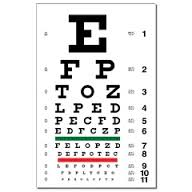
type of visual acuity measurement in which the patient must detect an object in the visual field on a contrasting background without naming or identifying what the object is
Example: white dot on blackground, black line on white background
detection (contrast discrimination)

type of visual acuity measurement in which the patient resolves two or more targets separated by space; as two lines or spots move closer to one another, this becomes increasingly difficult
Example: Patient discriminate the separation between critical elements of a stimulus pattern such as a pair of dots, a grating, or a checkerboard
resolution

type of visual acuity measurement that involves discriminating difference in the spatial segments of an object; also called Vernier acuity, and the differences in alignment are described in terms of the angle of displacement between the two targets
Example: discriminating differences such as a break in a line or alignment of dots
target localization

Target localization is also called what?
Vernier acuity
Out of visual recognition, visual resolution, localization, and detection, which is the most common method for clinically measuring VA?
visual recognition
refers to VA that defines the basic unit of measure for a letter optotype as the distance at which the letter subtends 5 minutes of arc
**minute of arc = unit of angular measurement equal to 1/60 of one degree - VERY small
Snellen acuity
Determining what the minimum legible is from a background is an example of what kind of acuity?
Snellen acuity
The 20/20 "E" optotype subtends how many minutes of arc at the retina of the normal eye?
**Hint: To see targets, the eye must be able to resolve 1' of arc.
5
What is the definition of VA in Snellen notation?
VA=viewing distance/distance at which each letter of a line subtends 5 minutes of arc
A 20/40 letter subtends 5 minutes of arc at what distance?
40 ft
(so the farther away the letters are getting, the bigger they're becoming)
Per Hermann Snellen's design, you measure distance VA at what distance? Many exam rooms are shorter than this length, so what do you do in this instance to achieve the equivalent of this viewing distance?
20 ft, use a mirror system or calibrate letter size of chart for test distance used
Some countries record VA in decimal notation (M units). In this method, 20/20 = 1.0; 20/40 = 0.5, etc. This is also a standard method of recording vision in what technique?
vision rehabilitation
If a patient has 20/40 vision, what exactly does this mean?
at 20 feet away, they can see what someone with normal vision sees at 40 feet away
(therefore, their vision is below average)
standard unit for visual acuity used as an alternative to Snellen optotypes so that patients can't guess letters; this symbol (proposed by its namesake) has only one element of detail, a gap, that varies in its orientation (top, bottom, right, left)
Landolt C

A 20/20 Landolt 'C' subtends 5' of arc at what distance?
20 feet
(gap in the C measures 1')
standard unit for visual acuity that is often used for recording near visual acuity; one of these subtends 5' of arc at 1 meter
M unit
Who came up with M units for near visual acuity? Therefore, what do we call the reduced Snellen VA chart that involves M units?
Louise Sloan, Sloan card
1 M-unit subtends 5' of arc at what distance?
1 meter
(n M units subtends 5' at n meters)
M numbers are useful for recording what kind of VA?
near
How do we find VA in M units?
VA=distance in meters/size of print in M number
How do we find Snellen VA using M units?
x=20/VA in M units, and then Snellen VA is 20/x
If a patient reads 2.0 M at 20 cm, what is the patient's Snellen equivalent visual acuity?
20/200
(0.2/2.0=0.1, and then 20/0.1=200, so 20/200)
When using the reduced Snellen near card, what distance should the chart be from the patient?
Note: The VA gathered from this card is ONLY accurate if it's at this distance!!
40 cm (16 in)
VA test for children that is useful because the symbols are easy to name and recognize; you can use this to play a "matching game" so that a child can indicate how well they're seeing
Lea symbols test
refers to a logarithmic spacing sequence in which the spacing between each letter and row considers the width and height of the letters in that row
**this layout standardizes the crowding effect and the number of errors that a patient can make in each line
Log-MAR
(MAR being minimum angle of resolution)
Who proposed a logarithmic progression in spacing on optotype charts in 1868? Who actually used this progression in a chart design in 1976?
John Green, Bailey and Lovie
In the 1980s, the Early Treatment Diabetic Retinopathy Study (ETDRS) promoted what style of VA chart as a standard for research methods?
log-MAR progression and Sloan optotypes
What are seven factors affecting visual acuity?
refractive error, pupil size, illumination, state of eye adaptation, time of exposure of the target, area of the retina stimulated, eye movement
How do refractive errors affect visual acuity?
create defocus at the retina
In a myopic eye, is the optical system too weak or too strong? Does the image focus in front of or behind the retina?
too strong, in front of
In a hyperopic eye, is the optical system too weak or too strong? Does the image focus in front of or behind the retina?
too weak, behind
What is the optimal pupil size for visual acuity?
3-5 mm
How does illumination affect visual acuity?
photoreceptors have different sensitivities at different illuminations
How does state of eye adaptation affect visual acuity?
rods function better in dim illumination, cones function better in brighter illumination
refers to rods functioning more optimally in dim illumination
scotopic (conditions)
How does time of exposure of the target affect visual acuity?
it is more important for some types of targets (such as line target of varying widths) rather than illuminated targets (which have varying brightness)
refers to cones functioning more optimally in bright illumination
photopic (conditions)
Visual acuity is the greatest at the center of fixation. At what distance from the center of fixation is there a measurable loss in visual acuity?
5' of arc
How does eye movement affect visual acuity?
retinal image is constantly moving at least 3' of arc per second
When do you perform visual acuity testing in the eye exam?
immediately following case history
Why do we perform VA testing immediately following collection of case history? (2 reasons)
you want to know how your patient sees (may influence what tests you do), you want to protect yourself legally (so they can't say you blinded them)
For a new patient, what VAs do we measure at a CEE?
(use sc, cc, OD, OS, and OU abbreviations)
sc then cc at distance and near for OD, OS, and OU
For an established patient, what VAs do we measure at a CEE? F/U?
(use sc, cc, DVO, NVO, OD, and OS abbreviations)
cc at distance and near for OD, OS, and OU at CEE, just cc at distance at F/U
Why should we measure the patient's unaided visual acuity before measuring their aided visual acuity?
to prevent them from just memorizing the chart
Why do we present patients with black, high contrast optotypes against a white background?
minimizes impact of room illumination
What are five applications of visual acuity once we determine it from a patient? We use VA to...
figure out optimal correction of refractive error, screen for ocular abnormalities, monitor the effects of disease, determine visual aids needed, estimate individual's ability to perform certain tasks
For near sighted patients, we expect ____ D increments of ____ power for each line of improvement in vision when conducting VA testing.
**does NOT apply to hyperopic patients under the age of 40 since these patients often use their accommodation to compensate for their refractive error
0.25, minus
(for example, if your patient has unaided VA of 20/30 caused by uncorrected myopia, you expect -0.50 DS to return the patient's vision to 20/20, since -0.25 DS to reach 20/25 and -0.50 DS total to reach 20/20)
Why is it important to always be watching your patient when testing VAs?
make sure they are covering up the eye not being tested and not squinting
When you measure visual acuity, you identify if your patient reads at least how much of the optotypes in a visual acuity line?
**they need at least this much to "get credit" for that line
50%
If a patient reads at least half of the 20/25 line and gets 2/5 of the letters correct on the 20/20 line, how do we record their VA?
20/25+2
If a patient reads 3/5 letters correctly on the 20/25 line but can't read any of the 20/20 letters, how do we record their VA?
20/25-2
When your patient has reduced vision at one viewing distance (far or near), then you can be confident that the reason for your patient's decrease in vision is due to what?
refractive error
When your patient has reduced vision at both viewing distances (far and near), then your patient's decrease in vision could be due to what?
refractive error or other issue (eye disease, lazy eye, etc)
If your patient has reduced vision at both viewing distances (far and near), then what tool do you use to help you identify if the problem might be a refractive error or something else?
pinhole occluder

When do you use a pinhole occluder?
when patient's vision is 20/40 or worse at BOTH distance and near with best correction
Do we use the pinhole occluder to test at distance, near, or both?
distance
How do we know if a refractive error is the issue that is causing our patient's decreased vision after they use the pinhole occluder?
their vision improves through the occluder
How do we know if an underlying condition (e.g., disease) is the issue that is causing your patient's decreased vision after they use the pinhole occluder?
their vision doesn't improve through the occluder
If a refractive error is present, how does the pinhole occluder improve vision?
decreases diameter of blur circle on the retina
(since pinhole allows fewer light rays to get through and therefore decreases light scattering)
If the patient's vision improves with the pinhole occluder, then you know that a refractive error is the issue at hand. If it's a problem with the cornea, then what tests can help you figure this out?
keratometry, biomicroscopy
chart that is useful for a patient who has reduced vision (low vision) or a patient with partial vision due to congenital or acquired eye problems; allows you to measure vision to levels of 20/1400
Feinbloom chart
If a patient is unable to read the largest letter on a visual acuity chart, then what five tests do we perform next (in order) to figure out how well/if they can see?
walk up acuity, finger counting, hand motion, light projection, light perception
How do we perform the walk up acuity test for patients that can't read anything on a VA chart?
escort patient toward chart and see when they can first identify the 20/400 optotype
(example: at 10 feet, this would be "20/400 @ 10'")
How do we perform the finger counting (FC) test for patients that can't read anything on a VA chart or see anything in walk up acuity?
hold up 1, 2, or 5 fingers 2 feet from the patient's face for them to identify
How do we perform the hand motion (HM) test for patients that can't read anything on a VA chart, see anything in walk up acuity, or count how many fingers you're holding up?
move your hand across patient's field of vision and ask them to identify if they can see the motion and in which direction
(top to bottom, left to right, etc)
How do we perform the light projection (LProj) test for patients that can't read anything on a VA chart, see anything in walk up acuity, count how many fingers you're holding up, or detect hand motion?
place transilluminator approximately 2 feet from the patient's face and ask if they can identify if it is on and where it's coming from
How do we determine light perception (LP) for patients that can't read anything on a VA chart, see anything in walk up acuity, count how many fingers you're holding up, detect hand motion, or detect light projection?
if patient can only identify that light is on but not its location
How do we designate an eye that has no ability to perceive light?
**includes amaurosis
NLP (no light perception)
What is legal blindness? (2 definitions)
VA is 20/200 or worse with best corrected vision in better seeing eye, maximum visual field diameter is 20 degrees or less in best eye regardless of VA
True or false: Legally blind implies WITH correction.
true
(so if someone says they are legally blind without their glasses, that's technically incorrect)
Our patient is 61 years old and complains of blur in OS D & N for the past two weeks. VA cc is:
OD (D) 20/30
(N) 0.5 M @ 40 cm
OS: LProj PHNI UTT (unable to test VAs, unable to get a reading)
Is their decreased VA likely due to a refractive error? Are they legally blind?
no, maybe
(pinhole no improvement so not a refractive error, maybe legally blind since we haven't tested visual field yet and that may be very limited)
Our patient is 13 years old and failed a vision screening. VA sc is:
OD (D) 20/40-2
(N) 0.4 M @ 40 cm
OS (D) 20/30+1
(N) 0.4 M @ 40 cm
What is the most likely cause of this patient's refractive error?
myopia
(20/20 at near, but reduced vision at distance)
Our patient is 23 years old and has lost their glasses. VA sc is:
OD (D) 20/50 PH 20/25
(N) 1 M @ 40 cm
OS (D) 20/60 PH 20/25
(N) 1 M @ 40 cm
What is the most likely cause of this patient's refractive error?
astigmatism
(PH improves distance vision, and near is also 20/50, so overall blurry vision at distance and near is probably astigmatism)