CH 2 Comprehensive Guide to Research Process in Psychology and Scientific Method
 Call Kai
 Learn
Learn Practice Test
 Spaced Repetition
 Match
Match Flashcards
 Knowt Play
1/53

There's no tags or description
Looks like no tags are added yet.
Name | Mastery | Learn | Test | Matching | Spaced | Call with Kai | Chat |
|---|
No analytics yet
Send a link to your students to track their progress
54 Terms
What is a research question?
An inquiry that a researcher aims to answer through observation and examination.
How is a research question typically created?
Through observation of the world.
Why is creating a research question important?
It helps researchers develop their study.
What makes a research question interesting?
It should make you passionate, provoke thought, encourage discussion, challenge assumptions, and be grounded in human experience.
What does it mean for a research question to be empirical?
It can be tested using direct and indirect observations or experiences.
What are the FINER criteria for a good research question?
Feasible, Interesting, Novel, Ethical, Relevant.
What does 'feasible' mean in the context of research questions?
It should be realistic and practical to answer.
What is a primary source?
A first-hand account of a research finding created by someone who directly examined the topic.
What is a secondary source?
A second-hand account of a research finding created by someone who did not examine the topic.
What is a peer-reviewed journal article?
An article evaluated and reviewed by experts in the field before publication.
What is the process of peer review?
Experts evaluate the quality of research reported in an article before it is published.
What is a research report?
A description of an empirical research study, including how data were collected, analyzed, and interpreted.
What is a systematic review?
A review of the literature that synthesizes the research evidence on a topic.
What is a meta-analysis?
A statistical analysis that compares and combines the results of individual, similar studies.
What is a hypothesis?
An educated prediction that provides a testable explanation of a phenomenon.
What distinguishes a scientific law from a hypothesis?
A scientific law describes what happened based on repeated observations, while a hypothesis explains why it occurred.
What is introspection in hypothesis generation?
Engaging in self-observation to identify factors influencing the variable of interest.
What does 'finding the exception to the rule' mean in hypothesis generation?
Generating hypotheses that describe instances that are exceptions to typical findings in existing literature.
What should a good hypothesis correspond to?
Reality, be simple and direct, specific, and falsifiable.
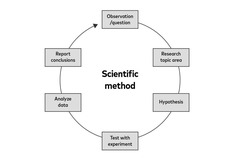
What are the key steps in testing a hypothesis?
Identify key variables, choose research design, conduct the study, analyze data, draw conclusions, communicate findings.
What are variables in research?
Factors or elements that are expected to change or vary.
What is a constant (or control variable)?
Variables that don't change within a study.
What is a conceptual definition?
A definition of a variable in theoretical terms.
What is an operational definition?
A representation of how variables will be used in a study.
What is experimental design in research?
A method where the experimenter controls and manipulates the independent variable to establish cause-and-effect relationships.
What is an independent variable (IV)?
A variable that influences another variable and is controlled to examine the cause-and-effect relationship.
What is a dependent variable (DV)?
A variable that is influenced by varying another variable.
What are extraneous variables?
Variables that are not the focus of the study but can influence the dependent variable.
What is the purpose of controlling extraneous variables?
To ensure that they do not influence the dependent variable.
What is a control variable?
A variable that is not the study of interest and does not influence the dependent variable.
What is the difference between within-subjects and between-subjects designs?
Within-subjects design exposes participants to all conditions, while between-subjects design exposes participants to one condition.
What is a nonexperimental design?
A design where there is no manipulation of the independent variable and no examination of cause-and-effect relationships.
What is correlational research?
Research that finds statistical relationships between two variables without implying causation.
What is observational research?
Research that observes the phenomenon of interest in a laboratory or natural setting.
What is survey research?
Research that collects data using questionnaires or interviews.

What is programmatic research?
A systematic and planned sequence of related studies that build on previous findings.
What is informed consent?
A part of standard ethical procedures where participants learn about the study's expectations, risks, and benefits before agreeing to participate.
What is debriefing in research?
An explanation of the study's purpose and disclosure of any deception, allowing participants to ask questions after the study.
What is the purpose of statistical analysis in research?
To avoid biased thinking, detect patterns in data, and transform data into numerical values.
What are the two main types of data?
Quantitative (numerical) data and qualitative (non-numerical) data.
What is discrete data?
Data that is countable, such as the number of students in a class.
What is continuous data?
Data that is measurable, such as height or temperature.
What is the difference between nominal and ordinal data?
Nominal data has no rank or order, while ordinal data is ranked or ordered.
What is interval data?
Data with no absolute zero, such as temperature.
What is ratio data?
Data that has an absolute zero, such as height.
What are parametric tests?
Statistical tests used for interval and ratio data, such as t-tests and ANOVA.
What are non-parametric tests?
Statistical tests used for nominal and ordinal data, such as the chi-squared test.
What is the significance of reporting research findings?
To publish research papers and present at conferences, sharing results with the academic community.
What is included in an APA style research paper?
Title page, abstract, main body, introduction, method, results, discussion, conclusion, and references.

What is the purpose of the abstract in a research paper?
To provide a brief summary of the research report, typically 120 to 250 words.
What should the introduction of a research paper include?
Background information about the research study.
What is the method section of a research paper?
A description of how the study was conducted.
What does the results section of a research paper provide?
The results of the statistical analysis, including figures and tables.
What is the purpose of the discussion section in a research paper?
To interpret the findings and provide an overview of the paper.