Unit Review - Human Origins and Ancient Mesopotamia Vocabulary Study Guide
 Call Kai
 Learn
Learn Practice Test
 Spaced Repetition
 Match
Match Flashcards
 Knowt Play
1/38

Earn XP
Description and Tags
Vocabulary flashcards covering time designations, hunter-gatherer societies, the agricultural revolution, characteristics of civilization, Mesopotamian geography, advancements, and the GRAPES framework.
Name | Mastery | Learn | Test | Matching | Spaced | Call with Kai | Chat |
|---|
No analytics yet
Send a link to your students to track their progress
39 Terms
BC / BCE
BC (Before Christ) / BCE (Before Common Era) count backward from year 0, meaning larger numbers represent dates farther back in time.
AD / CE
AD (Anno Domini) / CE (Common Era) count forward from year 0, meaning larger numbers represent more recent dates.
Circa
A term (abbreviated c. or ca.) meaning 'around/approximately' used by historians when exact dates are uncertain.
Decade
A period of 10 years.
Century
A period of 100 years, named one higher than the first digits.
Archaeologist
A scientist who studies the past by digging up and examining objects left behind by people.
Artifact
An object made or used by people in the past.
Hunter-Gatherer
A person who gets food by hunting animals and gathering plants.
Nomad
People who move from place to place to find food.
Paleolithic (Old Stone Age)
The time period when early humans used stone tools and lived as hunter-gatherers.
Agricultural Revolution (Neolithic)
The era (New Stone Age) when people learned to grow crops and domesticate animals instead of only hunting and gathering.
Domestication
Taming plants or animals so people can use them for food, clothing, or labor.
Food Surplus
Extra food beyond what a group needs right away.
Labor Specialization
When not everyone has to farm, so some people become skilled at other jobs (like pottery or tool-making) instead.
Barter Economy
Trading goods or services directly, without using money.
Culture
The shared way of life, customs, art, music, and traditions a group of people passes down over time.
Government
A system that organizes and regulates people by making laws, keeping order, and providing defense.
Religion
A set of beliefs, usually in a god or gods, along with rituals like prayers and ceremonies.
Social Structure
The levels/classes in a society, with rulers and priests at the top, free workers in the middle, and enslaved people at the bottom.
Stable Food Supply
Having enough food to survive AND extra for trade, which lets people perform jobs other than farming.
Technology
Tools, inventions, and processes that make life easier (such as fire-starters, the wheel, irrigation, calendars, etc.).
Writing
Symbols and signs put together to record information and preserve stories.
Mesopotamia
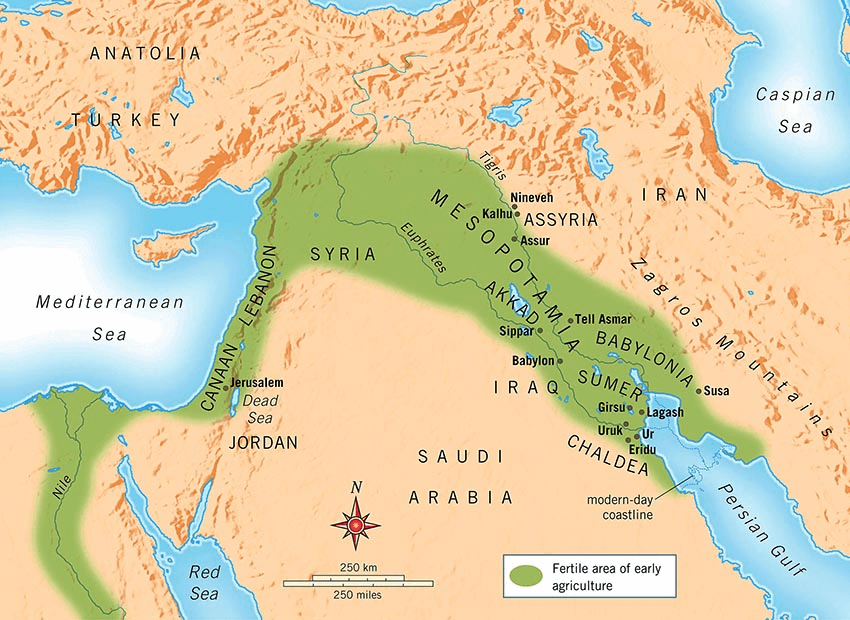
Greek for 'land between the rivers,' located between the Tigris and Euphrates Rivers in modern-day Iraq.
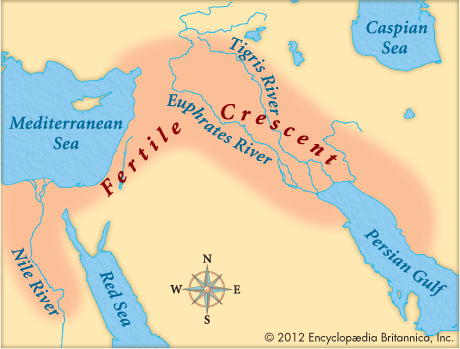
Fertile Crescent
A curved strip of fertile land good for farming, surrounded by desert.
Tigris River
The eastern river of Mesopotamia, featuring a faster, deeper current and measuring about 1,850 km long.

Euphrates River
The western river of Mesopotamia, which is slower, wider, and about 2,800 km long.

Persian Gulf
Body of water at the southeastern edge of Mesopotamia into which both rivers empty; key for trade with India.
Mediterranean Sea
Western boundary of Mesopotamia that served as a major trade route to Egypt and Greece.

Zagros Mountains
Mountain range on the eastern edge of Mesopotamia that blocks invaders and catches rain clouds for farming.

Irrigation
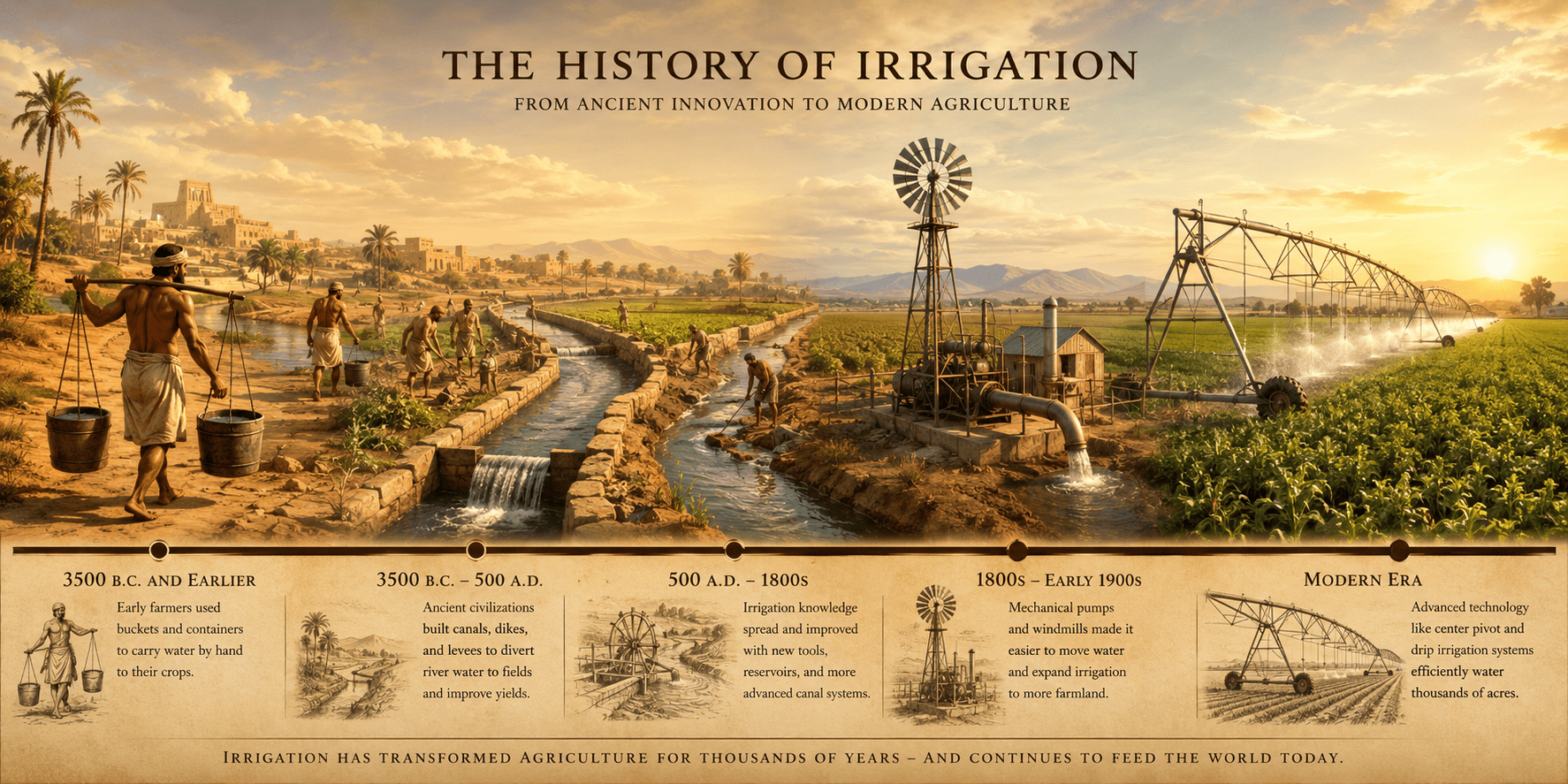
Man-made canals or ditches that move river water out to crops away from the river.
Metallurgy
Working with metals to make stronger tools and weapons instead of just stone.

Plow
A tool (often animal-pulled) that breaks up soil so seeds plant faster and deeper.

Wheel
Invention created in Mesopotamia used for carts and pottery to move goods and people faster.

Sail
Invention that allowed boats to use wind power on rivers for faster, easier trade and travel.

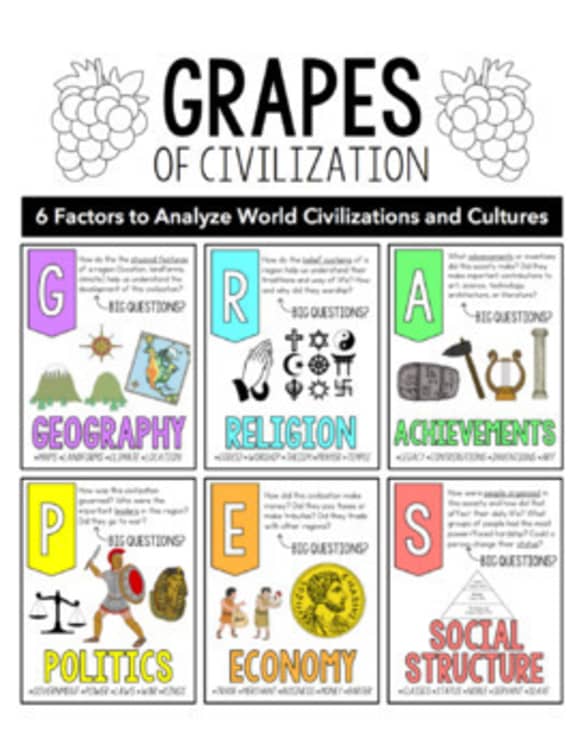
Geography (GRAPES)
The landforms, rivers, and climate of a region, and how they shaped where and how people lived.
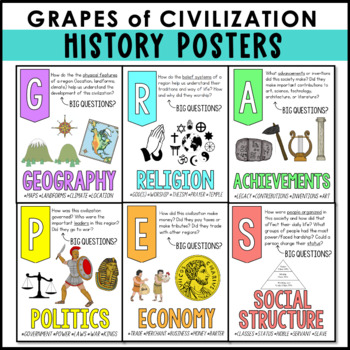
Achievements (GRAPES)
A civilization's inventions and lasting accomplishments (like the wheel or writing).
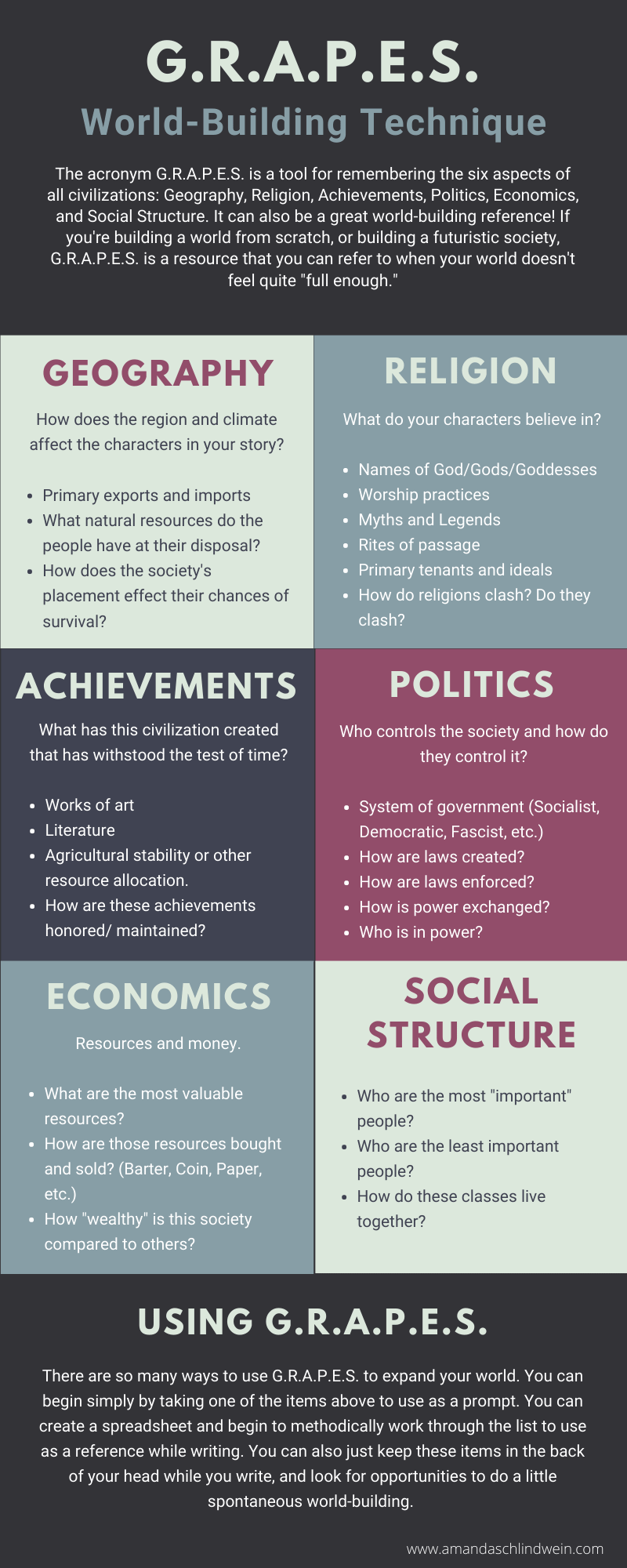
Political Structure (GRAPES)
The government and power structure of a society—who is in charge and how.
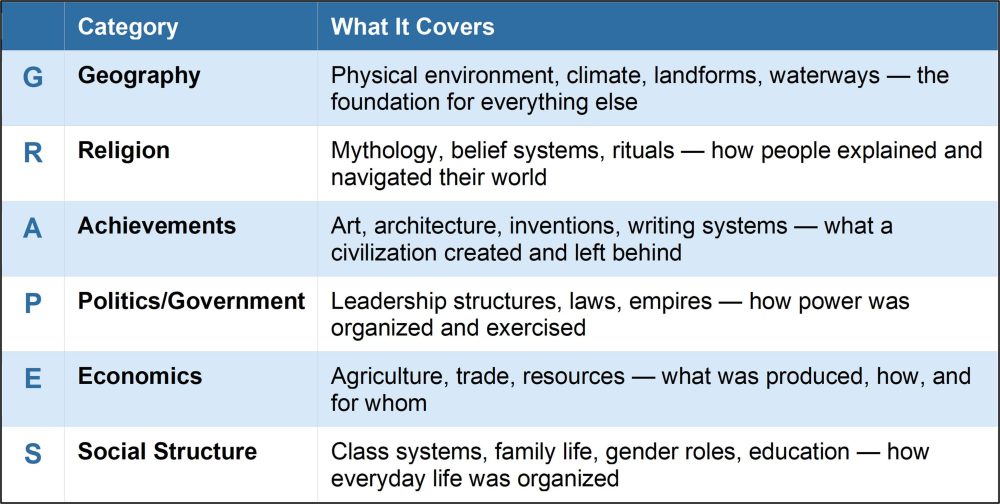
Economy (GRAPES)
How a society uses its resources, including goods, trade, and money on a whole-civilization scale.
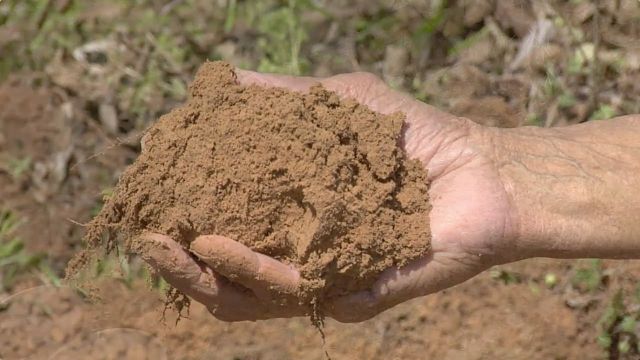
Silt
Rich mud left behind by annual river flooding that makes desert soil fertile enough to farm.