Marine Biology Exam 3
 Studied by 0 people
 Call Kai
 Learn
Learn Practice Test
 Spaced Repetition
 Match
Match Flashcards
 Knowt Play
1/88

There's no tags or description
Looks like no tags are added yet.
Name | Mastery | Learn | Test | Matching | Spaced |
|---|
No study sessions yet.
89 Terms
Big plant habitats
1) kelp forests
2) sea grasses
3) salt marshes
4) mangroves
kelp types and features
brown algae
1) laminaria: east coast
2) macrocystis: west coast
- grow large and fast: 10-45 m, cm per day
- undifferentiated cells but complex structure
- in coastal, shallow, clear, nutrient rich, cold water
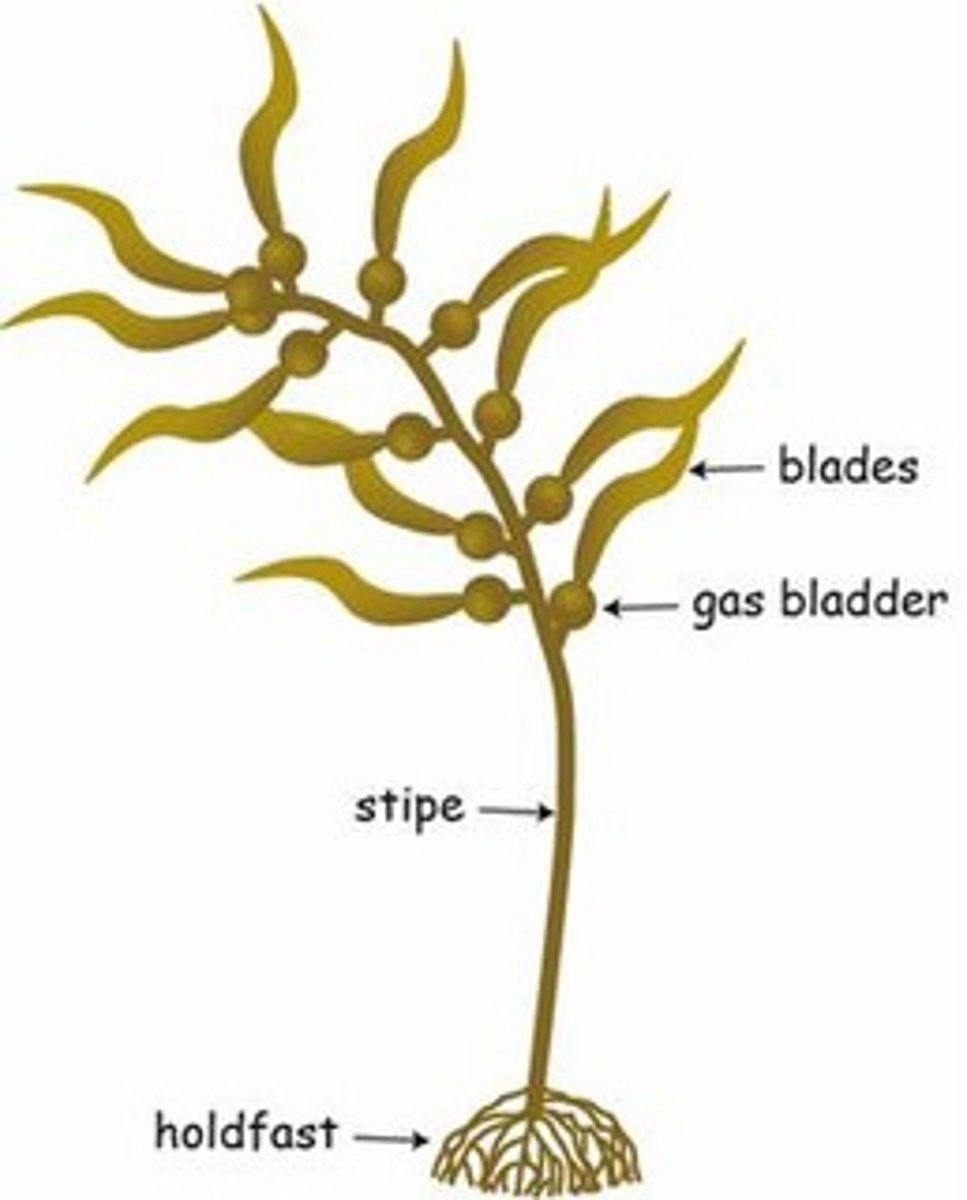
kelp structure
1) holdfast: near roots, dont draw nutrients/water
2) Stipe
3) Gas bladder: air filled, maintain buoyancy
4) Blades: high SA to collect light
kelp ecological roles
- Detritus supports deposit feeders + rest of detritus based food web
- Canopy provides structure for other seaweeds, inverts, fish (understory)
- Commercial uses: alginate + other food ingredients
keystone predator in kelp forests
sea otters
- Eat sea urchins which graze on kelp
- w/out them, urchins expand a ton and kelp is heavily reduced
maine ex) cod eat urchins
- crabs eating urchin, pops drop
- prevents recovery of sea urchins and maybe cod
macroalgae
Other "seaweed"
1) Sea lettuce (ulva lactuca)
2) Sargassum (sargassum)
grasses
1) sea grasses
2) marsh grasses
3) higher/vascular plants
4) C4 plants
eelgrass
Zostera marina
- 1 cm wide, up to 1 m long
- in clear shallow water
eelgrass ecological role
1) Support aquatic food webs
2) Structures the habitat
3) Spawning ground
4) Protection for atlantic cod juveniles
5)Food source for manatees, turtles
6) Stabilizes sediment through rhizomes
sea grass decline
- vulnerable to eutrophication: phytoplankton and epiphytes shade sea grasses
- Overfishing may result in reduced grazing and overgrowth or epiphytes which smother sea grasses (trophic cascade)
- Dredging and boat traffic
- Disease caused by fungus
salt marshes are dominated by...
why are salt marshes important
marsh grasses
- spartina alterniflora, spartina patens
- vertical zonation of species
1) High pp per area (higher than other ecosystems)
2) Base of food webs
3) Commercial fish depend on salt marshes for part/all of development
4) Wading birds (egrets, herons) feed in marshes during summer
5) Protect coastal areas from storms
6) Minimize soil erosion
7) Clean water by filtering sediments, nutrients, heavy metals, and other toxins from upland runoff
spartina
- ecosystem engineer
- complex rhizome system
- interconnected plants
- binds fine sediment + builds up meadows above low water
- anoxic and oxic layered sediment
- parenchymal tissue allows gas exchange in anoxic soil
salt marsh creek species
- fiddler crabs: burrows enhance spartina growth ( by aerating sediment)
- mummichog: connects coast to deep waters, can tolerate low O2 and salinity
creeks
- important for fish and fisheries
- support lots of inverts
phragmites
- invasive form: haplotype M?
- grows quickly, responds to high nutrients: more N promotes growth (+ less spartina)
issues
- changes structure of marsh
- Eliminates small intertidal channels
- Too dense for birds, mammals
- Raises marsh elevation, reducing saltwater flow + nutrient inputs
- Fire danger
mangroves (name and characteristics)
rizophora!
- tropical/subtropical
- 16 C water temp minimum
- highly productive
- 70 species
mangrove characteristics
1) anoxic mud
- Broadly rooted plants but only shallow depth in anoxic soils
- Projects into air that allows access to o2
2) salty water
- Halophytes: Able to grow in high salt concentrations
- Leaves have a salt gland which can excrete salt from cell systole to leaf surface
3) highly productive
- Detritus from leaves supports large diverse food web
- Structure/habitat for many organisms: mud crabs, pelicans
problems facing mangroves
- shoreline development
- sea level rise
- shrimp farms/maricultures
common features of big plants
- Detritus from large plants support food webs
- All provide physical structure: ecosystem engineers
- nurseries: Positive effect of structure on density, growth, or survival of juveniles
coral reefs background
- Diverse + ecologically complex
- in tropical, clear, well lit, warm, nutrient poor waters
- Formed via deposition of CaCO3
- Animal + plant symbiosis, very high pp
history
- 500 mill+ yrs
- GBR = largest living thing
reef building
Ca2+ + CO32- = CaCO3
1) aragonite structure
- corals
- calcareous green algae
2) calcite structure
- coralline red algae
single polyp→ colony → reef
coral reef importance
1) Ecotourism, pet exotic trade
2) Food for fisherman/coastal communities
3) Shoreline protection
4) Bioprospecting: medicines, biochemicals
5) Model system for exploring general ecological principles
6) Time capsules of past environmental conditions
7) Stable isotopes in CaCO3 examined over time
coral environmental characteristics
1) Develop with continental margins or islands
2) Most shallower than 25 m
3) Bounded by 20 C isotherm: exclusively tropical
4) Clear water, no turbidity or sedimentation
5) Require high salinity
6) light needed for photosynthesis
- stenothermal corals
- hermatypic corals
- ahermatypic corals
sensitive to small changes in temp
- live near upper limit
- small shifts may result in bleaching
- low temps inhibit reef formation: below 18-20 C, erosion> deposition/accretion
- ENSO events have influence
hermatypic = reef building coral
ahermatypic = non reef building coral
deep sea corals
- Up to 6000 m deep
- No light, not dependent on photosynthesis (heterotrophic)
- Trap particles for food
- Much colder, down to -1 C
- Widely distributed, more than 3000 species (Even off coast of antarctica)
coral zonation
- determined by depth
- bc of caring light conditions
- morphologies determined by wave action, species, and environment
coral taxonomy
- Phylum cnidaria, class anthozoa
- Related to sea anemones, jellyfish, et.
- morphological plasticity: Many morphologies
coral diversity hotspot
Indo-pacific
- 500 reef building species in pacific (Atlantic only 75)
hypotheses
1) Indo-pacific geologically older and more stable
2) Indo pacific source of all coral forms (Center of origin not valid)
3) Indo-pacific is bigger: island biogeography hypotheses
Darwins paradox
how can such a diverse, productive system exist in such oligotrophic waters?
- Reefs highly efficient in retaining and recycling nutrients
- Corals take up dissolved nutrients and feed on zooplankton from water
nutrient/production in corals
corals are mixotrophs:
1) feed on plankton
*not all corals are symbioses
2) sybiodinium (+ other genera)
- 30,000 cells in coral tissue
- reefs have highest pp on planet (1500-5000 g C m-2 yr-1)
- efficient recycling
coral gets: 95% C fixed by algae
algae gets: light, CO2, NH4, P, protection (lack of theca structure in algae while in coral)
problems impacting corals
1) Sedimentation from coastal development
2) Overfishing and over harvesting of corals and reef organisms
3) Coral diseases
4) Ocean warming, ocean acidification
coral disease
- White band disease
- White plaque
- White pox disease
- Yellow band disease
- Black band disease: most prevalent,
- cyanobacteria and sulfate reducing/oxidizing bacteria
stony coral tissue loss disease
- florida --> 18 countries
- causes: unknown, but pathogenic bacteria are involved
- infectous
polar systems: defining features
1) high latitude
- N/S of 66 degrees
2) Cold
3) Strong seasonal changes in
- Light
- Temperature
- Ice cover
4) Strong seasonality in primary productivity
arctic vs antarctic
Arctic: ocean covered by thin layer of perennial sea ice, surrounded by land
- Very deep
- linked with climate systems around it
- More sensitive to climate changes than antarctica
Antarctica: continent covered by thick ice cap
- Surrounded by rim of sea ice and southern ocean
arctic productivity
- short high productivity season
- seasonal ice melt: access to nutrients, light reaches deeper into water column
nutrient sources
1) water column
2) river run off
3) ice scraping of sediment, release during annual melt
food webs + productivity
- seasonally high productivity = flux to benthos
- high nutrients = diatoms
- shorter trophic levels, better efficiency
ice coverage
- Dynamic: seasonal melt in both arctic and antarctic
- limits light penetration
- Ice associated algae
- melt releases algae and nutrients
- Spatially concentrated
krill
- Dominate near ice edge (nearshore)
- Play crucial role in food webs (whale food)
- Fecal pellets important part of POC flux
Euphausia superba: antarctica
- Shrimplike, herbivorous, zooplankton
- Circumpolar distribution
- 5-6 years, reach 65 mm
- Strong swimmers
- biomass 215-380 million tons
- Important in nutrient cycling, especially iron (limiting nutrient)
whale driven Fe cycling
Whales eat iron rich prey, convert into blubber, defecate out iron and it re enters the water column
- enhances phytoplankton growth
- removal of whales shifts nutrient cycling
- 1 million whales killed in southern ocean: would have consumed 400 million tons of krill/year
RECYCLING Fe BACK INTO WATER COLUMN
*also aid in mixing via tail movements
Penguins
- limited to S hemisphere
- highly adapted to environment
1) thick fat layer
2) specialized feathers
- wings = short flippers
- tail/feet = rudder
- can dive 250 m
*only puffins in arctic
polar bears
Ursus maritimus
- exclusivly arctic: canada, Norway, russia, USA
- evolved from brown bears
- top predators: eat seals
- protected species
tied to sea ice
- pregnant bears use maternity dens off ice
- has moved landward as ice thinned
Antarctica/arctic access
Antarctica
- travel boat or plane
- USA: 700 ppl per year
- palmer, mcmurdo, Amundsen Scott
arctic
- land or ship based
- some ships overwinter in ice
climate change impacts
Greatest effects at high latitudes
1) loss of sea ice, especially arctic
2) shifts in pp: Increasing due to longer season, more light getting deeper into ocean
- May shift if melting leads to stratification and limits to nutrient availability
3) shifts in species distribution
- already happening
- concerns for ice obligate organisms, invasions
dead zones
- hypoxic or anoxic areas
- driven by nutrient over enrichment
- steep increase in dead areas
optimal O2 concentrations
Normoxia: 8 mg/L
Hypoxia: < 2 mg/L
General fish level: 3 mg/L
ex) shad: 5 mg/L
ex) striped bass: 5 mg/L
ex) mummichog: 1 mg/L
which species has great mechanisms for dealing with low O2?
fundulus good at this
1) Efficient at getting O2 from low O2 waters
2) Anaerobic metabolism
3) Reduce activity
4) Changes in behavior
Efficient at getting O2 from low O2 waters
anatomy:
- Gills covered by operculum
- Ventilates gills by alternating opening mouth and operculum
- Hematocrit = volume % of RBC in blood
efficiency:
1) increase SA of gill lamellae
2) Increase the stroke volume and/or ventilation frequency of opercular pumps
3) Countercurrent exchange: maintains large gradient in O2, Blood/water flows in opposite directions, equilibrium never reached
4) Higher hematocrit levels in long term hypoxia (high RBC levels)
Anaerobic metabolism
Aerobic metabolism: Glucose + 6O2 → 6CO2 + 6H2O + 36 ATP
- Oxygen is final electron acceptor
Anaerobic metabolism: Glucose → 2 lactates + 2CO2 + 2ATP
- inorganic molecule is e- acceptor
- Need a lot more stored food when O is low
- fundulus: possible bc of glycogen stores
Reduce activity
Lower growth and reproduction
Changes in behavior
Aquatic surface respiration (ASR): fish get O2 from top layer of water
- not Ariel respiration (getting o2 from atmosphere)
cost: more vulnerable to predators
benefit: breathing from the most oxygenated water possible
hypoxia cycling
Diel cycle driven by photosynthesis
- Increase in O2 during day bc of photosynthesis
- Decrease in O2 at night bc of respiration
ex) diel cycling in DE creek
hypoxia impacts on reproduction
1) Reduced growth
2) Reduced egg production
3) Reduced gonadal tissue
4) Masculinization: F turn into M
5) Epigenetic effects: heritable changes in gene function that dont have to do with changes to DNA
ex) oysters, croakers
Estuarine acidification
cause by diel cycling hypoxia
- Pp > respiration: pH increases
- Respiration > pp: pH decreases
Estuarine acidification: CO2 from respiration
Ocean acidification: CO2 from atmosphere
fish reproduction
- spawning stock
- recruitment
- unit stock
Spawning → eggs → larvae → juvenile → adult
Spawning stock: weight of all individuals in fish stock that have reached sexual maturity and can reproduce
Recruitment: considered recruited to a nursery when they are large enough to be fished
Unit stock: reasonable strict breeding group of one species of fish
high pp = high fisheries areas
CPUE = catch per unit effort
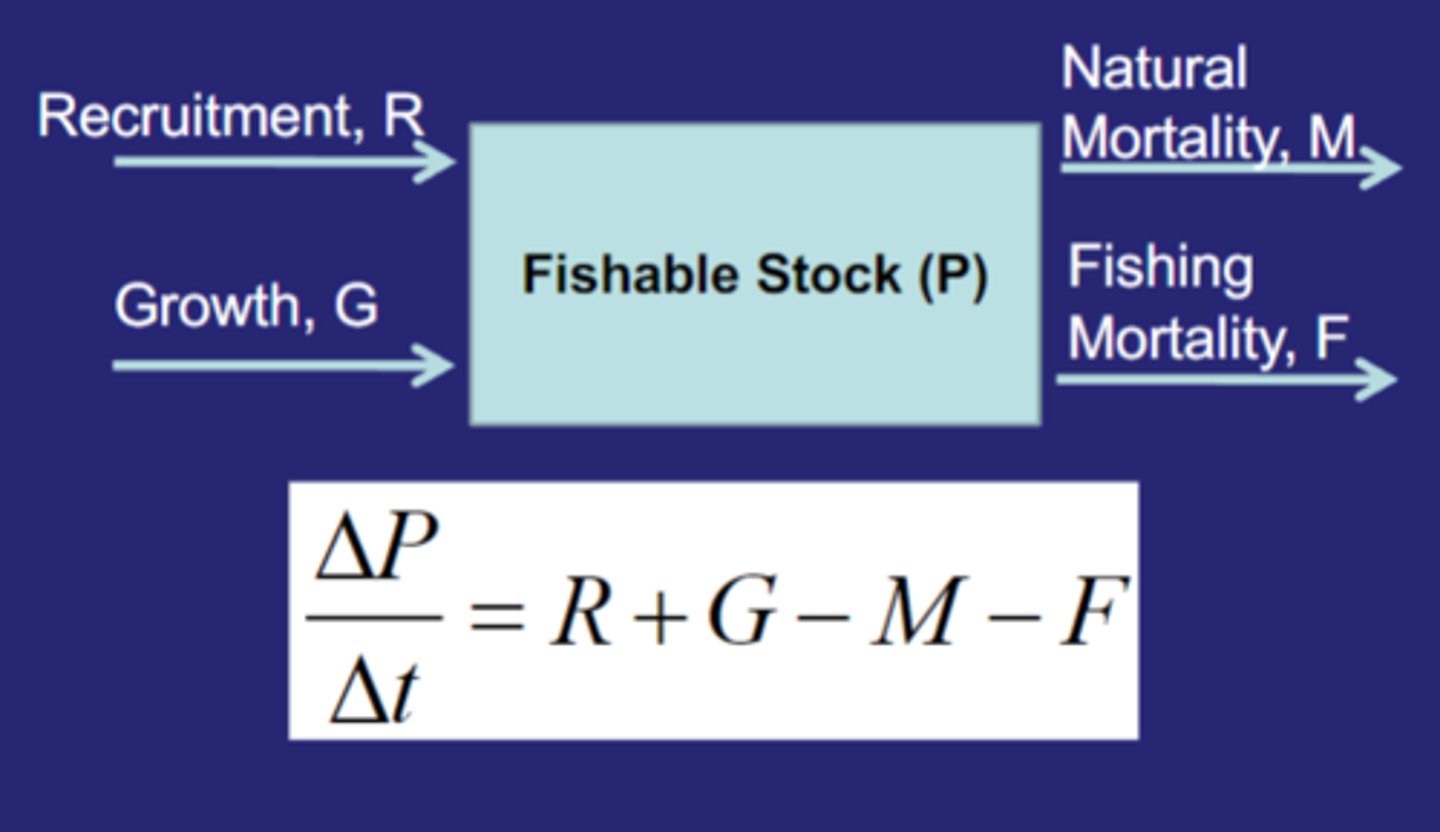
Stock size controls
Gains
- Recruitment R
- Growth G
Losses
- Natural mortality M
- Fishing mortality F
recruitment depends on...
1) # eggs layed
2) Hatching success
3) Retention in suitable habitat
4) Survival to appropriate size
survival depends on...
1) Temperature
2) Speed and direction of currents
3) Availability of food
4) Activity of predators
5) Habitat carrying capacity
Ricker curve
- Stock in previous year vs recruitment
- Decrease due to intraspecific competition for limiting resources
growth rates + fishing
complicated model
- rates differ: depends on age class structure and life history
- desired age class varies with fish
- age dependent mortality and age dependent survival/reproduction
fishing
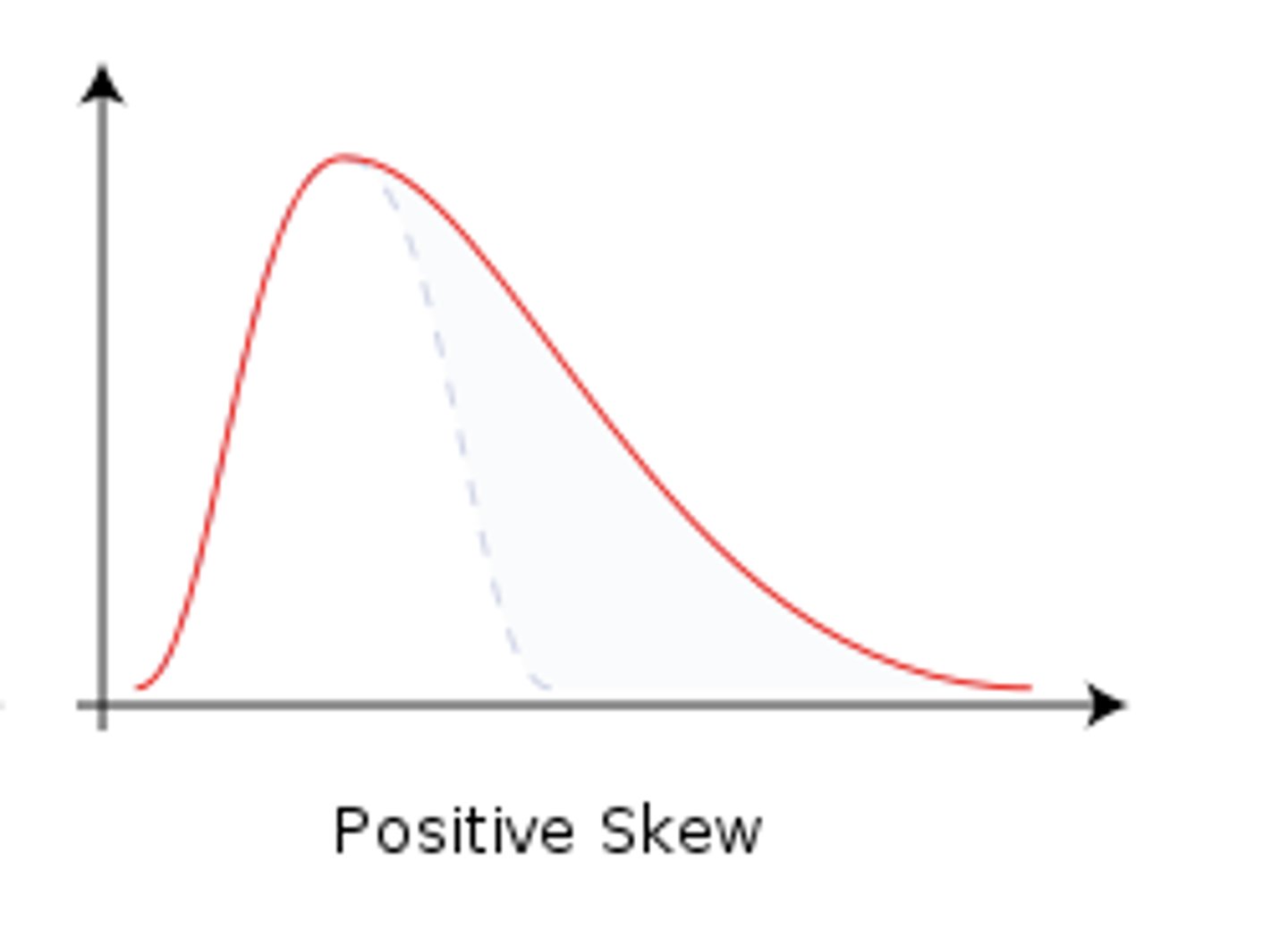
- fisheries select for largest and oldest fish
- intense fishing shifts age structure of pop towards younger and smaller
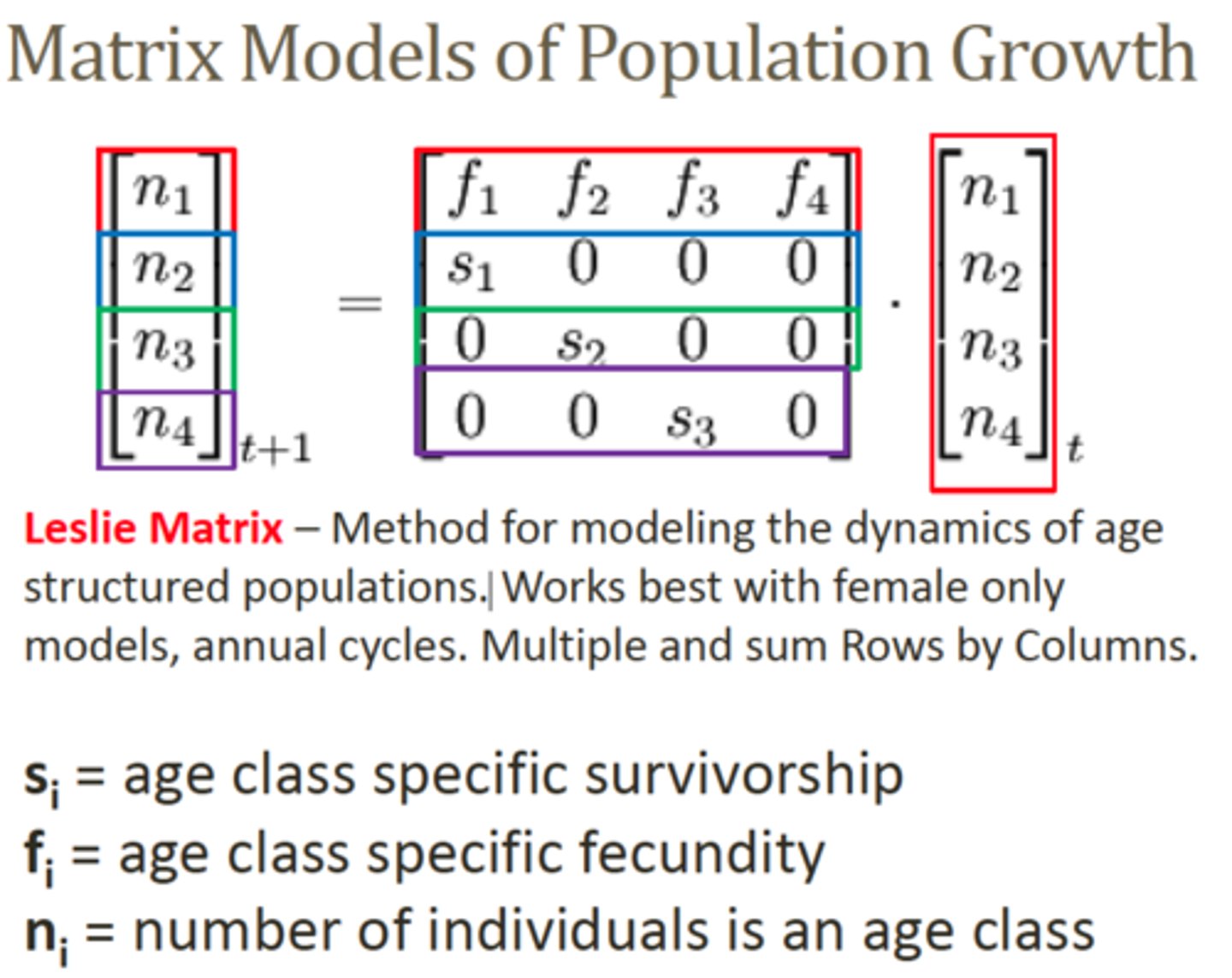
Leslie matrix
change in total fish pop depends on age class structure (accounts for age class differences and mortality)
X_ = age class
S = survival
R = reproduction
T = time
shifting baseline
- when scientists take the current degraded state as the baseline for stock biomass rather than the historical ecological abundance
- no sense of true scale
natural mortality vs fishery mortality
natural
- least well known
- estimate via mark/recapture
fishery
- Yield = amount of catch delivered to buyers
- Most prominent concern among fishers
maximum sustainable yield
MSY: most fish that can be harvested w/out negative impacts on fish production
- Fish could be harvested indefinitely at the MSY
- exists as a goal
reality:
- need to overexploit to find MSY, will overshoot before its found
- fisherman want $, will fish over MSY for optimal cost
MSY calculation
via ricker curve
N(t+1) = Nt e ^(r(1-Nt/K))
Nt = # at time t
r = intrinsic growth rate
K = carrying capacity
logistic growth
dN/dt=rN(K-N/K)
- dN/dt = 0, no more growth (N=K)
- dN/dt = rN, exponential growth (N<
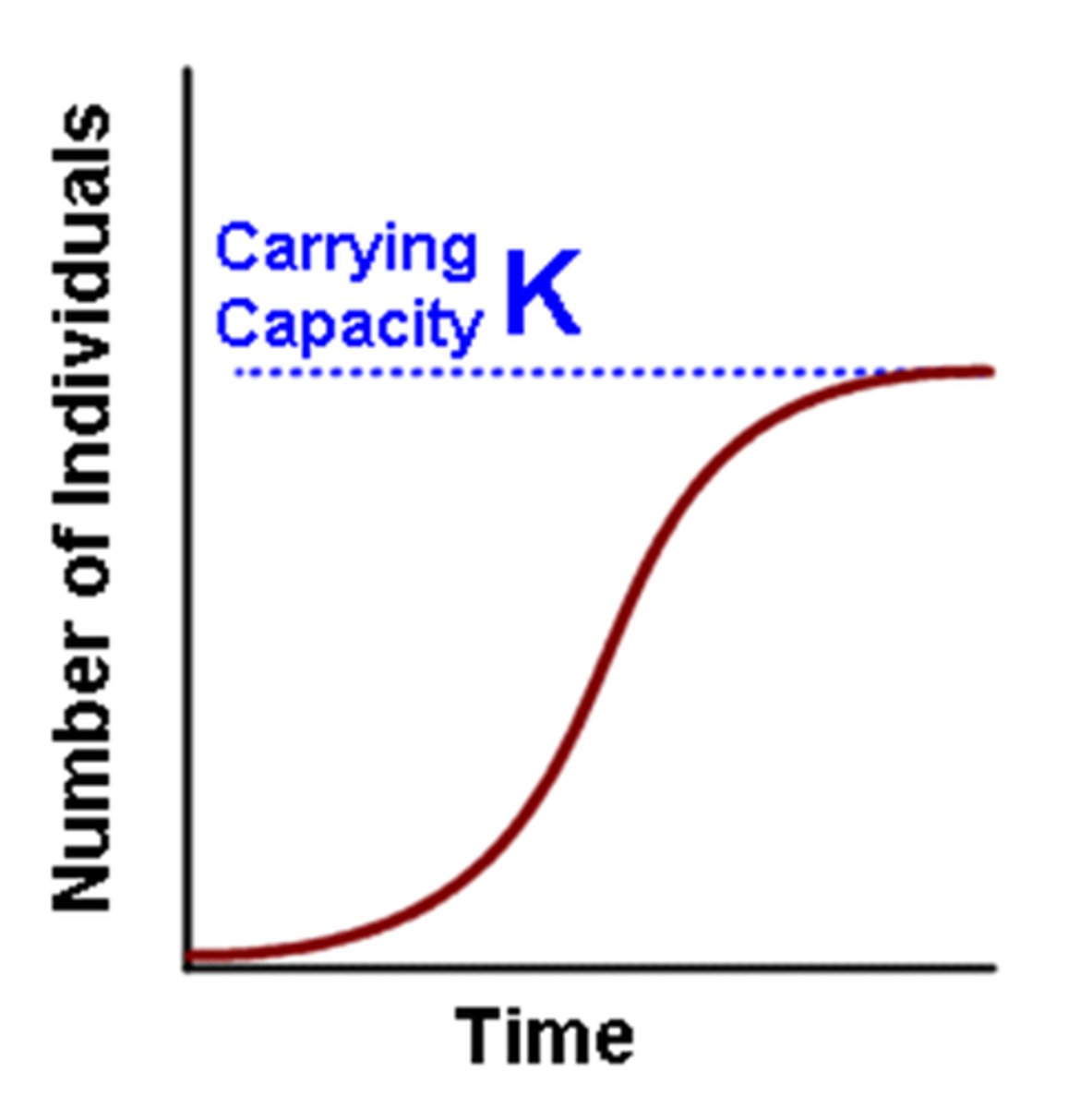
What stock (N) gives the highest change dN/dt (highest yield)?
Want to fish at half the carrying capacity (K/2)
fishery assessment models
complex: past catch data combined w/ biological factors + other info
1) Fish life history: natural mortality, length and age at maturity, growth rate
2) Catch: landings, gear selectivity, discards
3) Effort: days fished and number of hooks
4) Management controls: fleet allocations, allowable catch
overfishing
- Biomass of apex fish is decreasing
- bc of technological advances
1) satelite sensing
2) seining, trawling, long lining
- result: fishing down the food chain
- some attempt to reduce bycatch
complications in ecosystem managment
1) alternative stable states
- can prevent species pop from recovering
2) natural oscillations
- ENSO
- PDO, ADO
3) regime changes
- multi decade long term changes
- May be due to overfishing or total recruitment failure bc of climate change
- Best examples: forage fishes subject to industrial fisheries
takeaway: climate shifts complicate ecosystem based management
mammalia general characteristics
1) Covering of hair on some/most of body
2) Diaphragm: sheet of muscle that helps ventilate lungs
3) Nourishment of newborn with milk from maternal mammary glands
4) Differentiated teeth
5) 4 chambered heart
6) Endothermic
marine mammal phylogeny
Phylum chordata
subphylum vertebrata
class mammalia
- Independently evolved body form suited to marine life
- Long overshadowed by dinosaurs until 65 mil yrs ago
adaptations for living in water
1) Streamlined body: reduced drag
2) flukes/fins: propulsion
3) Thick subdermal fat layer: heat
4) Countercurrent exchange: heat conservation
countercurrent heat exchange
Heat is conserved before its lost at extremity
- vascular bundles: parallel intermingling vessels
- Rete mirabile: closely spaced arteries + veins that act as countercurrent exchanger
Veins = towards heart
Artery = away from heart
Mammal orders/classes
1) Cetacea
→ Odontoceti: toothed whales (dolphins and porpoises)
→ Mysticeti: baleen whales (blue, humpback, grey, etc)
2) Carnivora
→ Fissipedia
-family ursidae: polar bears
-family mustelidae: sea otters
→ Pinnipedia: seals, sea lions, walruses, elephant seals
3) Sirenia: manatee, dugong
cetacea general characteristcs
- Related to land mammals
- Forelimbs modified to stabilizing paddles
- Only vestigial bones left of hind limbs (lost in evolution)
- Nose migrates from front to top during fetal development (blowhole)
Odontoceti
toothed whales: dolphins, porpoises
- Most strong divers: food access
- Complex communication: sonic and ultrasonic clicks (Takes advantage of sound travel in water)
- Highly social: facilitated by communication
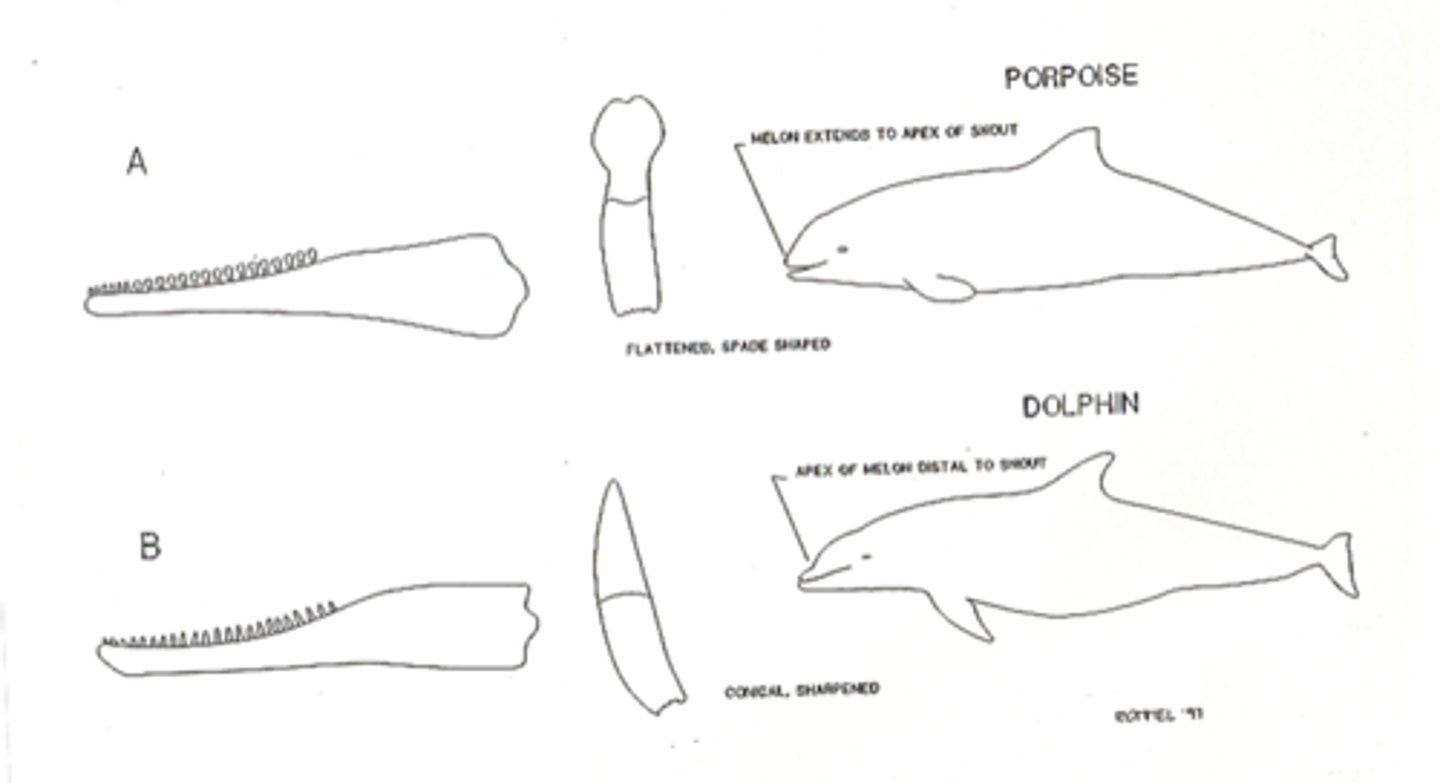
Porpoise vs dolphin
dolphin
- longer snout
- pointy teeth
porpoise:
-shorter snout
-flattened teeth
narwhal sound study
- Spatial/temporal patterns of sound production
- Tagged 6 E greenland narwhals
3 sound types, 2 purposes
- Echolocation clicks and buzzes for feeding
- Calls for social communication
results
- More calls found when they're at surface
- Buzzes are found when they're deeper
Mysticeti + their feeding stratagies
baleen whales (blue, humpback, grey,)
- Baleen plates are keratin: strain water to collect crustacean prey
feeding stratagies:
1) rorqual: Fin, sei, brydes, blue, minke, humpback whales
- lunge filter feeding
- Accelerate forward in rapid lunge to engulf prey
High energetic costs: due to acceleration and drag
2) ram suspension: Bowhead, right whales
- Skimming
- Swim at slow, steady speeds to drive prey into mouth
blue whale diving
-Balance of energy and food needs
- Feeding mode burns a lot of energy: bc of diving activity and maintenance of body temp
- to maximize density of patchy food (krill)
ex study)
- tagged 55 blue whales
- tracked diving and feeding
results: higher energy expendature= more krill, more O2 conservation= less krill
fissipedia: ursidae and mustelidae
1) Ursidae: polar bears
- Water adapted terrestrial animal
2) Mustelidae: sea otters
- smallest marine mammels
- Dense fur instead of blubber
- Traps air against body for insulation
- Exclusive in pacific nearshore
- keystone predator
pinnipedia general characteristics
seals, sea lions, walruses, elephant seals
- pinniped=feather footed
- Nearly exclusively marine
- Predators, feed on fish/squid (Evolved from terrestrial carnivore)
- Streamlined bodies
- Thick fat layer or blubber
- Expert divers: metabolism slows, heart rate decreases
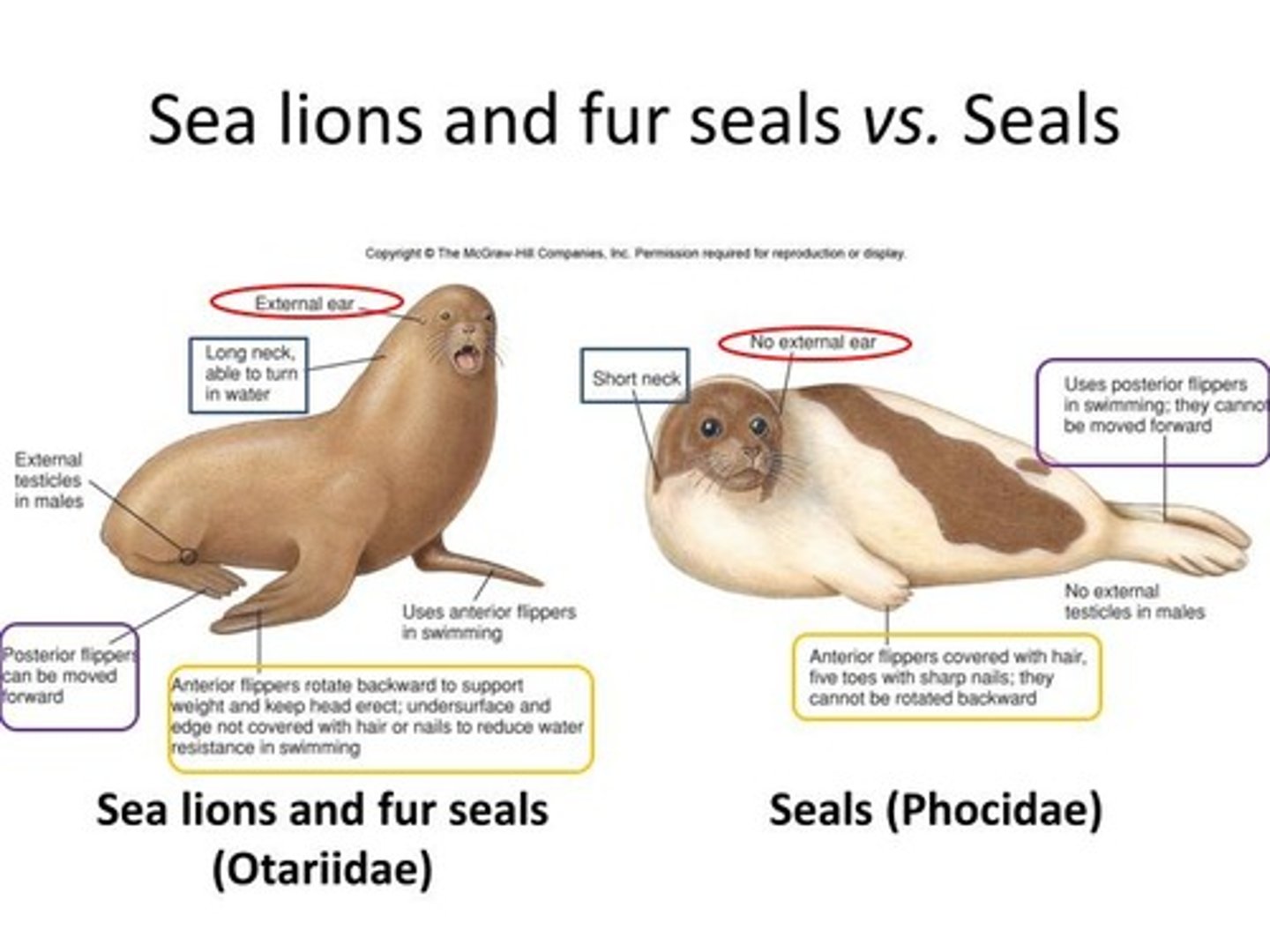
seals vs sea lions/fur seals
1) seals: Family phocidae
- Flippers can rotate
- No external ear flap
- Claws and fur on flippers
- Short, robust neck
2) sea lions/fur seals: Family otariidae:
- Roatable hind flippers
- External ear flap
- Long flexible neck
- No fur or claws on flippers
- Swim using front flippers
- Dont really move hind flippers
walrus
Family odobenidae
- Large pinnipeds w/ pair of tusks: Used for defense, anchoring onto ice
(M and F)
- Strictly arctic
- Benthic feeders: primarily clams
- Orcas are main predators
2 species:
→ Odobenus rosmarus rosmarus (atlantic)
→ Odobenus rosmarus divergens (pacific)
sirenia
sea cows
- Streamlined, hairless
- herivorous marine mammals, access to vegetation/algae
- Slow moving
- Have front flippers, no rear limbs
- Swim up and down strokes w paddle (manatee) of shaped tails (dugong)
- Closest land relative is elephant
- Some live in fresh and/or brackish water
- temperate or subtropical waters
- Threatened by boats, algal blooms, pollution, severe winter
manatees vision
poor, dont need to be good bc:
- Herbivorous
- No natural predators
- Rely on other senses for navigation
BUT makes them susceptible to boat strikes
Stellars sea cow
extinct
- Was in N pacific
- Fed on kelp
- 8 m long
- Hunted to extinction within 27 yrs of discovery
Mammal diving adaptations
1) Fusiform body (torpedo shaped)
2) Glide during diving
3) Air supply
dive for prey access, don't have huge lungs
Mammal breathing
Homeotherms: need high O2
get air at surface
adaptations:
1) Increased vol of arteries/veins
2) Store O2 muscles with myoglobin
3) Higher RBC concentration (to carry more O2)
4) Decrease heart rate and O2 consumption
5) Limit blood flow
6) Pinnipeds exhale before diving: minimizes buoyancy
jessie turner seminar summary
Location: West Antarctic Peninsula
Phenology: study of the timing of recurring seasonal events
Studied: How phytoplankton blooms were changing
- Over 2 decades (2 11 year periods)
Expected results: increased climate change cause EARLIER blooms
Actual results: increased wind currents cased LATER blooms
- Inc. wind mixing in spring (inhibits bloom)
- Causes more mixing