IB 303- Skeleton
 Call Kai
 Learn
Learn Practice Test
 Spaced Repetition
 Match
Match Flashcards
 Knowt Play
1/39

Earn XP
Description and Tags
Exam 1 content
Name | Mastery | Learn | Test | Matching | Spaced | Call with Kai | Chat |
|---|
No analytics yet
Send a link to your students to track their progress
40 Terms
Ontogeny
Embryonic development
Gastrulation
the phase during embryonic development where the single-layered blastula reorganizes into a multi-layered structure called the gastrula. Creates the gut.
Neurulation
Process of forming the neural tube, after the gut formation
Organogenesis
The process of organ formation in the developing embryo, following gastrulation and neurulation.
Maturation
Process from birth/hatching to adulthood
Ectoderm
Germ layer that gives rise to the skeletal tissue
Mesoderm
Germ layer that gives rise to the muscular/cardio/reproductive tissue
Endoderm
Germ layer that gives rise to the gut/digestive tissue
Ontogeny recapitulates phylogeny
The old hypothesis for ontogeny that states embryos go through all stages of evolution while developing.
“Fish-phase”
Law of the general to the specific
The alternative hypothesis for ontogeny that states embryos are undifferentiated and later develop taxon-specific features
No “fish-phase”, all vertebrates have same general features
Pharyngeal pouches
Bays inside embryonic pharynx, becomes pharyngeal slits in fish but don’t open in terrestrial vertebrates

Biomechanics
Study of biological function: Locomotion, Feeding, Defense, Fighting, reproduction
Fusiform shape
The best shape for movement through a body of water where the widest portion is about 1/3 behind the front

Square-Cube Law/Scaling
Volume increases faster than area/consequence of growth
Stress
The force/area, which causes things to break
Isometry
Everything (biological bodies/structures) grows at the same rate
Allometry
Everything (biological bodies/structures) grows at a proportional rate
Falling
The more mass, the faster the fall and vice versa
Exoskeleton
Derives from the dermis or epidermis
Endoskeleton
Derived from the mesoderm within the body
Endochrondral Bone
The ossification of long bones and the base of the skull from hyaline cartilage
Dermal bone
Ossifies skull, jaws, and shoulder girdle directly from fibrous membranes. Similar to exoskeleton of turtles
Chondrocranium
endochondral, initially formed from cartilage and becomes bone
in cartilage fish: may mineralize but does not become bone
“Brain case”, nasal capsule, and otic capsule

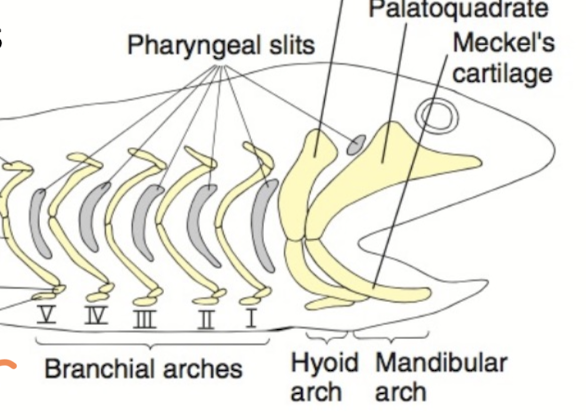
Splanchnocranium
endochondral, oldest of the three structures
composed of a series of arches that originally supported the gill slits, now supports the jaw
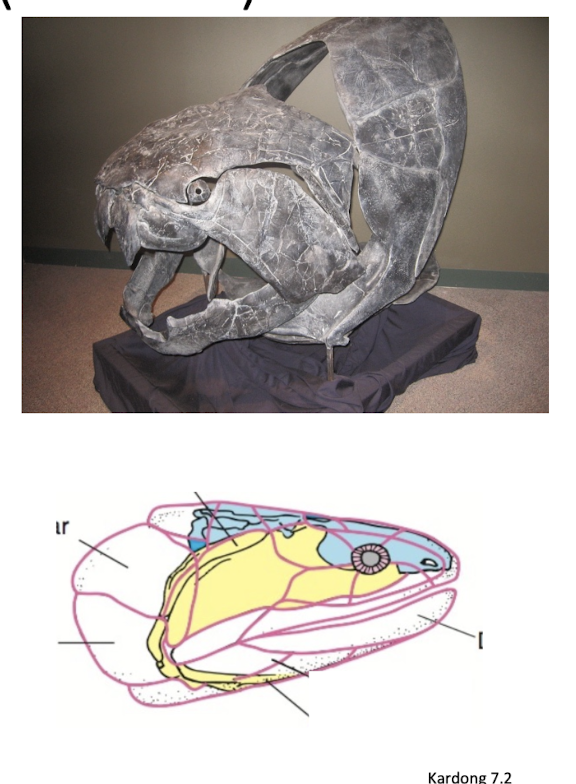
Dermatocranium
Dermal bone that originally bony armor in early fish
encase majority of skull in amniotes, makes the pre maxilla and maxilla
reduces in modern fish and amphibians
Palatoquadrate
Splanchnocranium bone that makes up the upper palate(upper jaw)
has the Quadrate and Epipterygoid

Meckel’s Cartilage
Splanchnocranium bone that makes up the lower jaw
persists in some osteichthyans but encased in dermal bone, posterior end forming an articular
surrounded in dermal bone at jaw to become the dentary

Hyomandibula
Splanchnocranium bones that are connected to the jaw to suspend it

Serial Theory
The theory that jaws evolved from a single brachial arch

Composite Theory
The theory that jaws evolved from parts of several brachial arches

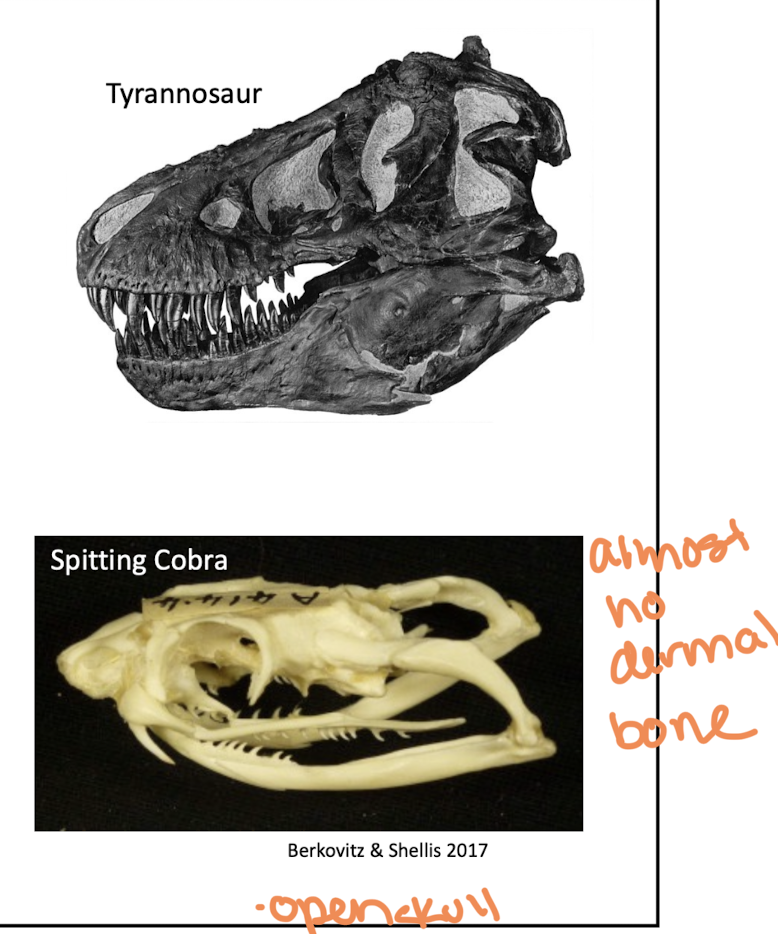
Skull Fenestration
The increase of “holes”/”openness” in the temporal region of the skull
Anapsid
No hole in temporal region of skull
Ex. Turtles
Synpsids
One hole in temporal region of skull
typically found in mammals
Some are merged with orbital opening

Diapsid
Two holes in temporal region of skull
typically found in reptiles
Can be extreme “openness”
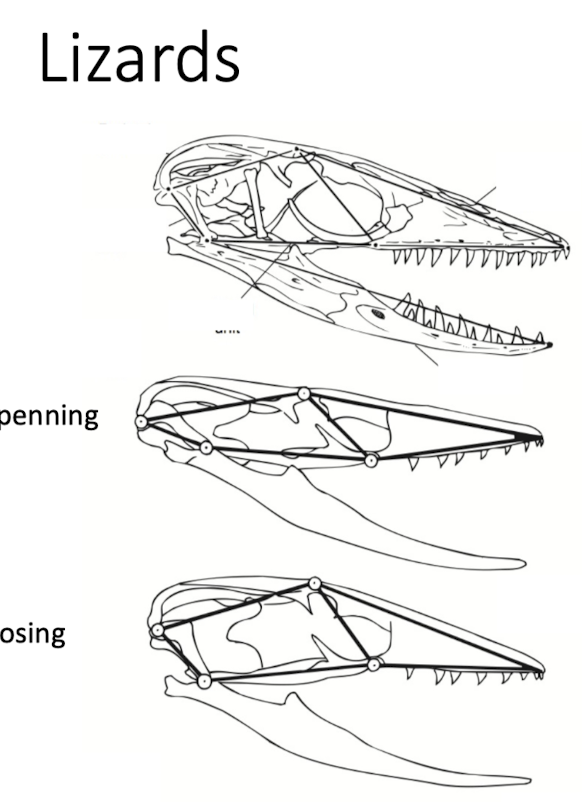
Cranial Kinesis
The increase(or decrease(mammals)) of skull mobility
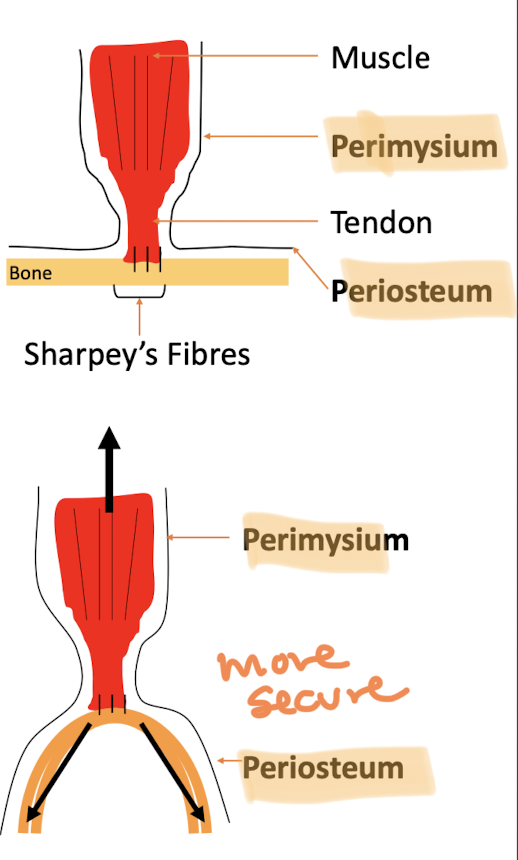
Sharpey’s fibers
How muscle attaches to bone
attaches more securely to edges, making fenestration favorable
Secondary Palate
Evolved feature that is a barrier between nasal canal and oral canal to keep air and food separate

Pterygoid Walk “tera-goid”
Mobile bones that allow disconnecting of one side of jaw bone at a time to “walk” jaw over large pray in snakes

Vertebral segments
comprise the vertebral column, arches and centra
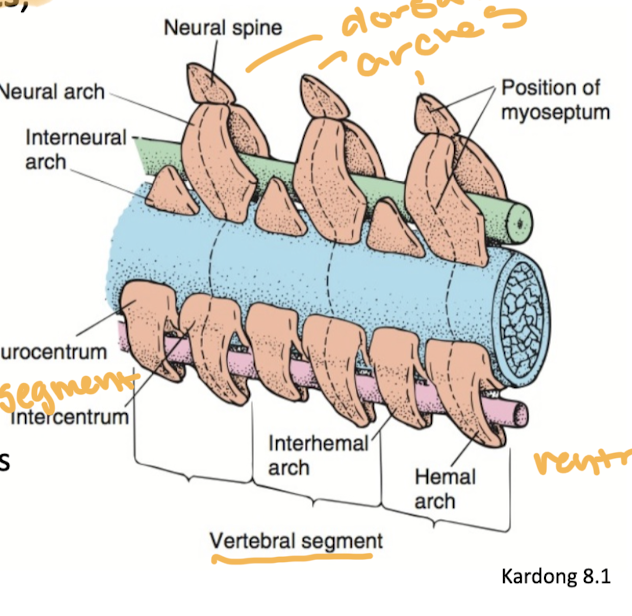
Dorsal Arches
protect neural tube
they are neural and interneural structures