Fiancial Maths
 Call Kai
 Learn
Learn Practice Test
 Spaced Repetition
 Match
Match Flashcards
 Knowt Play
1/55

There's no tags or description
Looks like no tags are added yet.
Name | Mastery | Learn | Test | Matching | Spaced | Call with Kai | Chat |
|---|
No analytics yet
Send a link to your students to track their progress
56 Terms
Describe the difference between equity (involving shareholders) and debt (involving bondholders).
Shareholders are part-owners of the company. Their returns are variable, and get a fraction of future profits (dividends) and cash flow. There is no guaranteed return. You have a say (can vote) on major company decisions.
Shareholders have residual economic rights, meaning they get the leftovers after all debts have been settled. This is the risk of shareholding.
Bondholders are third-party lenders which have a fixed rate of return. There is a predetermined interest payment and the original loan amount. You have no say on how the company is run, only the right to be paid back.
Describe assets.
Assets = Debt + Equity.
Two forms: Tangible assets: physical things which generate free cash flow (amount of actual cash left sitting in the company’s bank account) and income.
Intangible: non-physical thing which generate free cash flow and income.
How is free cash flow and profit different?
If a company sells a million dollars worth of products today, but the contract says the customers have 90 days to actually pay the bill, the company gets to report a million-dollar "profit" right now.
But they have zero extra cash in the bank today. You can't use a paper profit to pay your employees, and you can't use it to pay off your debts.
Free Cash Flow strips away all the accounting tricks and asks one simple question: After everything we had to pay for, did the amount of actual cash in our bank account go up or down?
What is a CAPEX?
Long-term spending on big assets.
Example: buying a $500k warehouse.
Describe investment decisions and financing decisions.
Financing decisions involves raising money for the business, where investment decisinos involve spending that money to build the business. However, the investment decisino isn’t just about buying new things, it is also knowing when to pull the plug.
Describe private and public companies.
Private: When a company starts, it is usually owned by the founder and a few early investers. They make the decisions.
Public: If they want to raise more money, they do an IPO (initial public offering). They sell millinos of shares to the general public on a stock exchange.
Once a company is public, it might have hunderds of thousands of owners. Since hundred of thousands of people cannot make business decisions, the owners elect a board of directors (BoD) which then hire a CEO to run day-to-day operations.
Describe financial functions. What makes an attractive return-to-risk profile?
The use of funded money inside the corporations. You can invest it (capital management) or keep it liquid for further opportunities (treasury management).
Capital management involves the emdium-long term perspective, whilst the treasury management involves the short-term perspective.
Involves risk management, which inolves looking ahead at what could go wrong and protecting the company.
This must align with the investors risk tolerances.
When a company balances treasury, capital and risk, it creates a good return-to-risk profile, This attracts outside investors into giving their money.
When a company has surplus cash, what can be done?
Invest in a new project (go left) to help grow the business.
Give the money back (maybe because there aren’t any ideas rn) to the shareholders in the form of dividends, where the shareholder can invest more into the market.
This is contingent on what would make the most money.
As a shareholder, you may earn 7% ROI on a basic stock market index fund, but perhaps the company’s new procet is project to earn a 10% ROI, so you’d want to keep them to keep the money and do the project. If it is vice versa, you’d vote no.

Describe future values.
A dollar today is worth more than tommorow.
This is due to inflation, and time preference (you prefer to do things now than later).
Due to this, if you are going to delay spending money you need to paid a rate of return.
C0(1+r)=C1
C0=cash at time zero
r= interest rate
C1=cash at time one.
What is the FV of $100 if interest is compounded annually at a rate of 7% for two years?

How to solve present value?

Graphs of future values vs present values.

Suppose that your company is valuing to invest in a huge building. The total cost of buying the land and
constructing the building is $700,000 and you’ll be able to sell the building for $800,000 in year 1. Assume
that equally risky investments in the capital market offer a return of 7%. Should you invest in the project
Yes.

What is the net present value?
NVP = PV-required investment.
NPV = C0+C1/(1+r), where C0 is the initial investment for the project, usually cash outflow and is negative. C1 = cash flwo fromt he project, and is usually positive.
r= opportunity cost of capital.

😂 holy year 7

A higher NPV is accompanied by a lower interest rate, explain why you wouldn’t want a high NPV and a low interest rate.
Consider a bank that pays a 1% and an 8% interest rate, you have $100k and you are deciding if you should open a coffee shop which will profit $10k per year.
Bank 1% would pay you $1000 for leaving that 10% in the bank, whilst the coffee shop pays you $10,000. THe higher NPV of the coffee shop makes it much more attractive for you to buy the shop, as it is paying $9000 more than the alternative.
With 8% the bank pays you $8000 for doing nothing, making the coffee shop giving you $2000 more unattractive, hence a low NPV.
Describe risk, NPV and PV.
Lets say a shop you buy for $700k will be $800k next year.
To find PV of the amount of money you would need to invest today to get $800k in a year, you do the PV formula. $800,000 / 1.07 = $747,664
Sooo to find the NPV, 747,664-700,000 = $47,664.
By doing this project you are becoming $47,664 richer today.
However, lets say that the shop is in a riskier area, investors do not want risk, hence to compensate they might demand more profix, perhaps a 12% return.
$800k/1.12 = $714,286, the NPV is now $14,286, and you end up earning less. NPV is in the context of how much the company earns, not the investors.
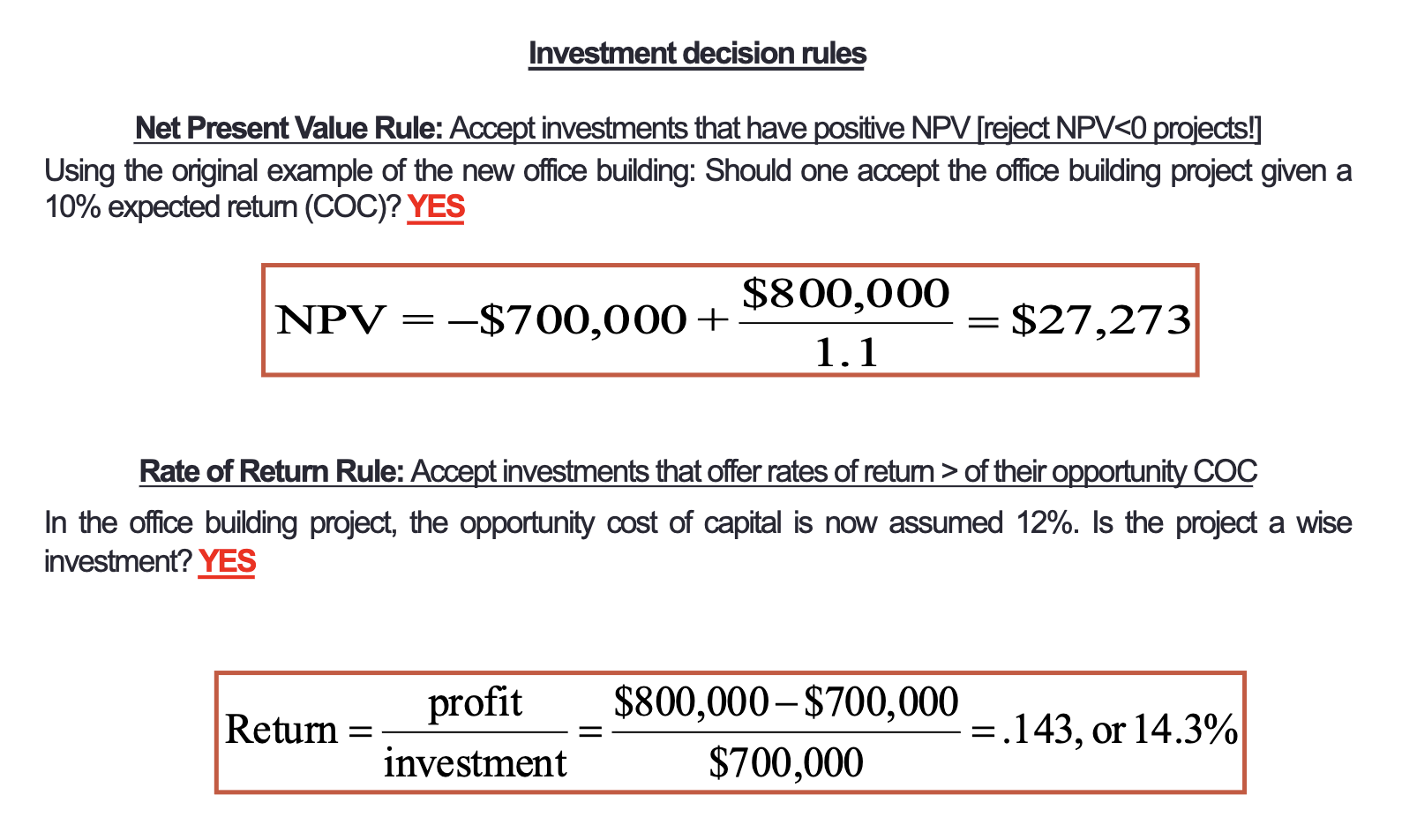
What is the net present value rule and rate of return rule?
What is perpetuity?
An investment that pays a fixed amount of money every single year, forever.
r=C/PV
r= discount rate - percentage penalty that we apply to future money to shrink it down to a present value. A high discount rate, means that future money is heavily penalised, meaning likely the investment is risky.
C= cash flow - the fixed amount of money you receive in each period ($10 per year).
PV= present value - what a future stream of money is worth in today’s dollars.
If there is a delay in perpetuity, where perhaps an investment won’t make money for X years, you need to consider it.
What is the present value of $1 billion every year, for all eternity, if you estimate the perpetual
discount rate to be 10%? What if the investment does not start making money for 3 years?

Imagine you buy a special government savings bond today. The government guarantees they will hand you exactly $5,000 in 4 years.
If your personal discount rate (your penalty for waiting, based on what you could earn elsewhere) is 8% per year, how much is that bond actually worth to you today?
Not a perpetuity, as it is only 4 years.
5000/(1+0.08)^4=$3675.15
You have a goal to make a large purchase in exactly 3 years, and you know you will need exactly $15,000 in cash to do it.
If you can invest your money at a 5% annual return (your discount rate), how much do you need to deposit today as a single lump sum to perfectly hit that $15,000 target in 3 years?
$12,957.56
Describe annuity.
Tiburon Autos offers payments of $5,000 per year, at the end of each year for 5 years. If interest rates are 7%, per year, what is the cost of the car?
An annuity is just a perpetuity that stops. Instead of paying you forever, it pays a fixed amount every year for a specific, set number of years, and then it is done.
PV=C/r-C/r(1+r)^t
$20,500.99
Describe constant growing perpetuity.
Essentially perpetuity, but inflation is taken into account to ensure that in X years the Y amount of dollars is still worth the same.
g (growth) is the fixed percentage by which your cash flow (C) increases every year.
PV=C/r-g
Delayed growing perpetuity.
PVt=Ct+1/r-g)
You have invested into a shop.
Because they need time to build the new location, they won't pay you right away. The very first cash dividend of $2,000 will arrive in exactly 4 years (Year 4).
Because they plan to slowly raise their prices over time, this annual payout will grow by 2% every single year, forever.
If your personal discount rate is 6%, how much is this investment worth to you today?
Delayed growing perpetuity.
Step 1: Calculate growing perpetuity.
2000/0.06-0.02 = $50,000
Step 2: Minus the delay.
Since t+1 = 4, t=3
50000-50000/(1.06)³ = $41,980.96
What is constant growing annuity?
A stream of cash flows that increases by a set percentage every year to keep up with something like inflation, but it eventually stops after a specific number of years.
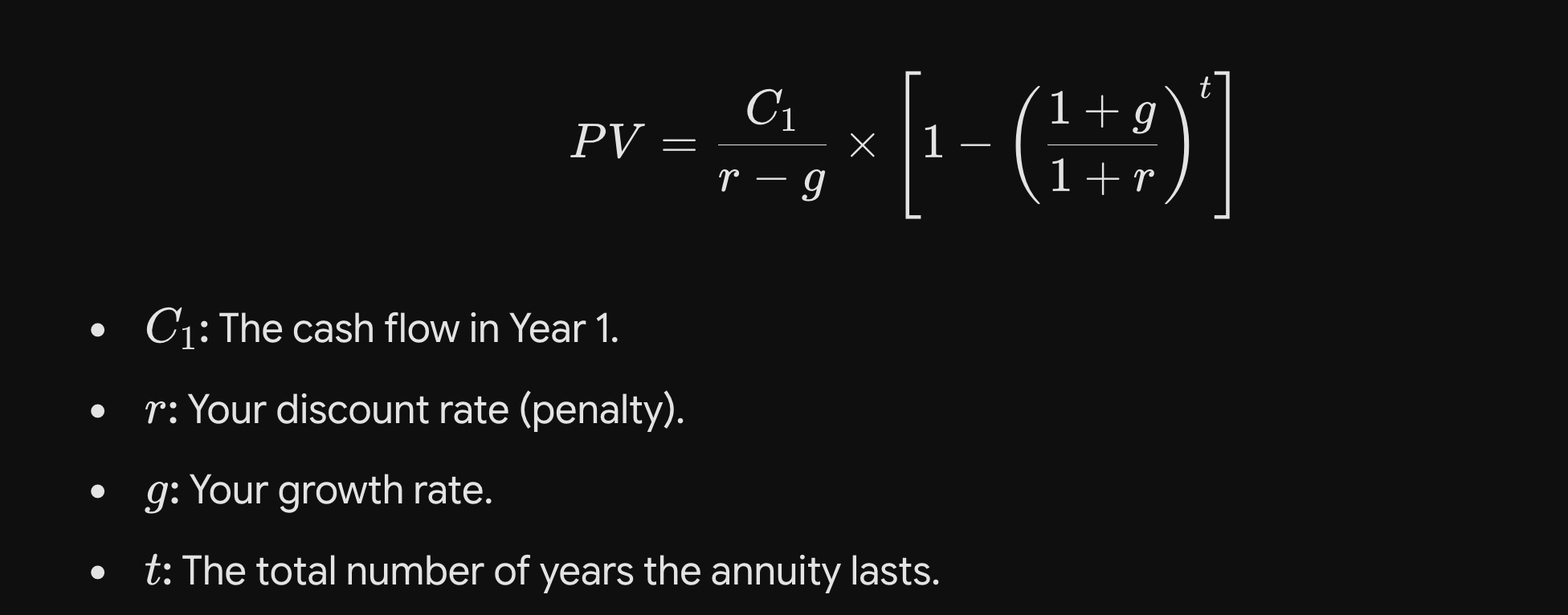
You find an amazing local seller in Bologna who agrees to source and deliver a curated box of rare 1960s rock and indie CDs to your flat at the end of every year to build up your collection.
You agree to a 3-year contract. The first box will cost you $1,000 at the end of Year 1. Because these vintage CDs are getting harder to find, the seller includes a clause that the price of the box will grow by 4% every year.
If your personal discount rate is 10%, what is the exact Present Value (the cost today) of this 3-year growing contract?

The state lottery advertises a jackpot prize of $365 million, paid in 30 yearly installments of $12,167 million, at the end of each year (30 x 12,167 = 365,010). Find the true value of the lottery prize if interest rates are 6%.

Golf club membership is $5,000 for 1 year, or $12,750 for three years. Find the better deal given payment due at the end of the year and 6% expected annual price increase, discount rate 10%

Suppose that you take out a $250,000 house mortgage from your local savings bank. The bank requires you to repay the mortgage in equal annual installments over the next 30 years. With an interest rate equal to 12%, what is the amount of each single annual payment?

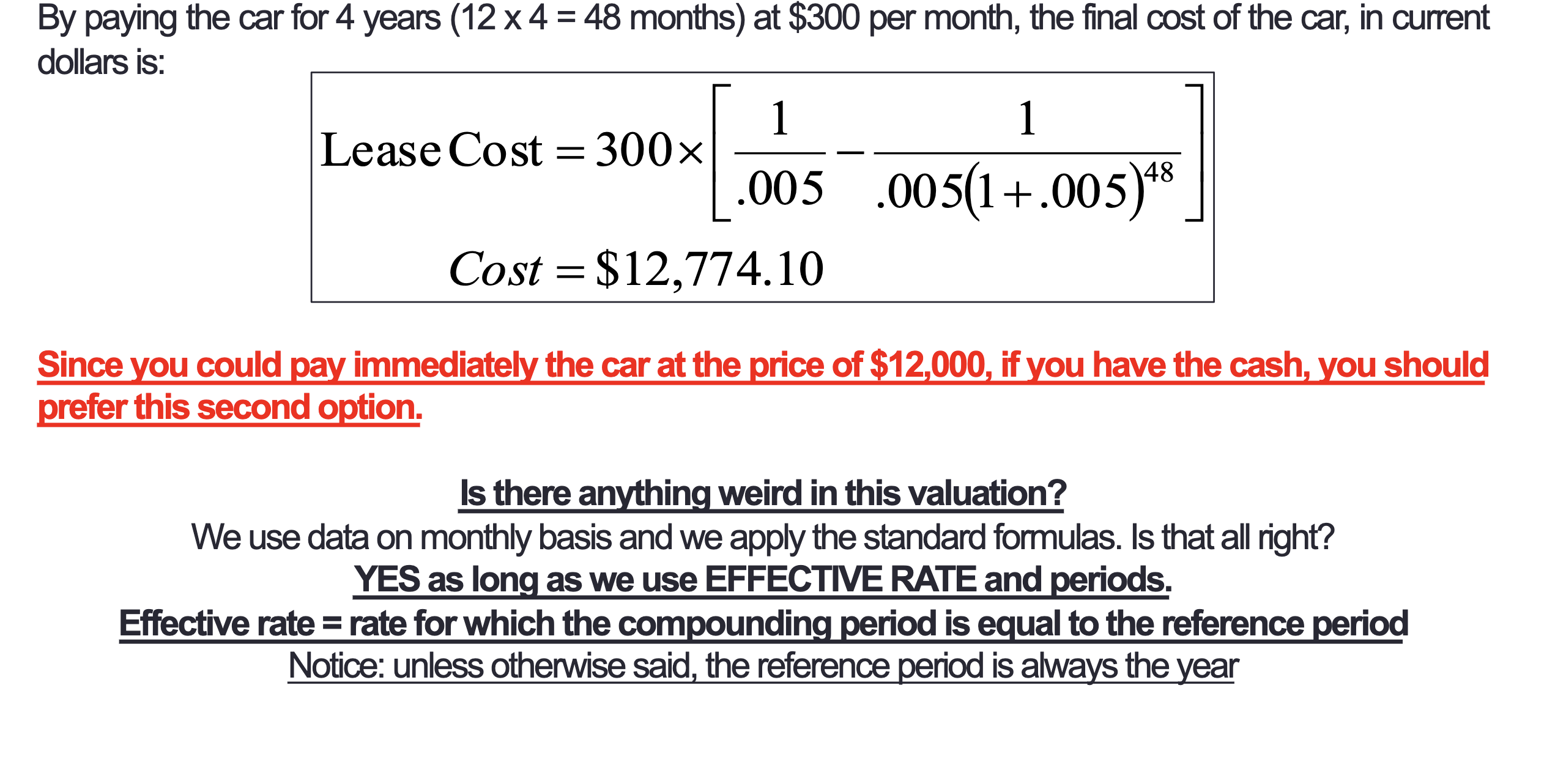
You could lease a car for 4 years at $300 per month. In this case, you are not required to pay any money up front or at the end of agreement. Otherwise you could pay immediately the car, at the special price of $12,000. If your opportunity cost of capital is 0.5% per month, what payment option do you choose?
Difference between annual percentage rate vs effective annual rate.
APR is the simple interest rate that ignores compounding.
EAR is the true interest rate. It takes into account compounding.

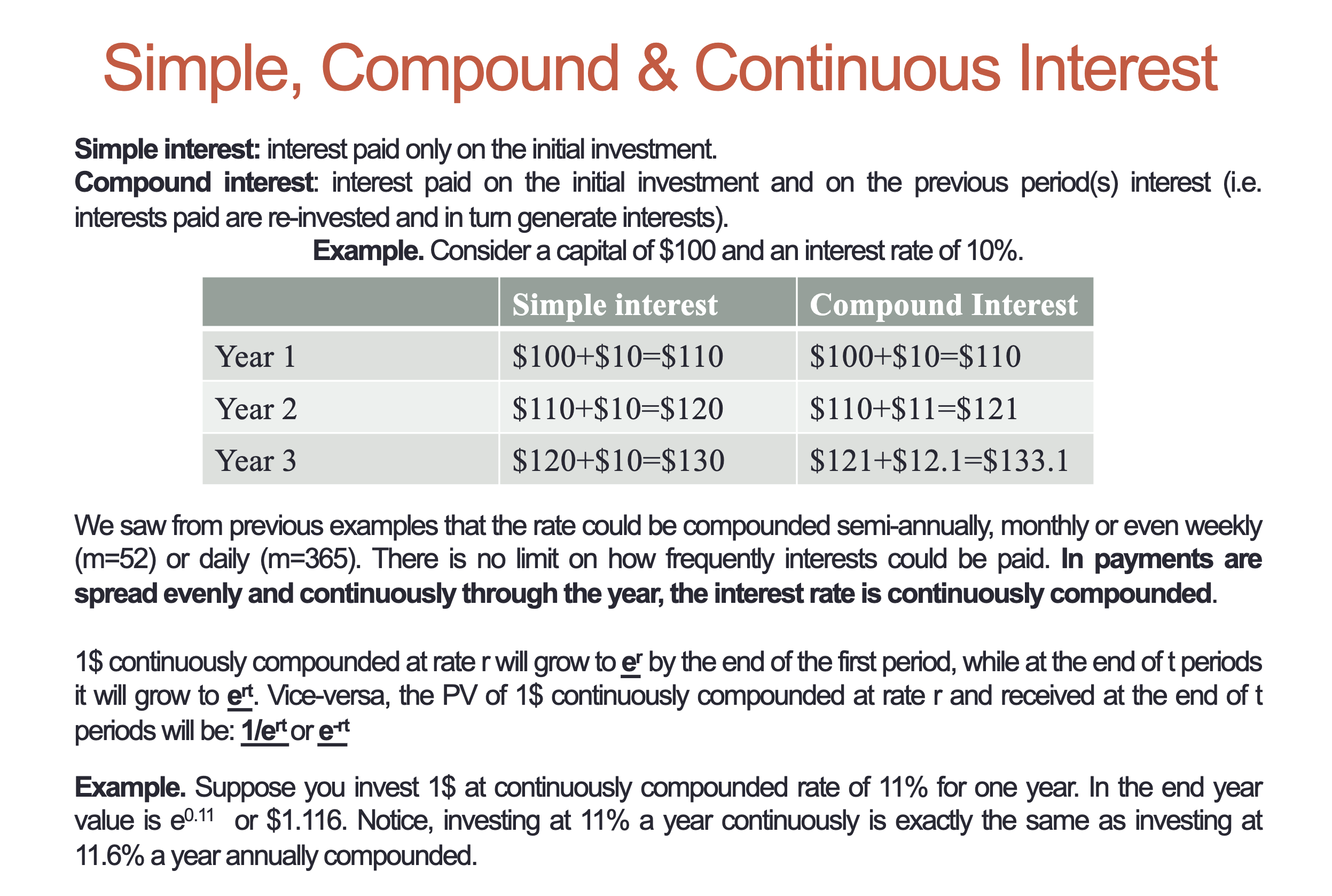
Describe simple, compound and continuous interest.
What are two ways in which a business can raise money?
Debt: ya business borrows funds from an external lender with a contractural agreement to pay the money back over time, alongside interest. It is a mandatory liaility, and payments must be made on schedule.
Equity: a business selling an ownership stake to investors, such as venutre capitalists, or the general public via an IPO.
What is debt financing?
Two types:
Short-term borrowing (bank loans): used to cover temporary working capital gaps (mismatch on when you get paid), such as buying raw materials to manufacture goods while waiting for customers to pay their invoices.
Long-term borrowing (bonds): used for large capital expenditures (building a factory). Because this requires large sums over many years, companies issue bonds to investors in the open market.
The value of debt financing is affected by three factors:
The cas flow generated
The interest rates
The cost of capital (YTM - yield to maturity)
Set by contract vs set by the market.
SBC: The cash flow and stated interest rate are locked into the contract. They do not change once the debt is issues (100k at 5% interest rate is always the same).
SBM: YTM (the market rate) changes every day. It represents the return investors could get elsewhere for taking a similar amount of risk. If a company wants investors to buy its debt (lend money), it must offer terms that match or exceed market demands for its risk.
What is a bond?
Debt contract where a company borrows money directly from investors and repays it according to a fixed schedule.
The investors are entitled toa. fxied set of cash payoffs (coupons), where these are interest payments the company delivers to the bond holder at the bonds T&Cs.
These coupons are computed as coupon rate (fixed annual interest rate) x bond face value (how much money is borrowed).
At bond maturity, the bond holder gets the final interest payment plus the redemption price (lump sum amount the borrower pays back at maturity), which is usually equal to the face value.
If you borrow $1000 at 5% p.a for a 5 year bond, at year 5 you would get $1050 and from years 1-4 you get $50 coupon rate.
Describe redemption.
When the bond reaches maturity, the company has to pay back the full redepmtion price to all investors at once.
If a company borrowed $100 mil, handing over that much o one day creates massive cash drain.
To prevent this you can”
Sinking fund: instead of scrambling to find all the cash at the end, the company saves gradually. Every month or year, the company sets aside money into a dedicated fund.
Refinancing: instead of paying the debt off with saved cash, the company replaces the old debt with new debt.
When bond A reaches maturity, the company issues bond B to new investors, takes that cash to pay off bond A.
How is a bond’s interest rate decided?
If a bond is higher risk, it means investors will demand a higher interest rate.
If a stable entity (like Microsoft) borrows money, there is little danger of them going broke. Because the risk is low, they can offer a lower interest rate. Opposed to a startup that might go bankrupt and not pay you back.
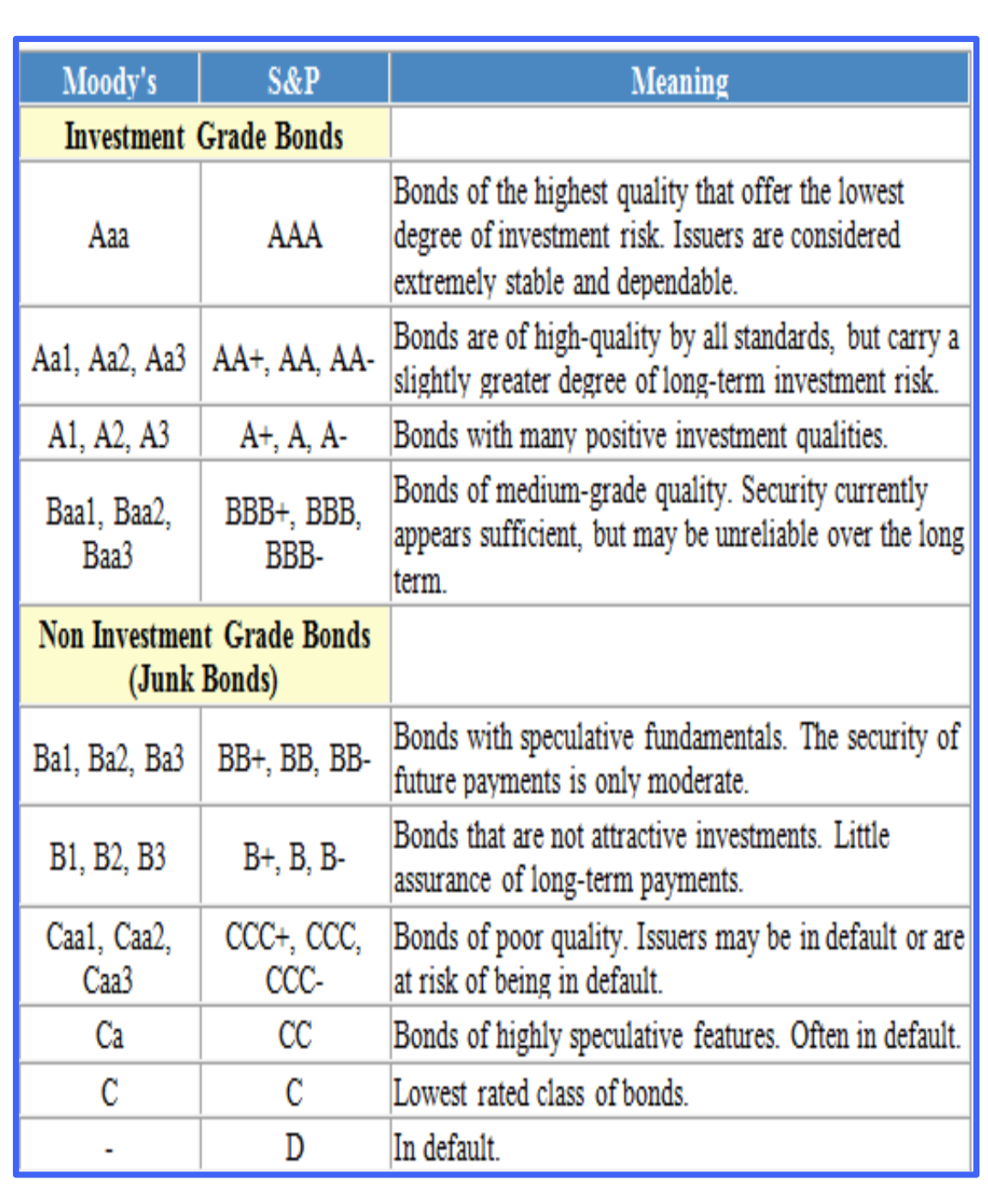
There are bond ratings which measure the investment risk by considering the degree of protection offered on interest payment and payment of principle.
Investment grade are very low risk bonds, where no-investment grade are high risk. D means the issuer is alread in default, they failed to pay.
Why are bonds easier to price than stocks?
Value is determined by two variables:
Future cash flows: how much cash will the asset put into your pocket, and when?
Interest rate: The discount rate used to adjust those future dollars to what they are worth in today’s money.
Bonds (predictable): The contract states the exact payment dates adn amount upfront.
Stocks: stockholders only get paid from whatever profit is left over after all suppliers, exployess, taxes and bondholders have been paid in full. If a company has a bad year, shareholders may receive zero dividends. ecause it is uncertain, stocks carry higehr risks.
What are the key bond parameters?
Face value - the amount printed on the contract and returned at maturity.
Nominal rate of return (coupon rate)
Actual rate of return (yield to maturity): The true annualised return earned if the bond is bought at its current market price and held until it matures.
Coupon frequency: how often interest is distributed.
Maturity
Extra provisions like indexation can be added.
What is a zero coupon bond?
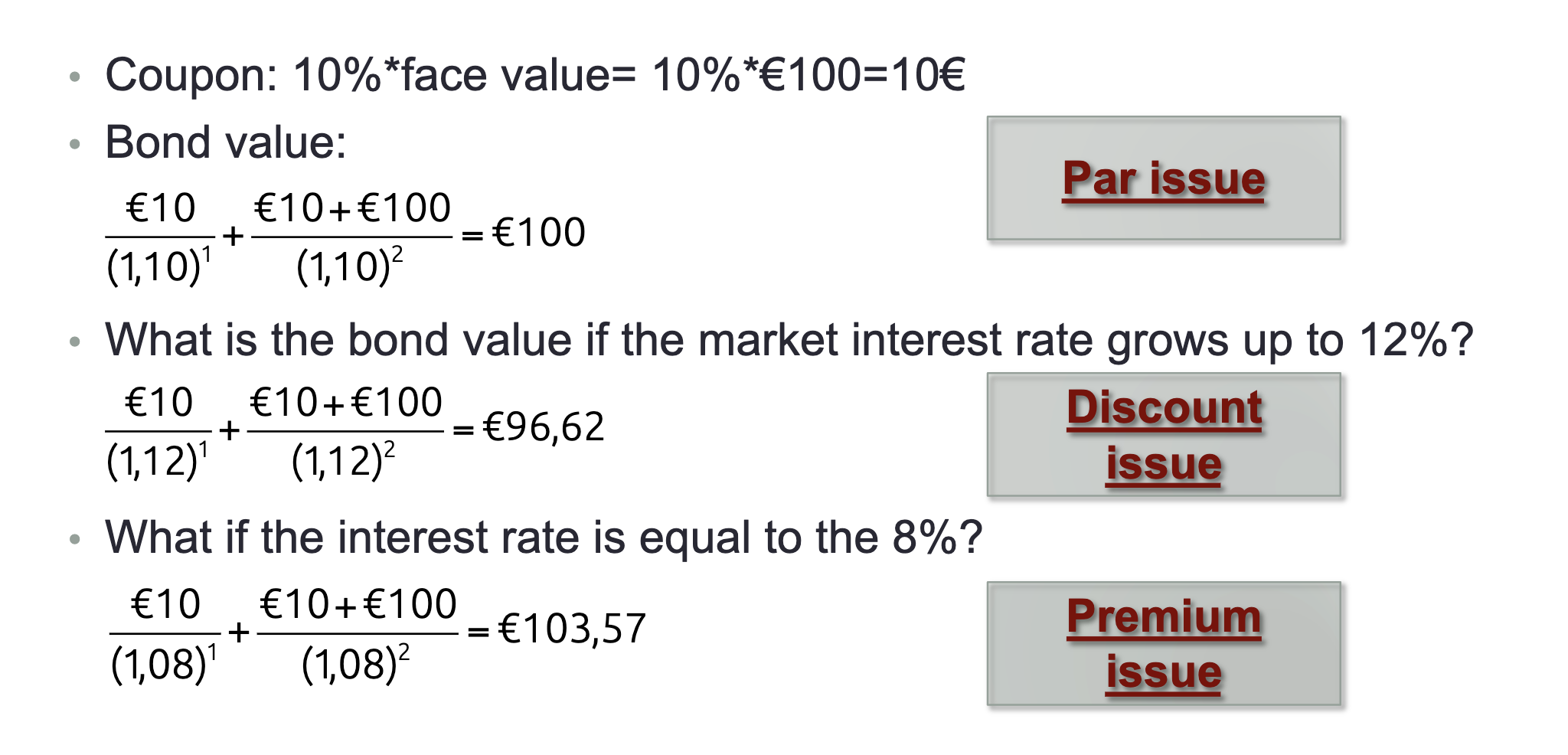
A zero coupon bond pays no regular interest (coupon) during its lifetime.
You only receive the face value at maturity. Therefore, the only reason an investor would buy it is they can buy it today for significantly less than face value. This is known as capital appreciation.
What is the price of a zero coupon bond with a 20 year maturity, face value equal to 1mil and rate of return equal to 10%? Repeat for 10
PV = 1,000,000/(1+0.1)20=$148,644
$385,543
10 years has a higher upfront payment due to you getting your money faster.

What if the bond value if the market interest rate grows up to 12% and down 8%.
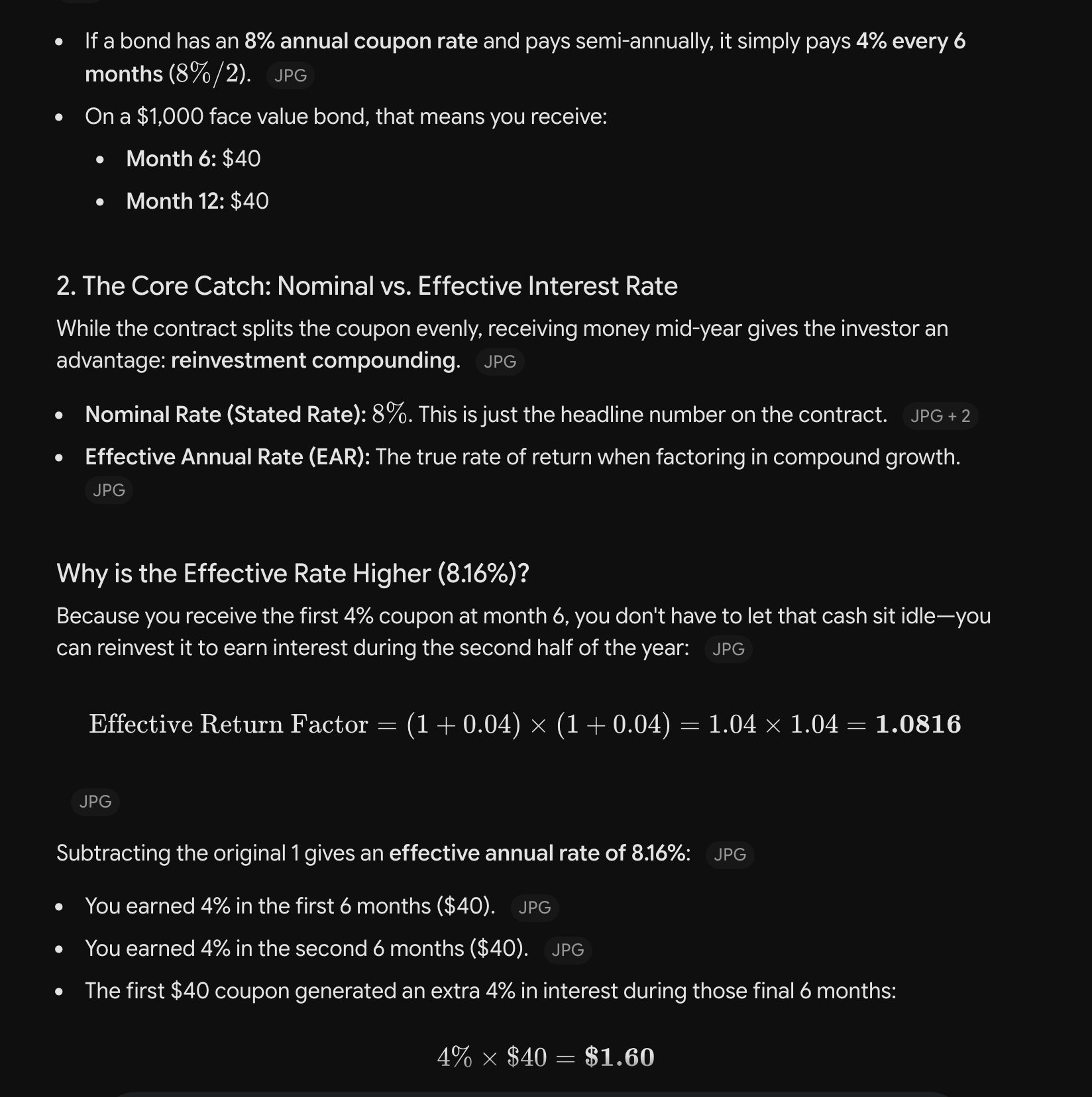
When a bond pays interest twice a year (semi-annulally), you earn slightly more than the state coupon rate. How?
In February 2012 you purchase a three-year U.S. government bond. The bond has an annual coupon rate of 11.25%, paid semiannually. If investors demand a 0.085% semiannual return, what is the price of the bond?
Take the same three-year U.S. government bond. If investors demand a 4.0% semiannual return, what is the new price of the bond?
YOU ASSUME $1000
11.25/2×51000=56.25

Describe irredeemable bonds.
Unlike regular bonds, these bonds never mature, meaning the company never repays the principal balance, but pays interest payments forever.
P0=Coupon/YTM

n October 2011 you purchase 100 euros of bonds in France which pay a 5% coupon every year. If the bond matures in 2016 and the YTM is 2.4%, what is the value of the bond? [Face Value = 100€ & Yearly Coupon Payment]

In July 2010 you purchase 200 yen of bonds in Japan which pay an 8% coupon every year. If the bond matures in 2015 and the YTM is 4.5%, what is the value of the
bond?
[Face Value = ¥200 & Yearly Coupon Payment

Why Do Bond Prices Fall When Interest Rates (YTM increases) Rise?
Scenario A: Market rates rise to 8%
New bonds being issued in the market now pay 8% ($80/year).
No one will buy your older bond paying only 4.875% for full price when they can get 8% elsewhere.
To attract a buyer, you must drop your bond's selling price below $1,000 until its total return matches the current 8% market yield.
Result: Market rates ↑⟹ Older bond prices ↓.
Scenario B: Market rates fall to 2%
New bonds are only paying 2% ($20/year).
Your older bond paying 4.875% is now far more attractive.
Buyers will compete and bid up its price above $1,000 to lock in that higher cash flow.
Result: Market rates ↓⟹ Older bond prices ↑.
2. The Anchor Point (Center of the Graph)
Look at where the two curves intersect at the dashed red line:
When the market interest rate equals the bond’s coupon rate (4.875%), the bond trades at exactly its 1,000FaceValue</strong>.</span></p></li><li><p><spanstyle="line−height:1.15;">Ifratesarelowerthan4.875> \1,000).
If rates are higher than 4.875%, the bond trades at a discount ($< \$1,000$).
3. Why Does the 30-Year Bond Swing Much More Than the 3-Year Bond?
The graph shows the brown curve (30-year bond) is steep, while the blue curve (3-year bond) is relatively flat.
The 3-Year Bond (Short-Term): If rates spike, you only have to endure that subpar coupon for 3 years before getting your $1,000 principal back. The damage is small, so its price barely budges.
The 30-Year Bond (Long-Term): You are stuck receiving an inferior coupon payment for three decades. Because the impact is multiplied across 30 years of cash flows, investors heavily penalize the price.
Rule: Longer maturity = higher sensitivity to interest rate changes (in finance, this sensitivity is known as duration).

Longer maturity means higher sensitivity to interest rates (market changes), but what do you do if the bonds have the exact same maturity date?
Zero-Coupon Bond (Strip): Pays $0 along the way, and $100 at the very end.
Bond A (Coupon = 2%): Pays small $2 semiannual coupons, plus $100 at the end.
Bond B (Coupon = 5.625%): Pays large $5.625 semiannual coupons, plus $100 at the end.
Zero-Coupon Bond: You get nothing back until the final day. 100% of your money is exposed to interest rate risk for the entire 6 years.
Bond B: Gives you back large chunks of cash every 6 months. Because you get a substantial portion of your investment back early, your money isn't tied up as long.
Takeaway: Even though all three mature on the exact same date, Zero-Coupon is the most sensitive/risky, followed by Bond A, while Bond B is the least sensitive.
To fix this, finance replaces maturity (calendar maturity) with duration (effective maturity).
Describe duration (effective maturity).
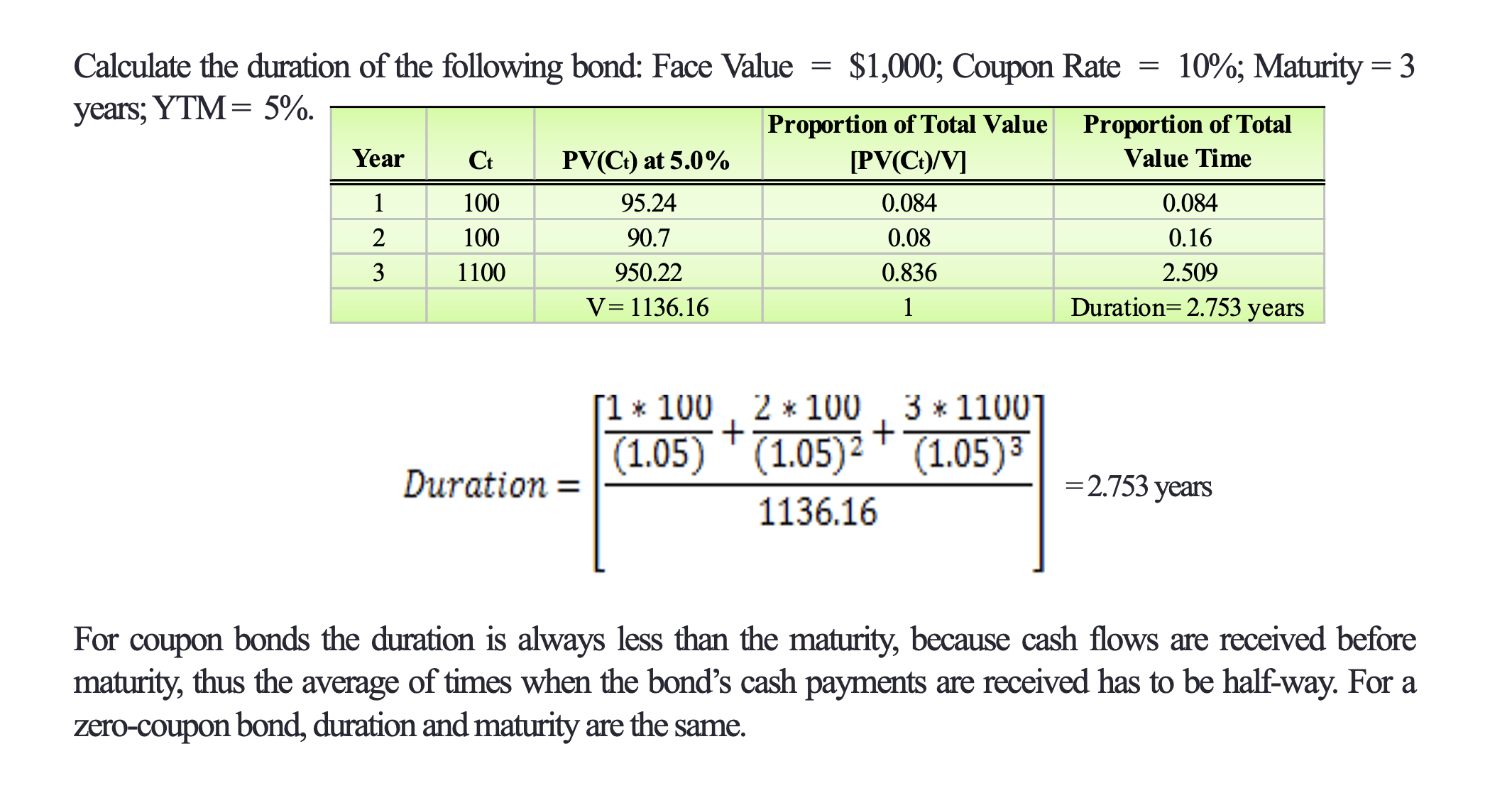
The weighted average of times when bond’s cash payments are received.

Calculate the duration of the following bond: Face Value = $1,000; Coupon Rate = 10%; Maturity = 3 years; YTM = 5%
Cash flow (Ct)= Y1 and Y2 = $100 and Y3 = $1100
Present Value (PV at 5%)= Y1 = $100/1.05= $95.24 Y2= $100/(1.05)²=$90.70 Y3= $1100/(1.05)³=$950.22
Total Bond Price (V) = $1136.16
Proportion of Total Value
Y1= $95.24/$1136.16 = 0.084 (8.4% total value)
Y2 = 8% total value
Y3= 83.6%
Weighting by time.
Y1 = 1×0.084 =0.084 years
Y2 = 0.16 years
Y3= 3×0.836 = 2.509 years
Duration = 2.753 years
Why Duration is Shorter than Maturity (2.753 vs. 3.000)
If this were a zero-coupon bond, 100% of the money arrives at year 3, so its duration would be exactly 3.00 years.
But because this bond hands you $100 at Year 1 and $100 at Year 2, you recover roughly 16% of your investment's value before the maturity date.
Those early cash flows pull the center of gravity backward from 3.00 years down to 2.753 years.
On average, you only have to wait 2.753 years to recover your cash.
Suppose a 3-year zero-coupon bond yields 10.00% per year, while a 2-year zero-coupon bond yields 8.00% per year.
Under the assumption of market equilibrium (no-arbitrage), what is the expected 1-year forward rate starting two years from today (f2,3)?
Assume $1 to invest.
Scenario 1 (there are only 2 possible scenarios)
1x(1.10)³=$1.331
Scenario 2:
After 2 years, $1x(1.08)²=$1.1664
To match strategy 1’s $1.331 payout, it is
$1.1664x(1+f2,3)=$1.331
Solving for f2,3=14.11%
This means the markey expects that a 1 year interest rate in 2 years will be 14.11%, but there is a reinvestment risk because the 1 year rates could be higher or lower.
What is a stock?
A stock represents fractional ownership (equity stake) in a company. When you hold shares, you gain two rights.
Income rights (residual cash flows)
-You have a clain on the company’s profits, typically paid out as dividends.
However, this claim is residual - company must pay everyone else first.
The return on equity (RE) must be greater than the return on debt (RD) since equity holders are last in line.
Voting rights
You get a say in major corporate decisions.
How are stocks valued?
Identical to bonds. = discount all future cash flows back to the present.
The complication is that while bond cash flows are locked into contract, stock cash flows depend on future company performance.
Two sources of stock value:
Current return (Dividend yield): The cash payouts the firm generates today.
Growth opportunities (Capital gains): The value of future investments the firm can make to grow profits over time.