8.2 Compounds in Aqueous Solution
 Studied by 0 people
 Call with Kai
 Learn
Learn Practice Test
 Spaced Repetition
 Match
Match Flashcards
 Knowt Play
1/7

There's no tags or description
Looks like no tags are added yet.
Name | Mastery | Learn | Test | Matching | Spaced | Call with Kai |
|---|
No study sessions yet.
8 Terms
Identify these compounds as containing covalent bonds or ionic bonds.
PCl3
FeCl3
Cl2
PCl3 = covalent bonds
FeCl3 = ionic bonds
Cl2 = covalent bonds
What does the 7 strong electrolytes have in common?
The first 3 are in group 7, Cl, Br, I, except for fluorine
what to all the strong bases have in common?
They all have OH and all are soluble
Identify each of the following substances as a strong electrolyte, weak electrolyte, or nonelectrolyte:
a.H2SO3
b.KCl
c.HNO3
d.HC2H3O2
e.C12H12O11
a.weak electrolyte
b.strong electrolyte
c.strong electrolyte
d.weak electrolyte
e.nonelectrolyte
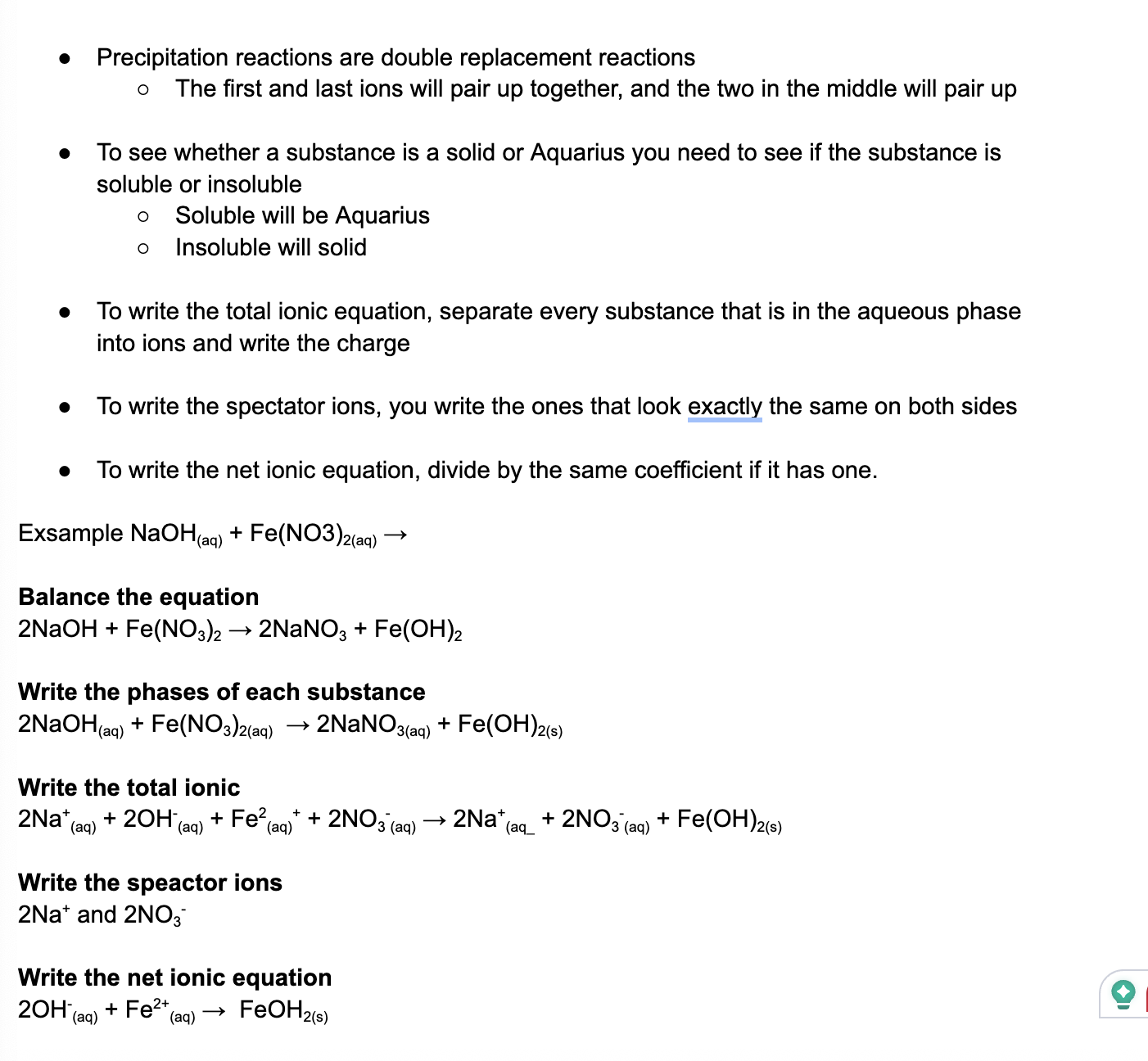
Write both complete ionic and net ionic equations for the following reactions:
NaOH(aq) + Fe(NO3)2(aq)—>
Predict the solubility of the following salts
a. BaSO4
b.K3PO4
c.Mg(OH)2
d.Mg(ClO4)2
a.insoluble
b.soluble
c.insoluble
d.soluble
Classify the following as strong or weak acids
a. HCl
b.HNO2
c.H2SO4
d. H3PO4
e. H2SO3
f. HClO4
g. HI
a. HCl Strong acid
b.HNO2 Weak acid
c.H2SO4 Strong acid
d. H3PO4 Weak acid
e. H2SO3 Weak acid
f. HClO4 Strong acid
g. HI Strong acid
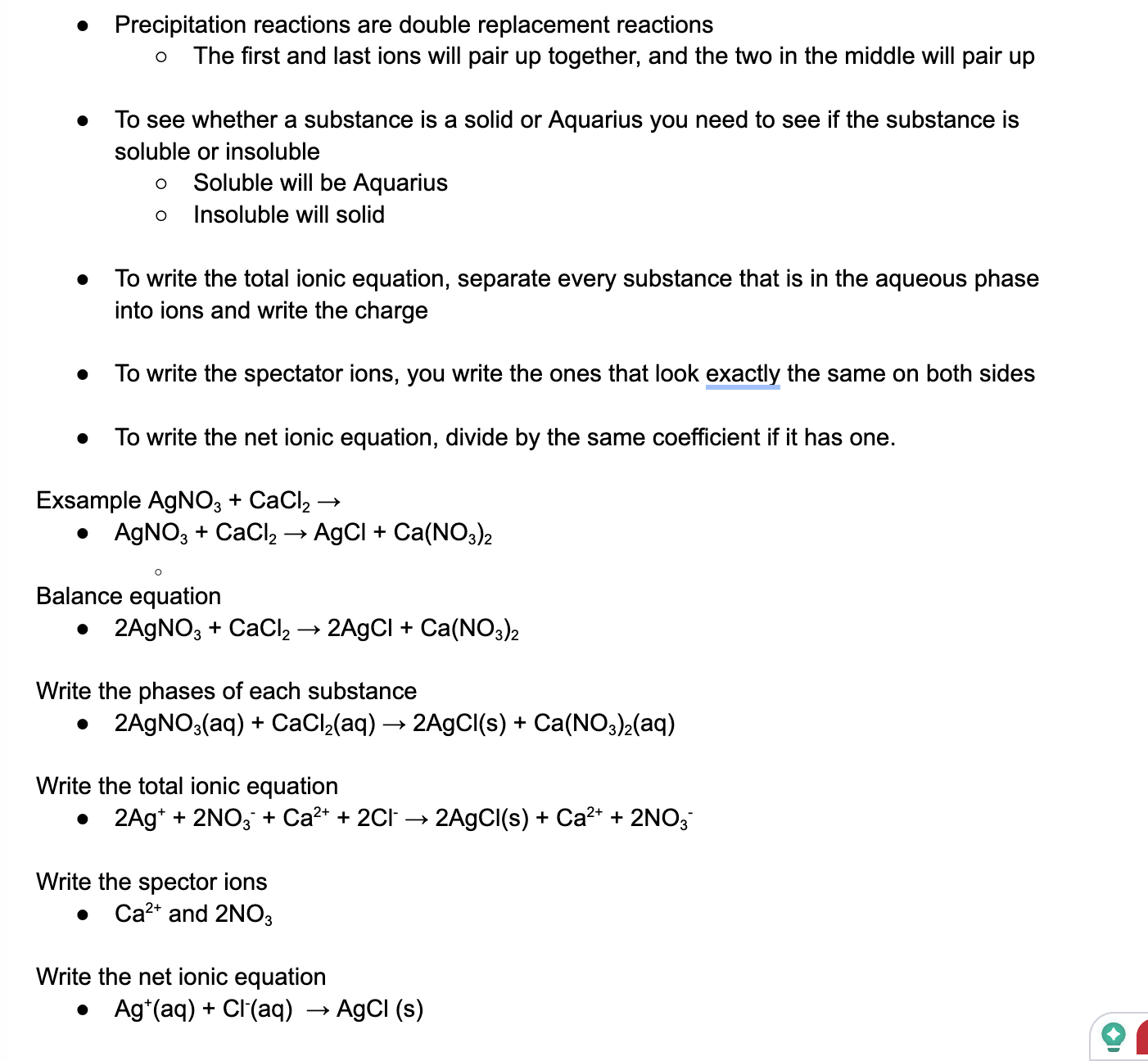
Write both complete ionic and net ionic equations for the following reactions:
AgNO3 + CaCl2 →