Unit 4 - Investment Companies
 Studied by 0 people
 Call Kai
 Learn
Learn Practice Test
 Spaced Repetition
 Match
Match Flashcards
 Knowt Play
1/30

There's no tags or description
Looks like no tags are added yet.
Name | Mastery | Learn | Test | Matching | Spaced |
|---|
No study sessions yet.
31 Terms
Investment Company Act of 1940
defines investment companies
mutual funds, face-amount certificates (FACs), unit investment trusts, and management companies
investment company: a corporation or trust that pools investors’ money and then invests that money in securities on their behalf
each fund has a clearly defined objective (ex. growth or income)
pooling funds in this way gives a small investor the purchasing power of a large investor
raise capital by selling shares to the public
must abide by the same registration and prospectus requirements imposed on other issuers by the Securities Act of 1933
subject to regulations regarding how their shares are sold to the public
Face-Amount Certificates (FACs)
a contract between an investor and an issuer in which the issuer guarantees payment of a stated (face) amount to the investor at some set date in the future
in return, the investor agrees to pay the issuer a set amount of money
either as a lump sum (fully paid FAC) or in periodic installments
not managed
once the portfolios are composed, they don’t change
**investment companies under the Investment Company Act of 1940
Unit Investment Trusts (UITs)
an investment company organized under a trust
have trustees
create a portfolio of securities designed to meet the UIT’s objectives
sell redeemable units or shares in the portfolio
each share is an undivided interest in the entire portfolio
portfolio is fixed
have a fixed end or maturity date
debt-based → will end when the last bond in the portfolio matures
equity-based → end date when the portfolio is liquidated and the funds are distributed to investors
b/c it’s fixed, there’s no need for active management and no portfolio turnover
don’t assess management fees
shares are redeemable with the issuer at intervals specified in the prospectus
Management companies
actively manages a securities portfolio to achieve a stated investment objective
closed end or open end
both sell shares to the public in an IPO
closed end → initial offering of shares is limited (closes after a certain # of shares are sold)
open end → perpetually offering new shares to the public
Open End vs Closed End Investment Companies

Mutual Funds
a pool of investors’ money invested in various securities as determined by the fund’s stated investment objective
issues common stock
don’t trade in the secondary market
investors purchase shares from the fund
redeem shares with the issuer who sends out money and cancels the investor’s shares
shares are redeemable securities (guaranteed) → the shares are marketable and liquid
owners have an undivided interest → no owner has higher status than another
generate dividends and capital gains for investors
they choose to either reinvest those or receive them in cash
reinvestments are done at the fund’s current NAV
distributions are taxable
may be sold in full or fractions
allows investors to specify a $ amount rather than # of shares
managed by investment managers
provides an investor w/ ownership in a diversified portfolio even w/ a small investment
maximum sales charge is 8.5% of the POP
shareholders have voting rights
Divided into Class A, B, C, or no load
Class A (Front-End Load) Shares
front-end sales charge
sales charges are paid at the time an investor buys shares
charge is taken from the total amount invested
Class A shares are best for investors with large investments and longer time frames. This allows the investor to lower the load cost overall and spread the one-time cost over several years.
Class B (Back-End Load) Shares
back-end sales load
contingent deferred sales charge (CDSC)
charge is paid at the time an investor redeems shares
the full investment amount is available to purchase shares
reduced by a % each year after purchase (declining sales charge)
charge is applied to the proceeds of any shares redeemed that year
usually drops to 0 after awhile
becomes Class A shares at that point
Class B shares are best for investors with smaller investments and longer time frames to get past the back-end loads.
Class C (Level-Load) Shares
have a 0.25% annual shareholder services fee, charged quarterly
fees never go away → level load
typically have a one-year, 1% CDSC to discourage short-term trading of the fund
have 12b-1 fees
appropriate for investors who have short time horizons b/c the annual charges make them expensive
Class C shares are best for investors with short time frames of at least a year but not more than five years. The size of the investment is less relevant for Class C shares; for Class C, it is the time frame that matters.
No-Load Shares
companies marketing their shares directly to the public, eliminating the need for underwriters and the sales charges used to compensate them
shares purchased at NAV
permitted to charge fees that aren’t considered sales charges
Reducing Front-end Loads
Class A shares have lower expense ratios, making them a more efficient way for most people to invest
b/c the sales charge is paid up front, the investor has no surprise sales charges when they redeem their shares
downside → investor loses a portion of their invested capital up front (impacting their return)
there are ways to reduce the charge (breakpoints)
Breakpoints
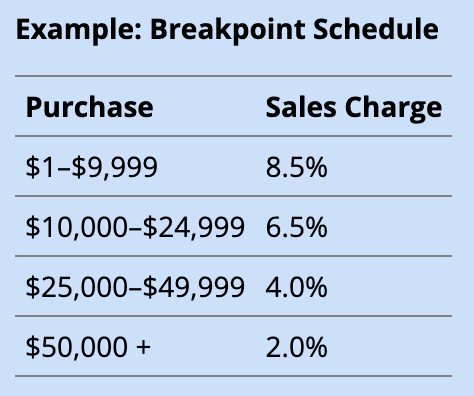
quantity discounts on Class A mutual fund sales charges
the greater the $ amount of a purchase, the lower the sales charge
follows a breakpoint schedule
most mutual funds allow investors to combine orders among related accounts in order to achieve a better breakpoint
Letters of Intent (LOI)
a person who plans to invest more money w/ the same mutual fund may decrease the sales charges by signing a LOI
investors tells the fund company their intention to add the additional funds needed to reach a specified breakpoint within 13 months
the fund applies the better breakpoint to all purchases during that period
lower sales charge = customer buying more shares for the amount they invest
extra shares from the reduced sales charges are held in escrow
a customer who completes the LOI received the escrowed shares
if someone doesn’t complete the LOI can either pay the difference in sales charges or surrender the escrowed shares
can be backdated up to 90 days
LOI begins the date of the letter
Breakpoint Sales
a sale just below a breakpoint
allowing a sale at an amount just below a breakpoint can be viewed as an effort by representatives to make higher sales charges
inconsistent w/ just and equitable principals of trade
the representative’s failure to disclose the breakpoint that triggers a violation
Rights of Accumulation
allow an investor to qualify for reduced sales charges
are available only for later investments
allow for reduced sales charges that will not apply to the first transaction
allow the investor to use any growth in the share price to qualify for breakpoints
don’t impose time limits
the customer may qualify for reduced sales charges when the total value of shares purchases meets a breakpoint
looks at the higher of these two:
current value of the position
the total of the investments made to date
Combination Privilege
a mutual fund sponsor (fund family) may offer more than one fund
an investor may receive a reduced sales charge by combining investments of two or more funds within the same family to reach a breakpoint
Exchange Privilege
allow an investor to redeem an investment in one fund for an equal investment in other fund in the same family w/o paying an additional sales charge
avoids any new sales load
taxable event
NAV
(total assets - total liabilities) / outstanding shares = NAV per share
calculated at least once per day
Liabilities and Expense Ratio
manager’s fee: cost of the investment advisor that makes the investment decisions for the portfolio
admin costs: trading, legal and accounting, transfer agent, etc
board of director’s costs: board members paid for their time plus other things related to them
12b-1 fees: used to pay for certain costs of distribution, usually for advertising and trailing commissions to BDs
expense ratio → actual cost of the expenses
fund’s expenses for a year / its average net assets for that year
Forward Pricing
the transaction price is based on the next time NAV is calculated going forward
Public Offering Price (POP)
NAV + SC = POP
sales charge (SC) is a percentage of POP
load fund → POP will always exceed the NAV
no-load fund → NAV = POP
SC can’t exceed 8.5% of POP
NAV > POP → closed-end fund
**order for MF → declaration day, record and pay date, ex-dividend date
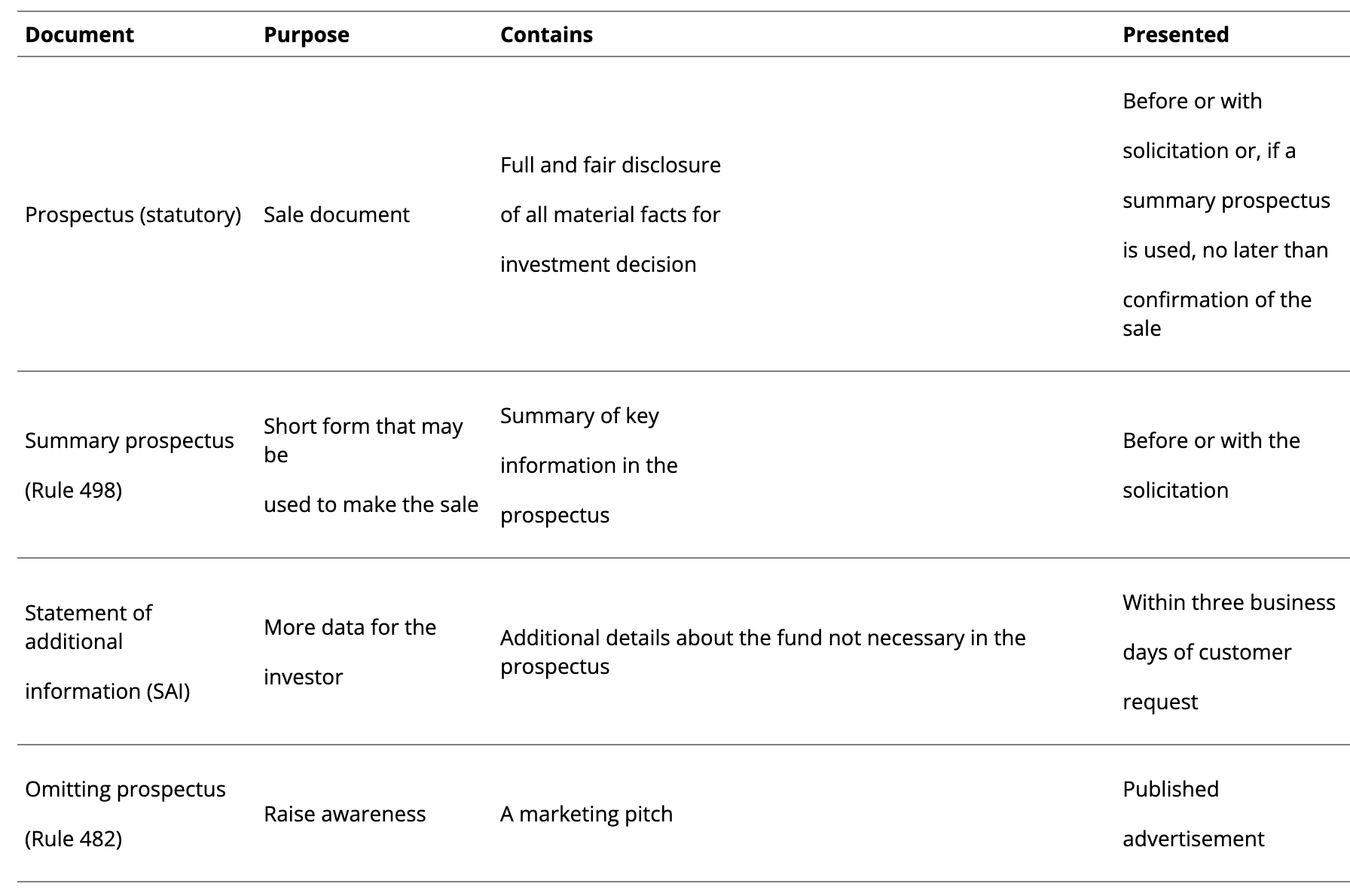
Disclosure Documents
Conduit Theory to Mutual Fund Taxation
to avoid the potential for taxation at three levels on the same dollar (triple taxation)
allows investment companies to avoid taxes on the dividends it pays shareholders if they meet certain criteria
companies qualify under subchapter M of the Internal Revenue Code
company calculates their Net Investment Income (NII) by doing Dividends + Interest - Expenses
investment company distributes at least 90% of the funds NII in dividends
Annuity
contract made with a life insurance company and is designed to provide retirement income
stream of payments guaranteed for some period of time
non-qualified
the investor puts money into an annuity where it grows tax deferred
accumulation phase → investor doesn’t pay taxes until money is withdrawn
annuitization → at retirement, the investor begins to receive an income
annuity phase → period during which the investor receives payments
Fixed Annuities
The contract has a set interest rate during the growth phase (also called the accumulation phase).
The rate may fluctuate from year to year but is never less than zero.
When the annuitant chooses to begin payments (called annuitization), the amount is fixed based on a formula and the payment does not change.
This is called the annuity phase.
The investment (called a premium) is invested in a general account and managed by the insurance company.
The insurance company must pay the guaranteed return even if the investment return does not cover the cost.
This is called investment risk. The insurance company takes on the investment risk with a fixed annuity.
The rate of return and fixed payment may not keep pace with inflation.
This is called inflation or purchasing power risk. The investor takes on inflation risk in a fixed annuity.
There is no market risk in a fixed annuity, so a fixed annuity is not a security.
A fixed annuity requires a life insurance license to sell, not a securities license.
Variable Annuities
investor takes on the investment risk
Premiums are placed into a separate account to be invested as the customer directs.
Funds in the separate account are directed into one or more subaccounts.
Subaccounts are a type of investment company and are classified as UITs or open-end management companies.
A classification as an open-end management company is more common.
Subaccounts operate much like mutual funds, but they are not mutual funds. They are separate accounts; do not call them mutual funds.
The subaccounts will have investment objectives similar to mutual funds.
Subaccounts are investment companies under the Investment Company Act of 1940, so they are considered securities.
The presence of securities within the VA makes the VA a security and subject to securities regulations.
The value of a separate account fluctuates with the investment returns of the subaccounts.
The returns may exceed the rate of inflation but are not guaranteed to do so.
Subaccounts may lose value due to market fluctuations.
All fees must be disclosed, and they include
administrative fees,
investment advisor fees,
custodial fees, and
surrender charges.
If the annuitant dies during the accumulation period, the beneficiary receives the greater of the account value or the premiums paid.
Sales of VAs require both a securities license and a life insurance license.
supplement an investor’s retirement
should maximize use of qualified retirement accounts before using a VA
Fixed vs Variable Annuities

Annuitization
when an investor reaches retirement, they may choose to annuitize their contract
a one-time, irreversible election to give up ownership of the assets of the annuity in return for a lifetime income guaranteed by the insurance company
initial payment based on a formula that has SAAPI
S of the annuitant
Age of the annuitant
Amount in the annuity
Payout option selected
assumed Interest rate (AIR) from investments in the separate account
Suitability of VAs for customers
A VA is for retirement income, not for a more immediate purpose like education funding or a home purchase.
A VA is a supplement to retirement income and is not a suitable investment for other investment needs.
A VA is not for preservation of capital.
A VA should be funded with available cash. VA funding should not come from
existing retirement or other tax advantaged savings,
cashing out a life insurance policy,
selling other investment assets,
borrowing against an asset, like a home equity loan.
A VA should not be used inside another tax-advantaged account like an individual retirement account or 401(k).
All other available contributions to qualified retirement plans should be maximized before a VA is used.
The customer should have the risk tolerance to handle market risk.
Tax Rules for VAs
they’re tax deferred, not tax-free
no tax consequences until they are withdrawn
when growth is withdrawn from a VA, it is taxable as ordinary income (not capital gain) for the year of the withdrawal
taxing annuitization
when the investor annuitizes, they surrender the value of the account to the insurance company in return for a life income
each payment will be part return of principal (the exclusion ratio) and part taxable income
taxing lump sum
the investor takes everything out and closes the annuity
the growth becomes taxable income and the rest is return of principle
taxing partial withdrawal
happens when the investor takes out a portion of the investment in a VA
withdrawal is from the growth first
(LIFO)
**any taxable amount taken out before the annuitant is 59.5 years old will be subject to a penalty of 10%
1035 Exchange
Funds in an annuity may be transferred directly to another annuity
these funds aren’t considered a withdrawal and aren’t subject to taxes
there still may be surrender fees