Respiration and Digestion (Cellular Respiration) and Fermentation
 Studied by 0 people
 Call Kai
 Learn
Learn Practice Test
 Spaced Repetition
 Match
Match Flashcards
 Knowt Play
1/39

There's no tags or description
Looks like no tags are added yet.
Name | Mastery | Learn | Test | Matching | Spaced | Call with Kai |
|---|
No analytics yet
Send a link to your students to track their progress
40 Terms
chloroplasts
found in plants and algae, are the site of photosynthesis, a metabolic process that uses the energy from sunlight to fix carbon (from CO2) and uses it to generate energy-rich organic molecules such as glucose
mitochondria
are the site of cellular respiration, a metabolic process that uses oxygen to generate ATP
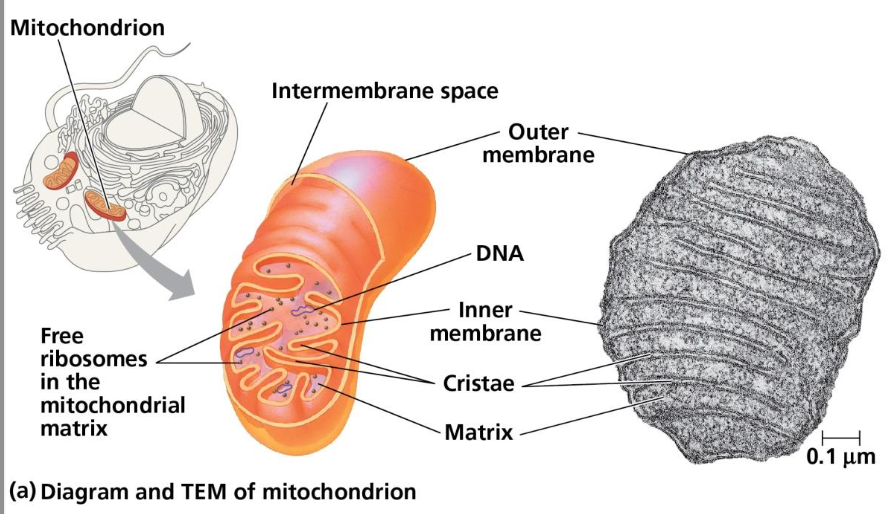
smooth outer membrane and inner membrane folded into cristae
inner membrane creates two soluble compartments: intermembrane space and mitochondrial matrix
What are some characteristics of mitochondria?
catabolic pathways breakdown organic molecules
What metabolic process is used to produce ATP?
consumes organic molecules of O2 and yields ATP
carbohydrates, fats, and proteins from our diet are all consumed as fuel; but cellular respiration is usually traced with the sugar glucose
What is aerobic respiration?
C6H12O6 + 6O2 → 6CO2 + 6H2O + energy (ATP + heat)
What is the equation for aerobic respiration?
True; cellular respiration involves many reactions in which electrons are passed from one molecule to another
(T/F) Respiration is a redox reaction.
redox reactions (oxidation-reduction reactions)
reactions involving electron transfers
oxidative phosphorylation
the process that generates most of the ATP, powered by redox reactions
it accounts for almost 90% of the ATP generated by cellular respiration
For each molecule of glucose broken down to CO2 and water by respiration, the cell makes up to 32 ATP
How much ATP is created from cellular respiration?
glycolysis
pyruvate oxydation
Krebs cycle (citric acid cycle)
electron transport chain
What are the phases of cellular respiration?
breaks down glucose into two molecules of pyruvate
occurs in cytosol
10-step pathway that’s broken in two phases
energy investment phase (1st 5 steps)
energy payoff phase (last 5 steps)
occurs whether or not O2 is present
What happens in glycolysis?
anaerobic → no oxygen consumed
Glycolysis is an (anaerobic/aerobic) process.
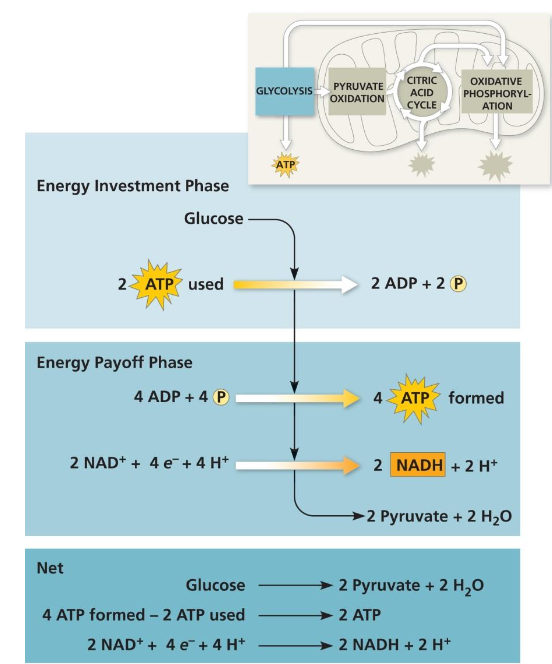
the investment phase → energy is consumed, glucose is split into two
the payoff phase → ATP is one of the products
What are the two main phases of glycolysis?
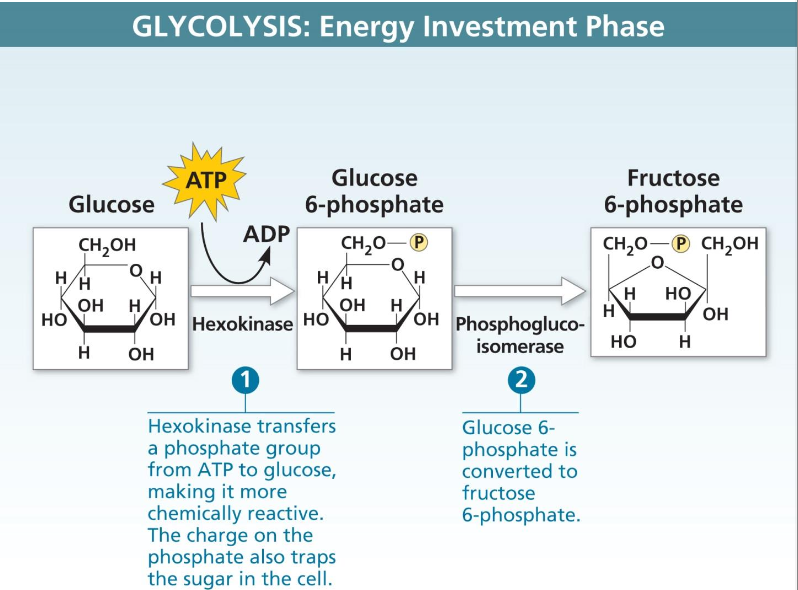
glucose is prepared for the next two phases by the addition of two phosphate groups
produces fructose 1,6 - bisphosphate
requires an input of energy in the form of two molecules of ATP (substrate-level phosphorylation)
phosphorylation of glucose traps the molecule inside the cell and destablilizes it so that it is ready for next phase
Describe how the energy investment phase of glycolysis works.
substrate level phosphorylation
a metabolic reaction that creates ATP or GTP by transferring a phosphate group from a high-energy compound to ADP or GDP
fructose 1, 6-bisphosphate is unstable and cleaved into two molecules
glyceraldehyde 3-phosphaste (G3P) and its isomer,
dihydroxyacetone phosphate (DHAP)
DHAP is converted into another molecule of G3P
resulting in two molecules of G3P at the end of phase 1
What happens when glucose is split in glycolysis?
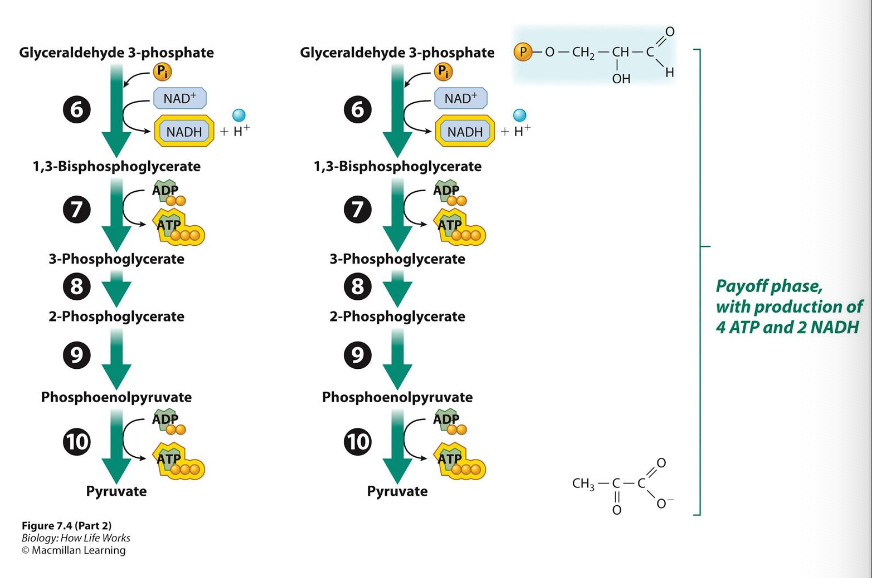
during the payoff phase of glycolysis
two molecules of pyruvate are formed
two molecules of the electron carrier NADH are produced
four molecules of ATP are produced
What happens in energy payoff?
carries electrons from one reaction to another
co-enzyme utilized in both cellular respiration and photosynthesis
NAD+ is oxidizing agent
electron acceptor
NAADH is the reducing agent
electron donor
How does nicotinamide adenine dinucleotide (NAD+) work?
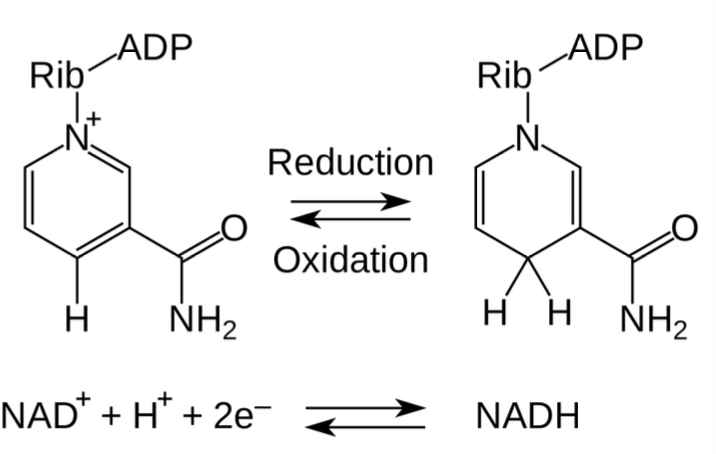
net gain of two ATP
energy payoff produced four ATP, but two were “invested” earlier
production of two NADH
used in the last reaction of cellular respiration
two molecules of pyruvate
these will be used in the next part of respiration
What are the products of glycolysis?
links glycolysis and the citric acid cycle
three reactions
pyruvates’s carboxyl group (-COO-) removed (produces CO2)
remaining 2-C molecule oxidized to form acetate (CH3COO-)
NAD+ reduced to NADH
coenzyme A (CoA) attached to acetate forming acetyl CoA
high potential energy
What is pyruvate oxidation?
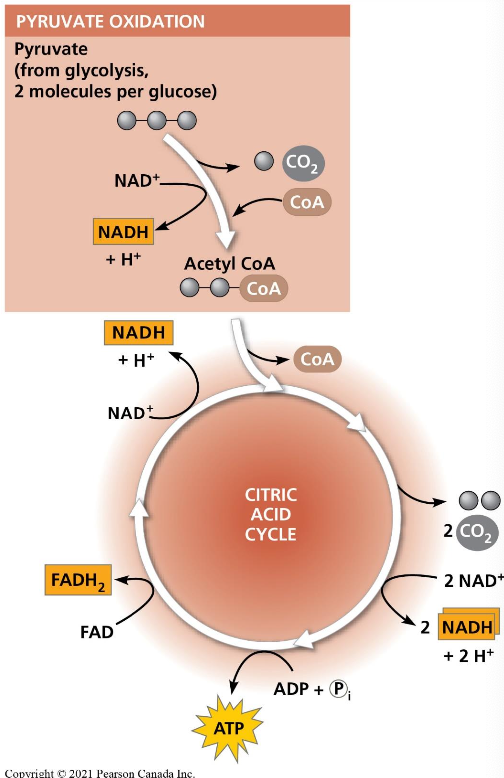
a closed loop
starts with and re-creates oxaloacetate
completes the oxidation of glucose into CO2
each turn of the citric acid cycle generates
1 ATP
3 NADH
1 FADH2
1 CO2
central driver of respiration
What is the citric acid cycle?
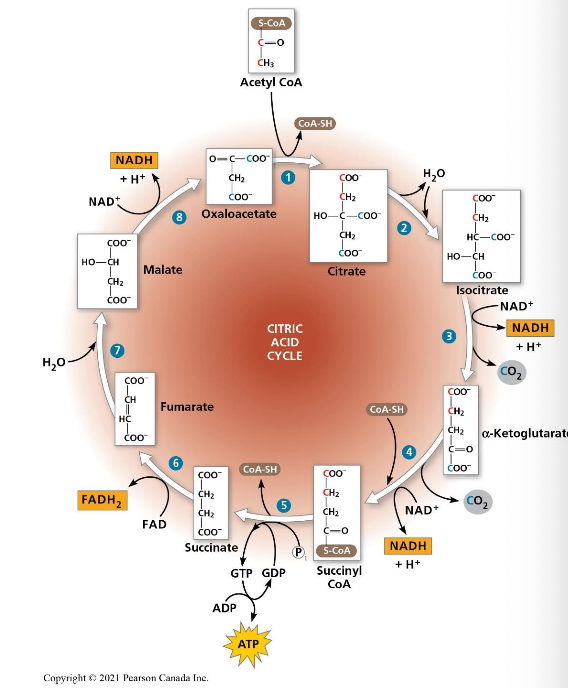
oxidation of acetyl-CoA produces the carbon dioxide we exhale
chemical potential energy that was stored in acetyl-CoA is then stored in NADH and FADH2
production of GTP is the result of substrate-level phosphorylation
What happens when acetyl-CoA is oxydized?
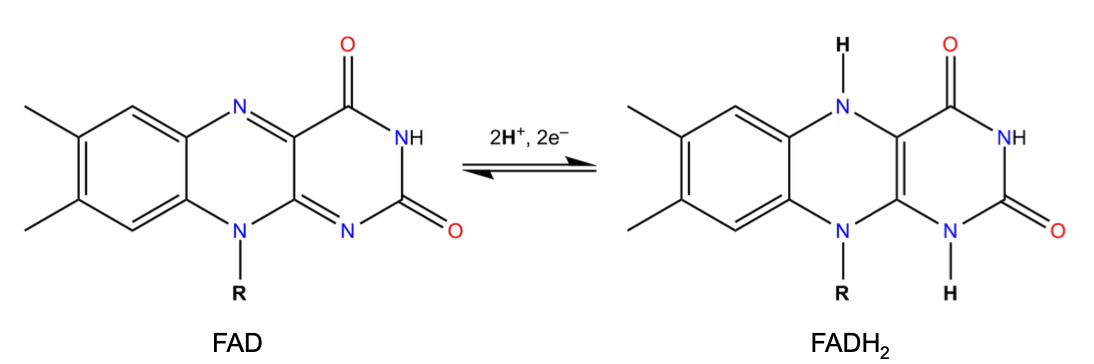
flaven adenine dinucleotide (FAD)
co-enzyme during step 6 of citric acid cycle
shuttles two electrons
spins twice for every molecule of glucose that enters cellular respiration
one spin
1 ATP
3 NADH (6 electrons)
1 FADH2 (2 electrons)
for each molecule of glucose it produces
2 ATP
6 NADH (12 electrons)
2 FADH2 (4 electrons)
What does the citric acid cycle generate?
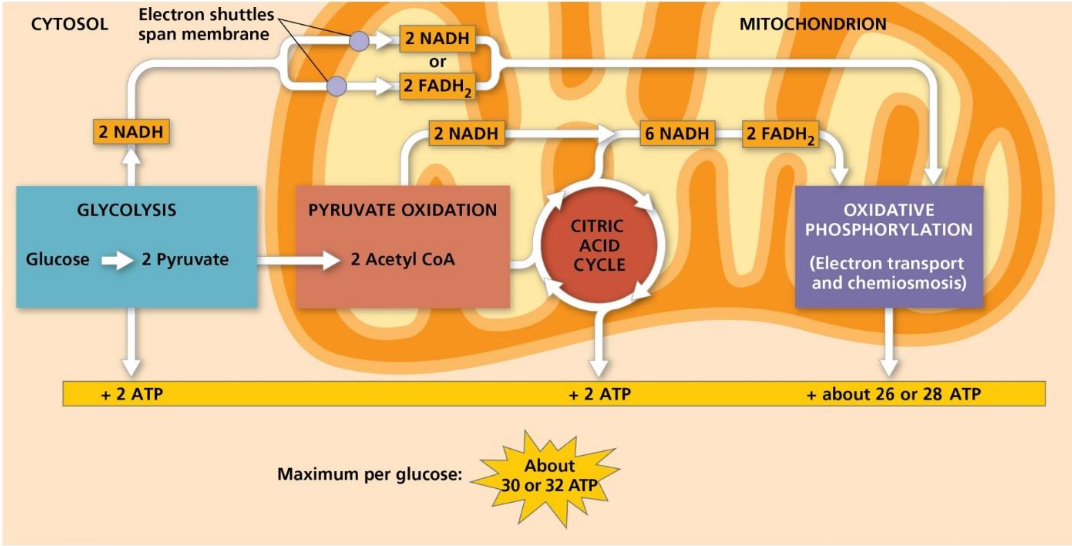
electron transport chain
during glycolysis, pyruvate oxidation and the citric acid cycle, most of the energy extracted form organic molecules is transferred to NADH and FADH2
Where do the products of the citric acid cycle go?
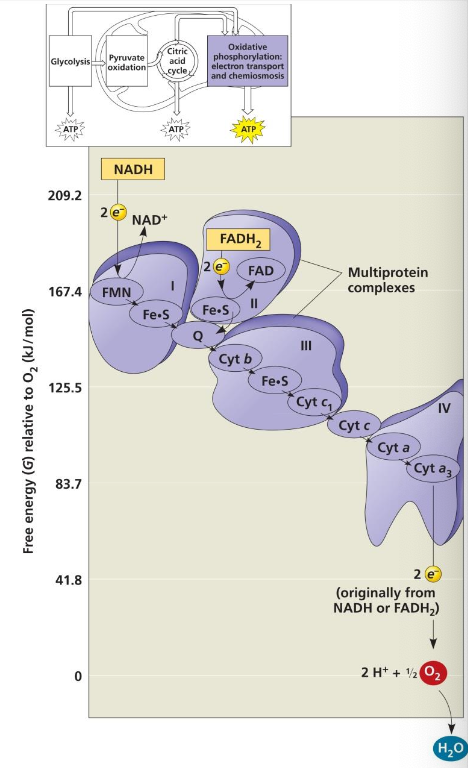
the overall energy drop (ΔG) for electrons traveling through the chain is 221.8 kJ/mol
the “fall” is broken up into a series of smaller steps
electrons passed down chain through a series of electrons carriers
breaks the large free-energy drop from NADH ana FADH2 into smaller steps
electrons release energy at each step in chain
some energy from fall used to pump H+ out of matriz into intermembrane space
How does the chain in the ETC work?
electrons are donated to split oxygen and form water
four electrons required to reduce each molecule of O2
two water molecules generated in the process
How are electrons used to actively pump H+?
use of energy in a H+ gradient to drive cellular work
H+ pumped against concentration gradient
H+ then flow down their concentration gradient backa cross the inner membrane, through ATP synthase
ATP synthase uses the exergonic flow of H+ to drive phosphorylation of ADP to form ATP
What is chemiosmosis?
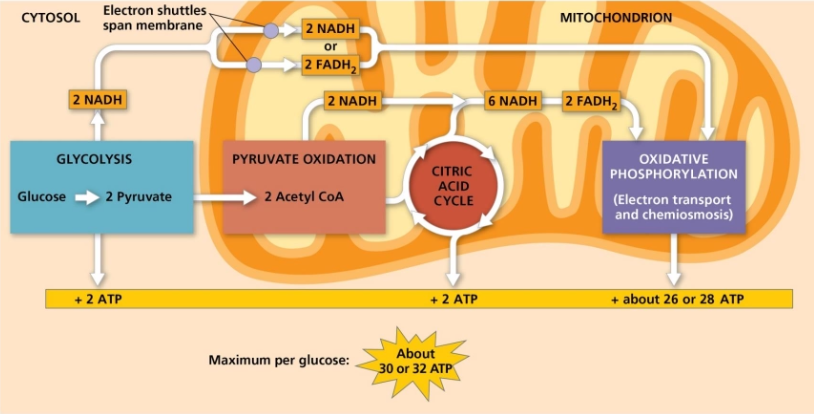
glucose → NADH/FADH2 → electron transport chain → H+ gradient → ATP
34% of energy in a glucose molecule is transferred to ATP via cellular respiration
Makes ~ 30-32 ATP
How does energy flow during cellular respiration?
metabolic integration
processes of cellular respiration use or produce many of the same molecules, making their rates interdependent
citric acid cycle uses NAD+ and produces NADH
ETC uses NADH and produces NAD+
How is NAD+ and NADH used?
if ETC slows down, it produces less NAD+, which reduces the rate of the citric acid cycle
What is the effect of the ETC on the citric acid cycle?
primary producers
autotrophs
primary consumers
herbivores
secondary consumers
primary carnivores
tertiary consumers
secondary carnivores
What are the different trophic levels?
ingestion
mechanical digestion
digestion
chemical digestion (enzymatic hydrolysis)
absorption
nutrient molecules enter body cells
elimination
undigested material
What are the stages of food processing?
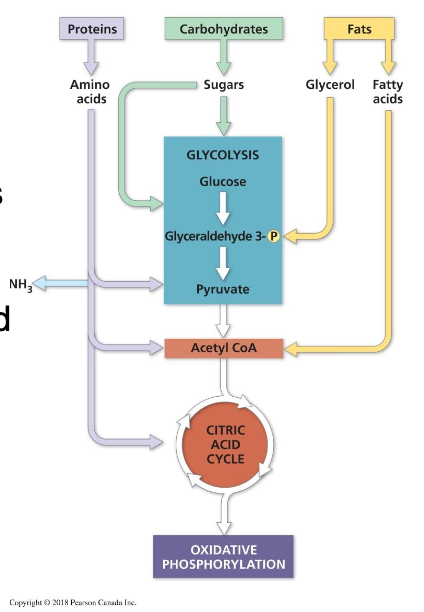
catabolic pathways funnel electrons from organic molecules into cellular respiration
carbs accepted in glycolysis
proteins digested to amino acids; amino groups can feed glycolysis or citric acid cycle
fats digested to glycerol (used in glycolysis) and fatty acids are broken down to produce acetyl CoA
What is the catabolism for different molecules of food?
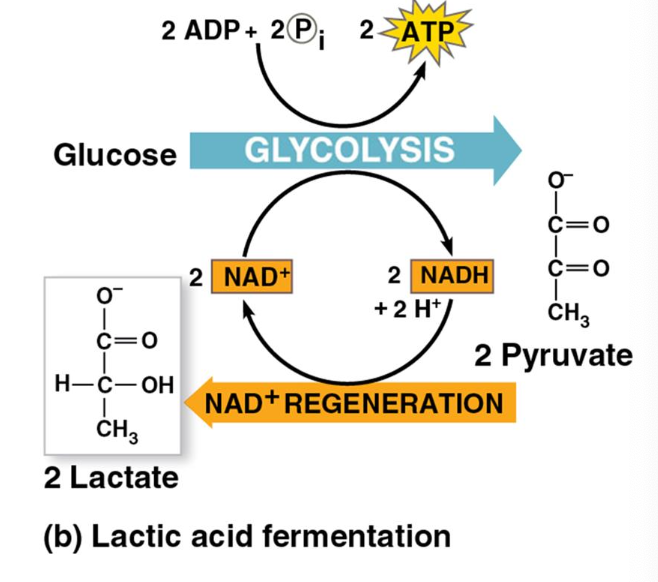
in the absence of oxygen, pyruvate produced from glycolysis can be reduced to lactic acid
enables NAD+ regeneration
the NAD+ can then be reduced in glycolysis, and ATP is still synthesized in small amounts for use by the cell
Glucose + 2 ADP + 2 Pi → 2 lactic acid + 2 ATP + 2 H2O
What happens to pyruvate when O2 is absent?
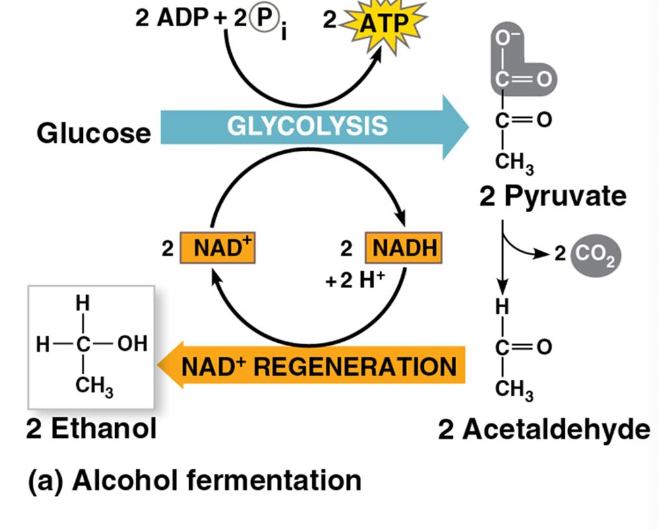
ethanol fermentation occurs in plants and fungi
pyruvate releases carbon dioxide and the acetaldehyde produced is reduced to form ethanol
regenerates NAD+ so than ATP can be generated during glycolysis
Glucose + 2 ADP + 2 Pi → 2 ethanol + 2 ATP + 2 H2O
What happens during ethanol fermentation?
obligate anaerobes
carry out fermentation or anaerobic respiration and cannot survive in the presence of CO2
facultative anaerobes
yeast and bacteria; they can survive using either fermentation or cellular respiration
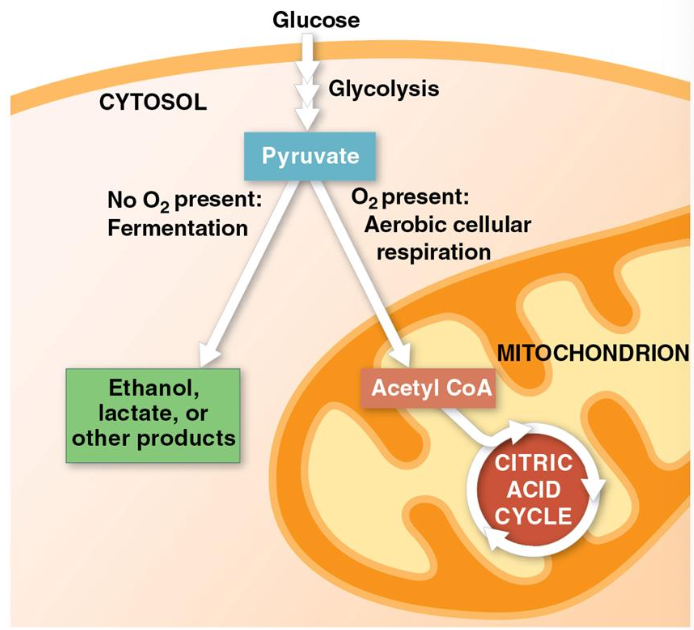
pyruvate is a fork in the metabolic road, leading to alternative catabolic routes
 Note
Note  Flashcards (61)