AP bio study
 Call Kai
 Learn
Learn Practice Test
 Spaced Repetition
 Match
Match Flashcards
 Knowt Play
1/19

There's no tags or description
Looks like no tags are added yet.
Name | Mastery | Learn | Test | Matching | Spaced | Call with Kai | Chat |
|---|
No analytics yet
Send a link to your students to track their progress
20 Terms

African elephants, Loxodonta africana, are often hunted illegally for their tusks. Both male and female elephants have tusks, although the tusks are much larger in the males. Researchers have followed the elephant population in Gorongosa National Park in Mozambique for many years. Figure 1 shows the percent of tuskless female elephants expected in wild populations throughout the species’ range, as well as the percent of tuskless females that survived the hunting between 1977 and 1992 (those over 25 years old) and the percent of female elephants born after 1992 without tusks in the park. The data are based on 200 known female elephants in the park. Which of the following best describes the process responsible for the change in the percent of tuskless female elephants in the Gorongosa National Park population shown in Figure 1 ?
Human hunting of elephants with tusks between 1977 and 1992.

Scientists investigated the role that beak depth plays in the ability of one species of seed-eating finch to reproduce. The scientists calculated the average beak depth of finches in mating pairs and then observed whether or not the pairs produced at least one offspring that survived to the next season. The data are represented in Figure 1. Based on the data in Figure 1, which of the following best describes the concept illustrated?
Parental pairs with a specific beak depth had the highest reproductive fitness.
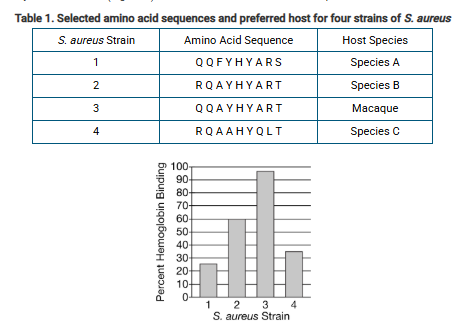
Staphylococcus aureus is a pathogenic bacterium that can infect a wide range of host species, including humans. S. aureus has a particular protein that binds with hemoglobin from the host organism. Hemoglobin is the iron-containing protein used to transport oxygen in the blood. Since iron is important for growth, S. aureus have evolved the ability to absorb the iron from the host's hemoglobin.
Different S. aureus strains preferentially infect different hosts and have different amino acid sequences at their hemoglobin-binding domains (Table 1; letters indicate different amino acids). In an experiment, different S. aureus strains were mixed with hemoglobin from macaque monkeys and their binding ability was measured (Figure 1). The differences in amino acid sequences contributed to the differential binding abilities observed. Which of the following processes is most consistent with the differences in the amino acid sequences listed in Table 1 ?
Each strain is best adapted to a specific host species.
A current challenge for doctors involves the bacterial strain Clostridioides difficile, which no longer responds to traditional antibiotic treatments.
Which of the following best explains why this particular strain of bacteria is resistant to antibiotic treatment?
The bacteria have high genetic variability and high reproductive rates.
The bird, Parus major, is commonly found in man-made habitats. During the summer these birds primarily feed on insects, and in the winter, when insects are scarce, they forage in gardens and bird feeders for seeds, nuts, and berries. Recently, climate change has led to a decrease in food available from gardens, and scientists have observed that the average beak length of the birds has increased.
Which of the following best explains the directional shift in beak length in these birds?
Longer beaks allow the birds to better access seeds in bird feeders.
Climate change is disrupting the length of winter in various ecosystems, resulting in less snowfall and milder winters. Scientists in Finland have been observing the tawny owl, a fairly large owl species that is commonly found in woodlands across much of Europe and Asia. Typically, the feathers of the upper body are either brown (BB) or gray (bb). Scientists studying tawny owls in Finland have found that the percentage of tawny owls that have brown feathers has increased over the past 28 years.
Which of the following best explains why the brown-feathered phenotype in tawny owls has increased over the past 28 years?
With milder winters, the advantage of gray feathers that blend into a snowy environment has decreased.
Which of these conditions do NOT occur in populations evolving due to natural selection?
Individuals pass on most traits that they acquire during their lifetime.
Which of the following statements best describes evolution?
Populations change genetically from one generation to the next.
What is the relative fitness of a sterile mule? Explain.
The relative fitness of a mule is 0% since it cannot reproduce at all.
Explain why natural selection is the only mechanism that consistently leads to adaptive evolution in a population.
Natural selection is the only evolutionary mechanism that consistently leads to adaptive evolution that is beneficial and always 100% happening
How did Hutton’s and Lyell’s ideas influence Darwin’s thinking about evolution?
By providing geological evidence, like fossils, to support his theories.

The carbohydrates glucose, galactose, and fructose have the same chemical formula(C6H12O6) but different structural formulas, as represented in the figure. Which of the following statements about glucose, galactose, and fructose is most likely true?
The carbohydrates have different properties because they have different arrangements of carbon, hydrogen, and oxygen atoms. They are isomers, glucose and fructose are structural ones.

Water and ammonia interact to form hydrogen bonds, as represented in the figure.
Which statement best helps explain the formation of the hydrogen bond represented in the figure?
The nitrogen has a partial negative charge, and the hydrogen attached to the oxygen has a partial positive charge
Figure 1 is a diagram of water molecules at the air-water interface at the surface of a pond.

Figure 1. Alignment of water molecules at air-water interface
Based on Figure 1, which of the following best describes how the properties of water at an air-water interface enable an insect to walk on the water's surface?
Hydrogen bonds between molecules at the surface of the water provide surface tension, which allows the water surface to deform but not break under the insect.

Which of the following statements best describes how organisms such as rabbits obtain the carbon necessary for building biological molecules?
Rabbits eat plants and break down plant molecules to obtain carbon and other atoms that they rearrange into new carbon-containing molecules.
The figure shows a model of the exchange of matter between the organisms that live together in an aquarium. The model includes matter exchange between plants, fish, and bacteria. The bacteria are represented as rod-shaped organisms living in the gravel at the bottom of the aquarium.

Which of the following statements best describes how molecules released by the fish become nutrients for the plants?
The ammonia molecules released by the fish are converted by the bacteria to nitrates, which are used by the plants to make proteins and nucleic acids.
Which of the following was not part of Darwin’s theory of evolution
Genetic variation MOSTLY comes from mutations

Figure 1. Formation of a peptide bond
Which of the following best describes the formation of the bond shown in Figure 1 ?
A covalent bond is formed between a carbon atom and a nitrogen atom along with the formation of .
Figure 1 represents a common process that occurs in organisms.

Figure 1. Structural formula for a common biological reaction
Which of the following is an accurate description of the process shown in Figure 1 ?
The formation of a covalent peptide bond in a dehydration synthesis reaction
Polypeptides are continuously being formed and degraded. One of these processes is shown.

Figure 1. Polypeptide reaction
Which statement is the most accurate description of the reaction shown in Figure 1?
It represents a polypeptide chain that is broken down through a hydrolysis reaction.