Intro to Neuroscience Exam 1
 Call Kai
 Learn
Learn Practice Test
 Spaced Repetition
 Match
Match Flashcards
 Knowt Play
1/93

There's no tags or description
Looks like no tags are added yet.
Name | Mastery | Learn | Test | Matching | Spaced | Call with Kai | Chat |
|---|
No analytics yet
Send a link to your students to track their progress
94 Terms
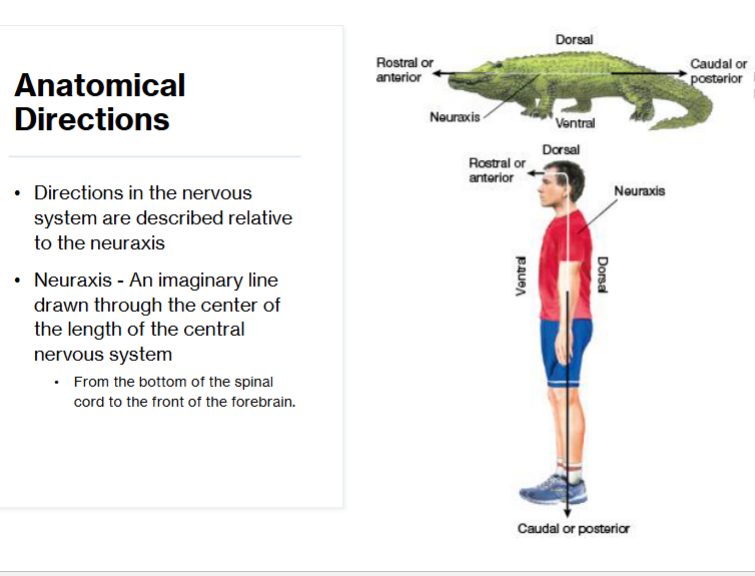
Neuraxis
Imaginary line drawn through the center of the length of the central nervous system
Ipsilateral
Structures on the same side of the body
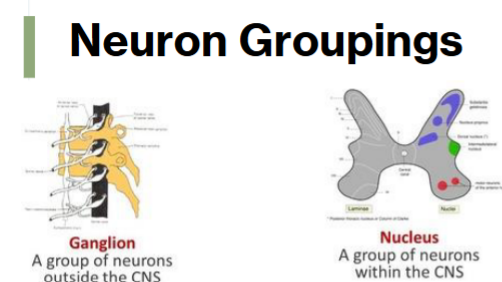
What are groups of neurons called within the central nervous system and within the peripheral nervous system
Within the CNS, nuclei, ganglions in the PNS
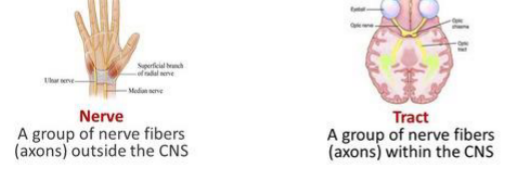
What are groups of axons called within the central nervous system and in the peripheral nervous system?
Tracts within the CNS, Nerves in the PNS
Fluid-filled space surrounding the brain that cushions the brain
subarachnoid space
What produces cerebrospinal fluid
The choroid plexus in the third ventricle
How is CSF reabsorbed into the blood supply?
arachnoid granulations
Divisions of the CNS: Forebrain, Midbrain, Hindbrain (cephalon)?
Telencephalon/Diencephalon, Mesencephalon, Metencephalon/Myelencephalon
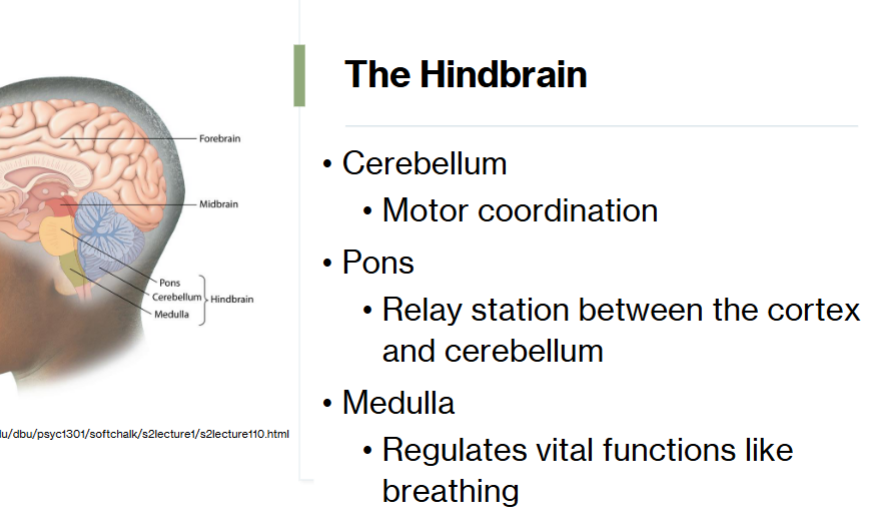
Relay station in hindbrain, between the cortex and cerebellum
Pons
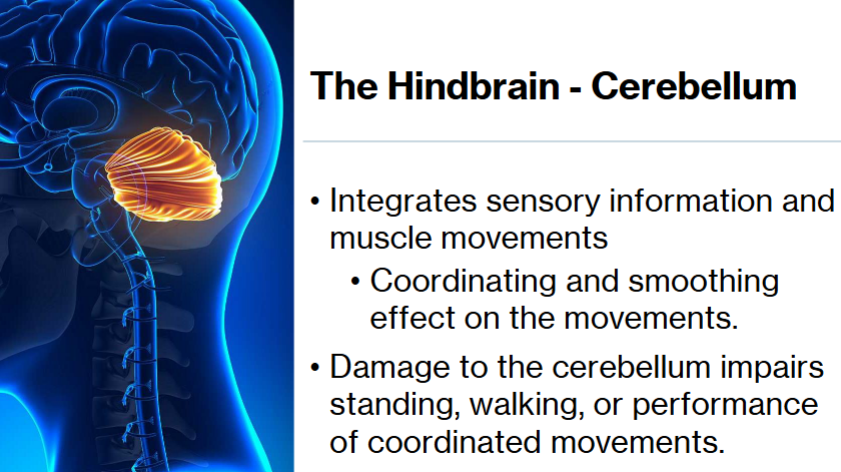
Functions of the cerebellum
Balance and posture - Integrates sensory information and muscle movements, coordinates and has a smoothing effect on the movements
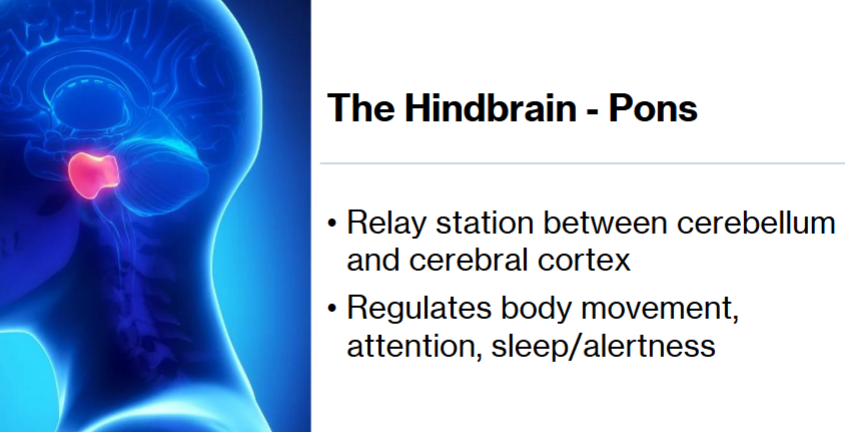
Functions of the Pons
Relay station between cerebellum and cerebral cortex, regulates body movement, attention, sleep/alertness
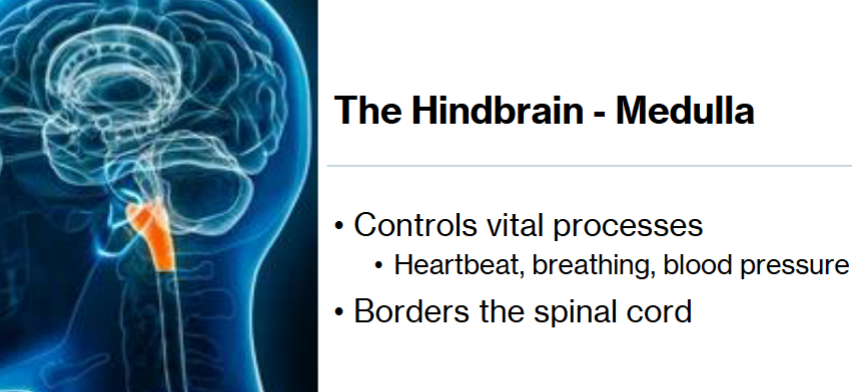
Medulla functions
Controls vital processes (heartbeat, breathing, blood pressure), borders the spinal cord
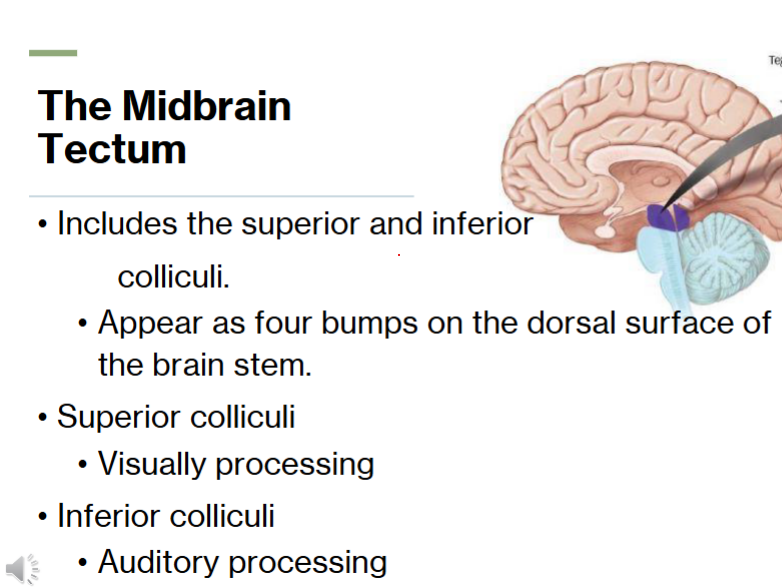
What processing do the superior and inferior colliculi of the tectum help with
Superior - visually processing
Inferior - auditory processing
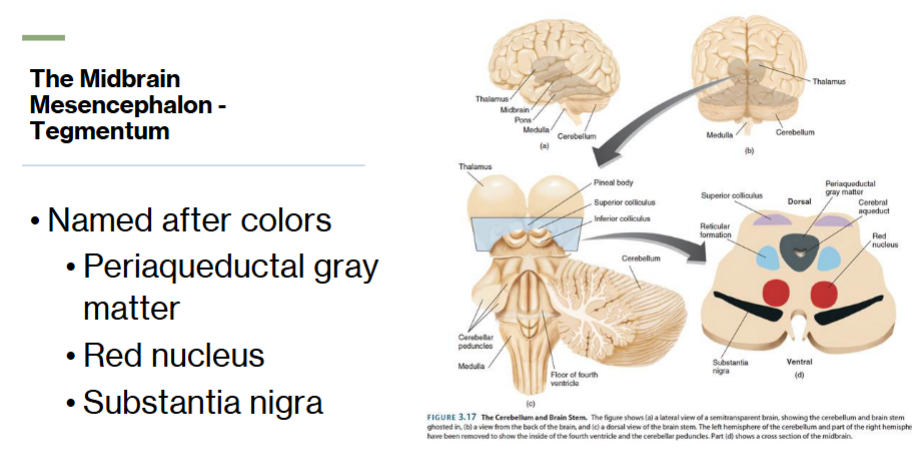
Core network of neurons in midbrain, key functional structures named after colors. Keeps us alert and coordinates movements.
Tegmentum in the midbrain
red nucleus (coordinates body movements), periaqueductal gray (blocks pain), reticular formation (controls sleep and wake cycles), and substantia nigra (uses dopamine to smooth out movements
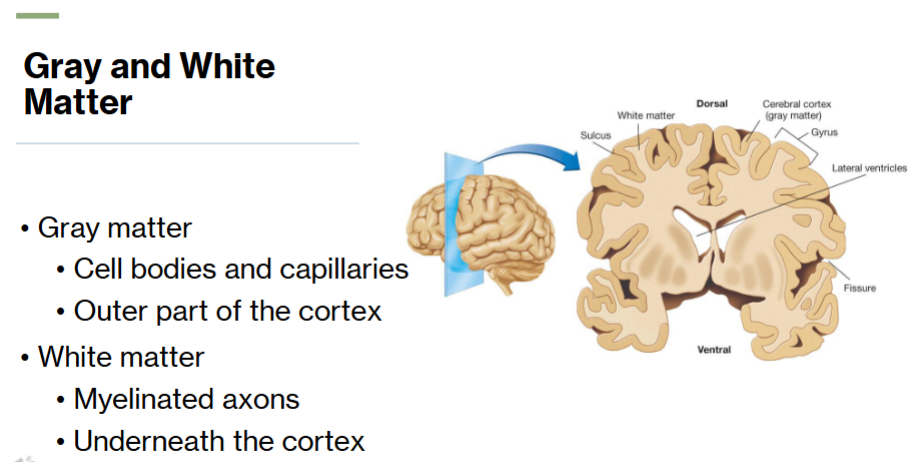
Does gray or white matter contain myelinated axons
white matter - gray matter has cell bodies and capillaries
Bundle of axons that connect the left and right cerebral hemispheres
Corpus Collosum
What are the 3 areas of the forebrain sensory cortex that receive information from sensory organs
Primary visual cortex
Primary auditory cortex
Primary somatosensory cortex
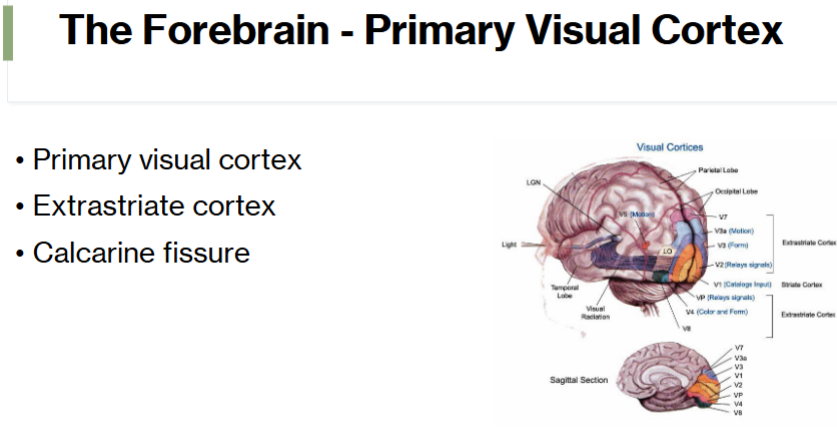
What fissure/sulcus houses the primary visual cortex?
calcarine fissure
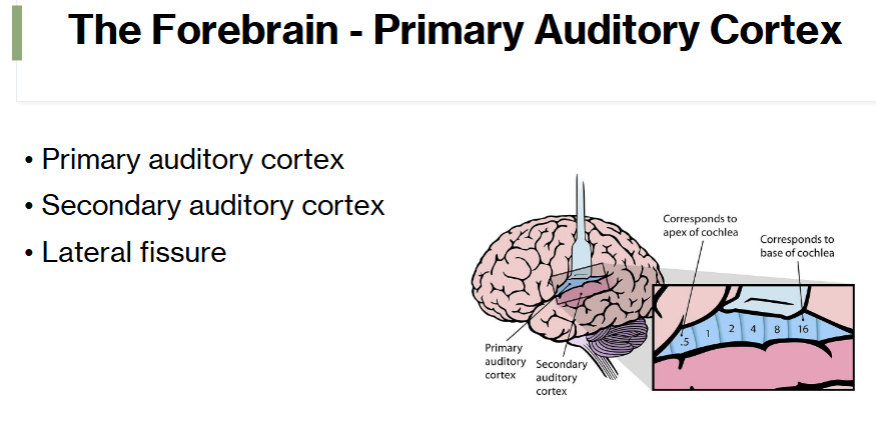
What fissure houses the primary auditory cortex
The lateral fissure
What brain portion produces posterior pituitary hormones and directly controls their secretion
hypothalamus
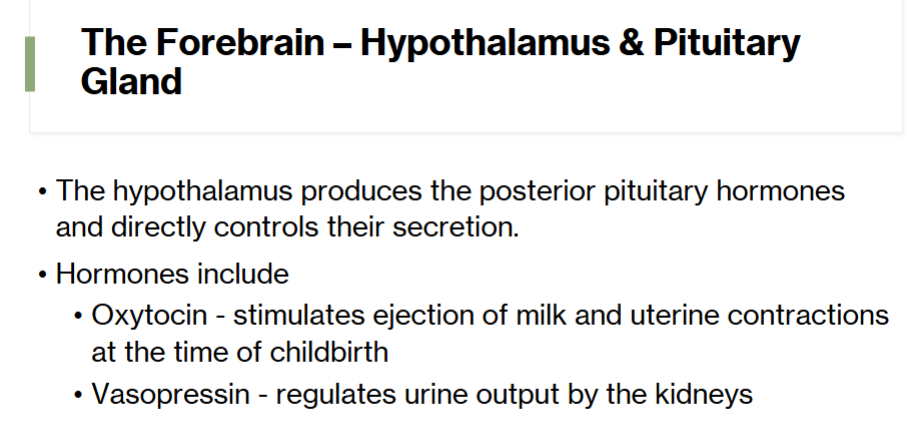
Thalamus functions
Relay station of the brain, prioritizes like a filter, receives info from sense organs. Sends info to the cortex via projection fibers
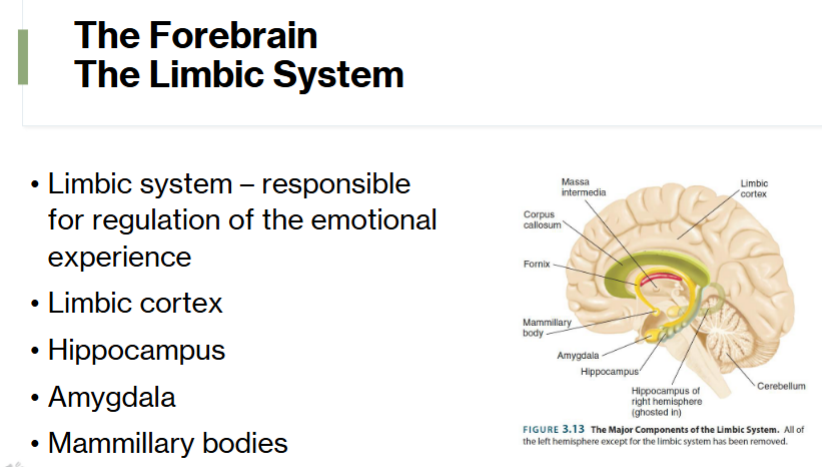
Limbic system functions
regulates emotional experience
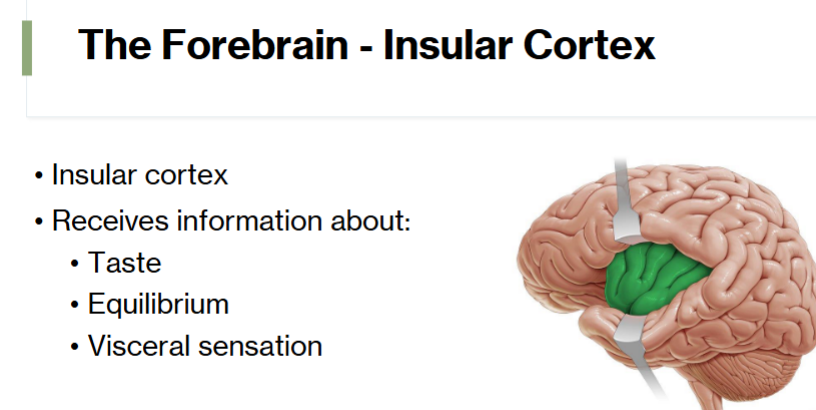
What does the insular cortex receive information about? Is it in the forebrain or midbrain or hindbrain?
Taste, equilibrium, visceral sensation
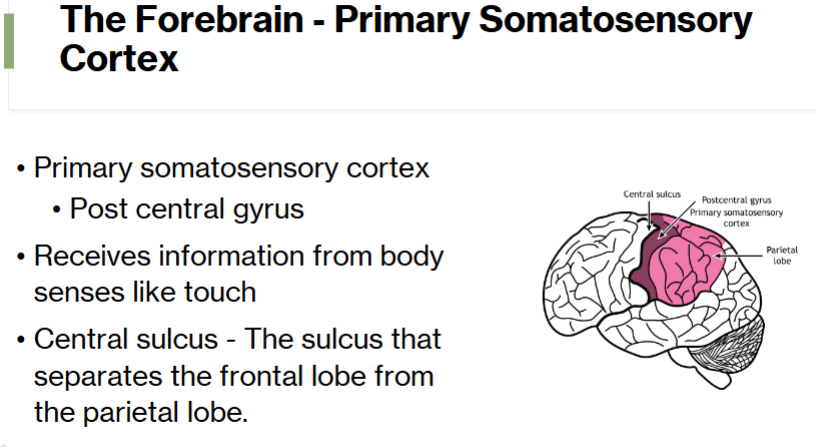
What sulcus separates the frontal lobe from the parietal lobe
central
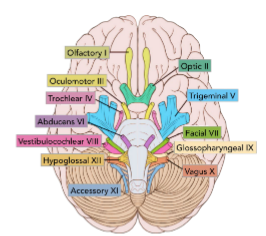
How many pairs of cranial nerves are there? OOOTTAFVGVAH
12 - Olfactory Optic Oculomotor Triochlear Trigeminal Abducans Facial Vestibulocochlear Glossopharyngeal Vagus Accessory Hypoglossal
Preganglionic neurons are located where
in the CNS
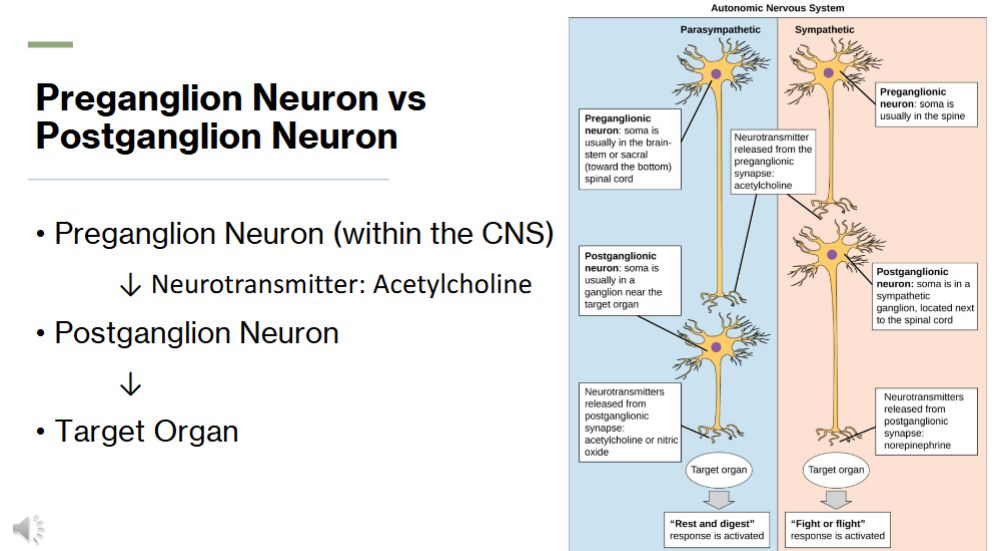
Both parasympathetic and sympathetic preganglionic neurons release this neurotransmitter:
acetylcholine
What neurotransmitter does a parasympathetic post-ganglionic neuron release
acetylcholine, to the target organs
What neurotransmitter does a sympathetic post-ganglionic neuron release
norepinephrine
What disease is caused by a degeneration of certain neurons that send axons to the caudate and putamen
Parkinson’s disease
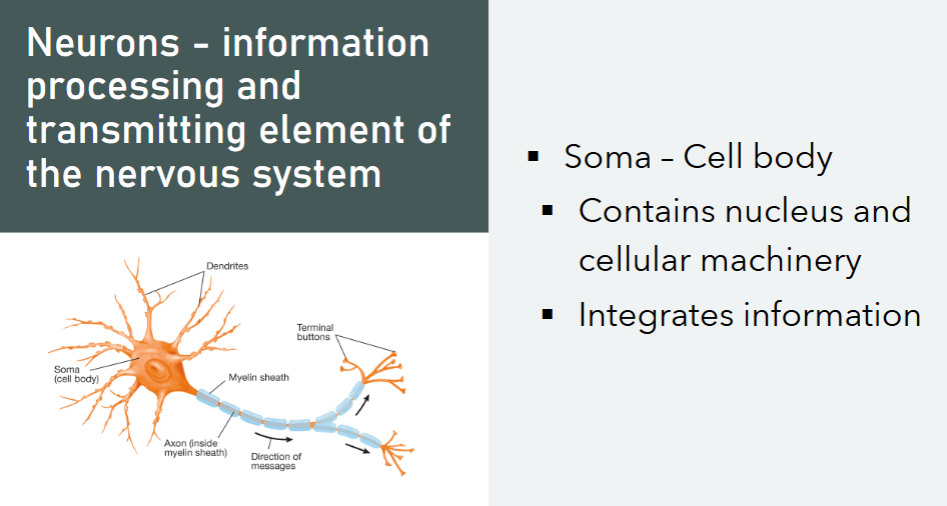
What is the cell body of a neuron called?
Soma
Axonic/Axoplasmic transport can be anterograde or retrograde. Which is slower?
Retrograde is half as slow as anterograde transport
Glial cells in the CNS
oligodendrocytes
Glial cells within the PNS
Schwann cells
What is the longest nerve in the body
Sciatic nerve
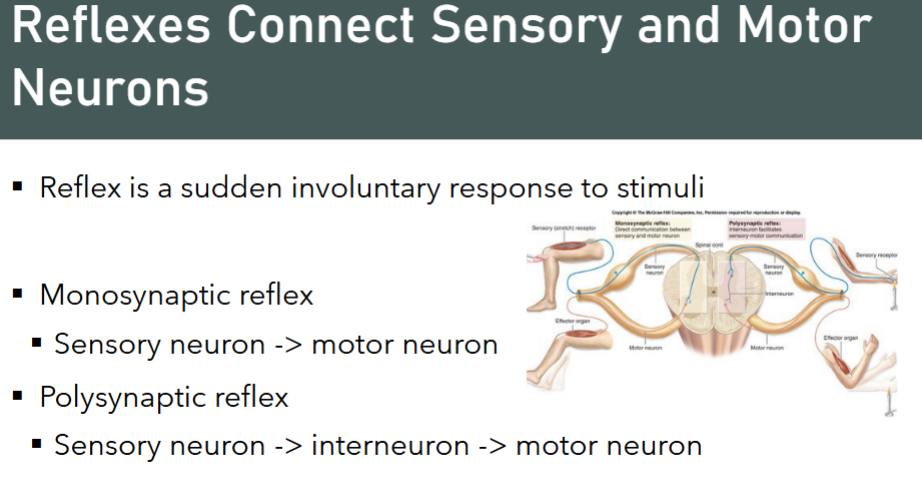
What type of reflex goes directly from a sensory neuron to a motor neuron
Monosynaptic reflex
What type of reflex goes from a sensory neuron to an interneuron and then to a motor neuron
Polysynaptic
Functions of astrocytes
phagocytosis on dead neuron debris
specialized ones form scar tissue
chemical nourishment to neurons
regulate chemical composition of fluid surrounding neurons
How many myelin segments can 1 oligodendrocyte produce
50
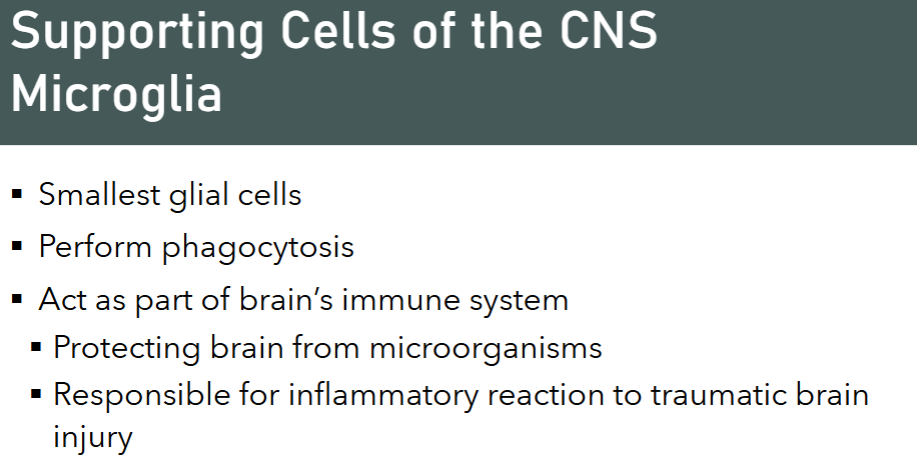
What are the smallest glial cells
Microglia
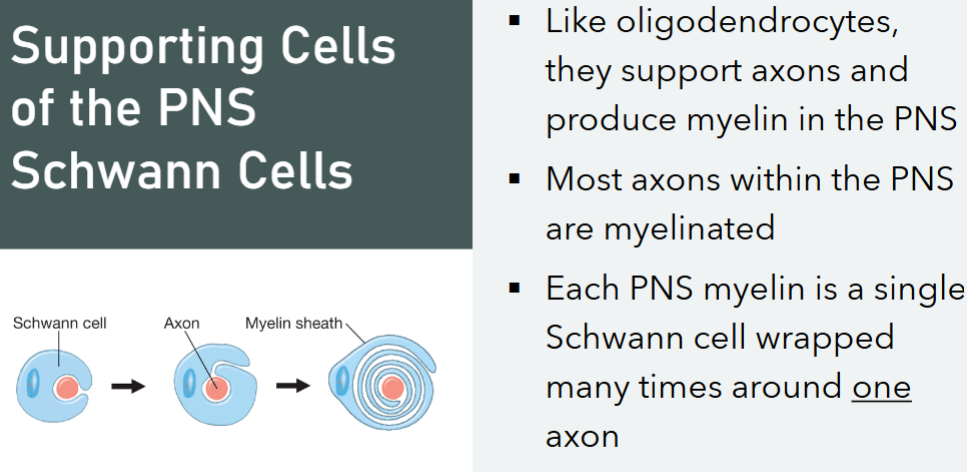
What is the structure of PNS myelin regarding Schwann cells?
Each PNS myelin is a single Schwann cell wrapped many times around one axon
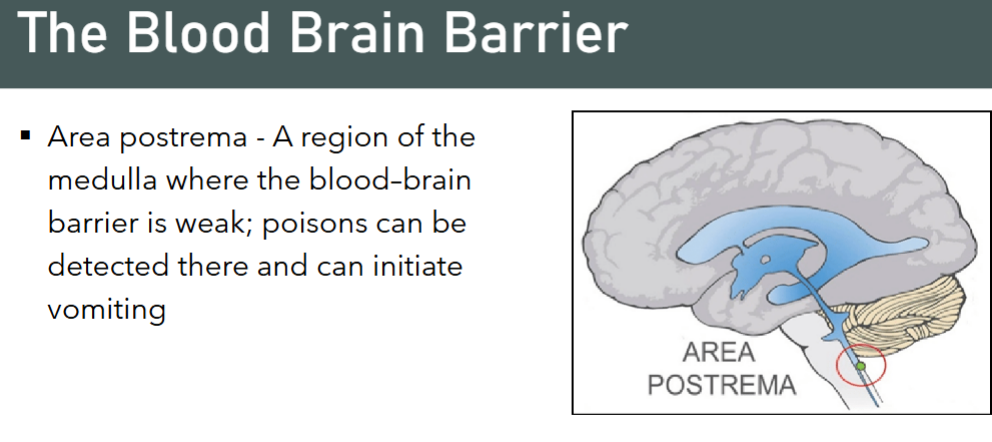
Region of the medulla where blood-brain barrier is weak; poisons can be detected there and can initiate vomiting
Area postrema
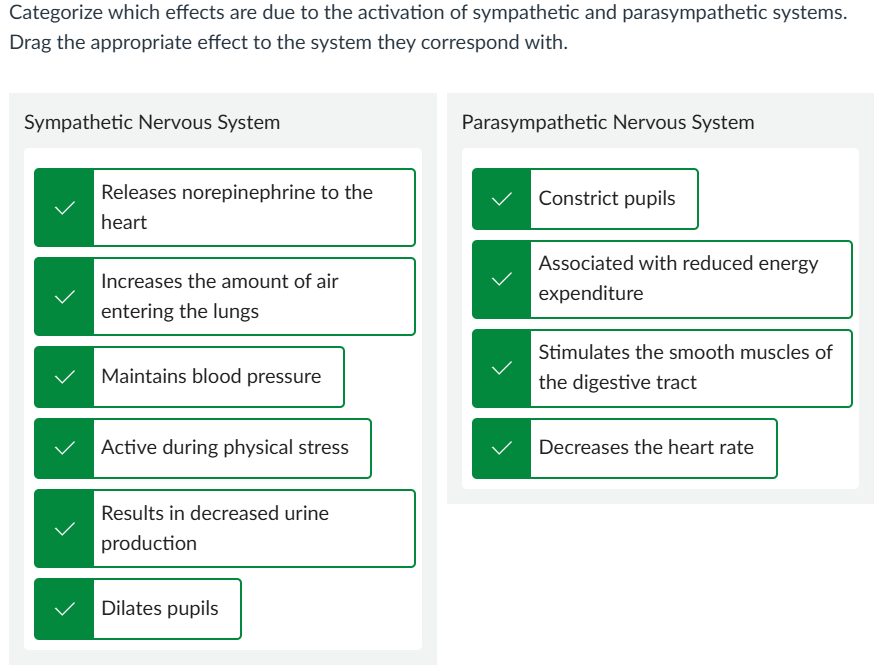
Does sympathetic or parasympathetic result in decreased urine production
sympathetic
What is the synthesis pathway for acetylcholine?
Acetate + choline → acetylcholine
Acetylcholine is synthesized by what enzyme
choline acetyltransferase
What enzyme breaks down acetylcholine
acetylcholinesterase
Nicotinic receptors are ______ type receptors that initiate _____ postsynaptic potentials
ionotropic, excitatory
Muscarinic receptors are _____ type receptors that initiate _____ postsynaptic potentials
metabotropic, excitatory
What is the synthesis pathway for glutamate
Glutamine →
What is the synthesis pathway for serotonin
Tryptophan → 5-HTP →
Serotonin activates 7 different families of 5-HT(1-7) receptors comprising of at least 14 distinct subtypes. Almost all serotonin receptors are metabotropic except for one which is an _______receptor.
ionotropic
The ionotropic 5-T receptor for serotonin opens a cation channel and is therefore _______ in nature
excitatory
Use the drop down list to select the most correct answer.
Norepinephrine Neurotransmitter Characteristics
What is the synthesis pathway for norepinephrine?
Tyrosine → L-DOPA → Dopamine →
norepinephrine activates 2 different receptor families.
Alpha-adrenergic receptors are _______ type receptors that initiate excitatory and inhibitory postsynaptic potentials
metabotropic
norepinephrine activates 2 different receptor families.
Beta-adrenergic receptors are metabotropic type receptors that initiate _______ postsynaptic potentials
excitatory postsynaptic potentials
Glutamate activates several different receptor types.
NMDA receptors are _______type receptors that initiate excitatory postsynaptic potentials.
ionotropic
Glutamate activates several different receptor types.
NMDA receptors are ionotropic type receptors that initiate ______ postsynaptic potentials.
excitatory
Glutamate activates several different receptor types.
NMDA receptors are ionotropic type receptors that initiate excitatory postsynaptic potentials.
AMPA receptors are ______ type receptors that initiate excitatory postsynaptic potentials
ionotropic
Glutamate activates several different receptor types.
NMDA receptors are ionotropic type receptors that initiate excitatory postsynaptic potentials.
AMPA receptors are ionotropic type receptors that initiate ______ postsynaptic potentials
excitatory
Glutamate activates several different receptor types.
NMDA receptors are ionotropic type receptors that initiate excitatory postsynaptic potentials.
AMPA receptors are ionotropic type receptors that initiate excitatory postsynaptic potentials
mGlu receptors are metabotropic type receptors that initiate _____ postsynaptic potentials
excitatory
GABA Neurotransmitter Characteristics
What is the synthesis pathway for GABA
Glutamine → glutamate →
GABA-A receptors are _____ type receptors that initiate inhibitory postsynaptic potentials
ionotropic
GABA-A receptors are ionotropic type receptors that initiate ________ postsynaptic potentials
inhibitory
GABA-B receptors are _______ type receptors that initiate inhibitory postsynaptic potentials
metabotropic
GABA-B receptors are metabotropic type receptors that initiate ______ postsynaptic potentials
inhibitory
What is the synthesis pathway for dopamine?
Tyrosine → L-DOPA →
Receptors in the D1 like family are metabotropic type receptors that intiate _____ post-synaptic potentials
excitatory
Receptors in the D2 like family are _____ type receptors that initiate inhibitory postsynaptic potentials
metabotropic
Receptors in the D2 like family are metabotropic type receptors that initiate inhibitory postsynaptic potentials
inhibitory
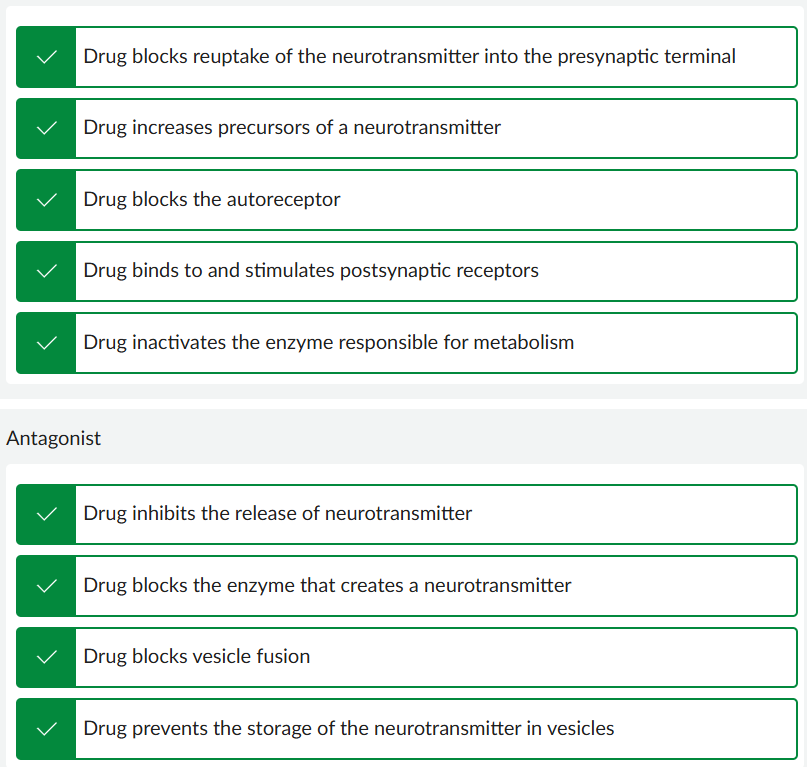
If a drug blocks the autoreceptor, is it an agonist or antagonist?
agonist
If a drug inactivates the enzyme responsible for metabolism, is it an agonist or antagonist?
agonist
Characteristics of agonists and antagonists
What is the normal resting voltage across the cell membrane
-70mV
Molecules move from areas of ____ to areas of ____ diffusion
more, less
Common electrochemical gradient: Sodium will move ____ the cell
into
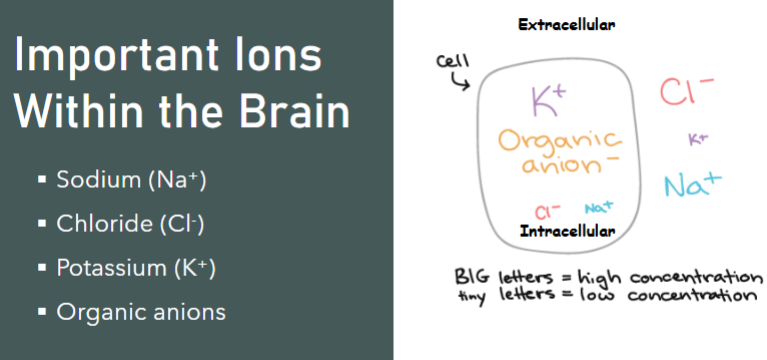
Common electrochemical gradient: Chloride will move ____ the cell
into
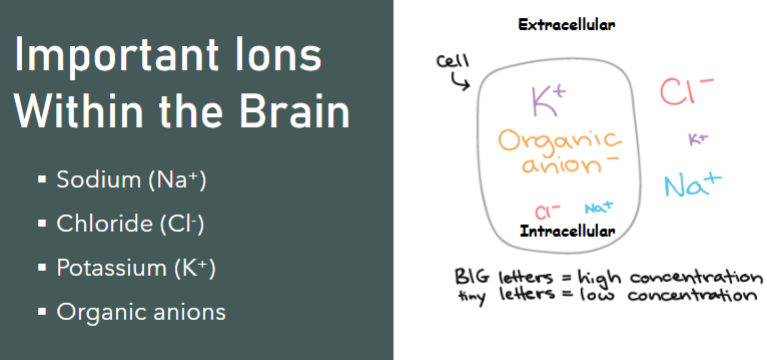
Common electrochemical gradient: Potassium will move ____ the cell
out of
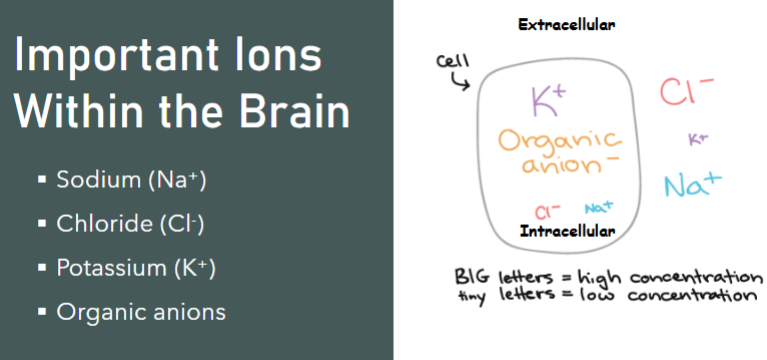
Is Ca2+ more concentrated inside or outside of the cell
outside
Sodium-Potassium pumps push __ Na+ ions out for every _ K+ ions pumped in
3, 2
What are the steps of neurotransmitters
Neurotransmitter synthesis
Neurostransmitter stored in synaptic vesicles
Action potential reaches axon terminal
Ca2+ enters neuron
Neurotransmitter released
Neurotransmitter binds to & deactivates a receptor
Excess neurotransmitter is removed from synaptic cleft
What type of receptors (ionotropic/metabotropic):
located directly on the ion channel
fast signaling
short term change
bind to neurotransmitters
can cause change in membrane potential
ionotropic
Metabotropic receptors
indirect pathway to neural signaling, longer lasting response
Neurotransmitter binds to GPCR
Produces a second messenger molecule which opens an ion channel
Binds to neurotransmitter
Can cause change in membrane potential
Autoreceptor
receptor on presynaptic terminal that responds to the neurotransmitter its own neuron released
usually not connected to ion channels
Mostly controls amount of neurotransmitter released
Axodendritic synapse
between axon and dendrite
Axosomatic synapse
between axon and soma
Axoaxonic
between terminal boutons of axons, they do not contribute to neural integration
alter amt of neurotransmitter released
presynaptic inhibition
presynaptic facilitation
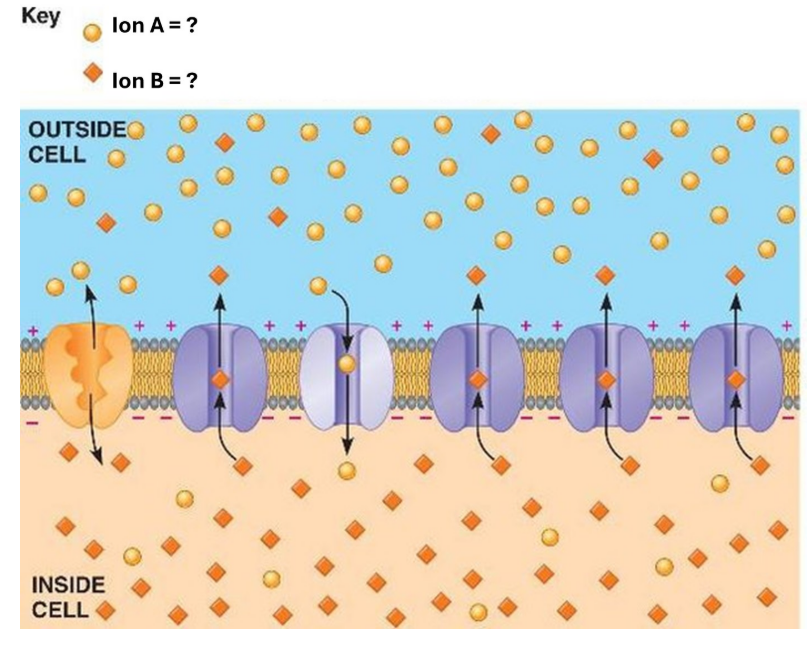
Identify ions A and B
A is sodium, B is potassium
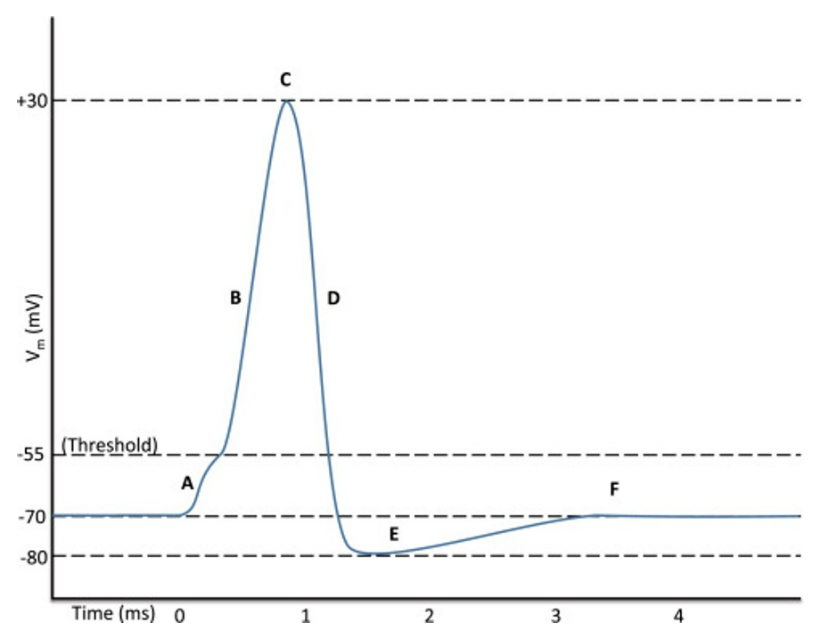
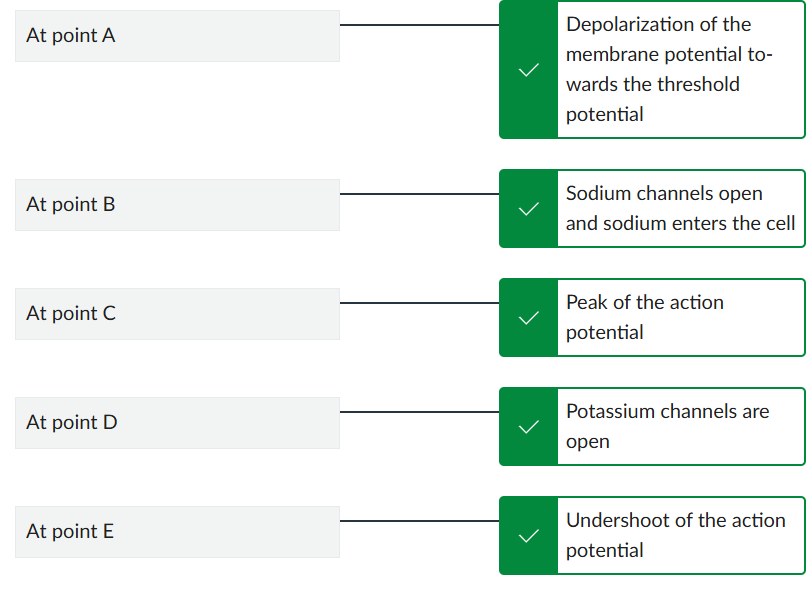
At point A what is happening
Depolarization of the membrane potential towards the threshold potential
The following are features of neurotransmitter receptors. Choose if each feature is describing an ionotropic receptor or a metabotropic receptor or both.
Bind to neurotransmitters
Cause fast effect
Linked to GPCR
Long lasting effects
Causes changes in membrane potential
Initiate a 2nd messenger cascade
Induce changes in the postsynaptic neuron
Bind to neurotransmitters - Both types receptors
Cause a fast effect - Ionotropic receptors
Linked to G-protein coupled receptor - Metabotropic receptors
Long lasting effects - Metabotropic receptors
Cause changes in membrane potential - Both receptors
Initiate a 2nd messenger cascade - Metabotropic receptors
Induce changes in the postsynaptic neuron - Both receptors
When a ligand gated sodium channel opens, ion enters the neuron which _____ the neuron
depolarizes
After ligand gates K+ channel opens, ion will exit the neuron, which will ____ the neuron
hyperpolarize
After a ligand gates Cl- channel opens, ion will ______ the neuron which will hyperpolarize it
hyperpolarize
GABA stands for
Gamma-aminobutyric Acid, the main inhibitory neurotransmitter within the brain