Macroeconomics II
 Call Kai
 Learn
Learn Practice Test
 Spaced Repetition
 Match
Match Flashcards
 Knowt Play
1/22

There's no tags or description
Looks like no tags are added yet.
Name | Mastery | Learn | Test | Matching | Spaced | Call with Kai | Chat |
|---|
No analytics yet
Send a link to your students to track their progress
23 Terms
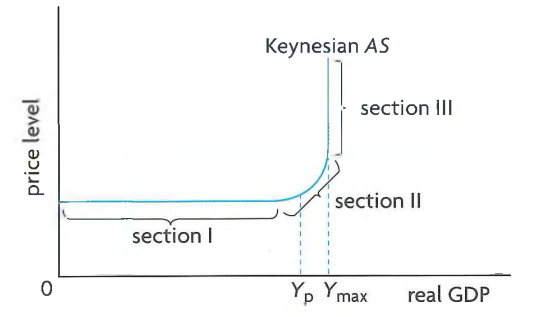
Explain shape of KAS
At flat section - there is a lot of spare capacity in the economy so firms can employ resources without having to bid up wages and other resource prices
Rising section - Eventually no spare capacity in the economy → firms start competing over resources and labor → price mechanism to increase their prices → production costs rise → price levels
Vertical part - All resources in economy are employed so real GDP cannot increase further
Reasons why economy may not return to long-run equilibrium
Wages do not fall easily (e.g: labor unions, protests) so firms avoid lowering prices
Large firms fear price wars
Factors shifting LRAS
Increase in FOPs
Technology improvement
Improved quality of FOPs
Increased efficiency
Reduced natural rate of unemployment
Pros of Economic Growth
Reduces / eliminates absolute poverity
Creates new jobs and lowers unemployment
Increases tax revenue
Higher sales revenues and profits for firms
Increased economic well-being
Increased R&D leading to innovation
Cons of Economic Growth
Expenditure on demerit goods
Increased risk of inflation
Deforestation / desertification
Air pollutioin
Unequal distribution of income
Climate change
Unemployment
Unemployment refers to people of working age who are actively looking for a job but who are not employed.
Reasons unemployment is hard to measure
Underestimation because:
discouraged workers drop out of labor force
no distinction between full-time and part-time jobs
no distinction between type work done
does not include people in retraining; early retirees
Overestimation because: does not include people employed in underground economy
regional/demographic-based unemployment differences are not accounted for
Personal & Social costs of unemployment
Personal: Increased indebtness and need to borrow to survive, loss of self-esteem, psychological tension, effects on family, suicide
Social:
Increased crime and violence
Drug use and homelessness (increased poverty)
Economic costs of unemployment
Loss of real GDP
Lost income for unemployed workers
Lost income tax revenue
Cost to government to pay unemployment benefits
Cost to governemnt to deal with social problems arising from unemployment
Larger budget deficit / smaller surplus
More unequal distribution of income
Difficulty finding work in the future
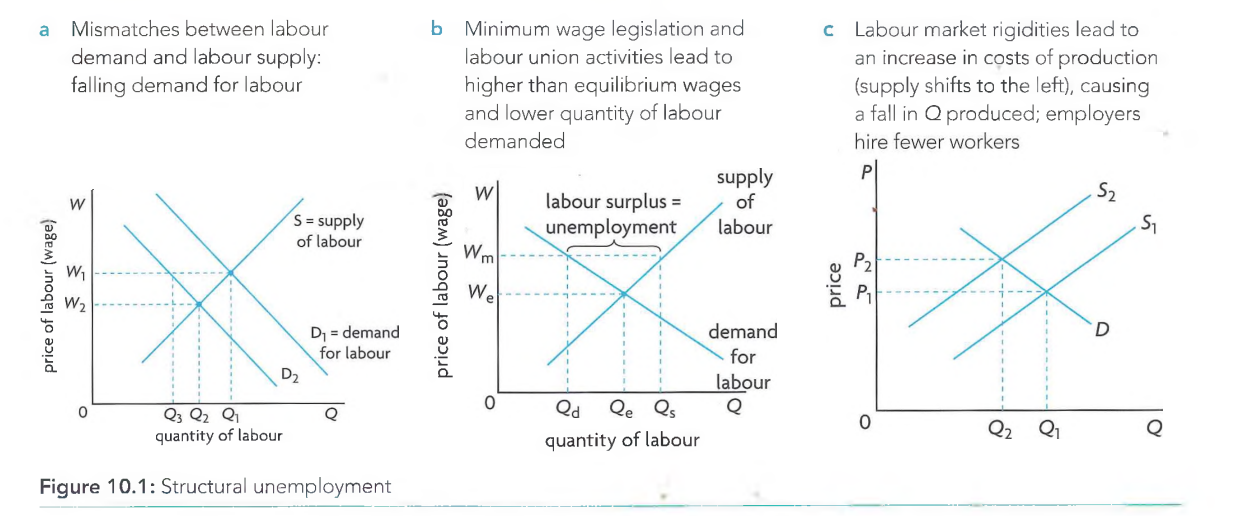
Structural unemployment
A type of unemployment that occurs as a result of technological changes and changing patterns of demand (causing changes in demand for labour skills), as well as changes in the geographical location of jobs, and labour market rigidities (lack of labour market flexibility}.
Seasonal unemployment
Seasonal unemployment occurs when the demand for labour in certain industries changes on a seasonal basis because of variations in needs.
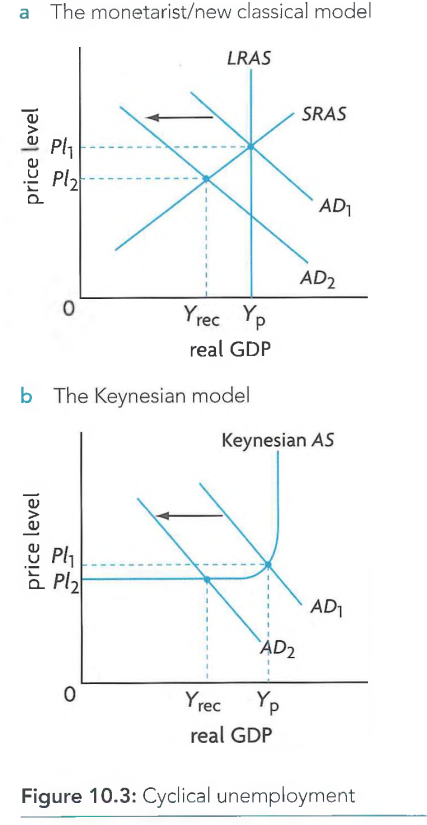
Cyclical/demand-deficient unemployment
A type of unemployment that occurs during the downturns of the business cycle, when the economy is in a recessionary gap; the downturn is seen as arising from declining or low aggregate demand, and therefore is also known as 'demand-deficient’ unemployment.
Inflation
Refers to the sustained increase in the general price level leading to a fall in the purchasing power of money
CPI
Measure of the cost of living for the typical household, and compares the value of a basket of goods and services in one year with the value of the same basket in a base year.
Price Index
Measure of average prices (costs) in one period relative to average prices (costs) in a reference period called the base period.
Zero inflation is bad because
small rise in prices are required because it encourages firms to increase their output
Limitations of CPI
Different rate of inflation for different income earners (difference in basket of goods)
May not reflect consumption patterns
No account for quality changes
Introduction of new products that miss the CPI calculation date
Overstate prices by no considering consumers substituting expensive goods with cheaper ones
International comparisons & comparability over time
Stagflation
Low growth and high inflation (often caused by cost-push inflation)
Consequences of inflation
Effect on competitiveness abroad
Wage spiral (high wages = increased price level = demanding higher wages to maintain living standards …)
Reduction in real value of savings and debt
Consumers / firms on fixed incomes lose out
Higher nominal interest rates (deflationary effect on GDP)
Disruption of business planning
Slower growth of company profits
Shoe leather costs
Menu costs
Why delfation is rare
Wages do not ordinarily fall
Firms do not want to lower prices and start price wars
Firms want to avoid menu costs
Why no deflation is ever good
Consumers put off buying things in anticipiation of prices falling even further
Consequences of deflation
Rise in value of savings and debt and income
Risks of bankrupcies as unable to pay back
Trade off low unemployment and low inflation
Combatting umeployment often involves lowering interest rates leading to higher inflation
Low unemployment means firms must combat to get workers and therefore higher wages and therefore cost-push inflation