Topic 4
 Call Kai
 Learn
Learn Practice Test
 Spaced Repetition
 Match
Match Flashcards
 Knowt Play
1/47

There's no tags or description
Looks like no tags are added yet.
Name | Mastery | Learn | Test | Matching | Spaced | Call with Kai | Chat |
|---|
No analytics yet
Send a link to your students to track their progress
48 Terms
What is protein phosphorylation
reversible
post-translational modification
phosphate group is added to a protein to alter it
What are the three most frequently targeted residues for protein phosphorylation
Serine, Threonine, and Tyrosine.
What are three examples of covalent modifications of proteins?
Linking fatty acid to side chain of cys
adding sugar to side chain of asn
adding phosphoryl group to side chain of ser

Why do we want to ever change the the function of a protein?
To be able to regulate protein func.
make it active or inactive by changing the side chain of the residue which will change conformation of the protein
Describe what ligands are
any molecule that binds to a target protein at designated binding site to form a protein ligand complex
How do ligands bind to proteins
multiple weak interactions (e.g., hydrogen bonds, van der Waals interactions)
or a few strong interactions
What are three types of ligand types and protein binding examples
Protein + small molecule
Protein + peptide
Protein + protein
What is a ligand defined by?
ligand is defined by function (binding), not by size or molecular type
What does the dissociation constant (Kd) measure?
binding strength or affinity between a protein and ligand
Can the equation of PL →← P + L be reversible?
Yes, because it has an equilibrium
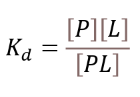
explain the formula for Kd
P = molar conc. of the free protein
L = molar conc. of the free ligand
PL = molar conc. of the protein-ligand complex
What does a low Kd mean
Low Kd = high affinity
→ little free protein and ligand is required to keep them bound together
What does a high Kd mean?
high Kd = low affinity
→ Lots of free ligand is needed to stay bound
What is Fractional Saturation (Y):
the total protein sites bound to the ligand

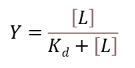
What is the relationship between these elements
L/Kd → 0 = Free ligand concentration is negligible compared to Kd
almost no protein is bound (Y = 0%)
L/Kd = 1 = Free ligand concentration is exactly equal to Kd
Exactly half of all protein binding sites are occupied (Y = 50%)
L/Kd → infinity = Free ligand concentration is overwhelmingly high compared to Kd
The system hits a plateau; protein binding sites are fully saturated (Y = 100%)
What is the relation of dissociation constants and their affinity?
High affinity = tight binding = small Kd
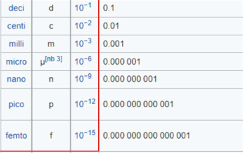
Name the 7 prefixes from low affinity to high affinity:
What is the primary role of myoglobin
Oxygen binding protein
facilitates oxygen diffusion through muscle tissue
What is the historical significance of myoglobin
first protein whose structure was determined by x ray crystallography

What structural quaternary classification does myoglobin have
Monomeric — a single polypeptide chain
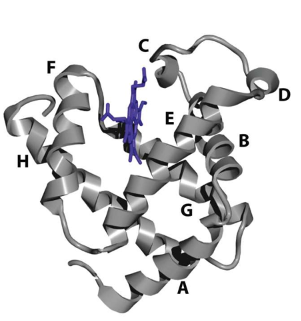
How many α-helices does myoglobin contain, and how are they labeled?
8 α-helices, labeled A through H

What prosthetic group does myoglobin contain, and why is it essential?
Heme group (shown in purple in the diagram) tucked within a hydrophobic pocket
essential because its the site of oxygen binding.
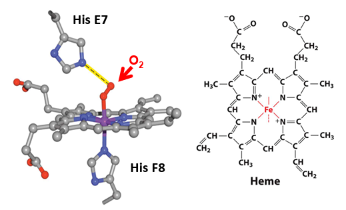
How many coordination bonds does the Fe(II) in heme form, and what are they?
the central Fe atom can form up to 6 coordination bonds
→ Bonds 1-4: Bonded with 4 nitrogen atoms
→ Bond 5: Bonded w/ N from side chain of His 8
→ Bond 6: Reserved for O2, which reversibly binds to the Fe atom
What is the role of His F8?
forms a direct coordination bond to Fe which anchors the heme group to the protein

What is the role of the His E7
does not coordinate directly w/ iron atom
Instead, it forms hydrogen bond with the bound O2 and stabilizes it
this also hinder CO binding
Why is O₂ binding to heme reversible?
Because it binds via a coordination bond at the 6th coordination site, not a permanent covalent bond.
Why does the hydrophobic pocket around heme matter?
It shields Fe(II) from oxidation to Fe(III), which cannot bind oxygen.

What does this eq tell us
Mb: Unbound (deoxygenated) myoglobin.
O2 Free oxygen (the ligand).
MbO2: Bound (oxygenated) myoglobin complex.
→ a reversible rxn
What is the dissociation constant for the eq. of myoglobin?
Free [Mb] and Free [O] in numerator
Bound complex [MbO2] in denominator
K is a measure of the affinity of Mb for O2
![<p>Free [Mb] and Free [O] in numerator </p><p>Bound complex [MbO2] in denominator </p><p></p><p>K is a measure of the affinity of Mb for O2 </p>](https://assets.knowt.com/user-attachments/479b1b5c-69e0-463e-b5ba-ad9988e92e49.png)

For this eq, what is the relationship between affinity and K?
As affinity increases, K decreases (almost all protein is bound to oxygen)
As affinity decreases, K increases (the protein drops oxygen easily)
ex. If Protein A has K = 10^-9 and Protein B has K = 10^-6, Protein A has the higher affinity (smaller K)
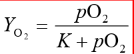
What does each variable represent
Y = fractional saturation of myoglobin (0 to 1)
pO₂ = partial pressure of oxygen
K = equilibrium constant (reflects myoglobin's binding affinity for O₂)
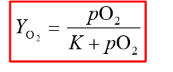
What happens to Y as pO₂ increases toward very high values?
Y approaches 1 — myoglobin becomes fully saturated with oxygen (the pO₂ term dominates over K in the denominator).

What happens to Y as pO₂ approaches 0?
Y approaches 0 — myoglobin releases essentially all its oxygen (little to no O₂ available to bind).
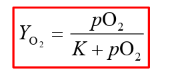
What is the physical/biological meaning of K in this equation?
a lower K means higher affinity (myoglobin saturates at a lower pO₂), and a higher K means lower affinity.
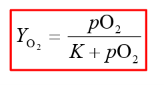
If pO₂ = K, what is Y?
Y = 0.5 (50% saturation)

What shape does a graph of Y vs. pO₂ produce for myoglobin, based on this equation?
A hyperbolic curve — Y rises steeply at low pO₂ and gradually plateaus toward 1 at high pO₂.

What two factors determine how much O₂ is bound to myoglobin?
The oxygen partial pressure (pO₂) and myoglobin's affinity for O₂
What is P₅₀?
The partial pressure of O₂ (pO₂) at which myoglobin is 50% saturated (Y = 0.5)
i.e., half of the binding sites are occupied.

What is the relationship between K (from the equation Y = pO₂/(K + pO₂)) and P₅₀?
K = P₅₀ — they are the same value.
Can P₅₀ be a low number? What would that mean?
Yes.
A low P₅₀ means the protein only needs a small amount of oxygen pressure to become half-saturated
this indicates high affinity for O₂
What would a high P₅₀ indicate about a protein's O₂ affinity?
Low affinity — it takes a lot of oxygen pressure to reach half-saturation.
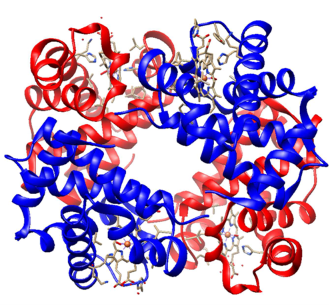
What is hemoglobin's function, and where is it found?
oxygen-transport protein
found in red blood cells (transports O₂ through the bloodstream).

What is hemoglobin's quaternary structure?
A tetramer composed of 2 α subunits and 2 β subunits.
How does hemoglobin's structure differ from myoglobin's?
Myoglobin is monomeric (1 chain, 1 heme, 1 O₂ site); hemoglobin is tetrameric (4 chains, 4 hemes, 4 O₂ sites).

At what level of protein structure are myoglobin and hemoglobin similar? At what level do they differ?
Similar in secondary and tertiary structure (individual chain folding)
different in quaternary structure (myoglobin = monomer; hemoglobin = tetramer of similar subunits).

If myoglobin and hemoglobin's subunits have different amino acid sequences, why do they fold into nearly the same 3D structure?
They are homologous proteins, evolved from a common ancestral gene
only critical residues (essential for function) need to be conserved; the rest of the sequence can vary substantially while the fold and function are maintained.

What percentage sequence identity do myoglobin and hemoglobin share, despite their near-identical 3D structure?
Only ~18% identical in primary sequence.