Transamination and Deamination Reactions
 Call Kai
 Learn
Learn Practice Test
 Spaced Repetition
 Match
Match Flashcards
 Knowt Play
1/17

There's no tags or description
Looks like no tags are added yet.
Name | Mastery | Learn | Test | Matching | Spaced | Call with Kai | Chat |
|---|
No analytics yet
Send a link to your students to track their progress
18 Terms
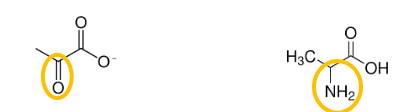
Name the keto acid and its amino acid
a-ketoacid: pyruvate
amino acid: alanine
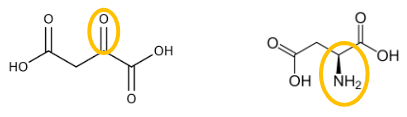
Name the keto acid and its amino acid
a-ketoacid: oxaloacetate
amino acid: aspartate
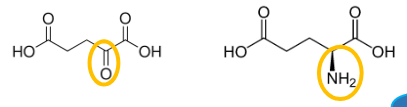
Name the keto acid and its amino acid
a-ketoacid: a-Ketoglutarate
amino acid: Glutamate
Describe the process of transamination
-removal of amino group from amino acid which is transferred to a-ketoglutarate > this create an amino acid and a-keto acid
-ENZYME: aminotransferase/PLP B6 derivative
-Amino acid + α-ketoglutarate ⇌ α-keto acid + Glutamate
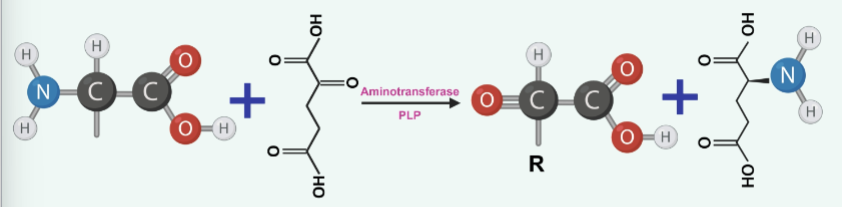
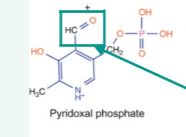
Describe the structure and significance of PLP
-amine group from amino acid is transferred onto aldehyde carbon of PLP
Describe Alanine Transferase
-converts alanine and a-KG to pyruvate and glutamate

Describe Aspartate transferase
-converts aspatate and a-KG to aspartate and glutamate

Why can’t proline and hydroxyproline undergo transamination?
-They’re secondary amines lack primary amino group needed to go through transamination
-Primary amines are needed to transfer amino groups to pyridoxal
Why can’t lysine and theonine undergo transamination?
They cyclize and become toxic nonmetabolites
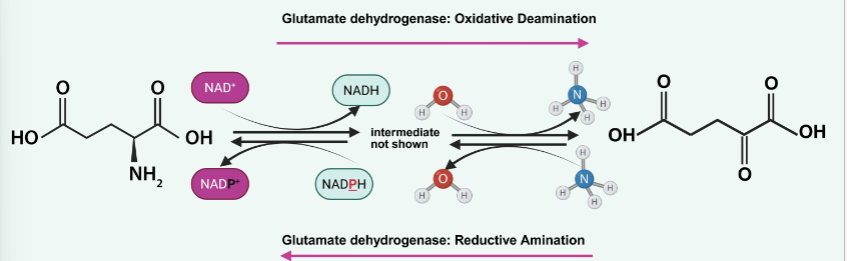
Function and location of glutamate dehydrogenase
Regenerates the amino acceptor (a-ketoglutarate) and provides ammonia,
either for reutilization or disposal (urea)
Mitochondrial matrix
Reduced NAD+ to NADH and oxidizes amino acids to a-KG
2 step process: hydrolysis and redox reactions
What is "transdeamination" and how does it work? (Coupling reactions)
The two-step process that funnels amino groups from any amino acid → glutamate → free NH₄⁺, which then feeds into the urea cycle.
Step 1 – Transamination (no net deamination):
An amino acid transfers its amino group to α-ketoglutarate via aminotransferase + PLP
α-ketoglutarate → glutamate (gets aminated)
The original amino acid → its α-keto acid
This "collects" amino groups from many different amino acids into one form: L-glutamate
Step 2 – Oxidative deamination (net deamination happens here):
Glutamate dehydrogenase (GDH) acts on glutamate
Uses NAD⁺ (or NADP⁺) as cofactor
Products: α-ketoglutarate + NADH (or NADPH) + free NH₄⁺
This regenerates α-ketoglutarate (so it can accept another amino group) and releases free ammonium
What inhibits the GDH?
High ATP, GTP, NADH > leads to protein synthesis cus your not breaking down proteins
What activates the GDH?
High ADP, GDP, Free Amino Acids > leads to deamination and amino acids breakdown
What is the function of glutaminase
a mitochondrial enzyme that
catalyzes the breakdown of glutamine to form
glutamate.
• Widely distributed in the body.
• Ammonia formed is consumed by the urea
cycle.
What is the function of asparaginase
an enzyme that breaks down
asparagine
How are the TCA cycle and Urea cycle linked?
Connection point: Fumarate
The urea cycle produces fumarate (from arginino-succinate → arginine)
This fumarate can enter the TCA cycle (mitochondrial matrix), converting to malate → oxaloacetate (OAA)
Two ways nitrogen enters the urea cycle from TCA intermediates:
OAA + glutamate → (via transamination) → aspartate + α-KG
Aspartate carries a nitrogen into the urea cycle, combining with citrulline to form argininosuccinate
α-KG from the TCA cycle can also pick up ammonia (via GDH, reverse direction) to help regenerate glutamate for more transamination
What is the aspartate-argininosuccinate shunt? (Link between urea cycle & TCA cycle)
Oxaloacetate (OAA) from the TCA cycle undergoes transamination with glutamate → produces aspartate + α-ketoglutarate
Aspartate carries a nitrogen (amino group) into the urea cycle
Aspartate combines with citrulline → forms argininosuccinate
Argininosuccinate is cleaved (by argininosuccinate lyase) → arginine + fumarate
Fumarate re-enters the TCA cycle (via fumarase → malate → OAA), completing the loop
Importance of aspartate-argininosuccinate shunt
This shunt is how a second nitrogen enters the urea cycle (the first comes from free NH₄⁺ combining with CO₂ to form carbamoyl phosphate)
It directly links the TCA and urea cycles by recycling the same carbon skeleton: OAA → aspartate → fumarate → malate → OAA
Carbon skeleton = recycled/shared; Nitrogen = donated to urea cycle and lost as urea