Metals (C9)
 Call Kai
 Learn
Learn Practice Test
 Spaced Repetition
 Match
Match Flashcards
 Knowt Play
1/27

Earn XP
Description and Tags
IGCSE Chemistry: C9.1 Properties of metals C9.2 Uses of metals C9.3 Alloys and their properties C9.4 Reactivity series C9.5 Corrosion of metals C9.6 Extraction of metals
Name | Mastery | Learn | Test | Matching | Spaced | Call with Kai | Chat |
|---|
No analytics yet
Send a link to your students to track their progress
28 Terms
Name and describe the physical properties of metals
Thermal and electrical conductivity: metals have delocalised electrons that can move through the metal structure and carry charge or thermal energy
Malleability and ductility: they are malleable, meaning they can be hammered into different shapes, and ductile, meaning they can be drawn into wires. This is because the layers of positive metal ions in the metal structure can move and slide over each other
Melting and boiling points: they have high melting and boiling points because there is a strong electrostatic attraction between the positive metal ions and the delocalised electrons. This strong bond requires a lot of energy to break
Describe the reaction of metals with cold water and provide an example
Metals form a metal hydroxide and hydrogen gas (more reactive metals react with cold water more vigorously and quickly)
Ex: Ca(s) + 2H2O(l) → Ca(OH)2(aq) + H2(g)
Describe the reaction of metals with steam and provide an example
Metals form a metal oxide and hydrogen gas (less reactive metals react with steam more vigorously
Ex: Zn(s) + H2O(g) → ZnO(s) + H2(g)
Describe the physical properties of non-metals
Thermal and electrical conductivity: they do not conduct heat and electricity, as all electrons are involved in covalent bonding
Malleability and ductility: not malleable or ductile, as they are brittle when solid and easily break apart
Melting and boiling points: low melting and boiling points since many non-metals are gases at room temperature and therefore have weak electrostatic forces of attraction between molecules
Describe the uses of aluminium and explain why it is used
Manufacture of aircraft: high strength-to-weight ratio, low density, aluminium atoms have a low atomic weight
Manufacture of overhead electrical cables: good electrical conductor, delocalised electrons are free to move and carry charge, low density
Food containers: non-toxic, corrosion-resistant, form an aluminium oxide layer to reduce further oxidation
Describe the uses of copper and explain why it is used
Electrical wiring: good electrical conductor (delocalised electrons are free to move and carry charge), good ductility (able to be stretched and drawn out into a wire without breaking)
What is an alloy?
A mixture of a metal with other elements that can be harder and stronger than pure metals, and be more resistant to corrosion and extreme temperatures (these features make them more useful than pure metals)
Name and describe some types of alloys
Brass: an alloy made of copper and zinc
Stainless steel: an alloy made of iron and other elements like chromium, nickel, and carbon
Describe the structures of alloys
Irregular arrangement of atoms
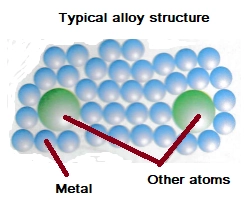
Why are alloys stornger than metals?
Because they typically contain atoms of different sizes, which distorts the regular arrangement metals usually have, making it more difficult for the metal layers to slide over each other
What can alloys be used for?
Alloys can be used to make a variety of tools due to their hardness and resistance to corrosion/rusting. Stainless steel is used to make cutlery since it is resistant to rusting and its hardness
What are ferrous metals?
Alloys that contain iron (can rust)
Describe the rusting of iron, what it is, and provide an example
Chemical reaction between iron, water, and oxygen (the reddish-brown oxide product called hydrated iron (III) oxide)
Iron + water + oxygen → Hydrated iron (III) oxide
Ex: 4Fe(s) + 3O2(g) + X H2O(l) → 2Fe2O3(s) + XH2O(l)
What are barrier methods?
Rust prevention methods by coating iron or steel with barriers preventing iron from coming into contact with oxygen or water, but if these barriers are broken or scratched it exposes the iron again
Give some expales of barrier methods
Grease, paint, oil, plastic
What is galvanizing?
Process where iron is coated in a layer of zinc
What is sacrificial protection?
When metals higher in the reactivity series are used to form a protective layer on the surface of metals lower in reactivity
Give and expample of sacrificial protection and explain it
Ex: zinc + iron
Zinc is higher in the reactivity series; therefore loses electrons more easily and reacts more easily. Zinc oxidises first and sacrifices itself to protect the iron
What is a metal ore?
A rock that contains enough of a metal to make it worthwhile extracting
What does the extraction of metals involve? Provide some examples
As many metal ores are oxides, extracting metal involves removing oxygen from the compound, making extraction a reduction process
Ex: Iron ore: haematite → blast furnace
Ex: Aluminium ore: bauxite → electrolysis
What are native metals? Provide some exaples
Native metals are very unreactive metals that are found as uncombined elements, since they don’t react easily with other substances
Ex: Gold, platinum
Metals above carbon in the reactivity series must be extracted using which method?
Electrolysis
Metals below carbon in the reactivity series must be extracted using which method?
By heating with carbon or carbon monoxide (blast furnace)
Higher metals in reactivity series =
More difficult to extract
Lower metals in reactivity series =
Easier to obtain
In a blast furnace extraction, what happens in zone 1?
In here an exothermic reaction provides heat for the furnace, so coke (carbon) burns in the hot air to form carbon dioxide
carbon + oxygen → carbon dioxide
C(s) +O2(g) → CO2(g)
In a blast furnace extraction, what happens in zone 2?
This zone is the main reducing agent in the furnace, so at high temperatures, coke reacts with carbon dioxide to form carbon monoxide
carbon + carbon dioxide → carbon monoxide
Co2(g) + C(a) → 2CO(g)
In a blast furnace extraction, what happens in zone 3?
Carbon monoxide reduces the iron (III) oxide to iron (iron extracted by reduction because oxygen is removed from the iron (III) oxide). Molten iron collects at the bottom of the furnace and is tapped off.
iron(III)oxide + carbon monoxide → iron + carbon dioxide
Fe3O2(s) + 3CO(g) → 2Fe(l) + 3CO2(g)
Limestone (calcium carbonate) is added to the furnace to remove impurities in the ore (calcium carbonate in limestone thermally decomposes to form calcium oxide).
calcium carbonate → calcium oxide + carbon dioxide
CaCo3(s) → CaO(s) + Co2(g)
Calcium oxide formed reacts with silicon dioxide—an impurity in the iron ore—to form calcium silicate (this melts and collects as a molten slag floating on top of the molten iron, which is tapped off separately)
calcium oxide + silicon dioxide → calcium silicate
CaO(s) + SiO2(s) → CaSiO3(l)