OMFPR 1 - Radiation Physics and Biology (Dr. Ramesh)
 Call Kai
 Learn
Learn Practice Test
 Spaced Repetition
 Match
Match Flashcards
 Knowt Play
1/214

There's no tags or description
Looks like no tags are added yet.
Name | Mastery | Learn | Test | Matching | Spaced | Call with Kai | Chat |
|---|
No analytics yet
Send a link to your students to track their progress
215 Terms
Define the following:
Energy in transit
Radiation
Define the following:
The removal of electrons form an atom resulting in the formation of an 'ion pair'
Ionization
What are the six types of atomic orbitals in order of increasing distance from the nucleus?
- S (closest)
- P
- D
- F
- G
- H (farthest)

t/f: electrons that are closer to the nucleus have a higher binding energy
true

What has the following characteristics:
- No charge (neutral)
- Mass approx. that of proton (1.68 x 10^-24 g)
Neutrons

the number of ____ defines an element
protons

What has the following characteristics:
- Atomic number (aka number of protons)
- Same as # of electrons in a neutral atom
- Determines identify of element
Z number
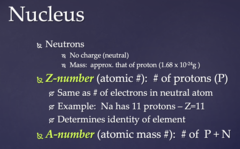
atomic mass (# of P+N) is known as the ______________
A number

Define the following:
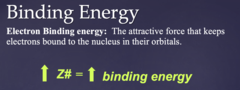
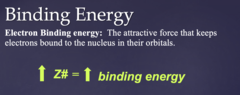
The attractive force that keeps electrons bound to the nucleus in their orbitals
Electron binding energy

An increase in Z number = an ____________ in binding energy
Increase
Why is it important to consider binding energy?
We need a force strong enough to break binding energy for ionization
Define the following:
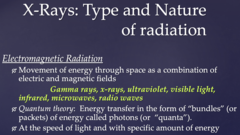
Movement of energy through space as a combination of electric and magnetic fields (no mass, free energy)
electromagnetic radiation
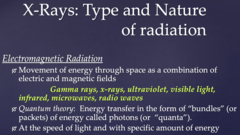
All of the following are examples of what type of radiation?
- Gamma rays
- X-rays
- Ultraviolet
- Visible light infrared
- Microwaves
- Radio waves
electromagnetic radiation
Define the following:
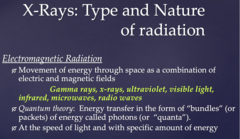
Energy transfer in the form of "bundles" (or packets) of energy called photons (or "quanta")
Quantum theory
X-rays travel at the speed of ____________ and with specific amount of energy
light

Do x-rays contain mass?
No

Do x-rays contain an electric charge?
No
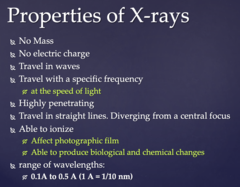
Do x-rays travel in waves?
Yes

Do x-rays travel with a specific frequency?
Yes, speed of light
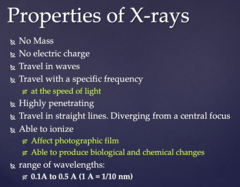
Are x-rays highly penetrating?
Yes (distance of penetration depends on amount of energy)
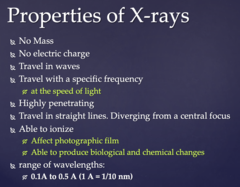
What direction do x-rays travel in?
Straight lines, diverging from a central focus
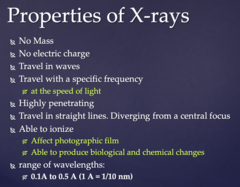
which of the following is true about x-rays ability to ionize?
A. Affect photographic film
B. Able to produce biological and chemical changes
C. All of the above
C. All of the above

what is the wavelength range for the categorization of x-rays?
0.1A to 0.5 A (1 A = 1/10 nm)
What are the two mechanisms of x-ray production?
- Bremsstrahlung
- Characteristic radiation
What mechanism of x-rays is an electron to nucleus interaction?
Bremsstrahlung Mechanism
What mechanism of x-rays is an electron to electron interaction?
Characteristic Mechanism

ID the mechanism:
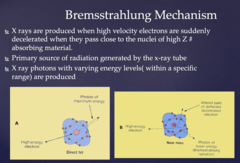
X rays are produced when high velocity electrons are suddenly decelerated when they pass close to the nuclei of high Z # absorbing material
Bremsstrahlung Mechanism

ID the mechanism:
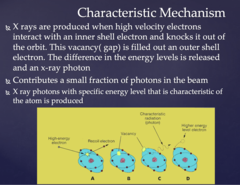
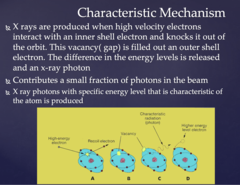
X rays are produced when high velocity electrons interact with an inner shell electron and knocks it out of the orbit. This vacancy (gap) is filled out by an outer shell electron. The difference in the energy levels is released as an x-ray photon
Characteristic Mechanism

which mechanism is the primary source of radiation generated by the x-ray tube?
Bremsstrahlung Mechanism

which mechanism contributes a small fraction of photons in the beam?
Characteristic Mechanism
when the entire kinetic energy of an electron is converted to a photon, it is known as a ______________
direct hit

when only a portion of the kinetic energy of an electron is converted to a photon, it is known as a ______________
near miss

which mechanism will result in X ray photons with varying energy levels (within a specific range)?
Bremsstrahlung Mechanism
which mechanism will result in X ray photons with specific energy level that is characteristic of the atom produced?
Characteristic Mechanism
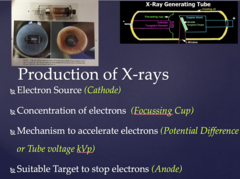
What four things are needed for the production of x-rays?
- Electron Source (Cathode)
- Concentration of electrons (Focussing Cup)
- Mechanism to accelerate electrons (Potential Difference or Tube voltage kVp)
- Suitable Target to stop electrons (Anode)

to produce an x-ray, what is the electron source?
cathode

to produce an x-ray, how do you concentrate the movement of the direction of the electrons from the cathode?
focussing cup

to produce an x-ray, what is the mechanisms used to accelerate the electrons?
Potential difference or tube voltage (kVp)

to produce an x-ray, what is a suitable target to stop the electrons?
anode
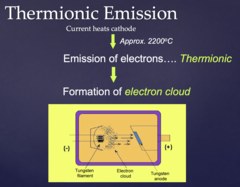
how are electrons produced at the cathode?
thermionic emission

The immediate result of thermionic emission in an X-ray tube is what?
Formation of an electron cloud around the cathode
what % of the kinetic energy produced turns into heat?
99%

what % of the kinetic energy produced is actually used for an x-ray?
1% (inefficient)

what is the material of the anode and cathode?
tungsten

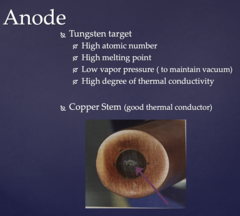
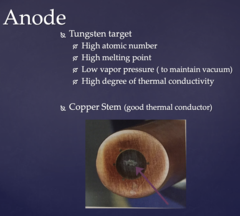
tungsten target has a _________ atomic number
high
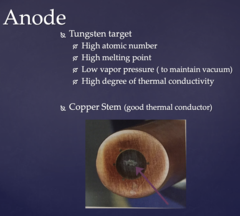
tungsten target has a _________ melting point
high
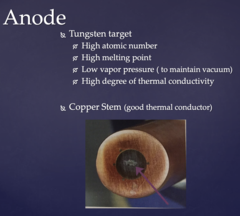
tungsten target has a _________ vapor pressure
low
tungsten target has a _________ thermal conductivity
high
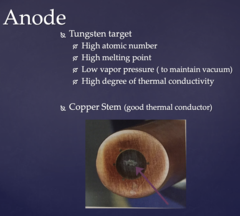
Why is a copper stem used in the anode?
It is a good thermal conductor
Changes in what factor is used to accelerate the electrons from cathode to anode?
tube voltage (kVp)

Changes in what factor affects how long the cathode is heated to produce electrons?
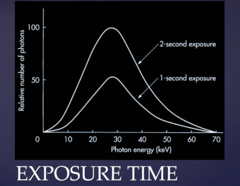
exposure time (s)

Changes in this factor affects the thermionic energy, how the cathode is heated to produce electrons?
tube current (mA)

What factor removes lower energy x-ray photons?
filtration

What factor adjusts size/shape of the x-ray beam?
collimation

What factor controls intensity of x-ray beam?
distance of x-ray tube from patient

which 2 factors controls heating the cathode to produce electrons?
- Exposure time
- Tube current

what is on the y-axis of the x-ray tube voltage graph?
# of photons

what is on the x-axis of the x-ray tube voltage graph?
photon energy (keV)

increase in kVp will result in an ___________ in maximum energy and an ___________ in mean energy
increase, increase

If the kVP increase and the photon energy increases, what happens to the number of protons, and mean energy?
- Number of protons increases
- Mean energy increases

On the tube voltage graphs, the maximum photon energy (keV) also gives you what piece if information?
tube voltage (kVp)

Define the following:
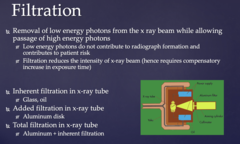
- Removal of low energy photons from the x ray beam while allowing passage of high energy photons
- Low energy photons do not contribute to radiograph formation and contributes to patient risk
filtration

Filtration reduces the intensity of x-ray beam, hence requires compensatory _____________ in exposure time
Increase

What two components attribute to the inherent filtration in x-ray tube?
- Glass
- Oil

What component attributes to the added filtration in x-ray tube?
aluminum disk
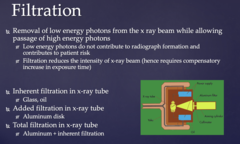
total filtration in the x-ray rube is made up of what 2 things?
- Aluminum
- Inherent filtration
when using a 50-70kVp, you must use a ___ mm Aluminum equivalent
1

when using above 70kVp, you must use a ___ mm Aluminum equivalent
2
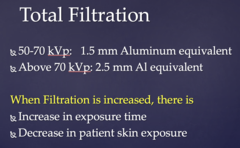
total filtration allows for increase in exposure time with _____________ in patient skin exposure
decrease
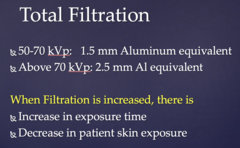
what must you do to compensate for the use of a filter in an x-ray machine?
increase exposure time

what is the purpose of the filtration system in an x-ray machine?
decrease patient exposure

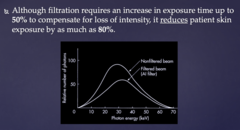
Although filtration requires an increase in exposure time up to 50% to compensate for loss of intensity, it ___________ patient skin exposure by as much as 80%.
Reduces
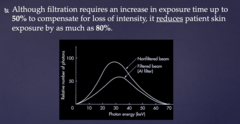
when a filter is added, the max energy (kVp) of the beam _____________
no change
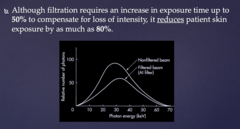
when a filter is added, the # of photons/quantity of the beam _____________
decreases

when a filer is added, the mean photon energy/quality of the beam _____________
increases

A useful way to characterize the penetrating quality of an x ray beam is to use the ______
Half Value Layer (HVL)

The term ________ refers to the mean energy of an x ray beam
quality
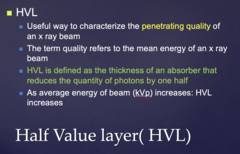
Define the following:
The thickness of an absorber that reduces the quantity of photons by one half
Half Value Layer (HVL)

As the average energy of beam (kVp) increases: HVL ____________
increases

if you double the tube current, the # of photon in that beam would ________
double
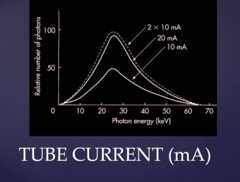
if you double the tube current (mA), the kVp would ________
no change

if you double the exposure time, the kVp would ________
no change
if you change the tube current (mA), what also will change?
A. Tube voltage (kVp)
B. # of photons
C. Mean photon energy (keV)
B. # of photons

if you change the exposure time, what also will change?
A. Tube voltage (kVp)
B. # of photons
C. Mean photon energy (keV)
B. # of photons

if you have x-ray photon graph and the max energy (kVp) is the same, but the photon quantity is decreased and the mean photon energy is increased, what event has occurred?
filtration
What has the following characteristics:
- Metallic barrier with an aperture that...
1. Reduces size and modifies shape of beam
2. Reduces volume of tissue irradiated
3. Improves image quality
collimator
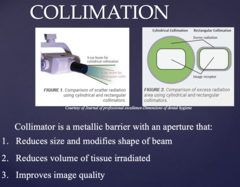
What are the 3 benefits of collimator?
- Reduces size and modifies shape of beam
- Reduces volume of tissue irradiated
- Improves image quality

For a given beam, the intensity is __________ proportional to the square of the distance from the source
Inversely

the distance between the patient and the x-ray tube has a marked effect on beam intensity and follows what law?
inverse square law

What is the inverse square law formula?
Intensity = 1/(distance^2)
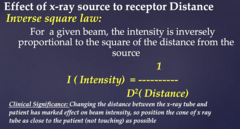
Changing the distance between the x-ray tube and patient has marked effect on beam intensity, so how should you position the cone of the x-ray tube?
As close to the patient as possible without touching

According to the inverse square law, if the distance from the x-ray source to the object is doubled, the beam intensity will:
A) Remain unchanged
B) Be reduced to one-fourth of the original value
C) Be reduced to one-half of the original value
D) Be reduced to one-eighth of the original value
B) Be reduced to one-fourth of the original value

What are the three types of interactions of x-rays?
- Coherent Scattering
- Photoelectric effect
- Compton Scattering
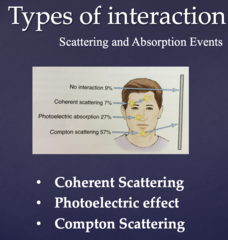
what percent of photons beamed at a patient participate in coherent scattering?
7%
7% of radiograph production is due to which type of interaction?
coherent scattering
27% of radiograph production is due to which type of interaction?
photoelectric effect

57% of radiograph production is due to which type of interaction?
compton scattering
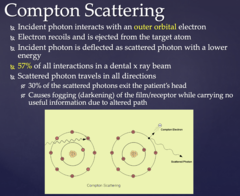
what percent of photons beamed at a patient participate in photoelectric absorption effect?
27%

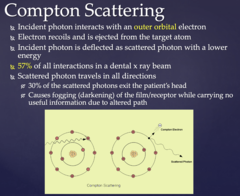
what percent of photons beamed at a patient participate in Compton scattering?
57%
ID the interaction:
- Low energy photon passes near an outer electron
- Causes electron to vibrate at the same frequency as the incoming photon
- Incident photon ceases to exist
- The vibration of the electron causes it to radiate energy in the form of another x-ray photon with same frequency and energy as in the incident photon
coherent scattering