Approaches
 Call Kai
 Learn
Learn Practice Test
 Spaced Repetition
 Match
Match Flashcards
 Knowt Play
1/22

There's no tags or description
Looks like no tags are added yet.
Name | Mastery | Learn | Test | Matching | Spaced | Call with Kai | Chat |
|---|
No analytics yet
Send a link to your students to track their progress
23 Terms
Outline classical conditioning including Pavlov’s research
Classical conditioning is an explanation as to why we behave how we do according to the behaviourist approach. Pavlov’s experiment:
Salivation of a dog was measued with test tubes surgically attatched to dogs cheeks.
Paired a bell (neutral stimulus) that had no response with dog food (unconditioned stimulus) which caused salivation (unconditioned response).
After repeated pairings the bell on its own caused same volume of salivation as food (now a conditioned response). The bell was now associated with receiving food and became a conditioned stimulus.
What is the therapy linked with the Behaviourist Approach?
Systematic Desensitisation Therapy - Progressive stages of exposure to fear inducing stimuli paired with calming techniques to re-establish the association to neutral
What are the different types of consequences according to Skinner’s research?
Negative Punishment - Taking away a good thing
Positive Punishment - Adding a bad thing
Negative Reinforcement - Taking away a bad thing
Positive Reinforcement - Adding a good thing
Evaluate the behaviourist approach
STRENGTHS
High internal validity - Uses lab studies with controlled variables to clearly define a cause and effect relationship - for example, Skinner’s rats were in a box with only the levers, and any other externaous variables were controlled. - Therefore, results are likely to be because of the change in indepentent variable, making them accurate and reliable.
SOTIVOT - Systematic desentisation has a 60-90% success rate - Because the therapy is based on the ideas of the behaviourist approach and conditioning, the success of the therapy indicates the validity of the theory.
Real world application - Skinner’s operant conditioning has lead to successful ‘token economies’ for example, prisons and schools (the irony isn’t lost) where good behaviour is rewarded with tokens (secondary enforcer) which can buy privalages such as snacks or TV/play time (primary enforcer)
WEAKNESSES
Exceptions - Some behaviours are not learnt, for example, a babies fear in height which is widely thought to be evolutionarily programmed - Some behaviours are therefore harder or easier to re-learn based on evolutionary importance - this suggests that conditioning and the behaviourist approach is not the only factor influencing behaviour.
Low external validity - Very controlled variables which is not condusive to real life, therefore, in experiements participants might act differently than in real life as in real life we are faced with mulitple complex factors at once. - Additionally, there is a sampling issue as the approach often uses animals which are considered less complex than humans, particualry in brain capability and structure.
Failure’s of SDT (10-40%)
Outline operant conditioning including Skinner’s research
Operant conditioning is an explanation for why we behave how we do offered by the behaviourist conditioning. Skinner’s experiment:
Rats in a box with two levers. One released food (reinforcement), the other released an electric shock (punishment).
The lever that released food was more likely to be pressed more frequently, and the lever that released the electric shock was more likely to not be pressed again.
Therefore, actions that have beneficial consequences are more likely to be repeated and actions that have harmful consequences are less likely to be repeated.
Skinner outlined 4 types of consequence: Negative reinforcement, positive reinforcement, negative punishment, positive punishment.
What are the key ideas of the behaviourist approach?
We learn behaviour from our enviroment and consequences
We are blank slates from birth
No free will
Humans are no more complex than animals so we can use animals for research
Experiments should be lab scientific controlled lab studies
Describe Bandura’s bobo doll study (1961)
3 groups of 12 girls and and 12 boys, sorted using aggression ratings to limit participant variables. Groups 1 and 2 observed an adult role model acting towards a bobo doll.
Condition 1 - Agressive action towards the doll.
Condition 2 - Gentle action towards the bobo doll
Condition 3 - No model (control)
After 10 minutes the child was given mild aggression arousal (you can’t play with these toys they’re for special kids), and bought back into bobo doll room.
Conditon 1 - Aggressive behaviour from children
Condition 2 & 3 - Little to no aggressive behaviour
Outline Bandura’s bobo doll study (1963)
4 groups of 12 girls and 12 boys, observed different things similar set up to first study. Used aggression ratings/matched ‘pairs’.
Condition 1 - Aggressive behaviour from model in the same room
Conditon 2 - Aggressive behaviour of an adult on a film
Condition 3 - Aggressive behaviour from a cartoon cat
Condition 4 - No model (control)
Mild aggression arousal.
Conditon 1,2 & 3 - All similar levels of aggression displayed by kids
Condition 4 - Little to no aggressive behaviour.
Conclusion -
What are the strengths of Bandura’s bobo doll study?
Highly controlled variable lab study (high internal validity)
Matched pairs design
What are the weaknesses of Bandura’s bobo doll study?
Unnatural enviroment (no interaction between child and adult model)
Most children had not seen a bobo doll before (Cumberbatch follow up study 5X less aggressive to bobo doll)
Issues with sampling (all taken from Stanford nursery WEIRD)
What are the strengths of the Social Learning Theory?
Support from Bandura’s and Fox and Bailenson’s study
Application into crime prevention (role models and vicarious reinforcement)
Application into health campaigns (BAME)
What are the weaknesses of Social Learning theory?
Issues with Bandura’s study
Ignores the complexities of human emotion and daily interactions
What are the key ideas of Social Learning Theory?
We learn behaviour from other people by imitating their behaviour - vicariously
We imitate behaviours from a model (some-one we identify with: same-s£x, older, attractive, successful)
There are mediational process that happen in order to imitate behaviour - this is where it differs from the behaviourist approach
Therefore, there is some free-will
What mediational mental processes are involved in imitation?
Attention
Retention
Motor reproduction
Motivation
What is a schema?
A mental framework that is used to organise and link the information in our memory.
What are the key ideas of the cognitive appraoch?
Behaviour is controlled by complex internal mental processes
These mental process can be studied by making inferrences from observed behaviour
Brain processes can be explained using theoretical and computer models
What is the multistore model of memory?
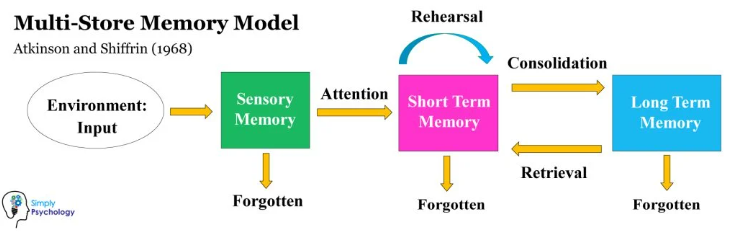
What is the computer model in the cognitivie approach?
Compares the human mind to a computer, input is the sensors, hard drive is memory, RAM is memory retreival, output is behaviour.
What are the strengths of the cognitive approach?
Success of cognitive behavioural therapy (90% with depression)
Scientific controlled experiments (high internal validity)
Application in police interviews
What are the weaknesses of the cognitive approach?
Over simplifies brain activity (human minds are more complex than computers)
Failure of CBT (10%)
Ignored human emotions and free will
Studies have low external validity
What therapy is linked with the cogntiive approach?
Cognitive Behavioural Therapy - Replacing irrational thoughts with rational thoughts
What is the evaluation for the Biological Approach?
Real world applications - drug therapies.
Evidence for neuroanatomy - MRI scans etc
Scientific methods - Objective, replicable,
Evidence for genetics - Twin and family studies
What is reductionism?
Breaking down the cause of complex human behaviour into ONE aspect.