AOS1 Nucleic acids

0.0(0)
Studied by 0 people
call kaiCall Kai
Locked
learnLearn
examPractice Test
spaced repetitionSpaced Repetition
heart puzzleMatch
flashcardsFlashcards
GameKnowt Play
Card Sorting

1/4

encourage image

There's no tags or description

Looks like no tags are added yet.

Last updated 5:22 AM on 8/24/26
Name
Mastery
Learn
Test
Matching
Spaced
Call with Kai
Chat

No analytics yet

Send a link to your students to track their progress

5 Terms

1
New cards

Protein structure

Amino acids

  • The building blocks of proteins (monomers of protein)

  • composed of a central carbon atom, carboxyl group, amino group, an R-group and a hydrogen atom.

  • when amino acids are joined together they produce nucleotide chains (polypeptides).

  • The joining of amino acids occur at the cells ribosome via condensation reaction, which results in the formation of peptide bonds between adjacent amino acids.

Protein structure

  • Primary- refers to the sequence of amino acids.

  • Secondary- When polypeptides fold by forming hydrogen bonds between amino acids of different sections, forming alpha helices, beta pleated sheets and random coils.

  • Tertiary- It is the functional 3d shape of a protein (proteins must at least have a tertiary structure to be functional). When secondary structures further fold by forming interactions between amino acids and r-groups of it’s different sections.

  • Quaternary- Formed through the bonding of two or more polypeptide chains with tertiary structures together.


<p><strong>Amino acids</strong></p><ul><li><p>The building blocks of proteins (monomers of protein)</p></li><li><p>composed of a central carbon atom, carboxyl group, amino group, an R-group and a hydrogen atom.</p></li><li><p>when amino acids are joined together they produce nucleotide chains (polypeptides).</p></li><li><p>The joining of amino acids occur at the cells ribosome via condensation reaction, which results in the formation of peptide bonds between adjacent amino acids.</p></li></ul><p><strong>Protein structure</strong></p><ul><li><p><strong>Primary</strong>- refers to the sequence of amino acids.</p></li><li><p><strong>Secondary</strong>- When polypeptides fold by forming hydrogen bonds between amino acids of different sections, forming alpha helices, beta pleated sheets and random coils.</p></li><li><p><strong>Tertiary</strong>-  It is the functional 3d shape of a protein (proteins must at least have a tertiary structure to be functional). When secondary structures further fold by forming interactions between amino acids and r-groups of it’s different sections.</p></li><li><p><strong>Quaternary</strong>- Formed through the bonding of two or more polypeptide chains with tertiary structures together.</p></li></ul><p></p>
2
New cards

Nucleic acids

  • nucleic acids are polymers of nucleotide monomers.

  • they store genetic information and form molecules that aid in the production of proteins.

Nucleotides

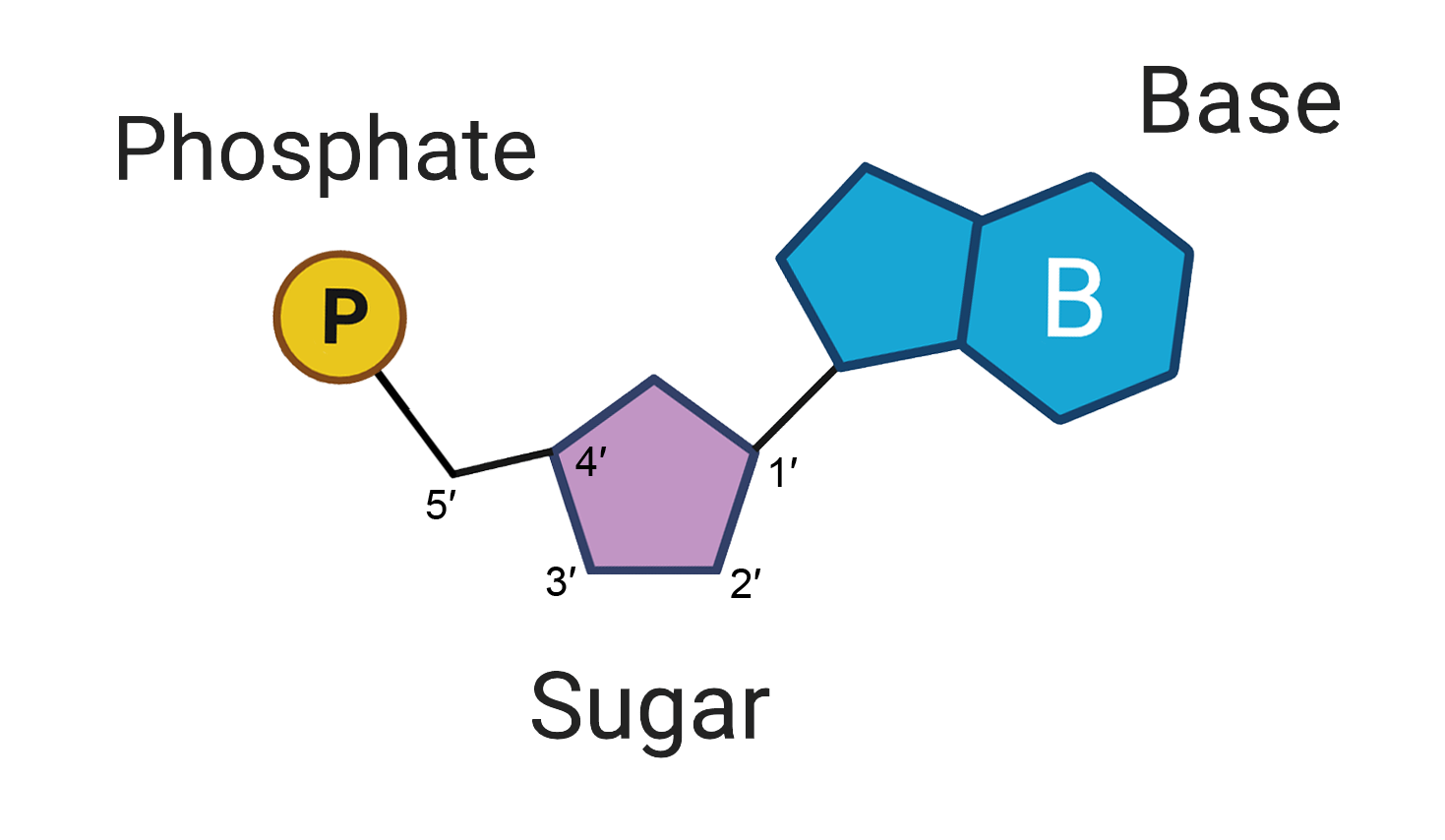
  • include a phosphate group, 5-carbon sugar and a nitrogen-containing base.

  • Within the 5-carbon sugar, each is assigned a number in a clockwise direction (one prime to five prime)

  • 1’ attaches to the nitrogenous base.

  • 3’ attaches to the phosphate of the following nucleotide.

  • 5’ attaches the 5-carbon sugar to the phosphate group of the nucleotide.

  • Sugar-phosphate backbone of nucleic acids- the linkage of sugars and phosphate groups.

  • many nucleotides join together through phosphodiester bonds formed via condensation reaction, forming polynucleotide chains. (bonds exist between the sugar group of a nucleotide and the phosphate group of another.

<ul><li><p>nucleic acids are polymers of nucleotide monomers.</p></li><li><p>they store genetic information and form molecules that aid in the production of proteins.</p></li></ul><p><strong>Nucleotides</strong></p><ul><li><p>include a phosphate group, 5-carbon sugar and a nitrogen-containing base.</p></li><li><p>Within the 5-carbon sugar, each is assigned a number in a clockwise direction (one prime to five prime)</p></li><li><p>1’ attaches to the nitrogenous base. </p></li><li><p>3’ attaches to the phosphate of the following nucleotide.</p></li><li><p>5’ attaches the 5-carbon sugar to the phosphate group of the nucleotide.</p></li><li><p><strong>Sugar-phosphate backbone of nucleic acids</strong>- the linkage of sugars and phosphate groups.</p></li><li><p>many nucleotides join together through phosphodiester bonds formed via condensation reaction, forming polynucleotide chains. (bonds exist between the sugar group of a nucleotide and the phosphate group of another.</p></li></ul><p></p>
3
New cards

n

4
New cards

m

5
New cards

m



