Ch 2. Chemistry of Life: Organic and Inorganic Overview
 Call Kai
 Learn
Learn Practice Test
 Spaced Repetition
 Match
Match Flashcards
 Knowt Play
1/94

There's no tags or description
Looks like no tags are added yet.
Name | Mastery | Learn | Test | Matching | Spaced | Call with Kai | Chat |
|---|
No analytics yet
Send a link to your students to track their progress
95 Terms
Chemistry
Study of substances' composition and properties.
Organic Chemistry
Study of molecules containing Carbon and Hydrogen.
Inorganic Chemistry
Study of molecules not containing both C and H.
Matter
Anything that occupies space and has mass.
Solid
Matter with a definite shape and volume.
Liquid
Matter that has a definite volume but no shape.
Gas
Matter that has neither definite shape nor volume.
Plasma
Ionized gas with free-moving charged particles.
Atom
Smallest unit of matter with unique properties.
Element
Matter made of a single type of atom.
Bohr Model
Model depicting electrons orbiting a nucleus.

Atomic Number
Number of protons in an atom's nucleus.
Atomic Mass
Total weight of protons, neutrons, and electrons.
Dalton (D)
Unit of mass for atomic particles, ~1 atomic weight unit.
Isotopes
Atoms of the same element with different neutron counts.

Radioisotopes
Unstable isotopes that emit radiation.
Valence Electrons
Electrons in the outer shell determining chemical properties.
Covalent Bonds
Strong bonds formed by sharing electron pairs.
Polar Covalent Bonds
Unequal sharing of electrons between atoms.

Nonpolar Covalent Bonds
Equal sharing of electrons between atoms.
Electronegativity
Atom's tendency to attract electrons.
Ionic Bonds
Bonds formed by attraction of oppositely charged ions.
Cations
Positively charged ions formed by losing electrons.
Anions
Negatively charged ions formed by gaining electrons.
Hydrogen Bonds
Weak bonds between hydrogen and electronegative atoms.

Solvent
Substance that dissolves another substance, often water.
Solute
Substance dissolved in a solvent.
Molecule
Combination of two or more atoms.
Compound
Molecule containing two or more different elements.
Trace Elements
Elements that account for 0.7% of body composition.
Physiologic Role of Elements
24 elements essential for human physiological functions.
Oxygen
65% of body composition, vital for respiration.
Carbon
18% of body composition, backbone of organic molecules.
Hydrogen
10% of body composition, involved in chemical reactions.
Nitrogen
3% of body composition, essential for amino acids.
Strength of Bonds
Covalent > Ionic > Hydrogen in terms of stability.
Hydrophilic Solution
Solute that dissolves in water (H2O).
Hydrophobic Solution
Solute that does not dissolve in water (H2O).
Colloid
Heterogeneous mixture with insoluble solutes suspended.
Suspension
Heterogeneous mixture where solutes settle out.
Metabolism
Total of all chemical reactions in the body.
Anabolic Reactions
Endergonic reactions creating larger molecules from smaller ones.
Catabolic Reactions
Exergonic reactions breaking down larger molecules into smaller ones.
Reaction Rates
Factors influencing the speed of chemical reactions.
Concentration
Higher reactant concentration increases reaction rate.
Temperature
Increased temperature speeds up reaction rates.
Enzymes
Proteins that catalyze reactions by lowering activation energy.
Water (H2O)
Unique molecule with special properties due to polarity.
Cohesion
Water molecules stick together due to hydrogen bonding.
Surface Tension
Insects can walk on water due to cohesive forces.
Solvent
Water dissolves salts and charged particles effectively.
Temperature Moderation
Water stabilizes temperatures, protecting organisms.
Acid
Substance that donates H+ ions in water.
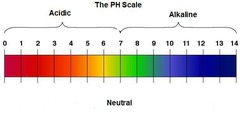
Base
Substance that accepts H+ ions in water.
pH Scale
Logarithmic scale measuring hydrogen ion concentration.
Acidity
Increases as pH scale decreases.
Alkalinity
Increases as pH scale increases.
Neutral Solution
Achieved at pH of 7 with equal H+ and OH-.
pH Calculation
pH = -log(H+) expresses hydrogen ion concentration.
Buffers
Substances that stabilize pH by neutralizing excess ions.
Macromolecules
Large organic molecules essential for biological functions.
Carbon Skeleton
Structure formed by carbon atoms in organic molecules.
Organic Molecules
Contain carbon and hydrogen, forming the basis of life.
Monomer
Simplest unit of each organic macromolecule.
Monomer
Basic building block of polymers, e.g., glucose.
Polymer
Multiple monomers linked together to form larger molecules.
Functional Groups
Specific arrangements affecting molecule properties in compounds.
Lipids
Diverse macromolecules unified by hydrophobic properties.

Hydrophobic
Substances that repel water molecules.
Nonpolar Lipid Bonds
Lipid bonds that do not interact with water.
Triglycerides
Fats with three fatty acid chains.
Fatty Acids
Carboxylic acids with long hydrocarbon chains.
Saturated Fat
Fat with only single carbon bonds.
Unsaturated Fat
Fat with at least one double carbon bond.
Polyunsaturated Fat
Fat with multiple double carbon bonds.
Steroid
Lipid with 17 carbons in four rings.

Cholesterol
Parent steroid for all other steroids.
Phospholipids
Lipids with two fatty acids and a phosphate group.

Phospholipid Bilayer
Membrane structure with hydrophobic tails inward.
Carbohydrates
Organic compounds of carbon, hydrogen, and oxygen.
Monosaccharide
Simplest form of carbohydrates; single sugar unit.
Disaccharide
Two monosaccharides linked together.
Polysaccharide
Long chains of monosaccharides; complex carbohydrates.
Cellulose
Polysaccharide forming plant cell walls.
Glycogen
Storage form of glucose in animals.
Proteins
Complex macromolecules made of amino acids.
Amino Acids
Building blocks of proteins; 21 types used.
Peptide Bonds
Covalent bonds linking amino acids together.
Polypeptide
Chain of three or more amino acids.
Nucleic Acids
Biopolymers essential for all known forms of life.
Nucleotide
Monomer of nucleic acids; includes phosphate group.
DNA
Genetic material of all cells and viruses.
RNA
Involved in protein synthesis and genetic material.
ATP
Main energy currency of cells.
High Energy Bonds
Bonds in ATP that release energy when broken.