Art history- Ancient Egypt lecture notes
 Call Kai
 Learn
Learn Practice Test
 Spaced Repetition
 Match
Match Flashcards
 Knowt Play
1/66

There's no tags or description
Looks like no tags are added yet.
Name | Mastery | Learn | Test | Matching | Spaced | Call with Kai | Chat |
|---|
No analytics yet
Send a link to your students to track their progress
67 Terms
Principles of Egyptian art
Egyptian Landsape
There is a drastic contrast between the green landscape around the nile and the desert landscape (most settlements developed around the river)
Deshert (red land) VS Kemet( Black land) (fertile land along the nile)
Upper Egypt is in the south
Lower Egypt is in the north

The direction of the flow of the nile
The Nile flows from the south to the north (from Upper Egypt to Lower Egypt)
Narmer Palette (Key work #1)
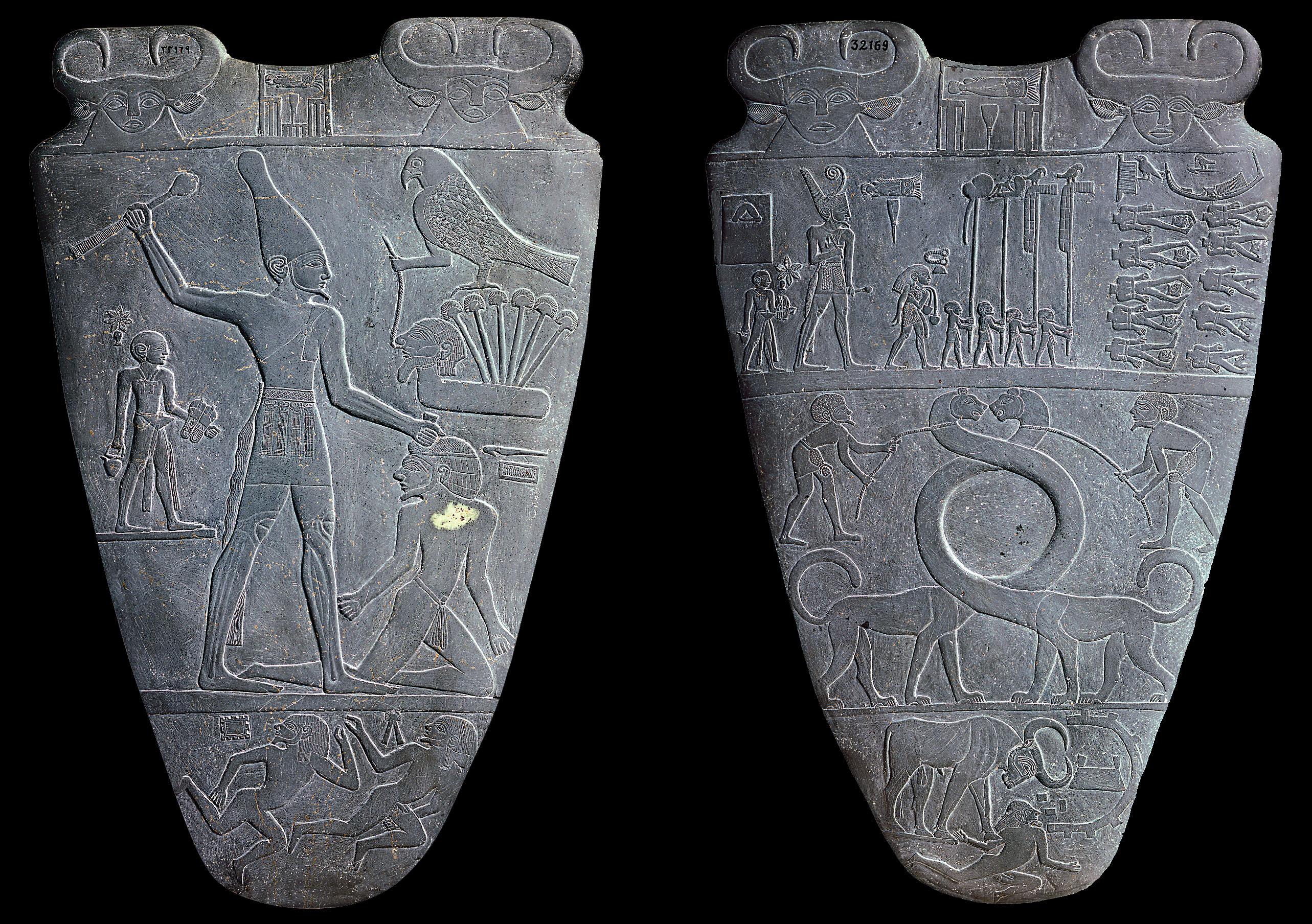
Narmer’s Palette characteristics
King Narmer's name in hieroglyphics (Catfish and chisel)
In the middle is a circular grinding area
was found in the temple area
A ceremonial or ritual object (Found with other ceremonial objects, so it was also a ritual object)
The lines on the palette are called “registers”
Each register is its own story

One side of the palette
The king is holding the enemy with his left hand and holding his scepter
Composite pose/twisted perspective: The king’s face and legs are facing to the side (profile), but both shoulders can be seen(shown in the frontal view)
* Egyptian art: Head in profile, shoulders frontal, chest in hybrid form, waist and buttocks in profile, legs in profile
Narmer is defeating the enemy
Other side of the palette
Hierarchical scale register: Narmer is depicted really large, but the servants next to him are really small (the difference in size shows status)
Serpopards: modern term: serpent + leopard
Bull is on the bottom: showing Narmer as an authority figure (maintains order)
What signifies that Narmer is king?
Narmer is shown barefoot- a holy or sacred figure
Narmer is shown as king of Upper Egypt, wearing a white crown of upper Egypt, red crown of lower Egypt, royal beard, and bull’s tail
Bull= strength and power (so the bull tail confirmed Narmer’s strength and authority)
The double crown meaning: Narmer’s power is confirmed throughout both Upper and Lower Egypt
Red crown of Lower Egypt and white crown of Upper Egypt = double crown
Menkarure Dyad (Key work #2)

Menkarure Dyad Characteristics
The king is on the left side, and the right side is suggested to be his wife (but uncertain)
It was found in the Menkaure Valley Temple
Both figures are strongly oriented to the front
Can still see traces of pigment (red pigment) (around the face and ears)
Menkaure statue
If you look down at Menkaure’s feet, his left foot is forward (even the woman’s left foot is also forward), showing a sense of movement
Royal beard: States Menkaure as king
Nemes (the wig on his head): States Menkaure as king
He has broad shoulders and a strong figure
Woman statue
The woman is almost the same scale as Menkaure signifying her importance
The woman’s gesture almost looks protective (wrapping her arms around him)
The woman’s body is much more slender and smooth (more youthful)
Ti watching a Hippopotamus Hunt (Key work #3)

Ti watching a Hippopotamus Hunt Characteristics
Ti also had composite perspective (chest is profile but legs and head is to the side)
Ti also has Hierarchical scale
Papyrus extends more upwards (there are a lot of birds)
The bottom has fish
The vertical lines are individual stems of papyrus (looking at a marsh environment near the Nile)
Can get a sense of abundance near the Nile (fish and birds) for hunting
Hippo hunting
The marsh can be dangerous: the men are hunting hippos (a crocodile is being bitten by a hippo)
Can think of the hunting as a way to control the powerful creatures (hippos)
The men hunting hippos: The man on the far left; his arms and shoulder are muscular (and very twisted)
Why did they choose to represent other figures in a rigid way?- For the other Egyptian works
If they could, why did they choose not to make the body more flexible and fluid and muscular?
Faience Hippopotamus (“William”) (Key work #4)

Faience Hippopotamus (“William”) Characteristics
Bright blue color
Lotus flowers are painted on the hippo's body (almost as if the marsh itself is covering him)
Blue: signifies fertility, life, water, marsh environment
The water, the plants, and the hippo seem to be connected together
The figure’s feet were mostly broken (which makes sense because the people hunted hippos and took out their legs and feet first)
William viewed under UV light: The feet of William reveal the extensive modern restorations performed on them by emitting UV light
Firing Silica
Faience is made from silica: the replication process can leave the bright blue color
After firing is when the object gets blue
The blue surface develops through the process of firing
Sacred Places and powerful images
Key works
Step Pyramid Complex of Djoser, Saqqara c. 2600 BCE
Great Temple of Amun-Re, Karnak, c. 1500-1000 BCE
Mastaba of Ti, Saqqara, c. 2450 BCE
Horus Stele c. 664-600 BCE
Step Pyramid Complex of Djoser, Saqqara c. 2600 BCE

Step Pyramid Complex of Djoser characteristics
Can clearly see levels and steps of the Pyramid
It is the First monumental Pyramid
The bottom part was the earliest stage (it started as a mastaba)
At first, the mastaba was extended outwards. Instead of just getting wider, it started growing upward
Reconstruction of Djoser’s funerary complex, Saqqara. Dynasty 3 (c.2630-2575)
The whole complex was surrounded by a wall (enclosure wall)
There are only one entrance (most of the other entrances are fake)
MOST of it was built of stone
Chapels of the Hed-Sed court, Step Pyramid Complex
was a ritual of royal renewal. You were not meant to enter the chapel.
The pillars were made from wooden roof beams recreated in stone (it looks like bundled plant stems)
Modern mudhif: a comparative example of bundled-reed construction
*Wood decays, but stone is more preserved

Serdab
is a small chamber in a tomb made to hold a statue (statue is enclosed in a stone chamber and can only look at it in front)
Inside the chamber, you see the statue of Djoser, painted limestone
Statue of Djoser
Inside the serdab you see the statue of Djoser, painted limestone
The statue of Djoser has the headdress and the royal beard

Mastaba of Ti, Saqqara, c. 2450 BCE

Mastaba of Ti Characteristics
Mastaba: Has a low rectangular shape (mastaba is Arabic for bench)
The actual chamber was underground
*Mastaba can also be family tombs
The main ritual place was deep inside the tomb (The location of the Serdab)
Where living can dead could interact (through the false door)
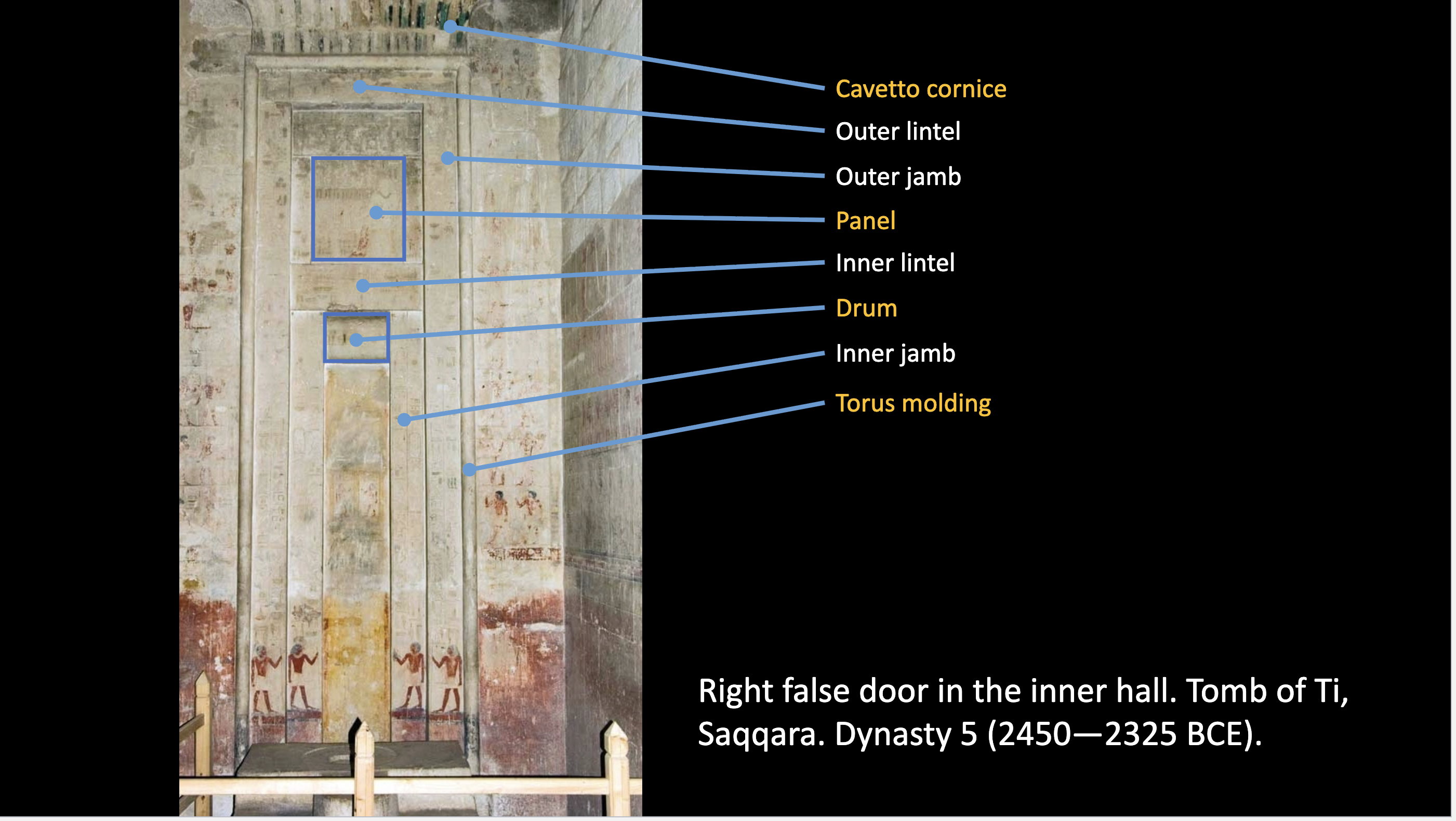
False door in the Ti of Mastaba
The tomb of Ti has two false doors (you couldn’t actually open the door) (but during rituals, the door would be used for rituals and offerings)
Offerings: can include food and drink (Ancient Egyptians) bread, beer, incense, clothes, ointments)
His wife had her own false door!
His son had his own false door! Where offering rituals could be made for them

Architectural details of the false door
Panel: rectangular area in the middle
Cavetto cornice (the area in the top): similar to A papyrus
Great Temple of Amun-Re, Karnak c. 1500-1000 BCE

Great Temple of Amun-re characteristics
As you enter the temple, you enter the monumental gate, the first Pylon
Then the second Pylon
As you go into the temple, the space becomes more enclosed
The most sacred place is the inner sanctum
As you go deeper into the temple, you are getting closer to the presence of the god/goddess
*Karnak: how architecture, imagery, and art maintain order - Temple as an ordered world

Procession of Amun from the Red Chapel of Hatshepsut, Dynasty 18. Karnak Temple
In certain times, the god himself was brought out to the people


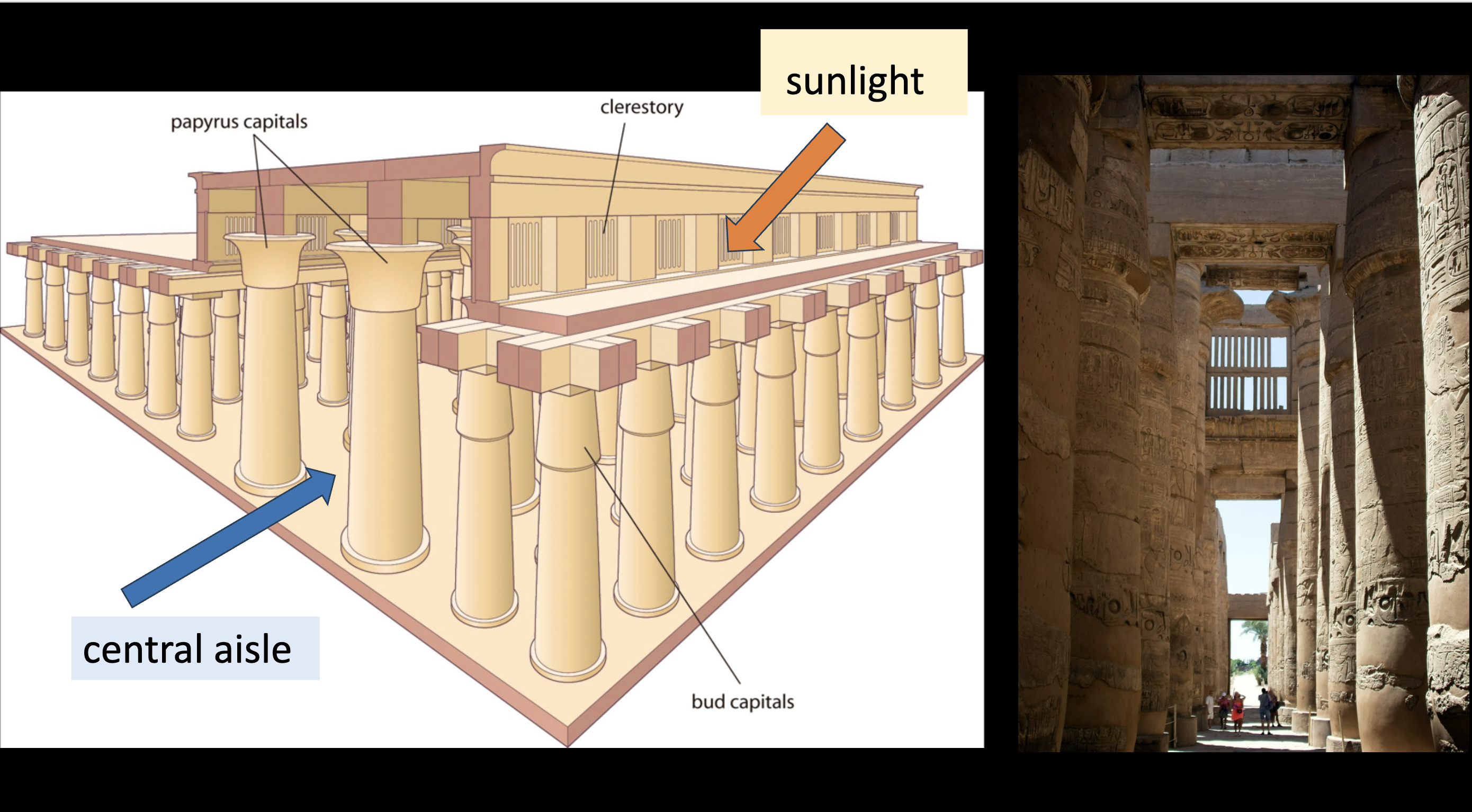
Columns with papyriform and bud capitals, Hypostyle Hall, Great Temple of Amun at Karnak
Hypostyle hall: The hall where the roof is supported by columns (Greek)(hypo: under)(stylos: column)
The uppermost part of the column is called the capital
The columns are based on the form of a Papyrus
The top(the tall) is almost like the bud of the Papyrus
When you moved through the halls, it was as if you were moving through a giant papyrus marsh

Clerestory in the Hypostyle hal
Clerestory: almost like windows that let sunlight through
Walls of the hypostyle hall
The walls of the column show a lot of drawings and rituals
Amun-re on the walls of the column: has the divine beard
Ma’at is presenting an offering to Amun-re: she is holding an ankh
*Ankh: Means order and life

Horus Stele c. 664-600 BCE

Horus Stele characteristics
Is a child because his hair has a sidelock
His name is Harpocrates: Horus the child
He is holding all the dangerous animals
Horus’s mother: Isis
Isis healed him and came to the rescue
Bes: on top of Horus's head of Horus: Bes=god
Bes’ role was to protect children
It is apotropaic
Horus’ face is smoother and worn out: might mean that people touch that part more often
*How images could be used for protection and healing
Apotropaic
something meant to protect you from danger
Portable amulets= Horus Cippi
Horus Cippi: can come in different scales and sizes
Can be handheld (portable)
People touched the object repeatedly
Back of the Horus stele
it is covered in Heiroglyphics
It is protective spells
Overview of Scared places and powerful images

The living and the dead
Key works
Stela of the Standard Bearer, Smen, c. 1400-1390 BCE - connecting the divine and ancestor cults
Coffin of Khnumnakht, c. 1850-1750 BCE- Coffin as cosmos
Ancestor Bust, c. 1200 BCE- The dead among the living
Book of the Dead of Hunefer, c. 1275 BCE- The dead as ritual actor
Coffin of Khnumnakht, ca. 1850-1750 BCE

Coffin of Khnumnakht characteristics
Rectangular coffin, covered with hieroglyphics
How the space around his body is organized
On the right side: There is a pair of eyes: Wedjat eye: protective symbol
Head towards the north and face turned towards the east
East is the direction of the rising sun: meaning rebirth and renewal
Middle Kingdom coffins: Four corners: the names of the sons of Horus
The names of the gods are helping to organize the coffin

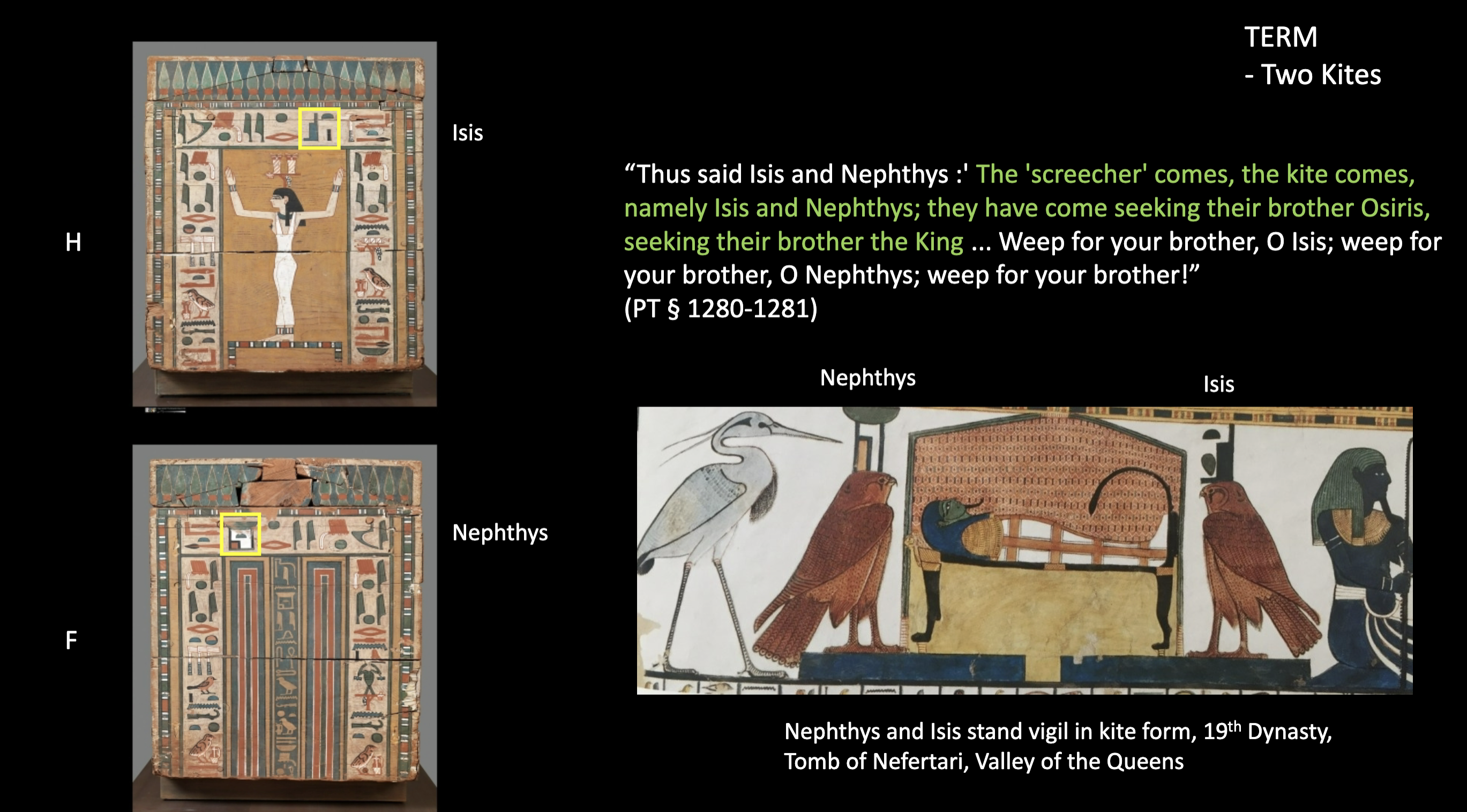
The two kites on the Coffin of Khnumnakht
Upper panel Isis: looks almost like steps
Lower panel Nephthys: Basket over the head
Isis and Nephthys are placed on opposite sides of the body (to protect the deceased)

The painting on the Coffin- Two kites
Birds are depicted as Isis and Nephthys
The deceased is represented by the god Osiris (see Osiris with green skin)
The birds are mourning over the body
After Osiris is killed by his brother Seth, they mourn for the body
Two kites: Isis and Nephthys
“The ‘screecher’ comes; the kite comes Isis and Nephthys; they have come seeking their brother Osiris, seeking for their brother the King”.
Sons of Horus
Duamutef, Amset, Hapi, and Qebhsennuf (the names are on the four corners)
Their names protect the deceased body
Canopic jars
Jars made in the shape of the sons of Horus
Imseti: human head
Hapi: Baboon head
Duamutef: Jackal head
Qubehsenuef: Falcon head

Stela of the Standard Bearer smen ca. 1400-1390 BCE

Stela of the Standard Bearer smen Characteristics
Has a rounded top
Divided into two registers
Upper register and lower register
Below is the offering formula
Upper and lower register structure seems similar: both have the offering table in the middle, piled with food and drinks, has ritual actors on the right; there is a recipient of the offerings
Upper register
Osiris is seen: He has an atef crown - has feathers on either side, a crook and a flail
On the right is Smen
Smen’s gesture represents worship (to Osiris)
Divine cult: ritual directed towards a deity
Divine cult: Osiris ← Smen
Lower register
Hesetre is Smen’s wife
Hesetre is on the right
Her deceased parents are on the left
She is performing a ritual and offering to her ancestors
Ancestor cult: her deceased parents ← Hesetre
Wife: to her deceased parents
Smen: to a divine god
Ancestor Bust c. 1320-1237 BCE
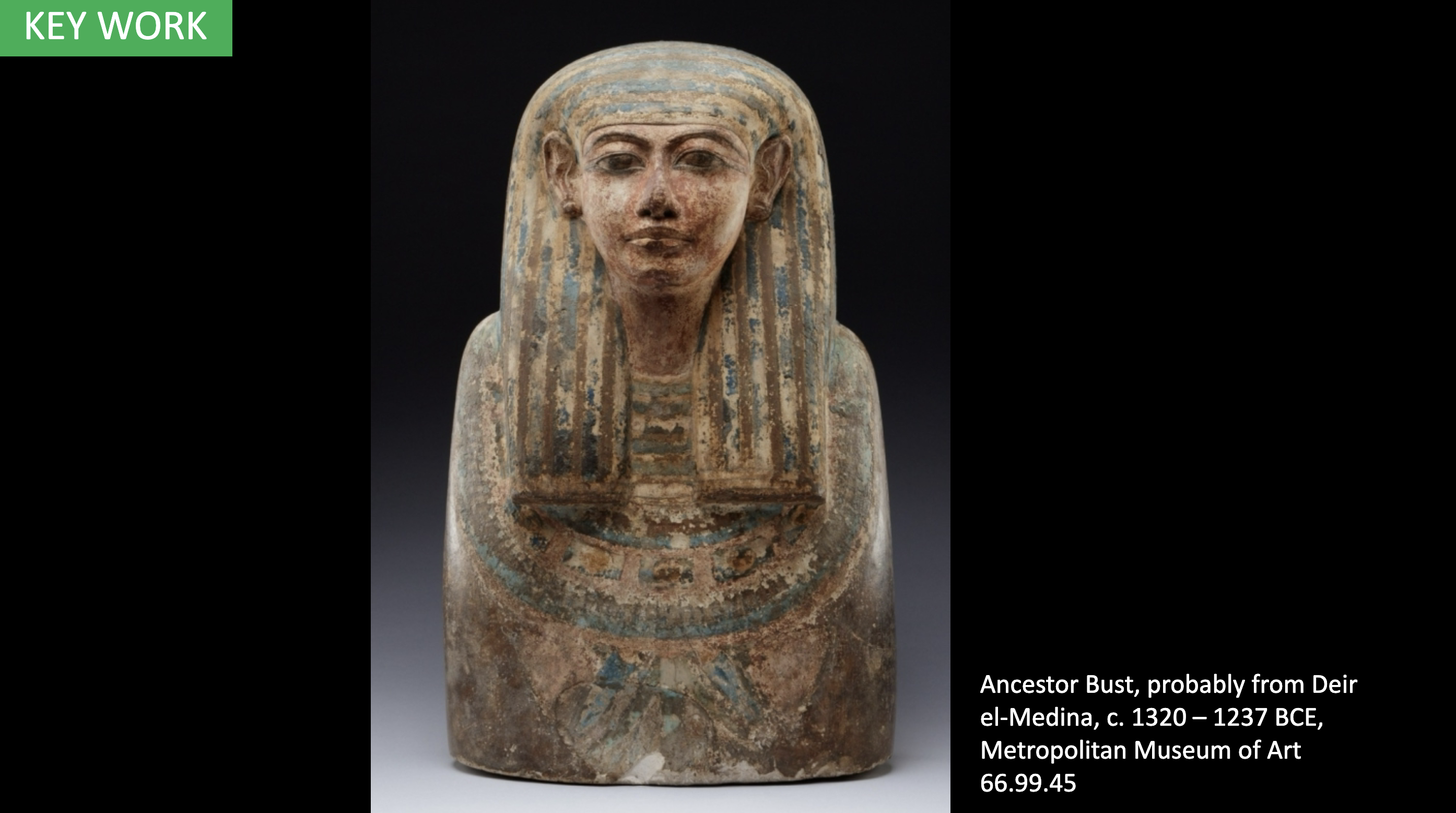
Ancestor Bust Charactertistics
Only the head and chest are shown
Can see original color ( the blue)
Relatively large; facial features are carefully carved
Deir el-Medina
Deir el-Medina: one of the locations in which these objects are found
The village of Deir el-Medina, home of the workers who built the royal tombs KV, and their tombs
The village itself is very well preserved.

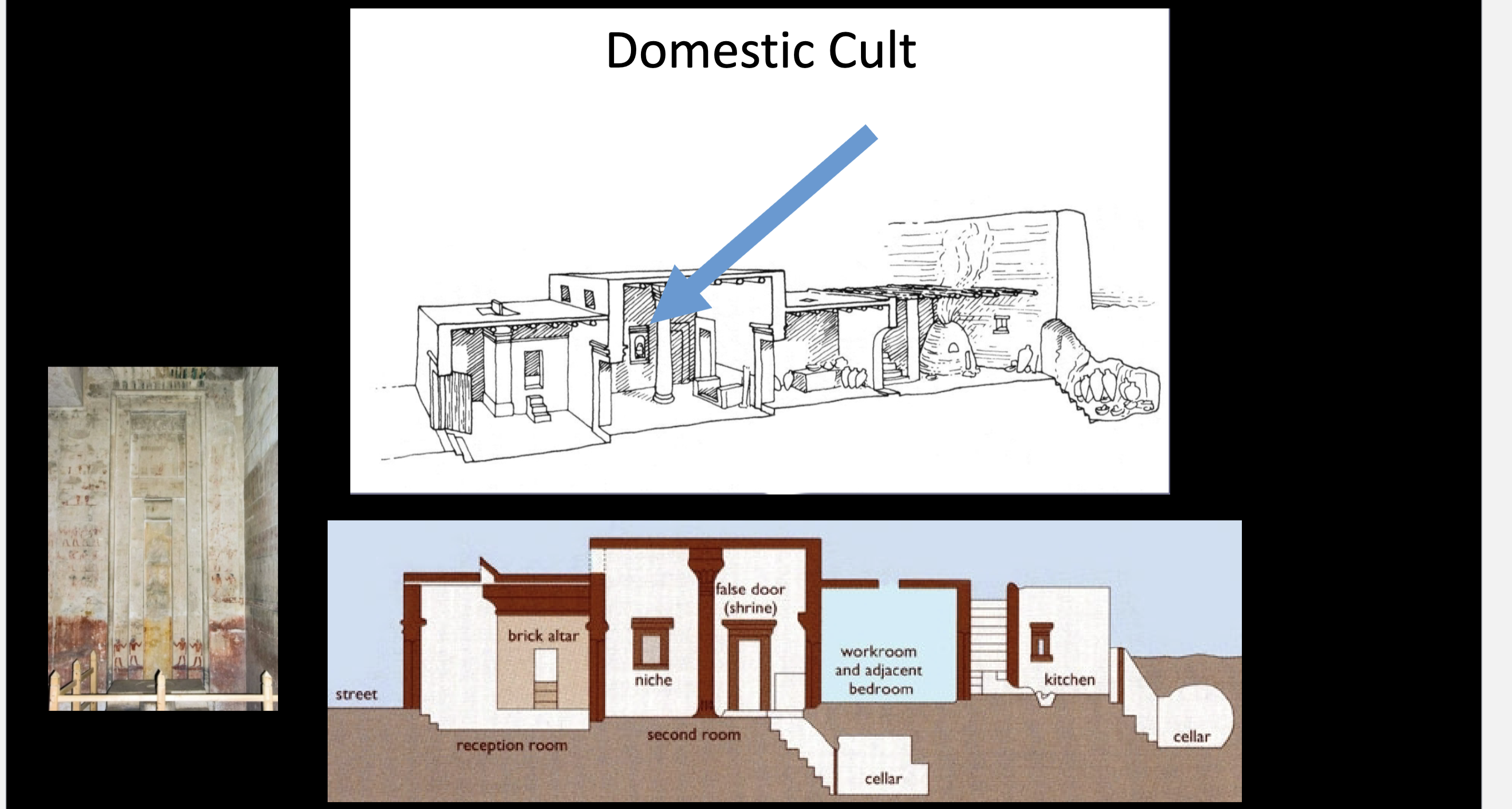
Domestic cult
A small niche is built into the wall (niches could contain religious images and objects)
There is a false door in the house that connects back to the false door in the tombs
Interaction between the dead could be part of an everyday experience
Ancestor bust
Small ancestor bust on the left; a woman is performing an offering, incense
The dead could “assist and protect the living” - reciprocity, the living give offerings to the dead
Akh/ effective death

Book of the Dead ca. 1275 BCE

Book of the Dead characteristics
Looks like a judgement scene (judgement after death)
One side of the balance: neper’s heart, feather of ma’at
Ma’at: representation of order
All the way on the right: Osiris is seating in his throne and shrine
Behind Osiris are two women/ goddess
Isis and Nephthys
In the papyrus: the owner and his wife are in a worshipping gesture
Weighing scene
more complex
Weighing the deceased person’s heart and the ostrich feather of Ma’at
The deceased person's heart (representing their soul, conscience, and all the deeds—good and bad—they committed during their lifetime).
The ostrich feather of Ma'at (the goddess of truth, justice, balance, and cosmic order)
Spell 125: declaration of the innocent (not tampering with ritual objects)
Repeats “I am pure” four times
The heart Scarab
The heart of Scarab: a relatively large scarab inscribed with spell 30B
Spell 30B: Works against the deceased; the spell helps it keep in proper condition (proper condition of the heart)
Weighing: a judgement (not only moral), whether the deceased is in the proper condition to approach Osiris
Horus leads Hunefer towards Osiris

Another scene from the Papyrus
They are doing the worshiping gesture (two people)(Hunefer and wife)
On the right are two images of renewal
Baboons gesturing worship towards the sun= represents daily renewal
Djed: In Egyptian hieroglyphs, the pillar-like symbol representing the backbone of the god Osiris, the main god of the afterlife. It symbolized stability and permanence and was closely associated with the regeneration of Osiris.
On either side of the djed are Isis and Nephthys (protecting the deceased) (two kites)
The two goddesses are in a worshiping pose

Overview of The living and the dead

Overview of Ancient Egypt
