Presentation 3: Strategic decisions of platform owners
 Call Kai
 Learn
Learn Practice Test
 Spaced Repetition
 Match
Match Flashcards
 Knowt Play
1/15

Earn XP
Description and Tags
Designing digital platforms ecosystems
Name | Mastery | Learn | Test | Matching | Spaced | Call with Kai | Chat |
|---|
No analytics yet
Send a link to your students to track their progress
16 Terms
What types of complementarities exist?
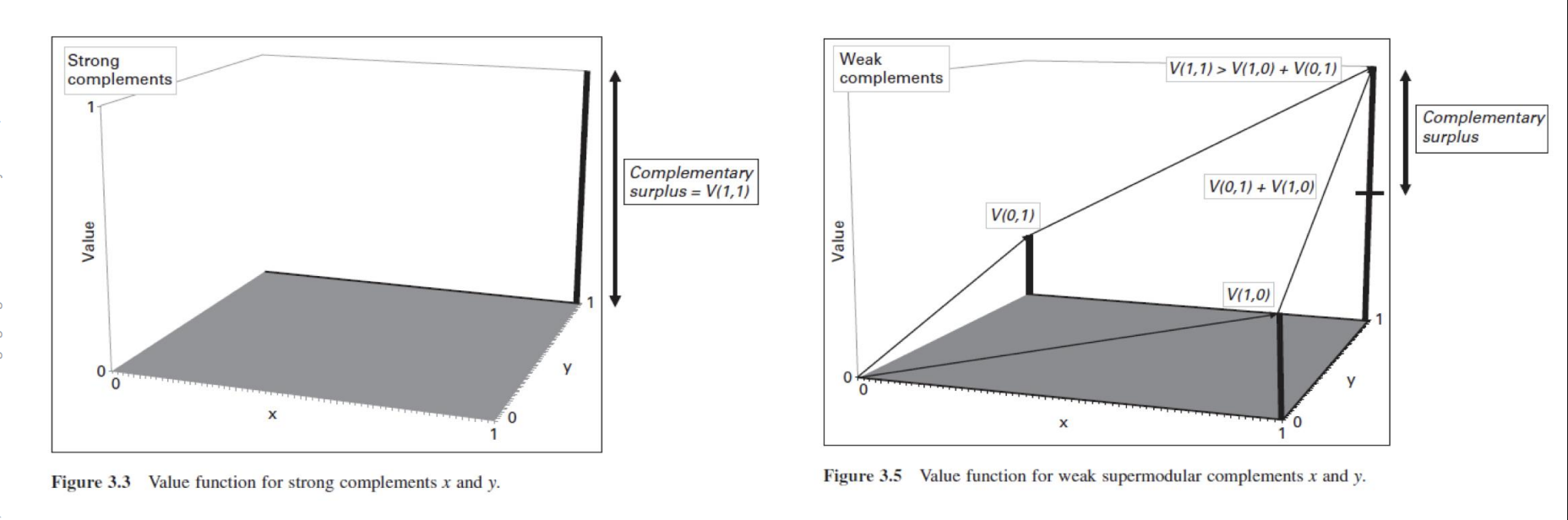
= Complementarities exist when two or more products, services, assets, or activities create more value together than separately
Unique/Strong Complementries:
Strict dependency
Part A requires Part B to function
e.g. a specific app that only works on Apple´s iOS (e.g. AirDrop + Apple devices, Apple Watch + iphone)
sometimes the same app exists on other platforms but it is never identical (Limited substitution)
Platform owner use it to create customer lock-in and differentiation
Generic/Weak Complementarities:
Standardized inputs widely available in markets
Any Part A works with any Part B
No exclusive pairing required (easily substitution, many combinations possible)
➡ There is little dependency between firms.
➡ Therefore, there is no real ecosystem relationship → no relevant for ecosystem i(f one supplier disappears, another can easily replace it)
e.g. Electricity, tea bags, USB-C Charger
Supermodular Complementarities:
“1+1 = 3” effect
More of Part A makes Part B more valuable
e.g. more apps make Apple´s iOS more attractive
(value function for weak supermodular complement x and y > Value function for strong complements x and y
platform owner use it to drive etwork effects, ecosystem growth and innovation
How can Complementarities can explain verticle integration?
Complementarities create both centripetal and centrifugal forces that influence whether activities should be integrated within one firm or coordinated through an ecosystem
complementarities as a defining feature of digital platform ecosystems
→ Platform success is driven by complementarities
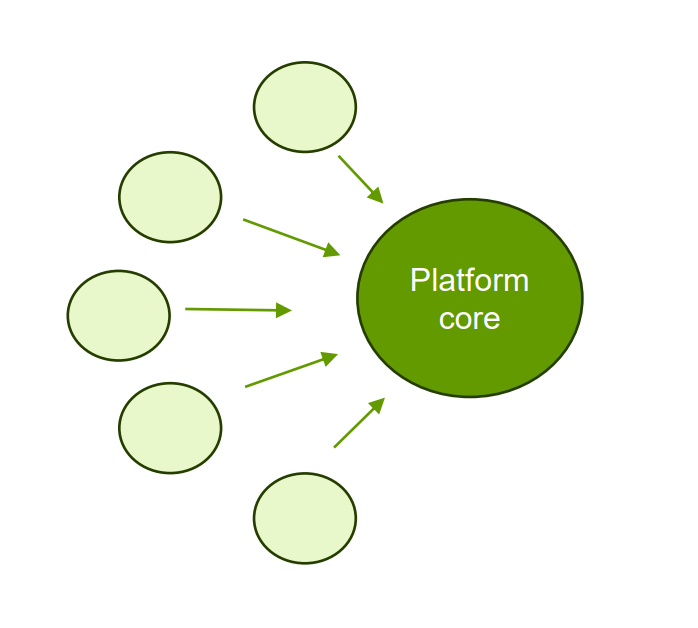
What are centripetal forces? Which four aspects support the forces and why?
= Pulling partners toward the Platform core (verticle integration)
Complementarities:
existst when assets, technologies, or tasks create higher value when used together within a single system
Task interdependence:
When tasks are highly interconnected, people and assets become cospecialized over time → making seperatly costly
this pushes firms toward tighter integration to coordinate more effeciently
Incomplete Contracts and Unobservable Effort:
When performance or effort is hard to measure, firms prefer closer control rather than relying (sich verlassen) on external partners
Integration helps reduce uncertainty (Unsicherheit) and improve incentives (Anreize)
Long-lived Co-specialized Investments:
Some assets only create value when used together
Keeping them in one firm prevents conflicts or “hold-up” problems between seperate owners
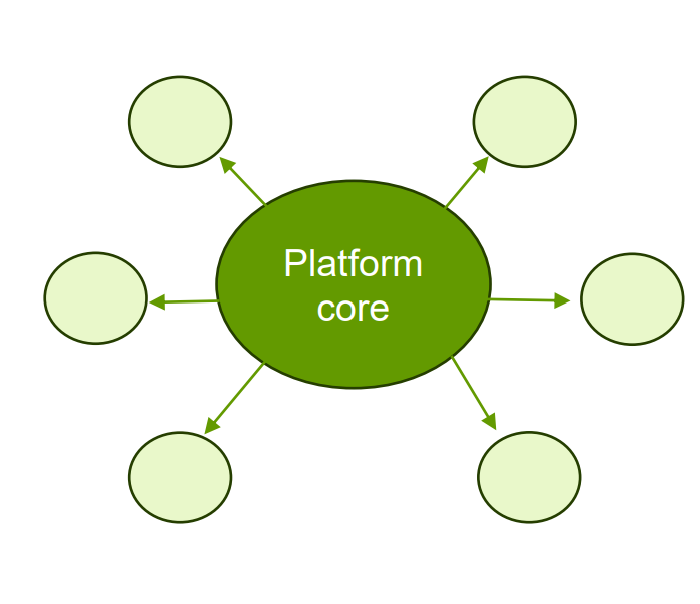
What are centrifugal forces? Which three aspects support the forces and why?
= Pushing partners away from the Platform core
Dispersed Knowledge and diverse Talent:
Knowledge and talent are spread across many people and organizations
Working with external partners allows access to more ideas and expertise
Modularity:
If a system can be divided into independent parts with clear interfaces, different firms can specialize in each part
This lowers coordination costs and increases competition
Network Effects:
The value of a system increases as more users or partners join
Firms benefit more by enabling broad participation than by cntrolling everything internally
Why is a balance between centripetal centrifugal and forces important for the platform owner? What happens when there is no balance?
To much centripetal force → everything is integrated → little innovation, high osts, slow development
Too much centrifugal forces → Everything is outsourced → los of quality control, coordination problems, fragmentation
→ Platform owner balance both forces to archiev innovation, coordination, ecosystem growth, control
→ e.g. For Apple:
Too much control → developers leave.
Too much openness → Apple loses quality and security.
Explain the concept of Complementarities and Forces by the Example of Apple´s iOS.
Weak Complementarities: A lot of apps have standalone value across platforms but combined with iOS value increases (e.g. WhatsApp works on Android and iOS)
Strong Complementarities: Some Apple services/apps only work with Apple devices (e.g. AirDrop)
Centripetal Forces: Apps must follow Apple´s rules (App Store, API, Payment, Security, etc.)
Centrifugal Forces: Apps are build by independent companies to work across platforms and bring their own features (e.g. WhatsApp, Spotify) → this brings inovation
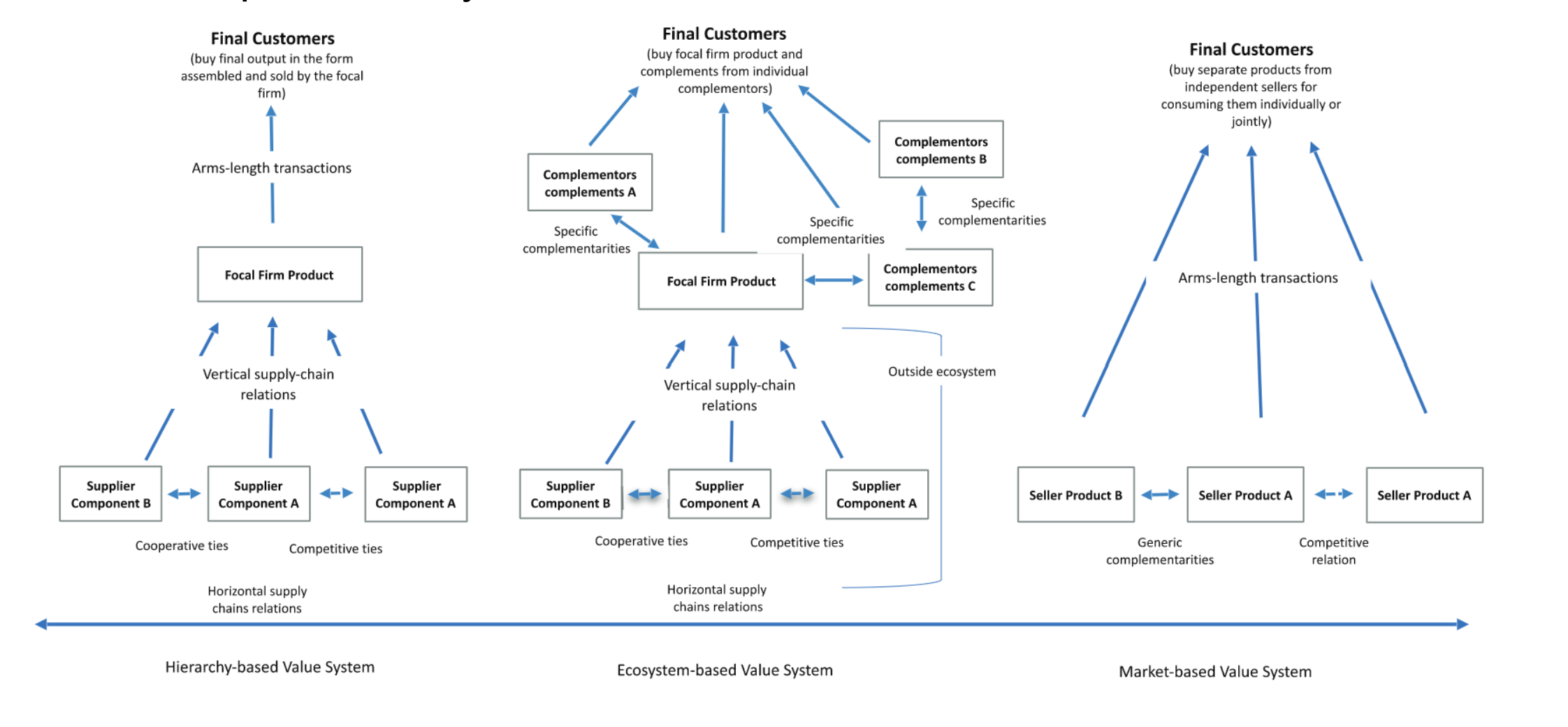
Which three types of value Systems exist? In which value system can you order the concept of complementarities?
Hierarchy-based value system:
Final customer buys final output in the form assembled and sold by the focal firm) → no complementarities
→ one firm owns almost everything (e.g. apple hardware production)
Ecosystem-based value system:
Final customer buys the local Firm products and specific complementarities from individual complementors
→ Independent firms cooperate using strong complements
Market-based Value system:
Final Customer buys seperate products (generic complementarities) from independent sellers for consuming them individually or jointly
→ independent firms exchange standardized products (e.g. USB cable, electricity)
→The value system of ecosystems, markets and hierarchies differ
Define Ecosystems.
= a system of organisms occupying a habitat, together with those aspects of the physical environment with which they interact (biological ecosystem)
= The collection of the platform and the modules/apps specific to it (Management/Technological-oriented ecosystem)
Why digital ecosystem?
Digital ecosystem = Variety in the developer and user communities
To increase the value of the product by extending the market horizon
When one market segment is obsolete because of competing technological platform, the ecosystem can still foster other areas
→ From an ecosystem perspective, greater diversity among developers and users increases platform value and resilience, helping the ecosystem remain viable even when specific market segments decline
greater innovation
greater diversity
higher resilience
larger market
adaptability
Define Platform Ecosystem by defining Ecosystem and Platform seperatly. Explain the value creation in it.
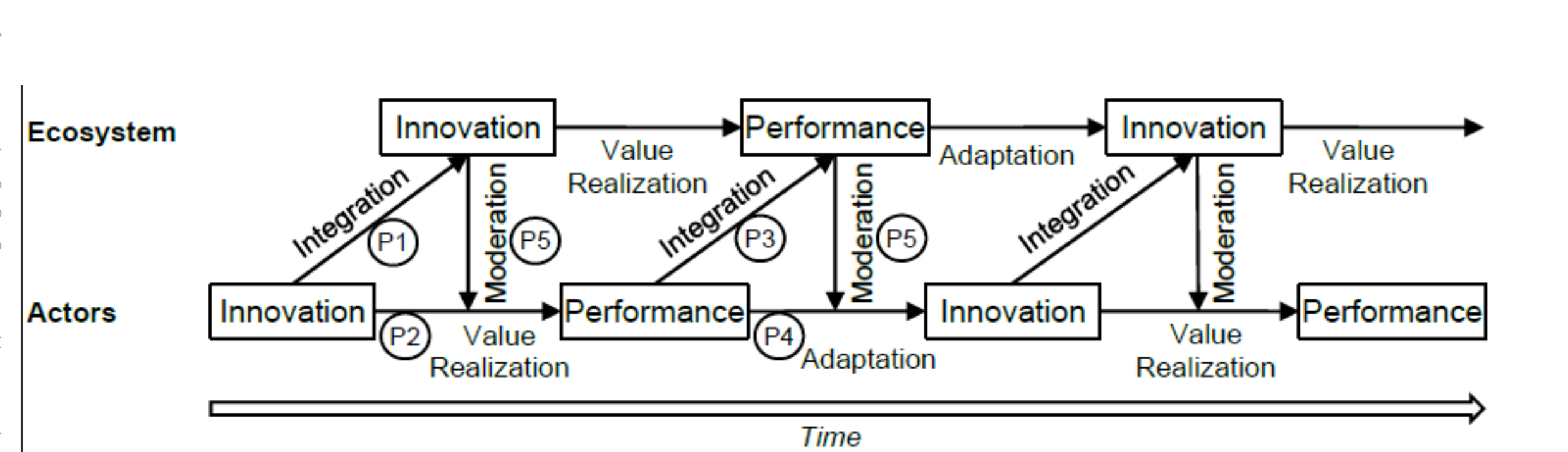
Ecosystem = Autonomous but interdependent group of firms and individuals
Actors create value together
Platform = Technical system with core functinal elements + optional complements
no value without optional complements
Purpose: provide options
Focus on technical architecture
Platform Ecosystem = Platform + provider/owner + complementors + end-users
Value co-creation through platform interactions (e.g. data integration, co-development)
What two dimensions for defining multi-platform integrtion strategies exist?
Type of the Platform: Innovation, Transaction, communication
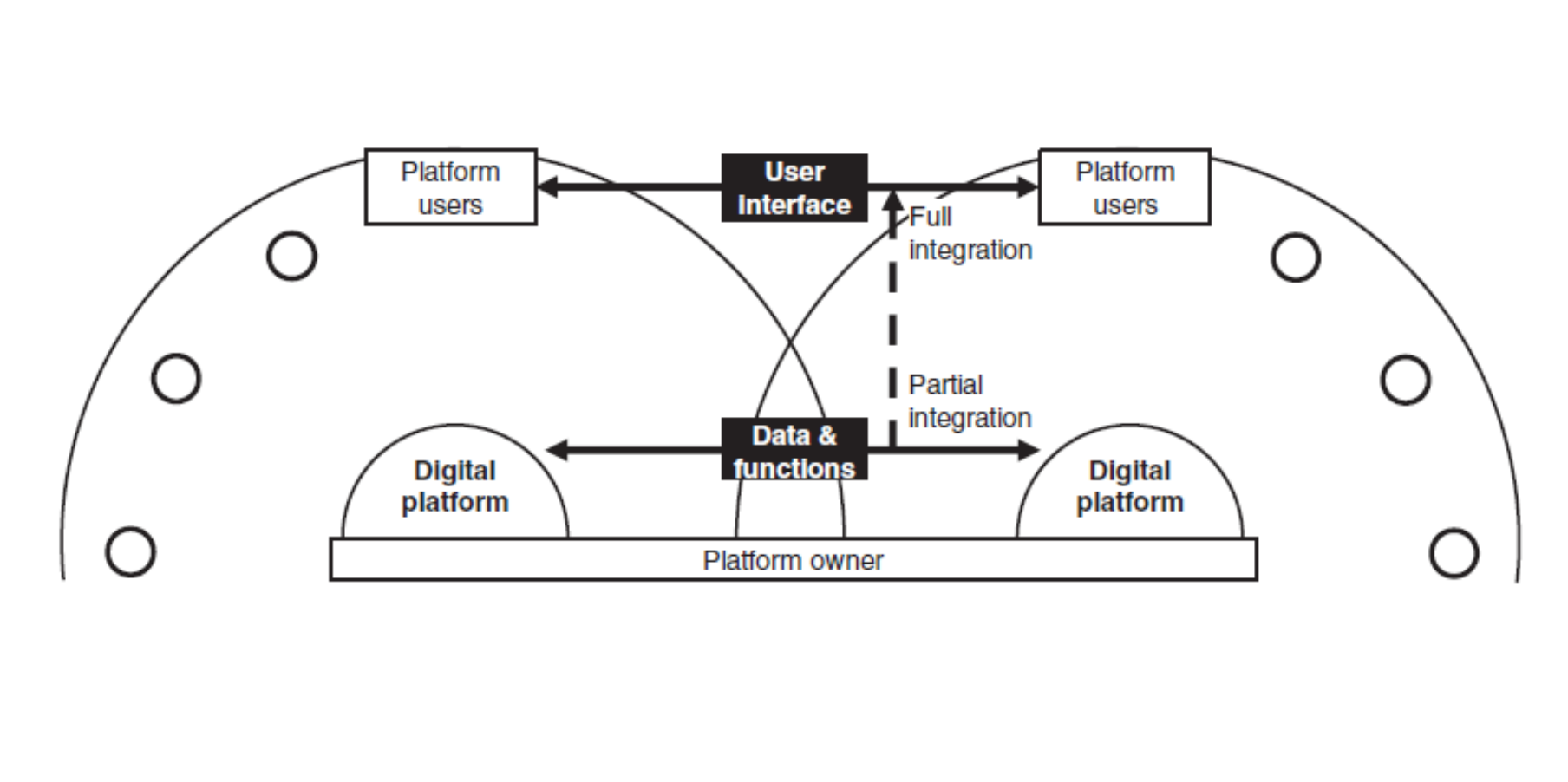
Entend of Integration:
Partial Integration:
Connected via APIs
Invisible for users
Shared data & functions
Example: Facebook Messenger & WhatsApp
Full integration:
Shared UI, data & functions
Visible for users
Example: Grab
Name the four Strategies of Multi-Platform Integration Strategies.
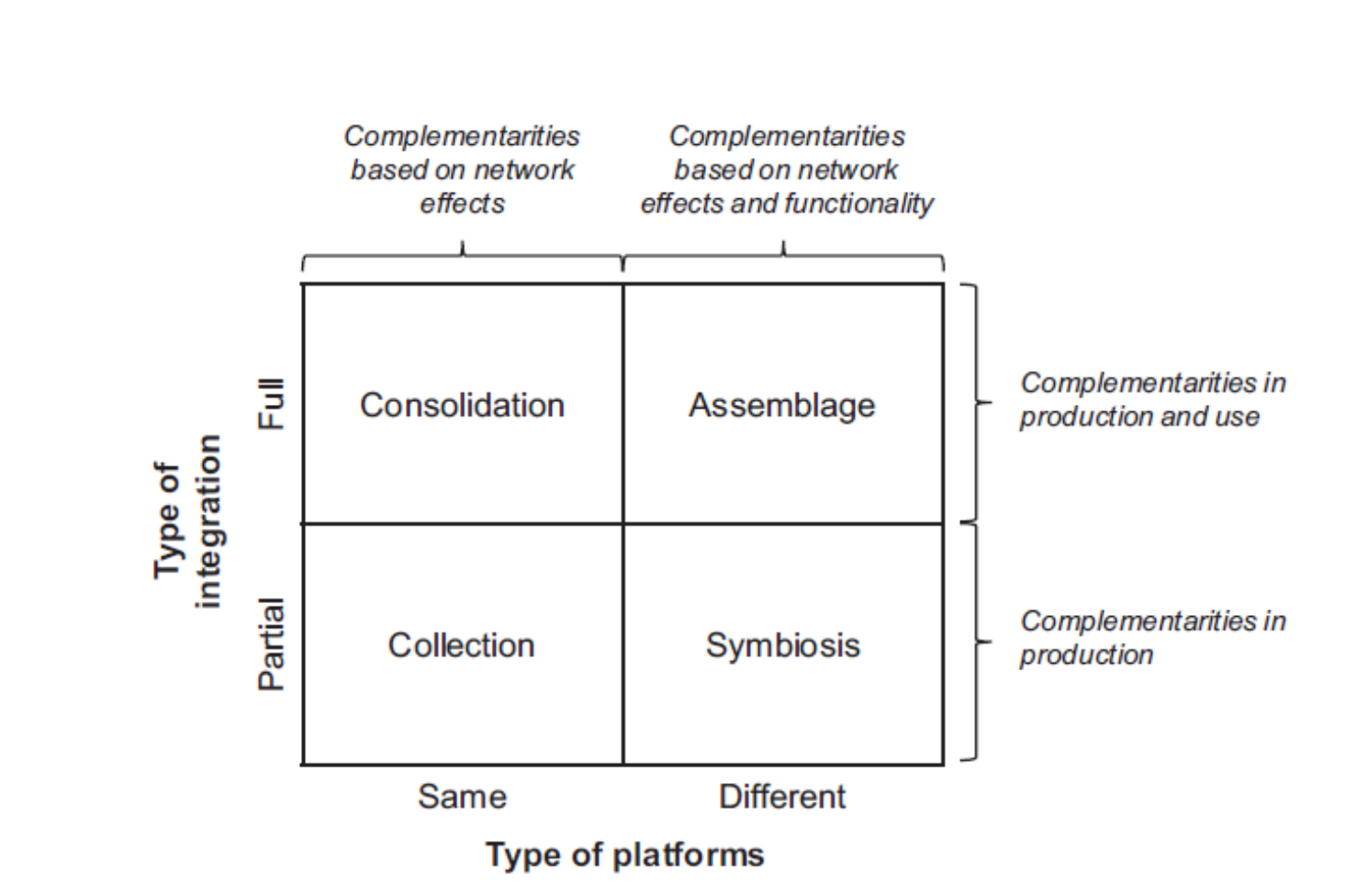
Collection
Consolidation
Symbiosis
Assemblage
→ Strategies are used to get complementarities by integrating multiple platforms into multi-platform ecosystems
Describe the four strategies of Multi-Platform Integration Strategies. In doing so, address the two dimensions used to define the strategies.
Collection: Same Platform Type + Partial Integrated
Complementarities: based on network effects and in production
More users & shared modules improve efficiency and quality
e.g. Adevinta (Collection of kleinanzeige, Subito, Kijiji)
Consolidation: Same Platform Type + Full Integrated
Complementarities: based on network effects and in production and use
Multiple similar platforms combined for convenience
e.g. Amazon Prime ( Consolidation of Marketplace, Video, Music)
Symbiosis: Different Platform Type + Partial Integrated
Complementarities: based on network effects and functionality and in production
Shared insights & ressources
e.g. SAP´s cloud platform and SAP Community
Assemblage: Different Platform Type + Full Integrated
Complementarities: based on network effects and functionality and in production and use
Combines community, innovation & transaction platforms
e.g. Facebook
What are cmplementarities based on network effects or/ and functionality and complementarities in production and/or use?
Complementarities based on network effects:
Users of one platform increase value of another (e.g. Facebook, Instagram: Messenger → Shared Users)
Complementarities based on functionality:
Different Platforms provide different capabilities)
Complementarities in production:
Platforms share technology, infrastructure, employess to lower production costs
Complementarities in use:
Users gain more value by using several services together
Define Inter-Platform Ecosystems and why they are used.
= Different platforms are becoming complementors for each other (Platform themselves also become complementors)
to boost cross-platform interactions and reduce searching costs and referral traffic
Name and explain the four strategies for building inter-platform ecosystems.
Meta-Platform:
Platforms that sit “on top” of others to aggregate them
e.g. Skyscanner (bundles Airlines)
Network Fusion:
Hosting content from a different competing platform
e.g. Wizzair/Booking.com (booking a hotel directly through a flight app
User-Community-Driven Cross-Platform Interactions:
Users create connections between platforms
Users of one platform discuss features/offers from another
e.g. Discord and Twich
Platfrom Concatenation:
Platform refers users to another platform for complementary services
e.g. Trip Advisor