Med I: Immunology Overview
 Call Kai
 Learn
Learn Practice Test
 Spaced Repetition
 Match
Match Flashcards
 Knowt Play
1/8

There's no tags or description
Looks like no tags are added yet.
Name | Mastery | Learn | Test | Matching | Spaced | Call with Kai | Chat |
|---|
No analytics yet
Send a link to your students to track their progress
9 Terms
Function Immune system
PREVENT or limit infections through a variety of defenses
Components of immune system
Both:
• NK T cell
• y6 T cell
Innate components:
COMPONENTS
• DENDRITIC CELL
• MAST CELL
• MACROPHAGE
• GRANULOCYTES (NK cell, Complement protein, basophil, eosinophil, neutrophil)
Adaptive components:
• B-CELLS AND T-CELLS
• ANTIBODY MEDIATED AND T-CELL MEDIATED IMMUNITY
first line of defense: barrier formed by intact skin and mucous membranes
second line: rapidly detect foreign material and destroy harmful agents
above are active before infectious exposure (INNATE)
third line: targeted defense that is specific for individual infectious agents
cell-mediated arm (T lymphocytes) and humoral arm (circulating factors, antibodies and cytokines)
above is the ADAPTED (aquired). takes time to become fully functional
Innate Immunity
nonspecific defenses that are encoded in genes prior to exposure to microbes
Rapid (w/in min) NO MEMORY
ex
cell mediated (NK natural killer cells, macrophages)
humoral (antibodies produced by B cells)
Functions
killing invaders and activating adaptive immunity
another imp function is to heal damaged tissue and clear away dead cells in a way that doesn’t harm body
barriers (e.g. skin and mucous membranes)
Adaptive Immunity
Highly specific
slow- requires several days before becoming affective
T-cells (cell-mediated immunity) VS B-cells (/humoral/antibody-mediated immunity)
B and T lymphocytes
Adaptive Immunity
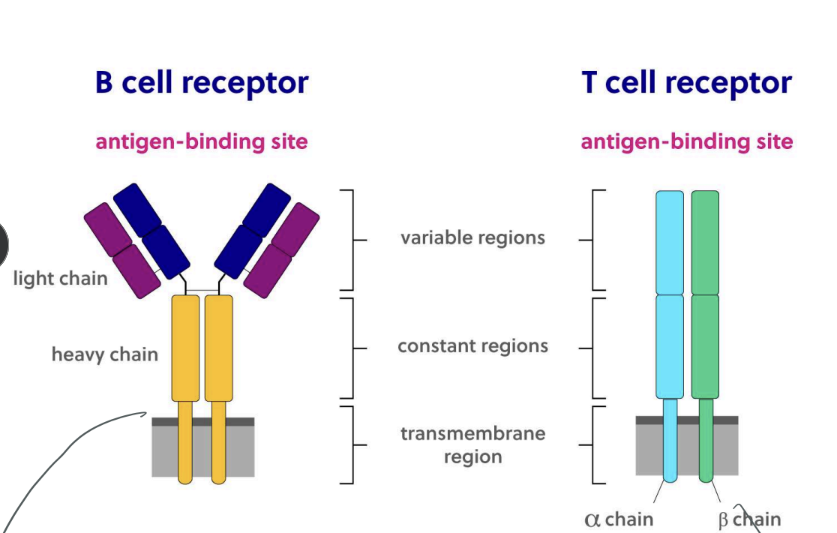
Features of B cell
• humoral mediated immunity
• cell surface receptors for pathogens are immunoglobulins (each B cell expresses a single type of B cell receptor)
• mature in bone marrow into plasma cells (plasma cells secrete antibodies against pathogens)
• play a role in presenting antigens and cytokine secretion
Features of T cells
• Cell mediated immunity
cell surface receptors for pathogens are T cell receptors (each T cell expresses single type of T cell receptor)
• mature in the thymus
• rely on MHC
• named by CD markers on their surface
Active Immunity
host immune response induced after contact with foreign antigens (e.g., microorganisms)
can occur through infection or an immunization with microbial toxins or antigens
resistance is long-term through formation of memory
Natural → Infection
ex. chickenpox
disadvantage: possibly fatal
Artificial → Vaccination
ex. vaccine
disadvantage: not immediate reactions to vaccine
Passive Immunity
Given in the form of immune components that were preformed in another person or animal in response to a specific antigen
advantage of fast availability of large amts of antibody. however, short durability
Natural → Maternal antibodies
Artificial → Monoclonal antibodies (lab-made protiens)
Immunogen
Substance that is able to provoke an adaptive immune response if injected on its own (means that the molecule is immunogenic)
Types
Antigen: immunogenic; any substance that body can recognize as foreign and use to trigger immune response
Haptens: small molecule that can react with specific antibody. cannot start an immune response on its own. Only when covalently bound to a “carrier protein
Adjuvants: Enhance the immune response to an immunogen, but do so without binding to antibody or to the immunogen
ex. can act by causing slow release of immunogen, prolonging stimulus etc
Immunity in Age
Newborn
not born with fully developed natural barriers
• IgG and IgA production begins AFTER birth reaches productivity at 1 year
• baby relies on maternal IgG (crosses placenta and would over before birth) and IgA secreted into breast milk
• vaccine schedules are not a guess. timed carefully so that baby can mount an effective response
Elderly
• lose immunity over time
• related to thymus atrophy and the loss of new T cells that can recognize new antigens
• can blunt responses to infection as well as vaccines
• Immunoscenescene - again immune system; ntural and gradual change to immune system as ppl age. body mount weaker response