MedChem for dyspepsia, GERD and PUD
 Call Kai
 Learn
Learn Practice Test
 Spaced Repetition
 Match
Match Flashcards
 Knowt Play
1/21

There's no tags or description
Looks like no tags are added yet.
Name | Mastery | Learn | Test | Matching | Spaced | Call with Kai | Chat |
|---|
No analytics yet
Send a link to your students to track their progress
22 Terms
Chemistry of antacids
CaCo3 + 2HCl ----> CaCl2 + H2O + CO2
physical interaction to neutralize stomach pH
H2-Receptor Antagonists (H2RA)
reduce acid secretion by blocking the actions of histamine and gastrin
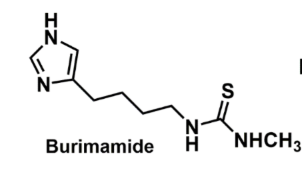
Burimamide
not orally active in acidic pH of the stomach
pharmacophore: thiourea
side effects like decreasing WBC
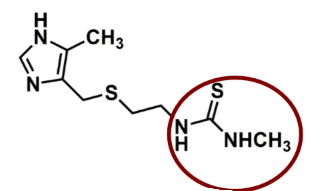
Metiamide
stable in the acidic pH of the stomach
pharmacophore: thiourea
side effects like decreasing WBC
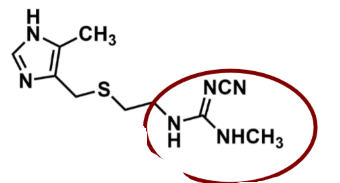
Cimetidine
stable in the acidic pH of the stomach
pharmacophore:
guanidino - does not have the side effects of decreasing WBC, contains an EWG that enhances binding affinity
imidazole - causes it to inhibit CYP450 enzymes
contains double bonds - sensitive to light
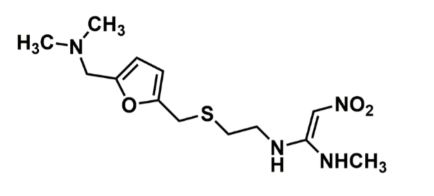
Ranitidine
stable in the acidic pH of the stomach
pharmacophore:
guanidino - does not have the side effects of decreasing WBC, contains an EWG that enhances binding affinity
furan- weaker interactions with CYP450 so fewer drug-drug interactions
contains double bonds - sensitive to light
5x more potent and selective vs cimetidine
tertiary amine off of furan ring will carry a positive charge and allow for H-bonding with Asp
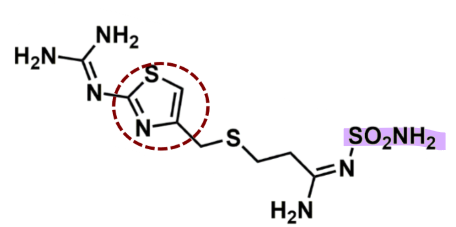
Famotidine
pharmacophore: thiazole
does not interact with CYP450 enzymes
risk of sulfa-allergies
contains EWG - very potent binding affinity
contains double bonds- sensitive to light
20x more potent and selective vs cimetidine
longer duration or action
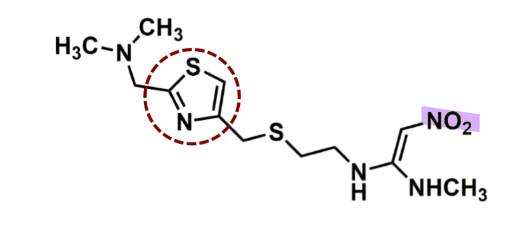
Nizatidine
pharmacophore: thiazole
does not interact with CYP450 enzymes
contains EWG - very potent binding affinity
contains double bonds- sensitive to light
excellent bioavailability
SAR of H2RAs
heterocyclic ring essential
5 member > 6 member
sulfur atom in side chain provides oral bioavailability (vs. carbon or oxygen)
terminal EWG provides optimum binding affinity
5 atom separation is best for binding affinity
Steps for PPI in vivo bioconversion
all prodrugs!
at acidic pH of stomach protonation of pyridine nitrogen
can then also get a protonated benzimidazole ring additionally
will then get protonation of imidazole nitrogen II
convert to active metabolite - cyclic “sulfenamide”
binds covalently to H+/K+ ATPase
also inhibit CYP2C19 and CYP2C9
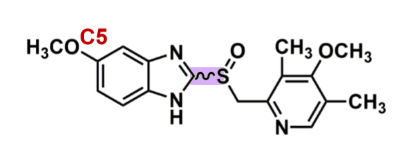
Omeprazole
pharmacophore: benzimidazole
racemic mixture
C5 = EDG - increase nucleophilicity and allow for protonation
Pyridine: substituents are EDG - increase nucleophilicity and allow for protonation
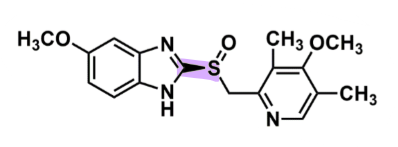
Esomeprazole
pharmacophore: benzimidazole
(S)- enantiomer of omeprazole
better oral bioavailability vs racemic mixture
C5 = EDG - increase nucleophilicity and allow for protonation
Pyridine: substituents are EDG - increase nucleophilicity and allow for protonation
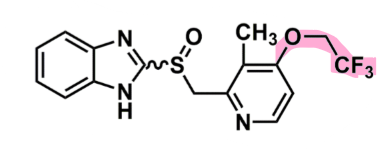
Lansoprazole
pharmacophore: benzimidazole
racemic mixture
superior oral bioavailability among PPIs
Pyridine: substituents EWG (trifluoroethoxy)- decrease nucleophilicity and less likely to protonate
most potent inhibitor
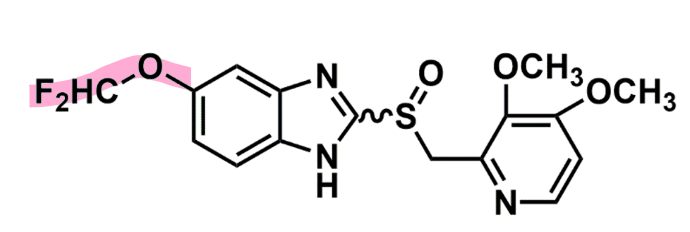
Pantoprazole
pharmacophore: benzimidazole
racemic mixture
C5 = EWG - decrease nucleophilicity and slow to protonate
Pyridine: substituents are EDG
C5 is dominant in considering the time to proteinate
slower conversion to active compared to the other PPIs
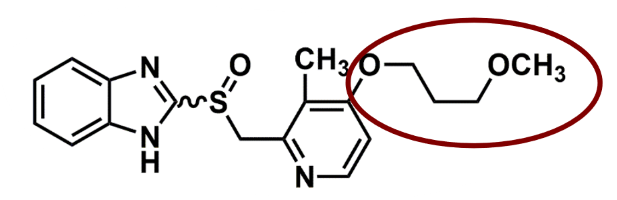
Rabeprazole
pharmacophore: benzimidazole
racemic mixture
Pyridine: substituents are EDG (methoxypropoxy) - increase nucleophilicity and allow for protonation
fast conversion to active compared to the other PPIs
SAR of PPIs
benzimidazole provides optimum activity
R4 with EDG favour good activity
sulfoxide between the ring structures is essential for activity
pyridine provides optimum activity
R2/R3 with EDG are favoured
R1 with EDG is favoured (OCH3 is optimum activity)
C6 and N1 substitution leads to loss of activity
PPIs and clopidogrel interaction
clopidogrel is a prodrug and requires metabolism by CYP2C19
PPIs can interfere with bioactivation and therapeutic effect b/c it can inhibit to CYP2C19
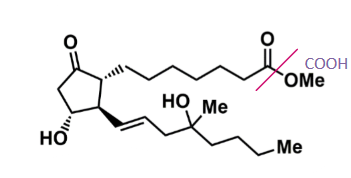
Misoprostol
prodrug
ester converts to carboxylic acid
prostanoid derivative (PGE1 derivative)
undergoes phase II conjugation - short half-life
Sucralfate
sucrose derivative
contains sulfates linked to aluminum hydroxide (neutralize HCl)
contains glycosidic bond - not stable at acidic pH
forms a protective layer
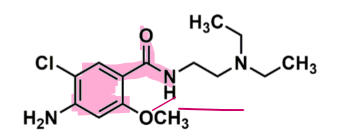
Metoclopramide
pharmacophore: benzamide
can perform H-bonding
methoxy group important for binding affinity
tertiary amine is very lipophilic so can get into CNS
5-HT4 agonist and D2-antagonist
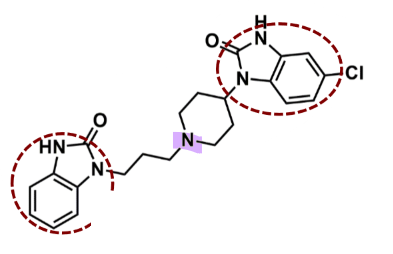
Domperidone
pharmacophore: benzimidazole
very polar - so won’t cross BBB
D2 and D3 antagonist
reduced CNS effects relative to metoclopramide
N in 6 member ring will also become charged