pathology
 Call Kai
 Learn
Learn Practice Test
 Spaced Repetition
 Match
Match Flashcards
 Knowt Play
1/7

There's no tags or description
Looks like no tags are added yet.
Name | Mastery | Learn | Test | Matching | Spaced | Call with Kai | Chat |
|---|
No analytics yet
Send a link to your students to track their progress
8 Terms

Fever = IL-1, IL-6, TNF
No appetite = TNF
Acute phase = IL-6
Positive = CRP, Ferritin, Fibrinogen, SAA, Hepcidin
Negative = Albumin, Transferrin, Transthyretin
Anti-inflammatory = IL-10
Fibrosis = TGF-β
T-cell = IL-7
Eosinophil = IL-5
Neutrophil = IL-8
Ménétrier = TGF-α
Myeloma = IL-6
और सबसे important 3-number trick:
5 → Eosinophil
7 → T-cell
8 → Neutrophil
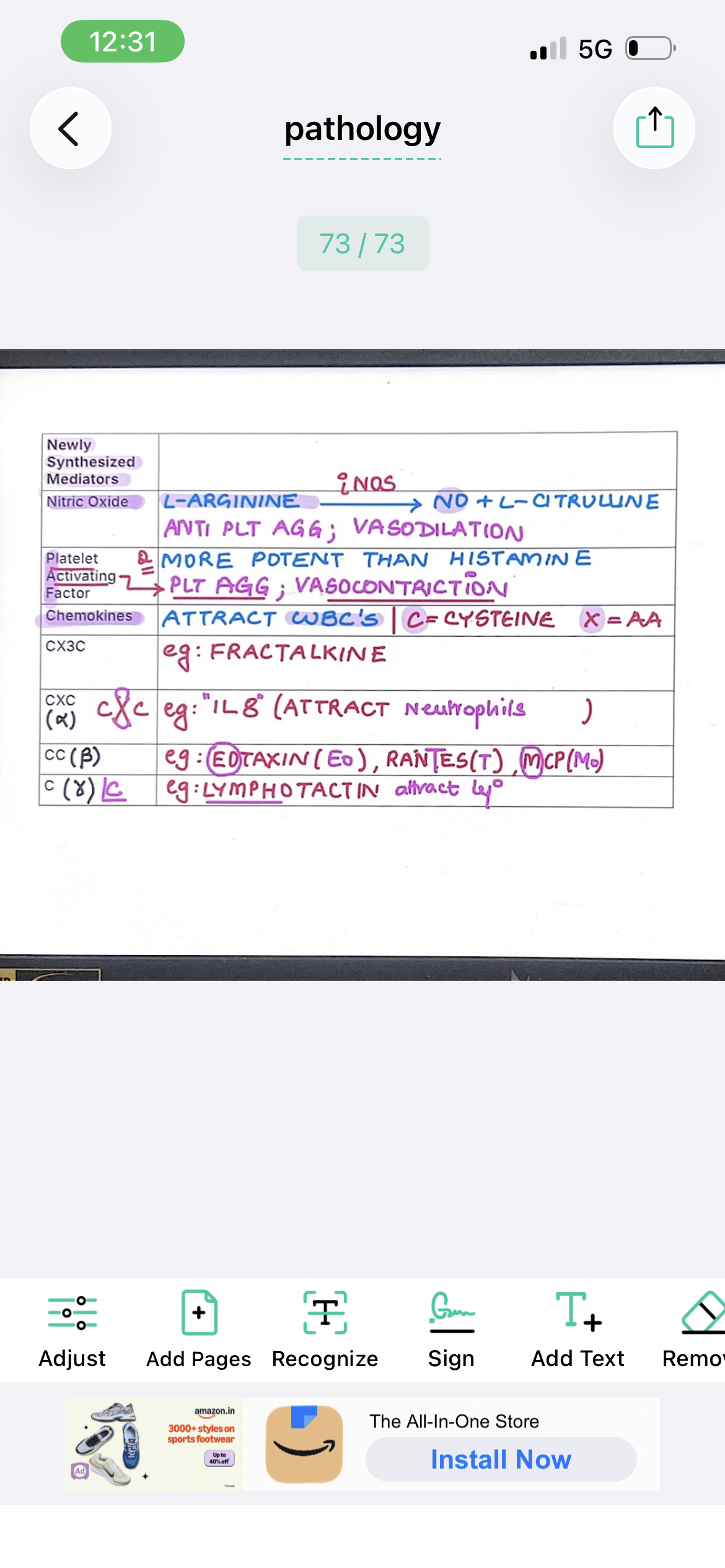
Nitric oxide , pAF lysosomal enzyme
Dominant negative
Fibrillin elastin in marfan syndrome
Carcinoma → Lymphatics
Exceptions (Blood): RCC, HCC, Follicular thyroid carcinoma, Choriocarcinoma.
Sarcoma → Blood
Exceptions (Lymph nodes): Rhabdomyosarcoma, Synovial sarcoma.
CSF spread: Medulloblastoma (drop metastasis).
Pseudomyxoma peritonei: Usually mucinous appendix tumor.
Blumer shelf: Stomach cancer deposits in the pouch of Douglas/rectovesical pouch.
Krukenberg tumor: Stomach → bilateral ovaries, signet-ring cells.
⭐ 30-second Revision
PDGF/PDGFR → Astrocytoma
HST → Osteosarcoma
HGF (Scatter factor) → HCC
EGFR (ERBB1) → Lung adenocarcinoma → Erlotinib
HER2 (ERBB2) → Breast carcinoma → Trastuzumab
RET → MEN2 + Medullary thyroid carcinoma
RET loss → Hirschsprung disease
KIT = CD117 → GIST, AML, Mastocytosis, Melanoma, Seminoma
Easy (1–10)
Q1. PDGF-β mutation is classically associated with:
A. Glioblastoma/Astrocytoma
B. Osteosarcoma
C. HCC
D. Breast carcinoma
Q2. PDGFR-β mutation is seen in:
A. Astrocytoma
B. Melanoma
C. Seminoma
D. AML
Q3. HST gene mutation is associated with:
A. Osteosarcoma
B. HCC
C. Lung adenocarcinoma
D. MEN2
Q4. HGF is also called:
A. Stem cell factor
B. Scatter factor
C. Colony stimulating factor
D. VEGF
Q5. HGF mutation is associated with:
A. HCC
B. Breast carcinoma
C. GIST
D. Astrocytoma
Q6. EGFR (ERBB1) mutation is classically seen in:
A. Lung adenocarcinoma
B. Breast carcinoma
C. Osteosarcoma
D. Melanoma
Q7. Drug used against EGFR mutation:
A. Trastuzumab
B. Erlotinib
C. Imatinib
D. Rituximab
Q8. HER2 is also known as:
A. ERBB1
B. ERBB2
C. RET
D. KIT
Q9. HER2 amplification is classically seen in:
A. Breast carcinoma
B. Lung carcinoma
C. HCC
D. AML
Q10. Drug used against HER2:
A. Erlotinib
B. Trastuzumab
C. Imatinib
D. Gefitinib
Moderate (11–18)
Q11. RET proto-oncogene mutation causes:
A. MEN 2
B. MEN 1
C. NF1
D. VHL
Q12. Medullary carcinoma thyroid is associated with:
A. KIT
B. RET
C. HER2
D. HGF
Q13. RET mutation is seen in:
A. MEN 2A
B. MEN 2B
C. Familial medullary thyroid carcinoma
D. All of the above
Q14. Loss of function of RET causes:
A. Hirschsprung disease
B. Neurofibromatosis
C. Li-Fraumeni
D. Beckwith-Wiedemann
Q15. CD117 is another name for:
A. HER2
B. KIT
C. RET
D. EGFR
Q16. Which tumor is classically KIT positive?
A. GIST
B. Breast carcinoma
C. Astrocytoma
D. HCC
Q17. Which leukemia expresses CD117?
A. AML
B. CML
C. ALL
D. CLL
Q18. Mastocytosis is associated with mutation of:
A. KIT
B. HER2
C. RET
D. HGF
FMGE Tricky (19–25)
Q19. KIT mutation is also seen in:
A. Melanoma
B. Seminoma
C. GIST
D. All of the above
Q20. Match correctly:
A. EGFR → Trastuzumab
B. HER2 → Erlotinib
C. HER2 → Trastuzumab
D. RET → Erlotinib
Q21. Which growth factor is called Scatter factor?
A. PDGF
B. HGF
C. VEGF
D. FGF
Q22. Which oncogene is mutated in osteosarcoma?
A. HST
B. KIT
C. HER2
D. RET
Q23. Which one is NOT associated with KIT/CD117?
A. GIST
B. AML
C. Mastocytosis
D. Breast carcinoma
Q24. Which receptor belongs to the ERBB family?
A. EGFR
B. HER2
C. Both A & B
D. RET
Q25. Which of the following pair is incorrect?
A. HER2 → Breast carcinoma
B. EGFR → Lung adenocarcinoma
C. RET → MEN2
D. HGF → Osteosarcoma
⭐ Bonus FMGE One-liners (Very High Yield)
EGFR drug = ________
HER2 drug = ________
KIT = CD ________
HGF = ________ factor
RET loss of function = ________ disease
Which mutation is classically seen in astrocytoma?
Which growth factor is also known as Scatter factor?
Which mutation is associated with osteosarcoma?
Which receptor is ERBB1?
Which receptor is ERBB2?
Drug used for EGFR-mutated lung adenocarcinoma?
Drug used for HER2-positive breast carcinoma?
Which proto-oncogene is mutated in MEN2?
Loss of function of RET causes which disease?
Another name of KIT?
Name any four tumors associated with KIT mutation.
Which tumor is the classic board exam association with CD117 positivity?
Super High-Yield FMGE Integrated Questions
Q13. A woman has HER2-positive breast cancer. Which targeted drug is preferred?
Q14. A non-smoker has lung adenocarcinoma with EGFR mutation. Best targeted therapy?
Q15. A child has chronic constipation due to absence of enteric ganglion cells. Which gene is mutated?
Q16. Which mutation is common in medullary carcinoma thyroid?
Q17. Which immunohistochemical marker is positive in GIST?
Q18. Which receptor tyrosine kinase mutation is seen in mastocytosis?
Q13. A woman has HER2-positive breast cancer. Which targeted drug is preferred?
✅ Answer: Trastuzumab
Why?
HER2 = ERBB2
HER2-positive breast cancer → Trastuzumab (monoclonal antibody)
FMGE Pearl:
HER2 → Breast carcinoma → Trastuzumab
Q14. A non-smoker has lung adenocarcinoma with EGFR mutation. Best targeted therapy?
✅ Answer: Erlotinib
(Other EGFR inhibitors include Gefitinib, Afatinib, Osimertinib, but your notes specifically mention Erlotinib.)
FMGE Pearl:
EGFR (ERBB1) → Lung adenocarcinoma → Erlotinib
Q15. A child has chronic constipation due to absence of enteric ganglion cells. Which gene is mutated?
✅ Answer: RET (Loss-of-function mutation)
Disease: Hirschsprung disease
⚠ Remember:
RET Gain-of-function → MEN2, Medullary thyroid carcinoma
RET Loss-of-function → Hirschsprung disease
This is a favorite FMGE concept.
Q16. Which mutation is common in medullary carcinoma thyroid?
✅ Answer: RET proto-oncogene mutation (Gain-of-function)
Associated with:
MEN 2A
MEN 2B
Familial Medullary Thyroid Carcinoma (FMTC)
Q17. Which immunohistochemical marker is positive in GIST?
✅ Answer: CD117 (KIT/c-KIT)
FMGE loves asking this directly.
Remember:
GIST = CD117 positive
Q18. Which receptor tyrosine kinase mutation is seen in mastocytosis?
✅ Answer: KIT (CD117/c-KIT)
KIT mutation is also associated with:
GIST
AML
Mastocytosis
Melanoma
Seminoma
Q1. A patient with lung cancer develops hypercalcemia due to PTHrP. Which type of lung cancer?
Answer: Squamous cell carcinoma.
Q2. A patient with lung cancer has severe hyponatremia due to ectopic ADH secretion. Diagnosis?
Answer: Small cell carcinoma.
Q3. Which lung cancer is associated with ectopic ACTH causing Cushing syndrome?
Answer: Small cell carcinoma.
Q4. An elderly patient has sudden velvety hyperpigmentation in the axilla and neck. Which malignancy should be suspected?
Answer: Gastric carcinoma.
Q5. A patient has recurrent migratory superficial thrombophlebitis (Trousseau syndrome). Which cancer is classically associated?
Answer: Pancreatic adenocarcinoma.
Glioblastoma
Adult + Butterfly glioma + Grade IV + Pseudopalisading necrosis + Glomeruloid vessels + IDH wild type + Poor prognosis
Craniopharyngioma
How they can ask
Q1. Child with visual disturbance + headache; suprasellar tumor. Most likely?
👉 Craniopharyngioma
Q2. Craniopharyngioma arises from remnants of:
👉 Rathke’s pouch
Q3. Histological finding characteristic of craniopharyngioma?
👉 Wet keratin ⭐
Q4. Another characteristic histological feature?
👉 Peripheral palisading + stellate reticulum
Q5. Gross appearance of craniopharyngioma containing cystic material?
👉 “Machine-oil” fluid ⭐⭐⭐
Super-short memory
Prion disease
CJD → 14-3-3 + periodic sharp waves + myoclonus + dementia
KURU → cannibalism + kuru plaques
SCRAPIE → sheep/goat
BSE → cow → vCJD
PRION → PrPᶜ → PrPˢᶜ → spongiform brain