chapter 2
 Call Kai
 Learn
Learn Practice Test
 Spaced Repetition
 Match
Match Flashcards
 Knowt Play
1/296

There's no tags or description
Looks like no tags are added yet.
Name | Mastery | Learn | Test | Matching | Spaced | Call with Kai | Chat |
|---|
No analytics yet
Send a link to your students to track their progress
297 Terms
Matter
has mass and occupies space
3 forms: solid, liquid, gas
Atom
the smallest particle exhibiting chemical properties of an element
composed of 3 subatomic particles (neutrons, protons, electrons)
Element
92 naturally occurring __ make up matter
organized in periodic table
usually occur as a mixture of isotopes
Most common elements of the human body (99% of weight)
most
Oxygen
Carbon
Hydrogen
Nitrogen
Calcium
Phosphorus
least
*Oh, Can Harry Not Cook Pasta
Minor elements of the human body (less than 1% of weight)
most
Sulfur
Potassium
Sodium
Chlorine
Magnesium
Iron
least
SPS CMI
atomic mass unit (amu)
a standard unit used to measure the mass of atoms and molecules
1 amu = one-twelfth (1/12) of the mass of a single carbon-12 atom.
Subatomic particles
protons
neutrons
electrons
what differentiate these: mass & charge
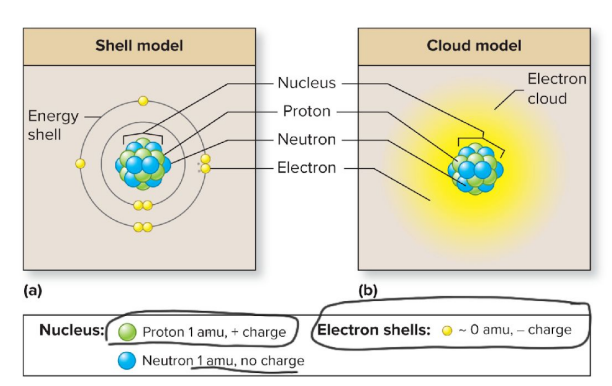
Neutrons
mass of 1 amu
no charge

Protons
mass of 1 amu
positive charge of one (+1)
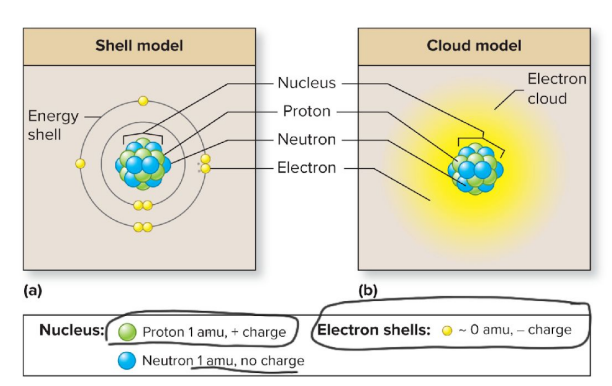
Electrons
0 amu
1/1800th of the mass of a proton or neutron
negative charge of one (-1)
located at varying distance from the nucleus in regions called orbitals (energy shells) or as an __ cloud
# of __ is determined by atomic number
since all atoms are neutral, the # of negatively charged _ must sequal the # of positively charged protons
Chemical symbol
unique to each element
usually identified by first letter, or first letter + additional letter (C = carbon)
Atomic number
number of protons in an atom of the element
located above symbol name
elements arranged by __ __ within rows
Average atomic mass
mass of both protons + neutrons
shown below the elements symbol on the table
Determining the # of subatomic particles
proton # = atomic number
neutron # = atomic mass - atomic number
neutron # = (p+n) - p
for ex, neutron # of Na = 23 - 11 = 12
electron number = proton #
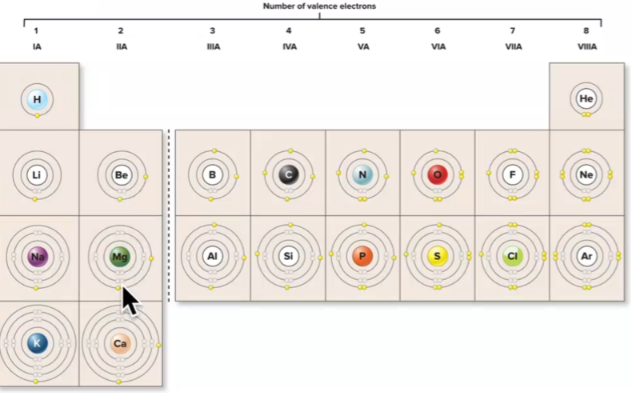
Cation
positively (+) charged ions
formed by loosing electrons
from atoms with 1,2, or 3 electrons in their outer shell
elements in columns IA, IIA, or IIIA, in periodic table (left side)
“cats are pawsitive”
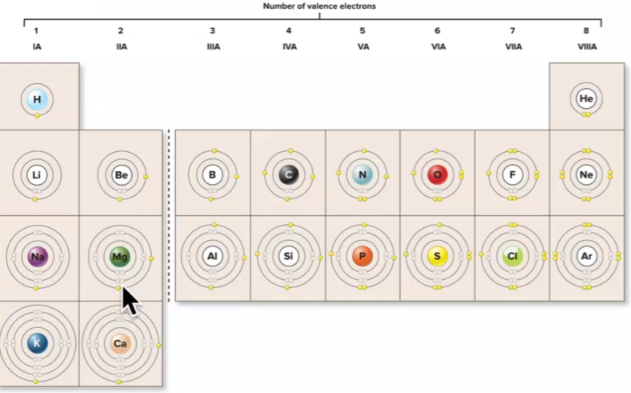
Anions
negatively (-) charged ions
formed by gaining electrons
by atoms typically with 5, 6, or 7 electrons in the outer shell
elements in columns VA, VIA, or VIIA (noble gases) in periodic table (right side)

Left side of periodic table
loose /donate electrons (to form a completie valence shell)
form cations when they react
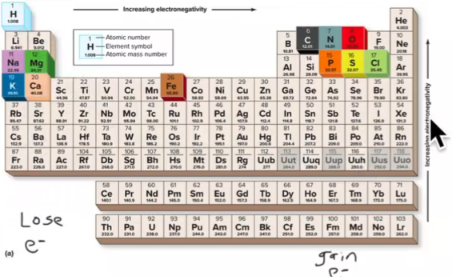
Right side of periodic table
gain electrons (to form a completie valence shell)
form anions when they react
Anomalies in the period table
iron (Fe)
it can form more than 1 type of ion, either a ferrous (Fe²+) or a ferric (Fe³+) ion
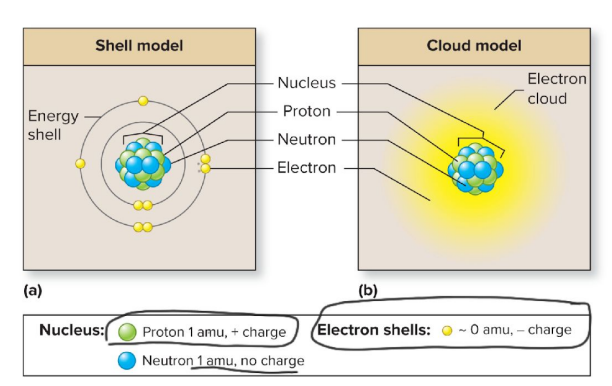
Shells
an atom has __ of electrons surrounding the nucleus
each has given energy level
each holds a limited # of electrons
innermost shell: 2 electrons
second shell: up to 8 electrons
shells close to the nucleus must be filled first
Isotopes
different atoms of the same element
same # of protons & electrons, diff # of neutrons
identical chemical characteristics, diff atomic masses
for ex, carbon exists in 3 isotopes
carbon-12 with 6 neutrons
most prevalent type
carbon-13 with 7 neutrons
carbon-14 with 8 neutrons
weighted average of atomic mass for all isotopes is the average atomic mass
Average atomic mass
the weighted average of the atomic masses of its naturally occurring isotopes
Radioisotopes
unstable forms of an isotope
contain excess neutrons, so unstable
radioactive: release radiation as they decay into a more stable isotope / loose nuclear components in the form of high energy radiation
alpha particles
beta particles
gamma rays
may be traced & quantitfied by the high energy radiation these isotopes emit following their uptake into the body
scintigraphy
nuclear medical imaging procedure whereby a body structures metabolic activity may be assessed with these isotopes
Physical half-life
the time for 50% of radioisotope to become stable
the time it takes for a radioactive isotope to decay by half through nuclear processes,
can vary from a few hours to thousands of years
Biological half-life
the time required for half of the radioactive material from a test to be eliminated from the body
The time required for an organism, such as a human, to excrete or clear 50% of a specific substance.
Nonradioisotopes
stable isotopes
atoms of the same chemical element that have a different number of neutrons but do not break down or emit radiation over time
Radioisotopes introduced into the body during medical procedures
• Used by cells in a similar manner to nonradioisotopes
• Can trace products of metabolic reactions that use these elements
• Thyroid gland darker in areas where less radioactive iodine taken
up
• Can help locate a nodule
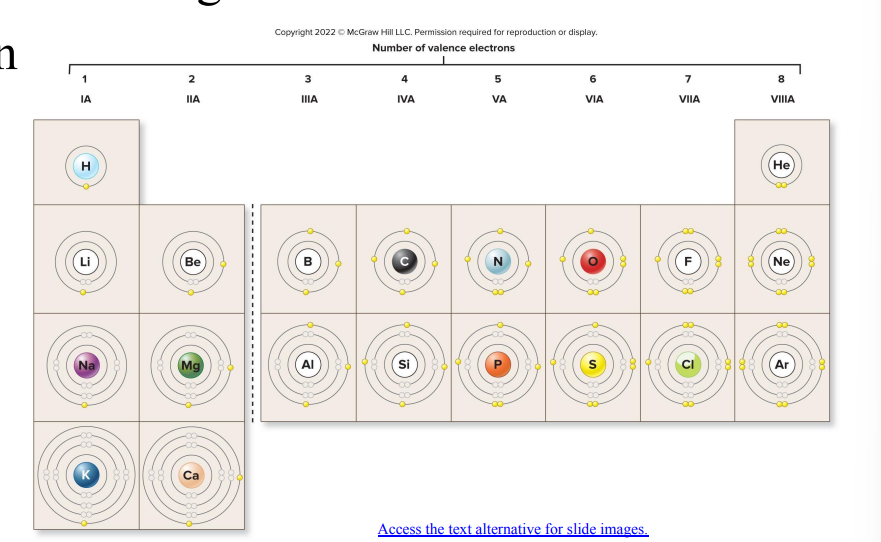
Periodic table organization
organized horizontally across the table based on increasing atomic #
organized into columns based on # of electrons in outer shell (valence shell)
elements tend to lose, gain, or share electrons to obtain complete outer shells with 8 electrons
Column IA all have one electron in their valence shell
hydrogen, lithium, sodium, potassium
each consecutive column has 1 additional electron in valence shell
Column VIIA elements each have a full valence shell
results in chemical stability
helium, neon, etc, chemically inert noble gases
What two subatomic particles determine the mass of an atom?
proton
neutron
What two subatomic particles determine the charge of an atom
proton
electron
Uncharged atom
has an equal number of protons and electrons
Octet rule
atoms are most stable when they have 8 valence electrons (electrons in their outermost shell).
2-8-8 Rule
electron-filling model for how electrons stack into shells (energy levels) around a nucleus
first shell holds up to 2 electrons, the second holds up to 8, and the third temporarily holds up to 8 before spilling over
Chemical compounds
made of two or more different elements joined together by chemical bonds in a fixed ratio / stable associations between 2 or more elements combined in a fixed ratio
classified as ionic or molecular
Ionic compounds
structures composed of ions held together in a lattice by ionic bonds/ electrostatic interactions
ex
sodium chloride (NaCl)
sodium bicarbonate (NaHCO3)
magnesium chloride (MgCl2)
calcium phosphate Ca3(PO4)2
Ions
atoms with a positive charge (cations, loose electrons) or a negative charge (anions, gain electrons)
produced from loss or gain of 1 or more electrons
significant physiological functions
ex of common ones
sodium (Na^+)
calcium (Ca²+)
magnesium (Mg²+)
hydrogen (H^+)
chloride (Cl^-)
bicarbonate (HCO3^-)
phosphate (PO4 ³-)
potassium (K^+)
for ex, K^+ is used in sports drinks to replace the K^+ lost in sweat
K^+ in a large dose is used in some states for lethal injection

Sodium can reach stability by
donating an electron
satisfies ocetet rule
now has 11 protons & 10 electrons
charge is +1 (cation)
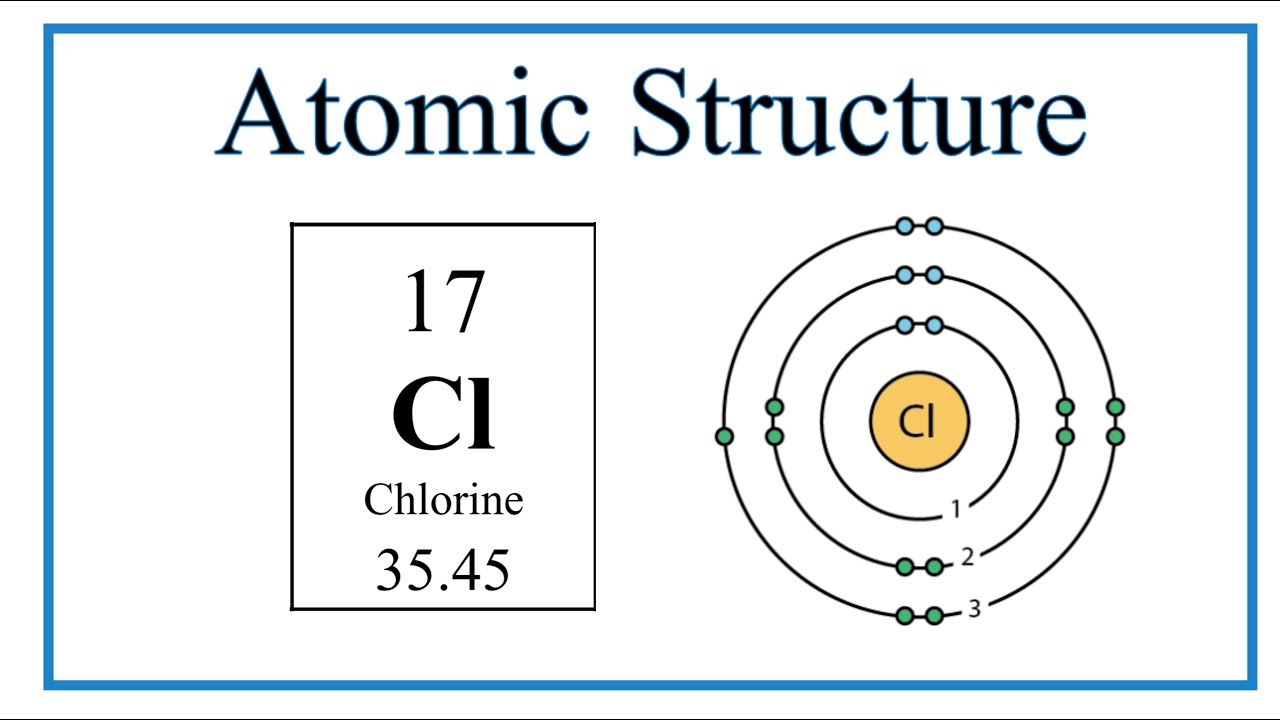
Chlorine can reach stability by
gaining an electron
satisfies octet rule
now has 17 protons & 18 electrons
charge is -1 (anion)
Polyatomic ions
ions with more than 1 atom
for ex, bicarbonate ion (HCO3^-) & phosphate ion (PO4³-)
Intracellular
the liquid found inside cells
more negative
ex. potassium (K^+), phosphate (PO4³-), CO2, protein, magnesium (Mg²+),
“Poke Inside” “Kept inside” “Keep Most Positive” “KPMPC”
Extracellular
the liquid found outside of cells
more positive
ex. sodium (Na^+), calcium (Ca²+), O2, chloride (Cl-), bicarbonate (HCO3^-)
“NaCl is out in the ocean, and we are salty on the outside” / “NaCaClB” “NaClCa + bicarbonate
Common cations
Sodium ion (Na^+)
Potassium ion (K^+)
Calcium Ion (Ca²+)
Magnesium ion (Mg²+)
Hydrogen ion (H^+)
“Silly Penquins Can Make Hugs”
Sodium ion (Na^+)
most common extracellular cation
particpant in conducting electrical signals in nerves & muscle
most important in osmotic movement of water
sodium gradient involved in cotransport of other substances across a plasma membrane
Potassium ion (K^+)
most common intracellular cation
participant in conducting electrical signals in nerves & muscle
role in glycogen storage in liver & muscle
function in pH balance
Calcium Ion (Ca²+)
extracellular
hardens bone & teeth
muscle contraction
exocytosis (including release of neurotransmitter)
blood clotting
second messenger in hormonal stimulation of cells
Magnesium ion (Mg²+)
required for ATP production
Hydrogen ion (H^+)
one proton + one electron
concentration determines pH of blood & other fluids of the body
Common anions
Chloride ion (Cl^-)
Bicarbonate ion (HCO3^-)
Phosphate ion (PO4)
Cheesy Burger Please
Chloride ion (Cl^-)
alters nerve cell responsiveness to stimulation
component of stomach acid (HCl)
___ shift in erythrocytes

Bicarbonate ion
conversion of CO2 gas to HCO3^- which is transported in the blood
buffering of pH in blood
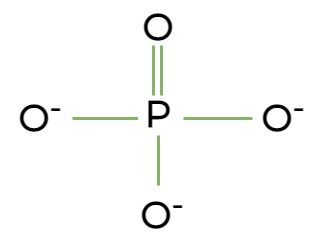
Phosphate ion
as Ca3 (PO4)2 it hardens bone & teeth
component of phospholipids (membranes)
component of nucleotides, including ATP & nucleic acids (DNA, RNA)
most common intracellular anion
intracelular buffer
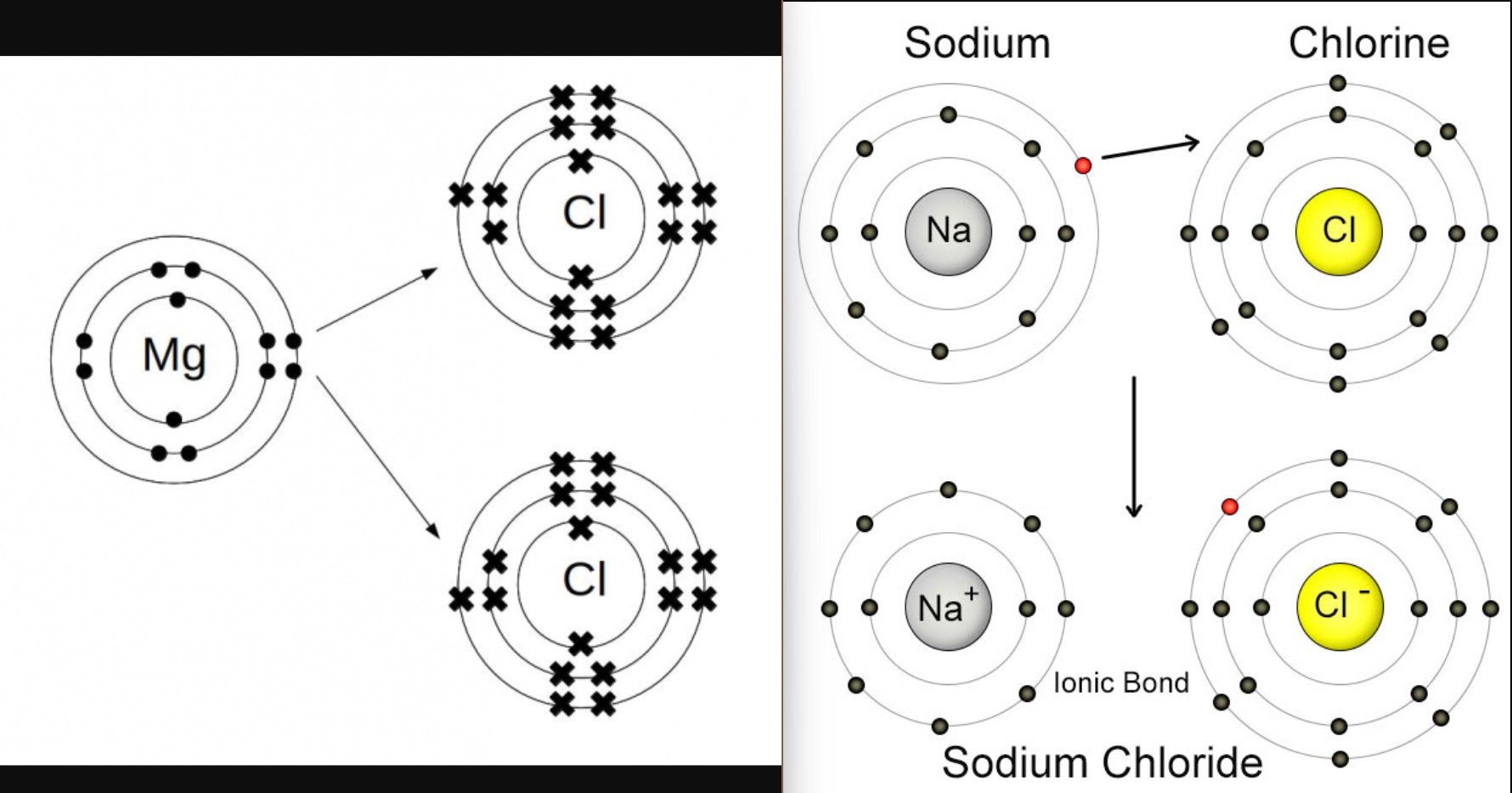
Ionic bonds / Salt bridges
complete transfer of electrons to create charged ions
typically form between a metal & a nonmetal
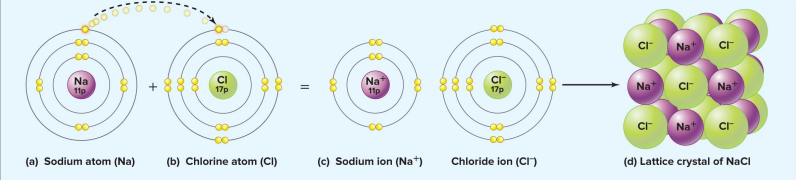
electrostatic attractions between + charged cation & - charged anions that form ionic compounds (lattice crystal/salt)
can form between an R group with a negative charge & an R group with a positive charge
called salts
for ex. table salt (NaCL)
each sodium atom looses 1 outer shell electron to a chlorine atom
soidum & chlorine ions are held together by ionic bonds in a lattice crystal structure (ionic compound)
for ex. magnesium chloride (MgCL2)
each magnesium atom loses 1 electron to each of the 2 echlorine atoms
Whats the most common ionic compound in the body?
calcium phosphate Ca3(PO4)
hardens bone & teeth
The elements that form the common ions of the human body (do not include the polyatomic ions
Sodium (Na^+)
Role: Balances body fluids and helps send nerve impulses.
Potassium (K^+)
Role: Regulates heart rhythm and supports muscle contraction.
Calcium (Ca²+)
Role: Builds strong bones, teeth, and triggers muscle action.
Magnesium (Mg²+)
Role: Supports immune function and helps produce energy.
Chloride (Cl^-)
Role: Forms stomach acid and keeps body fluids balanced.
Hydrogen (H^+)
Role: concentration dertermines pH of blood & other fluids of the body
Why ions form based on the octet rule
Atoms form ions by gaining or losing valence electrons to reach a stable, filled outer shell with eight electrons
Metals (Cations): Atoms on the left side of the periodic table have few valence electrons. They lose these electrons to become positively charged ions.
Nonmetals (Anions): Atoms on the right side of the periodic table are close to having a full shell. They gain electrons to become negatively charged ions.
Could an ionic bond form between two cations or between two
anions?
No, Ionic bonds require an electrostatic attraction between particles with opposite charges.
Cations: These are positively charged ions.
Anions: These are negatively charged ions.
they push away from eachother instead of binding,
* like charges repel
Covalently bonded molecule
electrons shared between atoms of 2 or more diff elements
Molecular compound
a chemical substance made of atoms that share electrons through covalent bonds
molecules composed of 2 or more diff elements covalently bonded together
ex. CO2, H2O
GICoS
Give electron = Ionic Bond
Covalent Bonds = Sharing electrons
Molecular formula
indicates # & type of atoms within a molecule
for ex. carbonic acid (H2CO3)
Structural formula
indicates # & type of atoms within a molecule
AND indicates arrangement of atoms within the molecule
for ex. O=C=O (carbon dioxide)
allows differentiation of isomers
same # & type of elements, but arranged differently in space
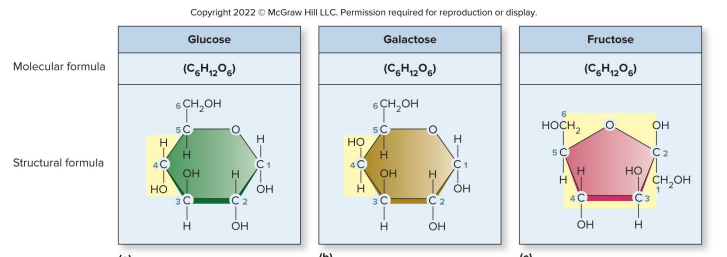
Isomer
same # & type of elements/atoms, but arranged differently in space
may have diff chemical properties
ex. glucose. galactose, fructose
6 carbon, 12 hydrogen, 6 oxygen
atoms arranged differently
Covalent bond
form between nonmetals
atoms share electrons (to fill outer shells) = resulting structure is molecule
may be polar/nonpolar (shared unequally/equally)
determined by electronegativity
occurs when both atoms require electrons to become chemically stable
formed commonly in human body using HONC
are elements that most commonly form __ __ in the human body
stabilize the folding of a protein
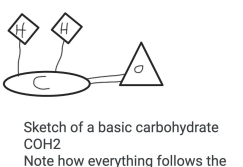
HONC 1,2,3,4
Hydrogen (wants 1 bond)
Oxygen (wants 2 bonds)
Nitrogen (wants 3 bonds)
Carbon (wants 4 bonds)

Single covalent bond
one pair of electrons shared (2)
ex. between 2 hydrogen atoms
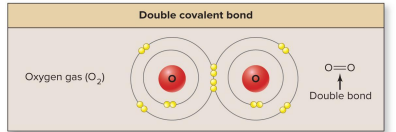
Double covalent bond
two pairs of electrons shared (4)
ex. between 2 oxygen atoms
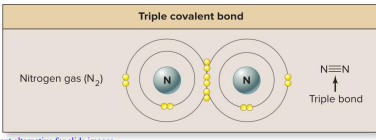
Triple covalent bond
three pairs of electrons shared (6)
for ex, between 2 nitrogen atoms

Carbon Covalent Bonds
wants 4 bonds
Methane (CH4)
Carbion dioxide (CO2)
Ethanol (C2H5OH)
Carbon skeleton
the arrangement of molecules that have numerous carbon atoms bonded together within their chemical structure
the molecules “backbone”
ex.
straight chain
branched chain
rings

Covalent Bonds Carbon skeleton formation
bonds in straight chains, branched chains, or rings
carbon present where lines meet at an angle
additional atoms are only hydrogen
Electronegativity
relative attraction of each atom for electrons
determines how electrons are shared in covalent bonds
determined both by the # of protons in the nucleus (pull on electrons) and the proximity of the valence electron shells to the nucleus
in periodic table __ increases
from left to right across row
from bottom to top in column
* top right is most electronegative
more ___ atom = develops a partial - charge
less ___ atom = develops a partial + charge
written using Greek delta (δ) followed by superscript plus or minus
More electronegative atom
develops a partial negative charge
Less electronegative atom
develops a partial positive charge
Least to greatest electronegativity for 4 most common elements composing living organisms
hydrogen < carbon < nitrogen < oxygen
"Oh, No, Carl’s Here!"
"Have Copy Notes Only”
HNCO

Nonpolar molecules
contain nonpolar covalent bonds / charges pull equally in all directions or if the bonds have no charge difference
however, ___ ___ may contain polar covalent bonds, if the polar covalent bonds cancel each other
ex. carbon dioxide
How to identify
Same elements: Molecules made of only one pure element (like
O2 or N2) share electrons equally
Pure hydrocarbons: Molecules with only carbon and hydrogen (like methane,
CH4) are nonpolar because their atoms share pull evenly.
Symmetry: If the outer atoms are all identical and there are no extra unshared electrons on the middle atom, the pulls cancel each other out (like CO2)

Nonpolar covalent bond
2 atoms of same element have equal attraction for electrons
If two different elements share a nearly identical pull on electrons, the charge stays balanced
the bonded atoms have the same or very similar electronegativity values
difference is 0 to 0.4
any bond with an electronegativity difference under 0.4 as nonpolar
ex. C—C, C—H, O—-O bonds & oxygen (O2), triglyercide (fat), carbon dioxide (CO2)
Nonpolar examples
C—C
O—O
C—H (the exception)
oxygen (O2)
triglyercide
carbon dioxide (CO2) (
because its linear, symmetrical shape causes its individual bond pulls to cancel out
has polar covalent bonds that extend in opposite directions can be __ bc the partial charges cancel each other
hydrocarbons
megthane gas (CH4)
Polar
“Dipole”
a molecule has a separation of electric charge, creating a positive side and a negative side like a tiny magnet
refers to the different “poles” of partial electric charge
“—-” opposites, north & south pole, WATER!!
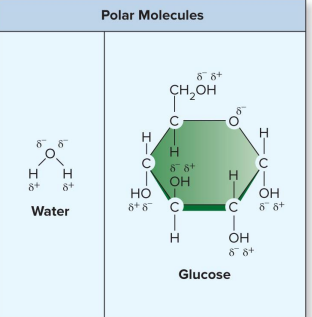
Polar molecules
contain polar covalent bonds / one side pulls harder on electrons than the other, creating a positive side and a negative side
How to identify
Different outer atoms: If the atoms attached to the central atom are different, the pull is uneven (like CH3F)
Lone pairs: If the central atom has leftover unshared pairs of electrons, it bends the shape and makes the molecule lopsided (like water, H2O or ammonia NH3)
Asymmetry: If the shape is uneven, individual bond pulls do not cancel out
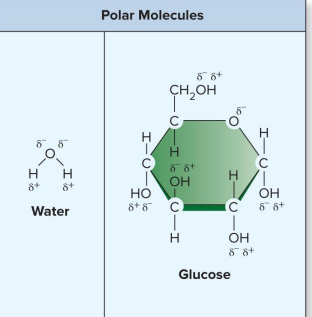
Polar covalent bond
sharing of electrons unequally (between atoms of different elements)
one atom pulls the shared electrons closer because it has a higher electronegativity
difference is 0.5 to 1.7
creates a partial positive and partial negative charge on the molecule.
ex. O—-H (H2O), C—O, N—H, N—O, glucose (C6H12O6), ethanol (C2H5OH), ammonia (NH3)
Polar examples
O—H
C—O
N—H
N—O
water (H2O)
glucose (C6H12O6)
ethanol (C2H5OH)
ammonia (NH3)
carbohydrates
O—H
C—O
N—H
N—O
water (H2O)
glucose (C6H12O6)
ethanol (C2H5OH)
ammonia (NH3)
carbohydrates
hydroxl (-OH)
carboxyl or carboxylic acid (—COOH)
amine (-NH2)
phosphate (PO4 ³-)

Amphipathic molecules
large molecules w both polar & nonpolar regions
form chemical barriers within the body, including membranes & micelles
ex. phospholipids

Intermolecular attractions
weak chemical attractions between molecules
important for shape of complex molecules
for ex, DNA & proteins
unequal charges in nonpolar molecules
electrons orbiting nucleus briefly, unevenly distributed
induce unequal distribution of adjacent atoms of another nonpolar molecule
individually weak, collectively strong
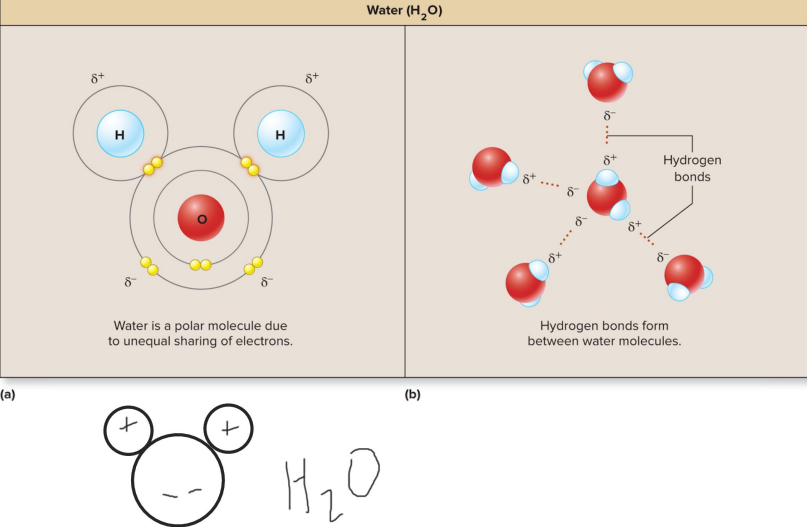
Hydrogen bond
forms between polar molecules (unequal sharing)
electrostatic attraction between a partially positive hydrogen atom & a partially negative atom
individually weak, collectively strong
influences how water molecules behave
Hydrophobic interactions
nonpolar molecules placed in a polar substance
if occurring between parts of large molecule, termed intra molecular attraction
Assign the partial charges between nitrogen and hydrogen (N—H) in a polar covalent bond.
Nitrogen (N): (partial negative)
Nitrogen is highly electronegative (3.04).
Hydrogen (H): (partial positive)
Hydrogen has lower electronegativity (2.20).Nitrogen pulls shared electrons closer.
Identify the exception to the rule that polar covalent bonds are formed between two different types of atoms.
The carbon-hydrogen (C–H) bond
even though they are two different elements, their electronegativity difference is extremely small (about 0.35)
bc this difference is so tiny, they pull on electrons with nearly equal strength
as a result, the C–H bond shares electrons fairly evenly and is treated as a nonpolar covalent bond
Are O2 and CO2 nonpolar or polar molecules? Explain why.
O2: nonpolar
It is a diatomic molecule made of two identical oxygen atoms. Because both atoms have the exact same electronegativity (ability to attract electrons), they share the bonding electrons equally.
CO2: nonpolar
Oxygen is more electronegative (better at attracting electrons) than carbon. Each double bond pulls shared electrons closer to the oxygen atom, creating an individual "bond dipole" (a pull of electrical charge)
Organic molecules
carbon + hydrogen
are (or were) part of a living organism
ex. glucose, proteins, triglyceridedes
Inorganic molecules
all other molecules
ex. water, salts, acids, bases
Water
is polar
1 oxygen atom bonded to 2 hydrogen atoms
oxygen atom has 2 partial negative charges
each hydrogen has 1 single partial positive charge
can form 4 hydrogen bonds with other water molecules
inorganic
universal solvent (esp of the body)
bathes organs in fluid which provides protection & support
plays a major role in bodies chemical reactions
neutral
+ hydrogen ions (H^+) = - hydroxide ions (-OH)
2/3 of body weight

Phases of water
depending on temp
gas (water vapor)
substances with low molecular mass
liquid (water)
almost all water in the body
liquid at room temp due to hydrogen bonding
sold (ice)
Functions of liquid water
transports
substances dissolved in water move easily throughout body
lubricates
decreases friction between body structures
cushions
absorbs sudden force of body movements
excretes wastes
unwanted substances dissolve in water are easily eliminated
Properties of water
cohesion
attraction between water molecules due to hydrogen bonding
surface tension
inward pulling of cohesive forces at surface of water / pull of water molecules at the surface
causes moist sacs of air in lungs to collapse
surfactant, a lipoprotein, prevents collapse
adhesion
attraction between water molecule & a substance other than water
high specific heat
• Amount of energy required to increase temperature of 1 gram of a
substance by 1 degree Celsius
• Water’s value extremely high due to energy needed to break
hydrogen bonds
• Contributes to keeping body temperature constant
high heat of vaporization
• Heat required for release of molecules from a liquid phase into a
gaseous phase for 1 gram of a substance
• Water’s value very high due to hydrogen bonding
• Sweating cools body
• Excess heat dissipated as water evapora
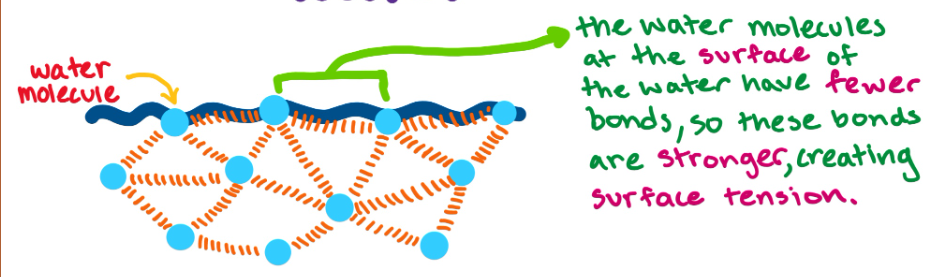
Surface tension
inward pulling of cohesive forces at surface of water / pull of water molecules at the surface
tendency of a liquids surface to resist breaking when placed under stress
bc at the surface water molecules are pulled by hydrogen bonds in only 3 directions whereas water molecules that are internal in the liquid are pulled by hydrogen bonds in 4 directions
causes moist sacs of air in lungs to collapse
surfactant, a lipoprotein, prevents collapse
contributes to the need to produce surfactant & prevent collapse of the alveoli
surfactant
a substance that lowers the surface tension of a liquid, allowing it to spread easily and mix with other substances like oil and water

Cohesion
attraction between water molecules due to hydrogen bonding
attraction of water molecules to other water molecules

Adhesion
attraction between water molecule & a substance other than water
Temperature
measure of kinetic energy of atoms or molecules within a substance
higher __ = greater kinetic energy