Separation Techniques
 Call Kai
 Learn
Learn Practice Test
 Spaced Repetition
 Match
Match Flashcards
 Knowt Play
1/14

There's no tags or description
Looks like no tags are added yet.
Name | Mastery | Learn | Test | Matching | Spaced | Call with Kai | Chat |
|---|
No analytics yet
Send a link to your students to track their progress
15 Terms
Filtration
the separation of an insoluble solid from a liquid or solution
Evaporation
Used to separate a mixture that has a solute dissolved in a solvent (usually water)
Filtration Example
The separation of sand and water (a heterogeneous mixture), poured through filter paper and into a funnel. Sand isn’t soluble and therefore cannot pass through the pores in the filter paper.
Evaporation Example
Salt and water (a solution) is heated on an evaporating dish. Water evaporates leaving behind the salt
Distillation
the separation of a liquid mixture based on the difference in volatility or boiling points between the components of the mixture
Distillation Example
Separating a mixture of ethanol and water: Ethanol and water are miscible, meaning they fully dissolve when mixed, creating a homogeneous mixture.
Solvation
The separation of a heterogeneous mixture of two solids based on differences in solubility (if one substance is soluble in a solvent, but the other solid is insoluble). solvent molecules surround the soluble molecules and dissolve into a solution.
Chromatography
Used to separate the components of a mixture
4 types of chromatopgraphy
Paper chromatography, thin-layer chromatography, gas chromatography, high-performance liquid chromatography
Paper chromatography
uses a piece of chromatography paper as a solvent. The paper is known as the stationary phase, and the solvent, the mobile phase.
Recrystallisation
A separation technique used to remove impurities that are mixed in with a solid. This technique used the varied solubilities of solids at different temperatures to separate them
Basic principles of recrystallisation
The impure mixture is first dissolved in a small volume of hot solvent which should be just enough to completely dissolve it. At this point, any insoluble impurities can be filtered off
The solution is then cooled, which causes the solubility of the dissolved solids to decrease
The desired product forms crystals leaving the soluble impurities in the solution which is then filtered to obtain the pure product
Recrystallisation Example
recrystallisaton is used to purify sugar crystals from sugar cane juice, and is also used by pharmaceutical companies to remove any impurities that could contaminate medication
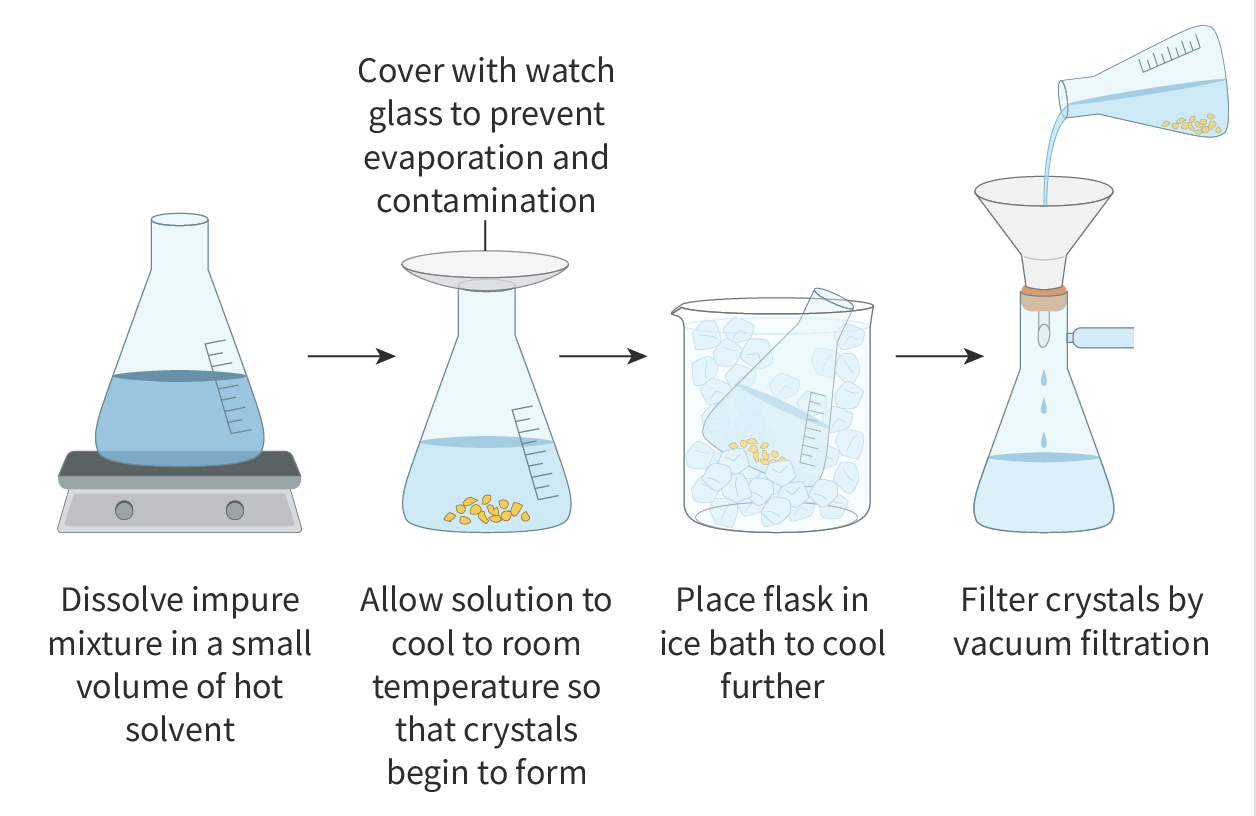
The process of recrystallisation used to separate a mixture of solids
Dissolve the impure mixture in a small volume of hot solvent
allow solution to cool at room temperature so that crystals begin to form (Cover with a watch glass to prevent evaporation and contamination)
Place flask in ice bath to cool further
Filter crystals by Vacuum filtration