a&p 2 circulation
 Call Kai
 Learn
Learn Practice Test
 Spaced Repetition
 Match
Match Flashcards
 Knowt Play
1/75

There's no tags or description
Looks like no tags are added yet.
Name | Mastery | Learn | Test | Matching | Spaced | Call with Kai | Chat |
|---|
No analytics yet
Send a link to your students to track their progress
76 Terms
What are the three types of blood vessels?
Arteries, capillaries, and veins.
: What do arteries do?
Carry blood away from the heart.
What do veins do?
Carry blood toward the heart.
What do capillaries do?
Exchange gases, nutrients, and wastes.
What are the three layers of a blood vessel wall?
Tunica intima, tunica media, tunica externa.
Which tunic contains endothelium?
Tunica intima.
Which tunic contains smooth muscle?
: Tunica media.
Which tunic is the outermost layer?
Tunica externa.
What are elastic arteries also called?
Conducting arteries
What is the largest elastic artery?
Aorta
What are muscular arteries also called?
Distributing arteries
What are arterioles?
Smallest arteries that regulate blood flow into capillary beds.
What are venules?
Small veins formed when capillaries unite.
Veins are formed by the convergence of what?
Venues
Which vessels contain valves?
Veins
Veins have thicker or thinner walls than arteries?
A: Thinner walls.
Veins have larger or smaller lumens than arteries?
Larger lumen
Blood pressure is higher in arteries or veins?
A: Arteries.
What are the three types of capillaries?
Continuous, fenestrated, sinusoidal.
Continuous capillaries in the brain form what?
Blood-brain barrier.
Which capillaries contain pores?
Fenestrated capillaries.
Which capillaries have large gaps and large lumens?
Sinusoidal capillaries.
Sinusoidal capillaries are found where?
Liver, spleen, bone marrow.
What regulates blood flow into capillary beds?
A: Precapillary sphincters.
What is blood pressure?
Force exerted by blood against vessel walls.
Blood pressure is measured in what units?
A: mm Hg.
What is pulse pressure?
Systolic minus diastolic pressure.
What is mean arterial pressure (MAP)?
Pressure that drives blood to tissues
Formula for MAP?
Diastolic pressure + 1/3 pulse pressure.
Three major factors affecting blood pressure?
Cardiac output, peripheral resistance, blood volume.
Formula for blood pressure?
BP = CO × PR.
What provides short-term blood pressure control?
Neural and hormonal mechanisms.
What provides long-term blood pressure control?
A: Kidneys.
Where are baroreceptors located?
A: Carotid sinus and aortic arch.
Increased blood pressure stimulates what receptors?
Baroreceptors
Increased baroreceptor activity causes what?
Vasodilation and decreased blood pressure.
Vasomotor centers are located where? A:
Medulla.
Chemoreceptors respond to what?
Increased CO₂, decreased O₂, decreased pH.
Blood pressure reflexes are integrated where?
A: Medulla oblongata.
Which higher brain centers influence blood pressure?
A: Cortex and hypothalamus.
What hormones are released by the adrenal medulla?
A: Epinephrine and norepinephrine.
What do epinephrine and norepinephrine do?
A: Increase cardiac output and cause vasoconstriction.
What does angiotensin II do?
Vasoconstriction
Low blood pressure causes release of what?
A: Renin.
Renin leads to production of what?
A: Angiotensin II.
Angiotensin II stimulates release of what hormone?
Aldosterone
What is the Circle of Willis?
Cerebral arterial circle.
Which arteries form the basilar artery?
A: Vertebral arteries.
What artery is commonly used to take a pulse at the wrist?
A: Radial artery.
Main artery of the arm?
Brachial artery
Artery in the armpit?
Axillary artery.
Main artery of the thigh?
Femoral artery
Vein commonly used for blood draws?
Median cubital vein.
Largest vein in the body
Great suphenous vein
Largest vein of the upper body?
Superior vena cava.
Largest vein of the lower body?
Inferior vein
Main vein of the thigh?
Femoral vein
Which artery/veins carries nutrient rich blood to the liver
Hepatic portal vein
Which artery/vein carries oxygen and nutrients from the mother to the fetus?
Umbilical vein
There are how many umbilical artery and vein in fetal circulation
2 umbilical arteries
1 umbilical vein
In a fetus ascending aorta and pulmonary trunk are connected by blank and later becomes a blank
Ductus arteriosus
Ligamentum arteriosum
In a fetus the opening in the intrtatrial septum is called and it layers gets covered by a membrane and remain as a depressed area called blank
Foramen ovale
Fossa ovalis
Umbilical vein revived blood from the blank of the mother body
Placenta
In a fetal circulation umbilical arteries receive ____type of blood from the ___ arteries
Deoxygenated
Internal iliac
Atrioventricular septal defect mostly occurs in those infants suffering from ______ syndrome and it occurs due to the presence of an extra copy of chromosome number ______
Down syndrome
Chromosome 21
In transposition of great vessels, the aorta is connected to the — instead of the —
Right ventricle
Left ventricle
What are the four defects of Tetralogy of Fallot?
Pulmonary stenosis
Ventricular septal defect
Overriding aorta
Right ventricular hypertrophy
Which condition occurs when a valve becomes thickened, stiffened, and does not open properly?
Steroids
A sound of blood flowing from atrium to ventricle heard in stenosis is known as
Heart murmur
Veins that appear twisted, enlarged, and bulging, often in the legs, are called what?
A: Varicose veins.
part of an artery wall weakens, allowing it to widen abnormally or balloon out
Aneurysm
What device is placed in a coronary artery to keep it open?
A stent
Widening of the venules causes thread-like red lines or patterns on the skin ______ or commonly known as ______
Telangiectasia
Spider veins
Narrowing of the arteries due to accumulation of fat, cholesterol, and other substances
Atherosclerosis
Death of myocardium due to blockage of coronary circulation is:
Myocardial infarction
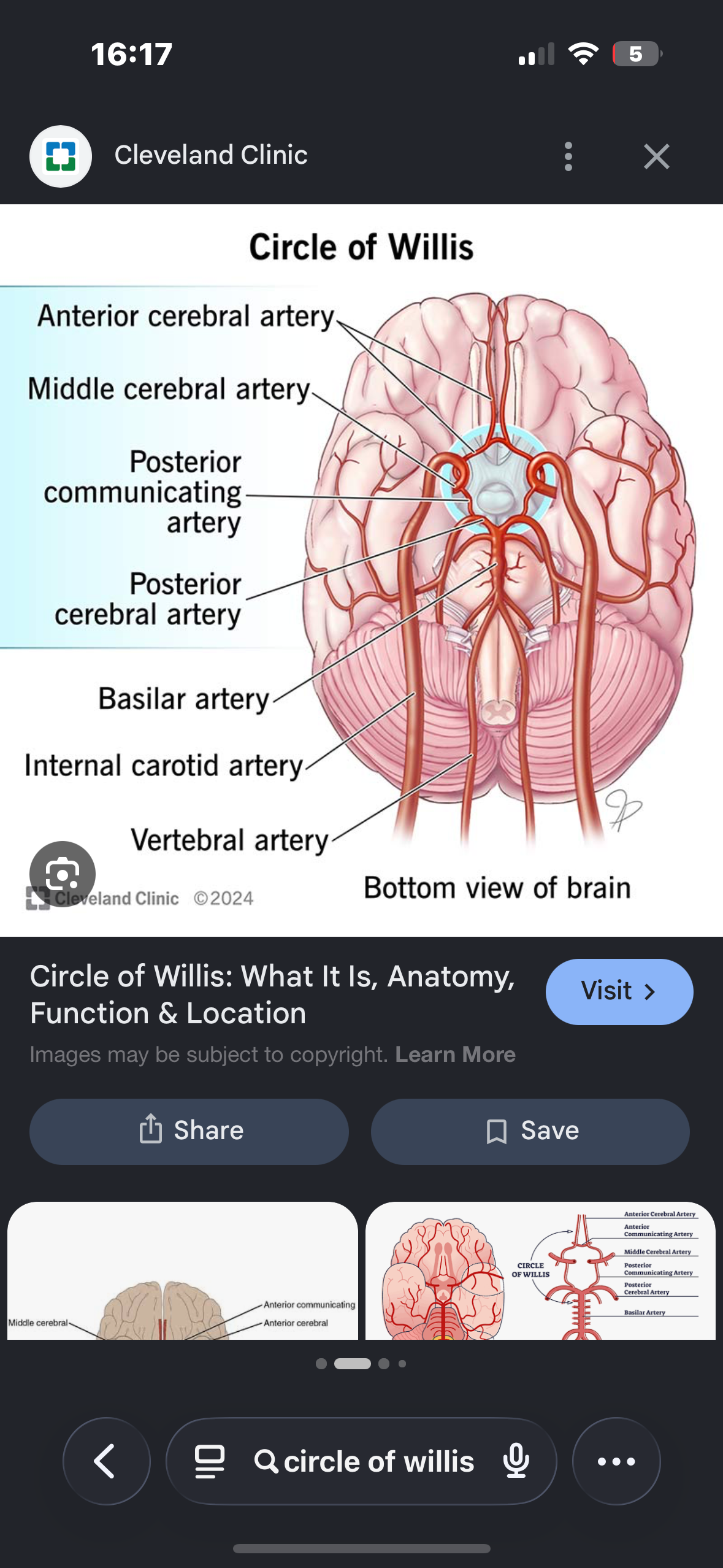
Circle of Willis